Showing posts with label france. Show all posts

Monday, September 08, 2025

Medal of Honor Monday: Army Pfc. Ernest Prussman


Army Pfc. Ernest William Prussman fearlessly led his squad into battle as the Allies pushed into Europe to free the continent from tyranny during World War II. Prussman didn't survive the mission, but his bravery demoralized the enemy and helped several battalions move forward. For his actions, Prussman was awarded a posthumous Medal of Honor. 

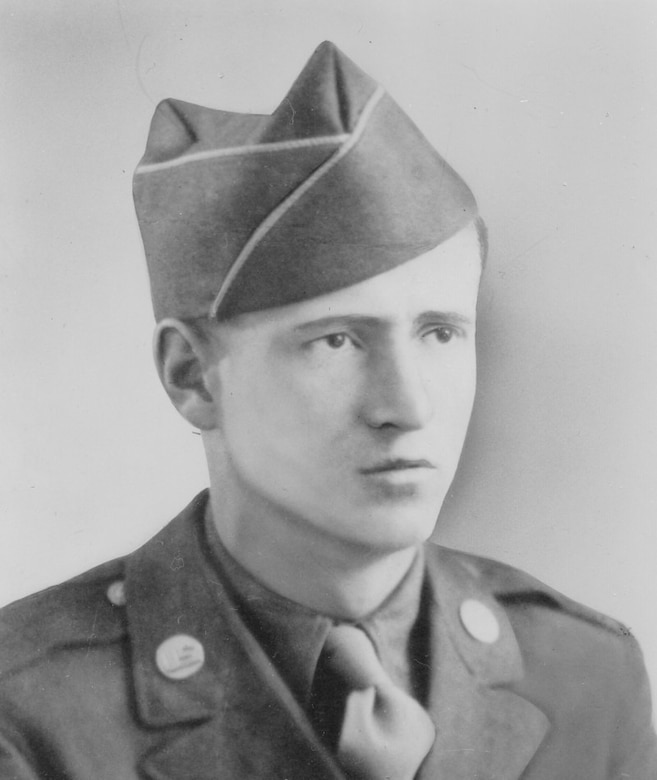
A man wearing a military uniform poses for a photo.

Prussman was born Sept. 15, 1921, in Baltimore, Maryland, to Herbert and Helen Prussman. He had a twin brother named Earl. Two other brothers, Calvin and Henry, also served during World War II.  

When Prussman was 5, his family moved to Brighton, Massachusetts, outside of Boston, where he grew up and graduated from Brighton High School.  

Prussman worked as a chain store clerk before joining the Army in October 1942. In July 1944, weeks after the Allies had regained a foothold on the European continent, Prussman's unit, the 13th Infantry Regiment, 8th Infantry Division, was sent to France. 

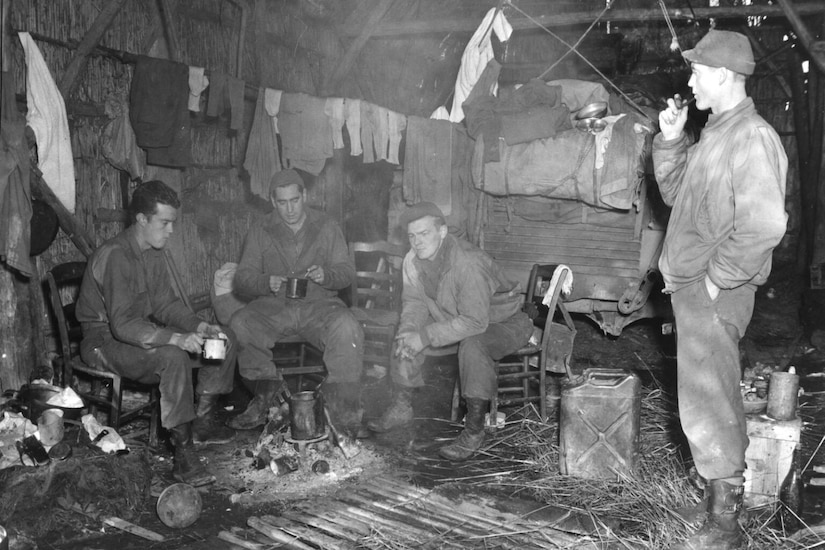
Three men sit in chairs in a shed filled with gadgets. A fourth man stands, smoking a pipe.

Two months later, Prussman gave his life in the fight for freedom.   

On Sept. 8, 1944, Prussman was with two battalions moving through the northwest Brittany region of France when their advance was halted by intense enemy mortar, machine gun and sniper fire. The assault was coming from an enemy fortification on Prussman's left, so he quickly prepared his squad to assault that position. 

Prussman took the lead and hurdled a hedgerow before disarming two enemy riflemen. He then led his squad across an open field to another hedgerow before advancing to a machine gun position, destroying the gun and capturing its crew and two additional enemy riflemen.  

Prussman continued to move ahead of his squad. This time, however, he was mortally wounded by an enemy bullet. But before he fell to the ground, he was able to throw a hand grenade, which killed one more enemy fighter.  

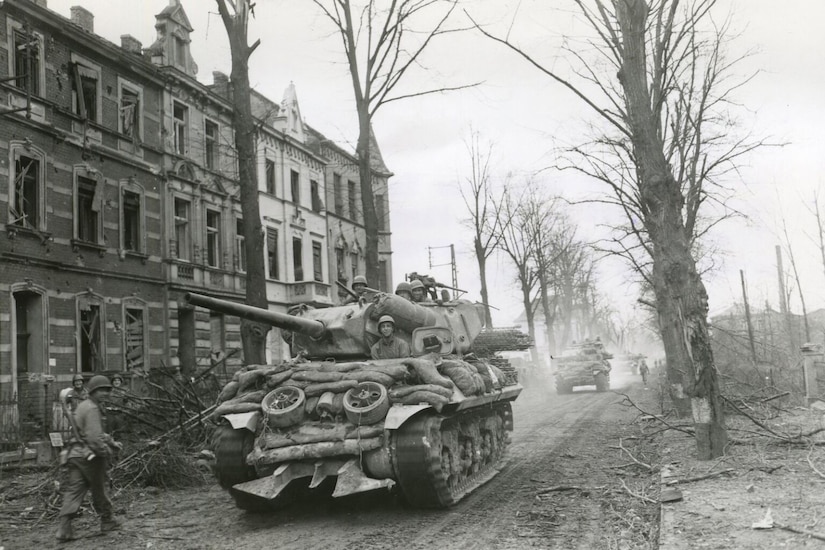
A tank rolls along a dirt road in a destroyed city.

While Prussman didn't survive, his leadership and heroic actions demoralized the enemy enough that their resistance collapsed, which allowed the Allied battalions to continue their march.  

On April 19, 1945, Prussman's parents and twin brother accepted the Medal of Honor on his behalf from Army Maj. Gen Sherman A. Miles during a celebration in Boston. Prussman also received the French Croix de Guerre with Bronze Star for his selfless actions. 

Prussman is buried in the Brittany American Cemetery in St. James, France.  

The young private has not been forgotten. At Army Garrison Rheinland-Pfalz in Germany, Prussman Avenue was named in his honor. A Medal of Honor monument was also established in Boston in 2016 in remembrance of his legacy. 

This article is part of a weekly series called "Medal of Honor Monday," in which we highlight one of the more than 3,500 Medal of Honor recipients who have received the U.S. military's highest medal for valor. 

Tuesday, June 06, 2023

D-Day Commeration


Army 1st Sgt. Christopher Kenney salutes during the national anthems played at a D-Day 79 ceremony in Picauville, France, June 1, 2023.

Sunday, July 22, 2012

World War II Veterans Honored for Their Part in Operation Dragoon


By Army Sgt. 1st Class Tyrone C. Marshall Jr.
American Forces Press Service

WASHINGTON, July 22, 2012 – A group of World War II veterans received recognized yesterday in a ceremony held here for their gallantry during a 1944 combat operation in southern France.

Operation Dragoon lasted from Aug. 15 until Sept. 14, 1944. It was the second largest amphibious invasion of World War II, with over 1,000 ships delivering three divisions of troops to the beaches of France. Additionally, an airborne division parachuted into the country to help secure beach heads along with Greek, Polish and Dutch forces, according to retired U.S. Army Lt. Col. Timothy Stoy, historian for the Society of the 3rd Infantry Division.

The Society of the 3rd Infantry Division hosted the ceremony honoring veterans who fought during the operation. French Army Col. Brice Houdet, military attaché from the French Embassy, presented the French Legion of Honor during the ceremony to retired U.S. soldiers John Singlaub, Paul Donlon, Darryl Egner, Elias Hernandez, Michael Halik and the son of Stanley Siemrzuch.

Before presenting the French awards, Houdet thanked the group of veterans on behalf of the people of France.

“I would like to salute all of the American allied veterans who took part in that momentous operation 68 years ago,” he said. “We are deeply honored to have some of you with us today.”

“I will have the distinct honor to present six of these highly deserving former service members with the Legion of Honor, France’s highest national honor and distinction, for their outstanding services during World War II,” Houdet said.

The six award recipients were all accompanied by members of the Military District of Washington’s Sgt. Audie L. Murphy Club, representing the connection to Murphy and the 3rd Infantry Division in which he served.

During the ceremony, U.S. Army Command Sgt. Maj. Edd Watson, currently the command sergeant major of the 3rd Infantry Division, narrated a Missing in Action presentation, and explained the items on a table displayed to honor fallen soldiers.

U.S. Army Maj. Gen. Randy E. Manner, Joint Staff director for the chief of the National Guard Bureau, said Operation Dragoon may not be as well known as some other World War II operations, but it should be remembered for its strategic importance.

“Sometimes, the voice of history does not speak as loudly about some events such as Operation Dragoon,” Manner said.

“So that’s our job today … to be that voice and to speak loudly about those great successes all those many years ago,” he said. “Those gathered here … know the strategic value of Operation Dragoon.”

Manner, whose father served under Singlaub, a retired Army major general, noted Operation Dragoon was critical because it opened a much-needed supply line into France for the allies to “continue to smash the Nazis.”

“History records that over 90,000 soldiers and over 11,000 vehicles were on the beach, on the ground, within days,” he said. “The bottom line is the operation significantly contributed to the shortening of the war in Europe, which meant, of course, the shortening and the lessening of the number of lives that were lost and the number of the families that were affected.”

U.S. Army Maj. Gen. Thomas S. Vandal, director of operations, readiness and mobilization for the Department of the Army, thanked all of the veterans present for their sacrifice and “tremendous” service to the country.

“Although not as well known as Operation Overlord, Operation Dragoon was a highlight of the second World War for many in our military,” he said. “[It was] one of the most successful combined joint operations in the European theater.

“Today, we take fighting as a joint team, alongside our sister services, for granted, just as we’ve come to count on our multi-national allies to be there in operations around the world today,” Vandal said. “But on Aug. 15, 1944, in the early days of the liberation of Europe, such a level of cooperation was far from commonplace.”

Vandal called the allied forces a “vanguard” of history who forged a path “for all of us to follow.”

“Some historians have mistakenly called Operation Dragoon the ‘forgotten D-Day,’ particularly in comparison to the larger and more famous invasions of Normandy,” he said. “In fact, some have even gone so far as to imply that the operation was easy – merely a cakewalk.

“Sgt. Audie Murphy, from the 3rd Infantry Division, might disagree with this characterization,” Vandal said. “Given that he earned a Distinguished Service Cross during Operation Dragoon, I think it speaks for itself [and what troops] did.”

Vandal noted allied forces of Operation Dragoon advanced more than 500 miles in less than a month and took more than 100,000 Germans prisoner.

“Overlooked by history or not, Operation Dragoon was a pivotal moment in the history of France, a fact well understood by all of you veterans sitting here today,” he said.

Vandal, a former member of 3rd Infantry Division himself, expressed his appreciate for all World War II veterans.

“All of our veterans are a national treasure, and we are all fortunate to be in their presence,” he said. “They have left a legacy for our Army and our nation to follow.”

Wednesday, June 06, 2012

Veterans, Contemporary Warriors Salute D-Day Landings


By Army Staff Sgt. Rick Scavetta
U.S. European Command

SAINTE-MÈRE-EGLISE, France, June 6, 2012 – When Eugene Cook jumped into Normandy during the predawn hours of June 6, 1944, he landed several miles from his intended drop zone.

Alone in the dark French countryside, the young 101st Airborne Division paratrooper from Georgia assembled his rifle, got his bearings and began looking for other Americans among Normandy’s hedgerows. In the days and weeks that followed, Cook took part in the now-famous battles that began the liberation of France and led to Allied victory over Nazi Germany.

Cook, 87, was among the handful of World War II veterans who attended the 68th anniversary of the D-Day landings here this week. U.S. service members from all the military branches took part in honoring the veterans, something Cook said he was glad to see.

“We have to commemorate the lives of the guys we left here,” Cook said. “They gave their lives for us, and we should show them thanks.”

Known as Operation Overlord, the D-Day landings of June 6, 1944, combined U.S. and Allied air drops with beach landings along Normandy’s coast. U.S. paratroopers from the 82nd and 101st Infantry Divisions dropped onto the Cotenin peninsula to secure bridges, roads and towns vital to allowing the troops landing at nearby Utah Beach to move inland.

“That day, 68 years ago, as American blood mixed with French soil, it cemented even further the strong bonds between our two nations,” said U.S. Army Secretary John McHugh said as visited the La Fiere drop zone.

For the returning veterans there was a mix of feelings -- glad to be alive and sharing good times and sorrowful memories of those who’d died.

Yesterday -- a cold and overcast day -- John Perrozi walked between rows of white marble gravestones at the Normandy American Cemetery, overlooking Omaha Beach. He stopped at one cross and then another, paying his respects to several buddies who died fighting in Normandy. As an 82nd Airborne Division paratrooper, Perozzi fought on D-Day with the 505th Parachute Infantry Regiment. It was his first trip back since the war.

During a June 3 ceremony at the La Fière drop zone, a battlefield where Perozzi fought, he received France’s highest military medal, the Légion d'Honneur. Before the ceremony, thousands of spectators watched as U.S. and international paratroopers recreate D-Day’s airborne operations -- jumping from U.S. Air Force planes onto the “Iron Mike” drop zone near the La Fière bridge -- at the Mederet River just west of Sainte-Mère-Eglise.

Soldiers from the Fort Bragg, N.C.,-based U.S. Army Civil Affairs & Psychological Operations Command and the Kaiserslautern, Germany-based 5th Quartermaster Detachment were among the hundreds of paratroopers who took part.

The Liberty Jump Team, which includes veterans from other conflicts and civilian parachutists, also jumped. Dave De Soucy, a retired officer from California who served in combat with the 101st Airborne Division during Vietnam, was one of the first to land in La Fiere’s marshy drop zone -- an area that was flooded on D-Day where several 82nd paratroopers drowned on D-Day, stuck in their chutes and harnesses. Packing up his chute, De Soucy said commemorative jumps honor World War II paratroopers, but also remind people about our current military operations.

“It’s an almost overwhelming experience,” said De Soucy, pausing as emotions welled inside him. “We’ve got to remember the folks who did it and those who still do it -- the one percent who go into harm’s way for the benefit of the [other] 99 percent.”

Afterward, Charles Rivkin, U.S. Ambassador to France, jumped with the Golden Knights, the U.S. Army’s parachute demonstration team. Then spectators, dignitaries, soldiers and veterans gathered on the grassy slope nearby for a series of commemorative speeches and wreath presentations.

John Roman, 87, who came ashore with the 4th Infantry Division, was surprised to hear a German military band at the ceremony, playing “Glory, Glory Hallelujah.” Seeing German troops didn’t bother him, he said.

“You’ve got to forget, some time,” Roman said. “It’s good that they are here. Maybe, the world will be better off.”

Toward the end of the war, Roman met a young French woman, Jacqueline, at a café. They’ve been married 66 years and had six children, she said. Each year, they come back, as Roman wants to remember buddies he lost, she said.

When wind gusts caught the beret of a German soldier, Jacqueline Roman watched in amazement as Lt. Gen. Mark Hertling, commander of U.S. Army Europe, walked over and knelt down to pick up the beret off the dirt, then handed it back to the German.

“That’s the American way,” she said. “That was wonderful.”
After World War II, there were 16 million living American veterans. Now, many are reaching their final years. U.S. troops cherished the opportunity to speak with them, to shake their hands and hear their stories.

“You can learn firsthand about history from these veterans,” Hertling said. “Not a lot has changed. They had the same fears and anxiety as they went into combat and the trauma from the things they faced. They teach our soldiers a lot about what that means.”

One older paratrooper hugged Army Staff Sgt. Rachel Medley, 34, of Eureka, Calif., who serves with the Golden Knights. Meeting soldiers from World War II is humbling, she said.

“They paved the path for the way the world is today,” Medley said. “The time is rapidly approaching when it won’t be living history anymore. It will be just something we read about in books because there will be no one who witnessed this. For us to be here and say thank you, it’s a huge honor to be in their presence.”

U.S. troops and veterans marched through Sainte-Mère-Eglise, where they were honored with a banquet in the town square. Similar events were held throughout the area during the days leading up to this year’s D-Day commemoration.

Earlier in the week, on June 2, U.S. Special Operations Forces demonstrated a high altitude, low opening jump near the historic Norman town of Mont Saint Michel. Army Capt. Stephen Cargill, an officer from the Stuttgart, Germany-based 1st Battalion, 10th Special Forces Group, said free falling above Normandy meant a lot to him.

“It’s just amazing to get the opportunity to see something so incredible,” Cargill said. “It hits that much closer to home, to land on hallowed ground.”

One evening, Cargill and fellow Special Forces soldiers relaxed outdoors near the Stop Café, a famous gathering spot in Sainte-Mère-Eglise. Troops mingled with French people wearing old-fashioned uniforms. One Dutch teen, Rob Van Meel, 13, cautiously approached the Green Berets in his authentic World War II uniform of a 101st Airborne Division soldier.

While many French children ask U.S. troops for a souvenir, Van Meel just asked about their patches. Impressed with Van Meel’s detailed uniform, Army Master Sgt. Damon Storey got down and presented Van Meel with a set of combat jump wings -- a treasured possession. Van Meel attended D-Day anniversaries in Normandy every year of his life, he said. In fact, his first costume was as a World War II ammunition box at just 3 months old. He thanked Storey, but said he wouldn’t wear the jump wings on the Screaming Eagles uniform, as it wouldn’t have been historically correct.

A handful of aging U.S. and Allied veterans attended several ceremonies over the course of week. Ellan Levitsky Orkin, 92, and her sister Dorothy, 95, who served together in Normandy as U.S. Army nurses, were offered honorary French citizenship during a June 4 ceremony in Bolleville. They helped unveil a new memorial to World War II medics, near where they served with the 164th Field Hospital. They come back every year, but they don’t quite understand all the excitement, Orkin said.

“We came and had a job to do and we went home,” she said. “When we went home, nobody asked us questions then and we didn’t talk about it. It was too painful.”

Still, some veterans are willing to share their tales. And they don’t mind using newer technology if it means bridging the gap of miles. Milt Staley, 93, of Redding, Calif., waded through chest-deep surf onto Utah Beach on D-Day with the 4th Infantry Division. He first returned in 2011 and has since kept in touch with his French friends on Facebook.

When Staley visits the church at Sainte-Mère-Eglise, he remembers occupying foxholes dug earlier by 82nd Airborne Division paratroopers. Afterward, Staley fought with the 90th Infantry Division and was wounded in combat. Coming back to France is not about reliving the horrors of war, he said. It’s about sharing time with people in France.

“I was never hugged and kissed and thanked so much for what we did,” Staley said. “It amazed and overwhelmed me and I think I’ll never forget it.”

Cook, on the other hand, has returned many times. He also looks forward to seeing people he’s met before, plus reflecting on some of his wartime thoughts, he said.

“This brings back the memories of the guys we were with here,” Cook said. “It’s important that we rededicate ourselves to their sacrifice and D-Day helps us do that.”
Sunday, June 19, 2011

Lynn Visits World War I American Cemetery in France

By John D. Banusiewicz
American Forces Press Service

BELLEAU, France, June 18, 2011 – “Time will not dim the glory of their deeds,” General of the Armies John J. Pershing said of U.S. service members. Near this village about 50 miles northeast of Paris today, Deputy Defense Secretary William J. Lynn III brought truth to that assertion as he paid his respects to 2,288 U.S. soldiers and Marines – 251 of whom have never been identified – buried on the site where they helped to stem a German offensive during World War I.

Lynn placed a wreath at the foot of the stairs of the chapel that overlooks the at the Aisne-Marne American Cemetery, before visiting the chapel and the nearby Belleau Wood, where much of the fighting took place and many of the Americans buried at the cemetery died.

Flora Nicolas of the American Battlefield Monuments Commission, public affairs officer for the cemetery, explained that Belleau Wood was significant because it represented the last natural barrier between 300,000 advancing German soldiers and Paris. The 3rd U.S. Division was the first to arrive when reinforcements were called in to help the French defend the Marne River, and the 2nd U.S. Division – which included 9,000 Marines – was in a reserve position and came as quickly as possible to Belleau Wood.

The 2nd U.S. Division had to cross open wheat fields in Belleau, and took heavy casualties before the division’s Marines killed German machine gunners occupying higher ground. The battle lasted 20 days, and on June 26, 1918, Belleau Wood was taken from the Germans.

Ten American divisions joined the fight and pushed back the German lines, crushing the offensive and marking the beginning of the end of World War I, Nicolas said.

The cemetery here was one of many temporary wartime cemeteries established by the Army’s Graves Registration Service, and was known as the American Expeditionary Forces Cemetery No. 1764 - Belleau Wood. In 1921, Congress authorized retention of the cemetery as one of eight permanent World War I military cemeteries on foreign soil. The following year, an agreement with the French government granted its use as a military cemetery forever, free of charge or taxation.

Marine Corps Maj. Gen. Lawrence D. Nicholson, Lynn’s senior military assistant, placed a wreath at a memorial in Belleau Wood honoring the U.S. Marines who fought there as part of the U.S. 2nd Division.

Two members of Congress – U.S. Rep. Jeff Miller of Florida and U.S. Rep. Devin Nunes of California – also were on hand for the visit, which included a stop at the famous “Devil Dog Fountain,” which honors the fighting spirit of the Marines who took Belleau Wood in June 1918.

Tuesday, February 08, 2011

This Day in Naval History - Feb. 09

From the Navy News Service

1799 - USS Constellation, commanded by Capt. Thomas Truxtun, captures the French warship l'Insurgente.
1943 - The organized Japanese resistance on Guadalcanal ends.
1947 - Carrier USS Wright (CVL 49) is commissioned.
1978 - A new era in naval communications begins with the launching of the first satellite of the Navy's Fleet Satellite Communications System.
1984 - Destroyer USS Moosbrugger (DD 980) fires approximately 150 shells at Syrian artillery positions east of Beirut.

U.S., French Defense Leaders Sign Space Agreement

By Jim Garamone
American Forces Press Service

WASHINGTON, Feb. 8, 2011 – U.S. and French defense leaders consulted on a wide range of mutual interests and signed an agreement on space situational awareness at the Pentagon today.

Defense Secretary Robert M. Gates and French Defense Minister Alain Juppe discussed Afghanistan, restoring NATO, containing Iran’s nuclear ambitions and defeating international terrorism, and also addressed the situation in Egypt.

Gates hosted Juppe and his party last night at a restaurant that once hosted John Quincy Adams and Marquis de Lafayette in 1824.

On Egypt, both men emphasized the need for a peaceful transition. Gates said the Egyptian military “has conducted itself in an exemplary manner” through the protests.

“They have acted with great restraint, and frankly, they have done everything that we have indicated we hoped they would do,” Gates said. “They have made a contribution to the evolution of democracy that we’ve seen in Egypt.”

Egypt needs an orderly transition, but it needs to continue to move forward in a way that allows people to see “a steady pace in implementing a number of the reforms that have been announced and which the Egyptian government has committed,” Gates said.

Juppe stressed that both the United States and France want free and fair elections in Egypt.

“It’s up to the people of Egypt to decide about that,” he said through a translator. “We are ready to support whatever decisions they make.”

Juppe said Arab leaders always have told the West that “it was either us or Islamic chaos.” He said the countries need to let opposition parties form and should not let anyone “confiscate the democratic process.”

Gates called the uprisings in Tunisia and Egypt a “spontaneous manifestation of discontent on the part of people who have both economic and political grievances.” The United States has been aware of the problems, he said, and has spoken to governments in the region on their need to address these problems.

“I would hope that other governments in the region, seeing this spontaneous action in Tunisia and Egypt, would take measures to begin moving in a positive direction,” he said. “In this way, we can have an orderly transition toward greater democracy.”

The two men also signed a bilateral statement on principles for space situational awareness. Gates said the agreement will go a long way toward addressing one of the key security challenges of the 21st century.

“As the new strategy puts it, space is becoming increasingly congested, contested and competitive,” he said.

A growing number of nations are using space for a growing number of purposes: manned spacecraft, satellites, the international space station and more. This increases the odds of accidental collisions.

In addition, many space technologies undergird civilian and defense capabilities such as precision navigation, climate monitoring, secure communications and natural disaster warnings.

“These agreements help us mitigate situations by sharing information and pooling our varied capabilities,” Gates said. “Our arrangement will foster safety and reduce the chance of mishaps, misperceptions and mistrust. Such cooperation is a key aspect of our National Security Space Strategy.”

Juppe emphasized the high level of confidence the French have in their military relationship with the United States. He said the close cooperation between the two nations allows their militaries to work together from Afghanistan -- where France has more than a brigade of troops working with American forces in Regional Command East -– to space, which the minister called one of the most challenging domains.

He assured Gates that France is a reliable partner despite budget constraints that all nations are facing.

“I want to stress that we will safeguard the operational capability of our armed forces,” Juppe said.

Thursday, February 03, 2011

This Day in Naval History - Feb. 03

From the Navy News Service

1801 - The U.S. Senate approves a peace treaty with France, ending an undeclared naval war which began in 1798.
1917 - The United States severs diplomatic relations with Germany.
1991 - Battleship USS Missouri (BB 63) fires eight 2,000-pound shells from her 16-inch guns, destroying prefabricated enemy concrete command and control bunkers Iraq is moving into Kuwait.

Wednesday, February 02, 2011

This Day in Naval History - Feb. 02

From the Navy News Service

1800 - USS Constellation, commanded by Capt. Thomas Truxtun, captures French vessel la Vengeance.
1862 - USS Hartford, commanded by Capt. David G. Farragut, departs Hampton Roads for Mississippi River campaign.
1894 - Sloop Kearsarge, commanded by Cmdr. Oscar F. Heyerman, wrecks without loss of life on Roncador Reef off Central America.
1991 - Coalition naval operations continue in the Gulf War with an attack on the Al Kalia naval facility. One Iraqi Exocet-capable patrol craft is hit directly with two laser-guided bombs, while a second U.S. aircraft launches a string of twelve 500-pound bombs across another patrol boat. The bombs also strike several buildings on the pier, generating several secondary explosions.

Saturday, January 22, 2011

USS George H.W. Bush Strike Group Underway for COMPTUEX/JTFEX

By Mass Communication Specialist 3rd Class Joshua D. Sheppard, USS George H.W. Bush Public Affairs

ATLANTIC OCEAN (NNS) -- George H.W. Bush Strike Group departed for its Composite Training Unit Exercise (COMPTUEX) and Joint Task Force Exercise (JTFEX), Jan. 19.

COMPTUEX and JTFEX are the final evolutions that must take place before USS George H.W. Bush (CVN 77) is certified for major combat operations.

"This is a great moment for this strike group and USS George H.W. Bush," said Rear Adm. Nora Tyson, GHWB Strike Group commander. "COMPTUEX is a critical step in our journey toward deployment, and I could not be more proud to be going to sea with these talented and dedicated Sailors."

COMPTUEX places the GHWB Strike Group into a training scenario loosely based upon real-world geo-political conditions. The scenario will test the effectiveness of the individual strike group components, as well as how they interact in combined operations. Challenges include small boat attacks, mines, strait transits in hostile waters and aerial, surface and sub-surface threats.

Assessors from Strike Force Training Atlantic will observe these exercises, mentor strike group staff and leaders, and assess GHWB Strike Group's performance.

Upon successful completion of COMPTUEX, GHWB Strike Group will move directly into JTFEX, which serves as the strike group's final operational exam before being certified for overseas combat operations. JTFEX will build upon the scenarios of COMPTUEX, but will also test the interactions of GHWB Strike Group with other U.S. military and coalition partners.

"We will be working extensively with coalition ships from Spain, France and Canada during this exercise," said Tyson. "They are an integral part of our team, and we look forward to working with them now and during our first combat deployment later this year."

GHWB Strike Group assets participating in COMPTUEX/JTFEX include USS George H.W. Bush, USS Mitscher (DDG 57), USS Gettysburg (CG 64), USS Truxtun (DDG 103), USS Anzio (CG 68), the squadrons of Carrier Air Wing (CVW) 8, and the Spanish frigate ESPS Almirante Juan de Borbon (F 102). GHWB Strike Group is scheduled to depart on its first overseas deployment this spring.

For more news from USS George H.W. Bush (CVN 77), visit www.navy.mil/local/cvn77/.

Thursday, June 07, 2007

Gates, French Defense Minister Reaffirm Defense Ties

By Donna Miles
American Forces Press Service

June 5, 2007 – Meeting here today on the eve of the 63rd anniversary of the D-Day invasion, Defense Secretary Robert M. Gates and French Defense Minister Herve Morin agreed to work toward strengthening their two countries' historic ties. Morin told reporters after a 45-minute session with Gates that he considers it "a great honor" that Gates is the first foreign defense
leader to visit since Morin took office two weeks ago.

Gates called today's meeting "a good introductory conversation" that covered a full range of defense issues.

Morin said he and Gates shared many common views during their discussions and agreed that they want to work together and collaborate on a variety of issues.

He reiterated France's support for the NATO International Security Assistance Force mission in Afghanistan, the NATO-led peacekeeping force in Kosovo, and the Darfur, Sudan, peacekeeping effort.

Asked about France's commitment to Afghanistan, Morin said: "Our role is not to remain forever." Rather, he said, the goal is to develop and reinforce Afghanistan's own institutions so it can stand on its own. He called training of Afghanistan's security forces a priority.

Both
leaders said they look forward to visiting Normandy together tomorrow, the 63rd anniversary of D-Day, when thousands of Americans died storming the beaches. Gates is slated to speak at the American Cemetery at Coleville-sur-Mer during ceremonies marking the anniversary.

"At the same time we will memorialize those who gave their lives on D-Day, we will also acknowledge and celebrate the long ties that have bound both the United States and France," Gates said.

Morin told reporters his father reminded him often "how much we owe to all the Allied soldiers, especially the young Americans who came to die on our beaches."

"The American graveyards have a great and deep significance," he said.

Gates' visit follows Nicolas Sarkozy's recent election as France's new president. Sarkozy, who has advocated closer relations with the United States, will meet this week with President Bush and other European, Canadian, Japanese and Russian
leaders during the G8 conference in Germany.

Article sponsored by
criminal justice online leadership; and, police and military personnel who have authored books.