Friday, September 04, 2026

Naval Warfare Center Showcases Unmanned Refueling at Sea

The Navy took a major step toward enabling persistent, unmanned operations last month when the Naval Air Warfare Center Weapons Division led a demonstration off the coast of Virginia using a robotic towed connector to repeatedly capture, refuel and release an unmanned surface vessel at sea.
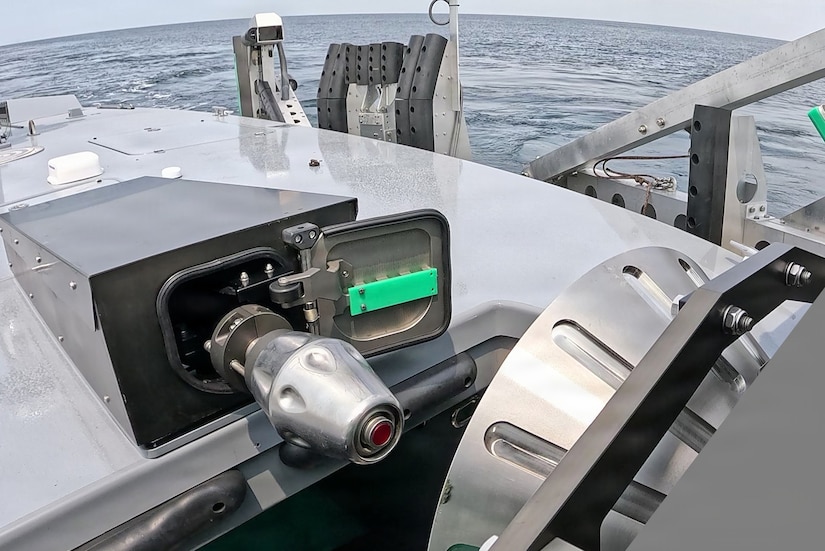
Two pieces of equipment are lined up next to each other on an unmanned vessel sailing in the water.

In seven months, a Navy-industry team moved from concept to real-world testing using the T38, a Navy-owned remotely controlled USV built by industry partners, and a towable capture and connection refueling system. 
 
The contracting partnership also helped the warfare center's Blue Water Instrumentation program address a broader operational challenge: keeping USVs and their sensors on station longer during critical capabilities testing without increasing reliance on crewed support. 
 
"At [Naval Air Warfare Center Weapons Division], our immediate focus is supporting hypersonic and precision long-range fires testing, where flight profiles can extend thousands of miles beyond fixed-range boundaries and require data-collection assets to be distributed across a vast area," said Spencer Holloway, director of the program's future capabilities office. "But the underlying challenge applies more broadly — every time an unmanned vessel must return to port for fuel, we lose persistence, reduce coverage and redundancy, and interrupt the mission." 
 
During the demonstration, the team ran dozens of full-cycle exercises at sea, in addition to pier-side demonstrations. The training support vessel USNS Vindicator towed the refueling system and transferred a total of 400 gallons of fuel to the T38 during the event. 
 
In total, the refueling system completed about 100 connection cycles over the course of a few days leading up to and including the event.
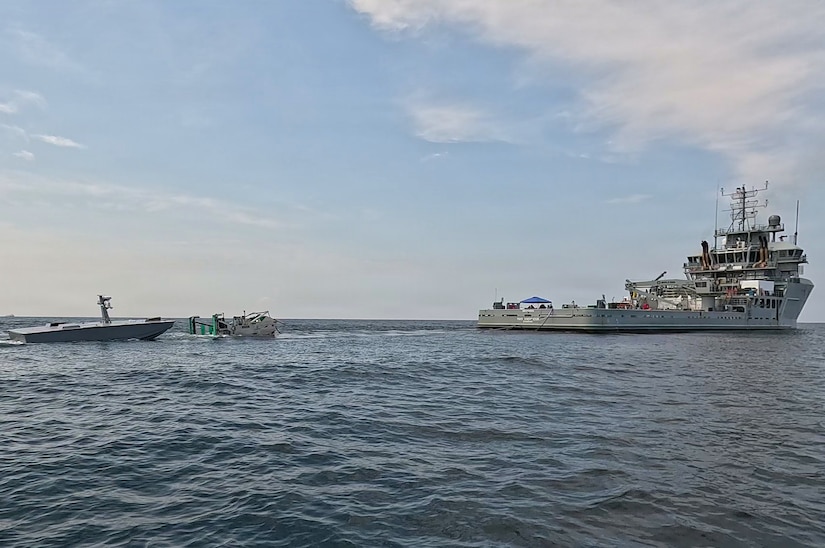
A large ship deploys a refueling rig using a cable toward an unmanned vessel sailing in water.

Ronald Raymer, branch head for capability, innovation, science and technology integration at U.S. Fleet Forces Command, also took part in the refueling demonstration. He said unmanned refueling can strengthen fleet readiness. 
 
"This will allow us to have greater reliance on unmanned vessels ... and we can push the USV into higher threat areas without risking manned vessels and personnel," he said. "It will also allow us to distribute greater capability into an area without having to invest in large, expensive manned vessels, and the refueling supports that." 
 
The event took place in the waters off Joint Expeditionary Base Little Creek-Fort Story, Virginia, and was sponsored by U.S. Fleet Forces Command, Naval Surface Warfare Center Dahlgren Division and Naval Surface Warfare Center Carderock Division. 
 
The milestone also brought together the Blue Water Instrumentation program team, fleet management team and industry partners. Together, they executed an underway refueling demonstration designed for USVs. 
 
The Littoral Combat Ship Mission Modules Program Office and the Navy's Portfolio Acquisition Executive for Robotics and Autonomous Systems also provided contracting support that enabled BWI to partner with industry and to run the demonstration.
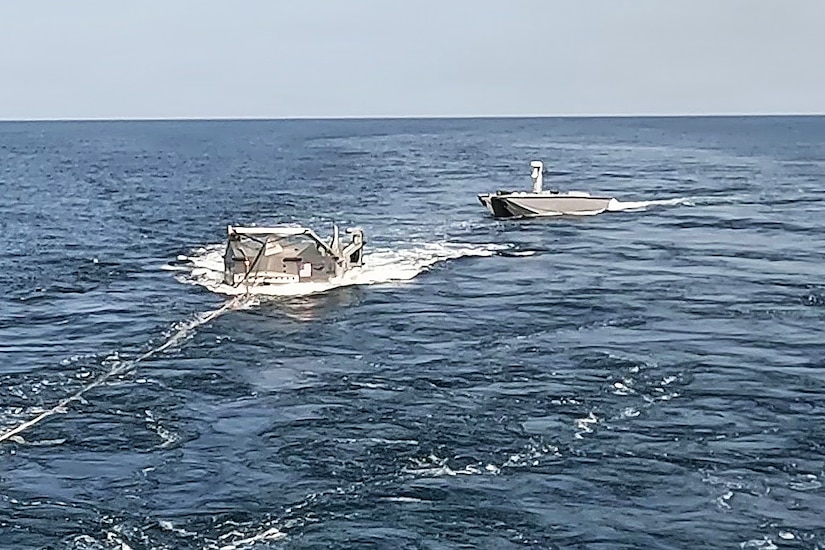
A refueling system is deployed in the water toward an unmanned vessel.

Holloway said the short timeline from inception of the refueling system to on-water demonstrations came from the collaboration between government and industry, which allowed the team to respond quickly to changes when needed. 
 
"Working directly with our industry partners allowed us to bring the platform, control systems, operators and engineers together as one integrated team," he said. "We could make changes, test them on the water and iterate quickly based on what we observed." 
 
The demonstration showed the role of government-industry collaboration in moving the refueling system from concept to testing in seven months.

BWI's next milestone is an end-to-end autonomous refueling demonstration that will test vessel rendezvous and approach, capture, fuel transfer, disconnection and return to mission as a single evolution.

Exercise Urgent Response Tests Marine Corps Installation Partnerships

Simulated gunfire interrupted the workday inside an occupied office building yesterday as service members, civilian employees and contractors at Marine Corps Support Facility Blount Island, Florida, faced a split-second decision: run, hide or fight.

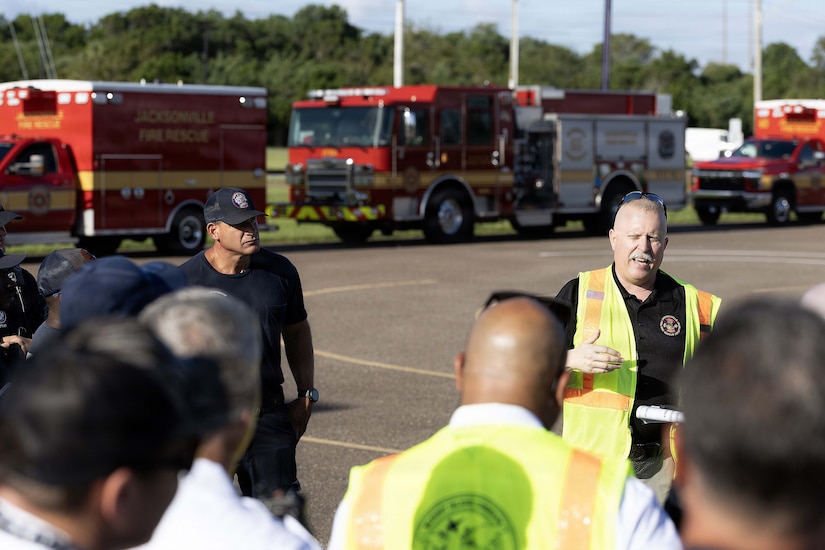
A man in business casual attire and a reflective vest talks to a dozen people in similar attire standing in a parking lot outside; there are three emergency vehicles parked in the background.

The attack was part of Exercise Urgent Response, a four-hour, full-scale force protection exercise that brought the Marine Corps facility together with Jacksonville fire and law enforcement agencies, state emergency managers and federal investigators. 
 
Participants tested how they share information, treat simulated mass casualties, respond to explosive hazards and preserve the military installation's mission during a complex emergency. 
 
The facility provides infrastructure, maritime access and workforce support for Blount Island Command. The tenant command, under Marine Corps Logistics Command, generates and distributes ready-for-issue equipment and supplies across the global positioning network. 
 
A high-decibel blast simulated gunfire as exercise role players portraying active assailants moved through stairwells, hallways, offices and cubicles.

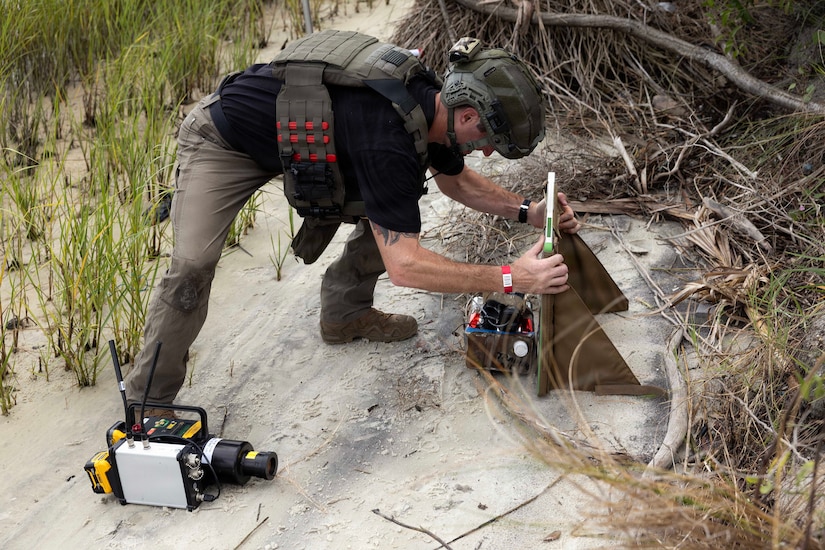
A man in emergency response gear puts an X-ray machine next to a simulated explosive sitting in the sand.

As occupants evacuated, sheltered in place or prepared to defend themselves, Marine Corps police department officers coordinated their response with the Jacksonville Sheriff's Office. The scenario tested individual preparedness, requiring those inside to recognize the threat, identify primary and alternate exits, report concerning activity and respond appropriately when law enforcement entered the building. 
 
Jacksonville Fire and Rescue Department crews entered once law enforcement secured access, triaging and treating simulated casualties before transport. 
 
"It was a lot of great communication on all sides," said Jacksonville Fire and Rescue Department Capt. Shawn Hall. "By the time we arrived, the Marine Corps police department was already in place, already taking lifesaving steps and giving trauma care, so we could get in with medical treatment and transport." 
 
The exercise also reinforced the Marine Corps' 2026 National Preparedness Month theme, "Prepare Today. Protect Tomorrow." The annual September observance encourages individuals and communities to plan ahead and strengthen their readiness for emergencies. 
 
The scenario later expanded to include a simulated explosive threat near the shoreline. The Jacksonville Sheriff's Office hazardous devices unit assessed and rendered the device safe.

Inside the installation's emergency operations center, participants tracked the evolving scenario, shared information and maintained a common operating picture for decision-makers and responders. Florida Division of Emergency Management representatives supported state-level situational awareness and resource coordination from the center. 
 
Naval Criminal Investigative Service personnel supported intelligence sharing and exercise control. 
 
Together, participants tested incident command, interoperable communications, threat and triage information sharing, resource coordination and emergency medical response while maintaining connectivity with the emergency operations center as multiple situations unfolded. 
 
The exercise expanded on a January operational planning effort that brought the installation, Blount Island Command and local, state and federal partners together to examine how they would protect the Marine Corps facility and sustain operations during a complex incident. 
 
"The exercise successfully validated installation defense plans, mutual aid agreements and real-world interoperability with local, state and federal partners," said Marine Corps Lt. Col. Beau Pillot, Blount Island Command operations director. "Exercise Urgent Response bridged the gap between deliberate planning and real-world execution." 
 
Evaluators from participating organizations observed performance against established objectives throughout the exercise. Their findings will inform a formal review and help refine response plans and future training events.

Special Operations Forces Tackle Unseen Threat of Blast Exposure

The U.S. special operations forces community is actively tackling the invisible threat of repeated blast overpressure to protect warfighters' brain health without compromising combat readiness.

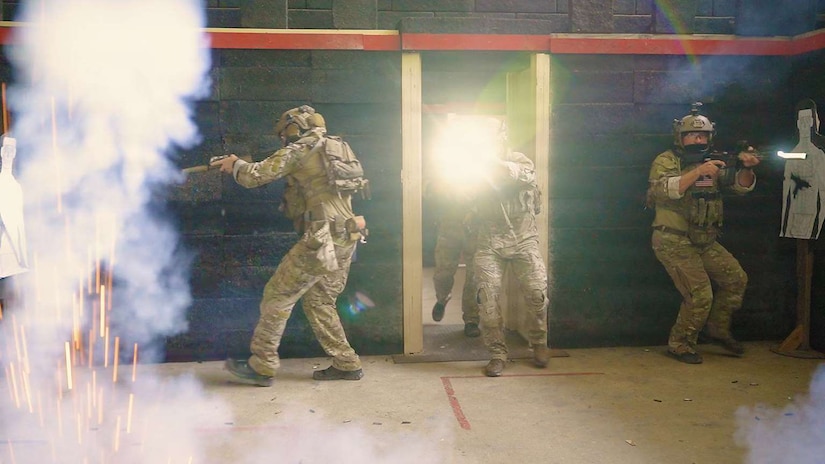
People in camouflage military uniforms and tactical gear walk through a door while having weapons drawn as a cloud of smoke and sparks cover the room.

This is important since, in just six months of initial entry training, a SOF soldier will fire thousands of small arms rounds, employ hundreds of flash-bang devices, and conduct dozens of explosive breaches. For these operators, low-level blast exposure of less than four pounds per square inch is not a rare incident, but rather a daily, unavoidable reality of their training and operational environments. 

Managing this risk factor presents a massive challenge. The scientific community suspects that cumulative, repeated blasts could cause long-term cognitive effects, yet there are currently no validated thresholds to guide medical decisions or return-to-duty timelines.  

Simply tracking the blasts is a logistical hurdle because current sensors are often bulky, competing for precious space on an operator's mission-essential gear. Furthermore, vendor data rarely synchronizes smoothly with standard military systems, and there is little agreement on how peak pressure and incident pressure meaningfully accumulate. 

"More importantly, current sensors only measure the blast wave itself, leaving a critical human gap with no event-linked cognitive, physiological or biomarker data for the operator standing in its path," said Army Sgt. Maj. Chris McNamara, 3rd Operations Support Group human weapon system director. 

To bridge these scientific and operational gaps, the SOF community launched aggressive, data-driven initiatives like the Elite Force Pilot Team. 

"This specialized task force is evaluating how to implement high-fidelity monitoring during high-risk training and operations," McNamara said. "Their goal is to ultimately standardize how leaders make risk and readiness decisions."

The objectives of the pilot team are to mitigate effects of blast overpressure by monitoring high-risk training and operations. They have used lessons learned to improve return-to-duty and return-to-shoot protocols and correlate blast overpressure to clinical outcomes by using evidence-based biomarkers. 

McNamara highlighted the operational reality of these efforts, noting that a delicate balance exists between collecting timely data and not disrupting the tempo of training. He emphasized the essential need to identify accurate and nonintrusive methods for collecting data on blast exposure, cognitive performance and biomarkers.

Three people in camouflage military uniforms and tactical gear walk in a hallway filled with smoke.
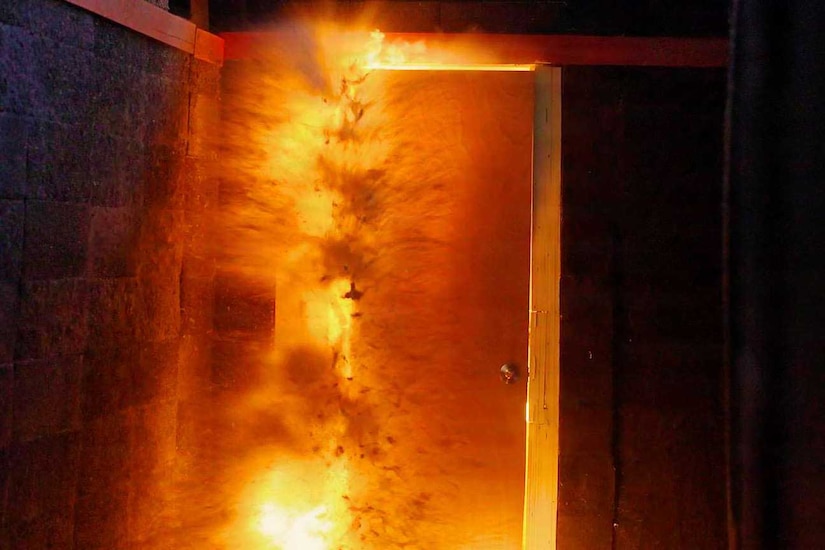
A door in a dark room is surrounded by fire piercing through the cracks.
"As the scientific community strives to find clarity in exposure measurement, leaders at all levels must simultaneously be equipped with relevant and effective risk-mitigation tools," said Kathy Lee, director of warfighter brain health policy at the Office of the Assistant Secretary of War for Health Affairs. 

Instead of waiting for universal medical standards to be finalized, SOF leaders are already implementing physical changes to training and equipment. One innovation is the multiuse charge housings for enhanced target effect, a flexible charge housing designed to optimize breaching operations while safeguarding service members.  

Made of nontoxic, inert materials, the system is dual purposed for sheet explosives and detonation cords. By using advanced 3D computer modeling and wave-shaping design techniques, the housing focuses blast energy toward the target, allowing for a lower net explosive weight. This optimization delivers identical target-defeat capabilities while reducing hazardous blast overpressure on the warfighter by 25-60%.  

The system is highly intuitive, significantly reduces charge preparation, builds time to maximize training efficiency and is currently being positioned for expanded military distribution. 

"Our priority is to field technology that treats the operator as our premier weapon system," said Chris Wilson, division lead for human weapon system at the U.S. Special Operations Command's Science and Technology Directorate. "Innovations like [the housing] prove we don't have to choose between lethality and safety. By using advanced engineering to shape the blast physics, we are actively lowering the physical toll on the human weapon system while keeping our operators sharp, lethal and in the fight longer." 

For SOF members, the firing ranges and facilities are being redesigned based on advanced modeling of blast waves. New construction materials are also being used that absorb shockwaves. 

Operators are also seeing improvements in their standard gear. This includes the increased use of updated weapon suppressors, heavy weapon simulators and strict helmet policies.  

Researchers are even using biometric instrumented head forms to measure exactly what happens inside a helmet during a blast, leading to improved helmet padding systems. For industrial hygiene monitoring, new hard-copy and mobile applications are being developed to streamline the recording of blast overpressure data directly in the field. 

Ultimately, the overarching warfighter requirement remains clear: a low-burden sensor with integrated power and interoperable data that clinicians can actually use to monitor health. 

By taking decisive action today, U.S. Special Operations Command is taking proactive steps to improve brain health, detect early warning signs and implement preventive measures to extend operational longevity, enhance mission readiness and ensure the long-term health of SOF warfighters.