The process of writing Army doctrine, traditionally
measured in years, is getting a 21st-century upgrade. Thanks to digital
tools, some enabled by artificial intelligence, authors at the Combined
Arms Doctrine Directorate are examining processes and gaining
efficiencies without sacrificing their high standards for quality and
precision.
"We have had people ask us about using AI and large language models to
speed up the doctrine development process for years," said Richard Creed
Jr., CADD director. "So, when some of these tools became available, the
first thing we did was figure out their capabilities. That meant that
we needed to identify people on our team with some AI experience from
using civilian applications who could help us figure out what was
possible."
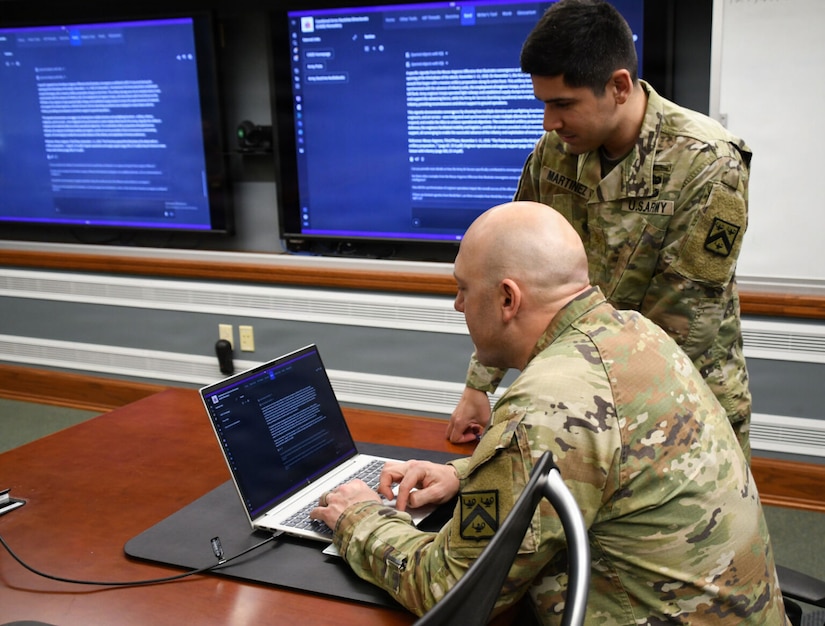
Two officers, Army Lt. Col. Scott McMahan, a doctrine writer assigned to
the Operational Level Doctrine Division, and Army Maj. Matthew
Martinez, CADD's information management officer, took guidance from
leaders and developed a four-pronged strategy to equip every doctrine
writer with the skills and tools to use AI effectively. The strategy
began with foundational training for all CADD members, allowing them to
apply approved AI tools to their work immediately.
To foster expertise, the plan also calls for training a "master gunner,"
someone highly qualified in using AI tools, within each doctrine
division. These experts can then help their teams tackle more difficult
challenges and find advanced applications for the technology. Furthering
the integration, AI best practices are being formally incorporated into
the Doctrine Developer's Course, ensuring future writers are introduced
to these techniques from the start.
Finally, CADD leaders are working with the Combined Arms Command and
industry partners to build a purpose-made AI tool. This new software
will be designed for all Army doctrine writers, but it will be
especially helpful to authors at the Centers of Excellence, where
personnel and time are often scarce.
According to McMahan, the answer is not in "letting AI write the books"
that guide the force. Instead, it is about providing human experts with
powerful new assistants.
"You treat it like a resourceful and motivated young officer who
might not know all the information, but they can certainly assist you in
cutting some corners and being a little more efficient," he said. "The
bottom line is that eventually it should, even if you're just shaving at
the margins, it's going to speed up the time when doctrine will reach
soldiers in the field."
Creed said his guidance was always to treat technology as a tool, not a panacea.
"Because we have such good people, I expected that we would stay
abreast of developments and be ready when the tools were ready," he
said. "They came up with an approach that would make one person in each
doctrine division an AI subject matter expert while training everyone
else in the basic use of AI for tasks related to their job. It was no
different than ensuring all soldiers are combat lifesavers while
assigning an actual medic to each platoon."
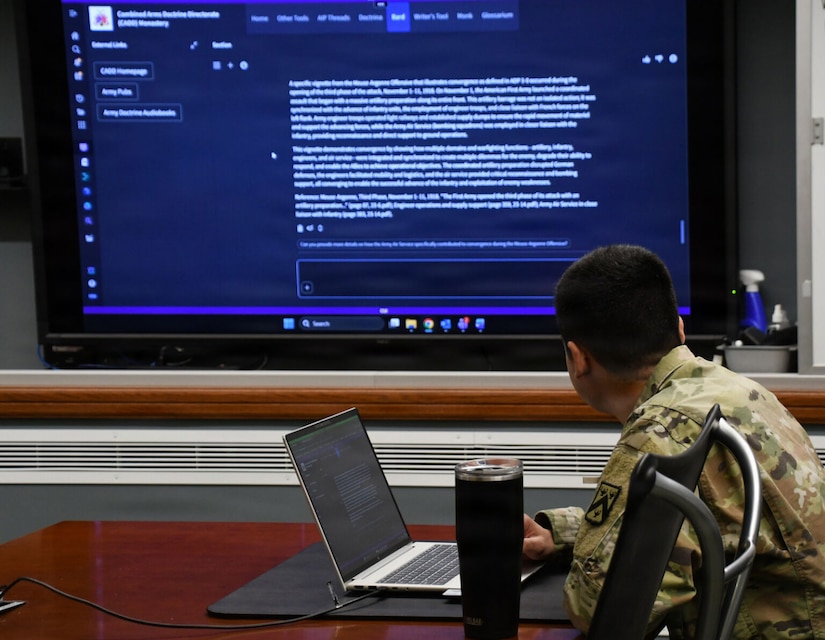
So far, changes have been small, but they add up when looking at
multiple individual and project tasks. One example is an internally
developed tool that enables writers to quickly search across hundreds of
texts for historical vignettes that illustrate a complex doctrinal
point. This task could once have taken days of research, especially for a
new doctrine author.
"The large language model tools under development now have access to the
databases we needed access to in the past. Access to the data is the
foundational measure of whether the tools are useful to us. We tip our
hats to those who figured out how to do that," Creed said.
Another use of AI is something McMahan calls "breaking the blank page."
The tool can help writers get through creative blocks and generate
ideas.
"[When] we were looking for some more meat for an idea, we were able
to feed this tool some initial thoughts, and of the three paragraphs it
spit out, one sentence was used, but that was a really powerful and
useful sentence," he said.
Blending technology and in-house experience is reducing administrative
burdens for doctrine authors and staff in several ways. For instance,
digital tools that assist with grammar and readability free authors to
focus on the complex aspects of their work, which in turn saves valuable
time for CADD's high-demand editors. This efficiency extends beyond
writing, as leaders have improved the publications tracking process with
automated forms and the use of power business intelligence tools, and
individuals are creating their own self-study tools to prepare for
internal certification.
McMahan recognizes that the technology is not perfect, but notes that it
is improving over time. He said that AI models can "hallucinate" by
inventing facts or confusing source materials when asked a question.
These are critical flaws in a field where accuracy is paramount. In one
case, an AI-generated question for a doctrine test was based on an
outdated manual, an error that was only caught because the user creating
the test was an expert on the topic.
Situations like this drive home the importance of subject matter expertise.
"We made it perfectly clear that AI tools were not intended to be a
crutch for not doing the work we expect from our people," Creed said.
"Humans will review every line of what a [large language model] produces
for accuracy. To make sure that happens, one must make sure your people
know their business."




 Posts
Posts

