Showing posts with label marine corps. Show all posts

Friday, September 04, 2026

Exercise Urgent Response Tests Marine Corps Installation Partnerships

Simulated gunfire interrupted the workday inside an occupied office building yesterday as service members, civilian employees and contractors at Marine Corps Support Facility Blount Island, Florida, faced a split-second decision: run, hide or fight.

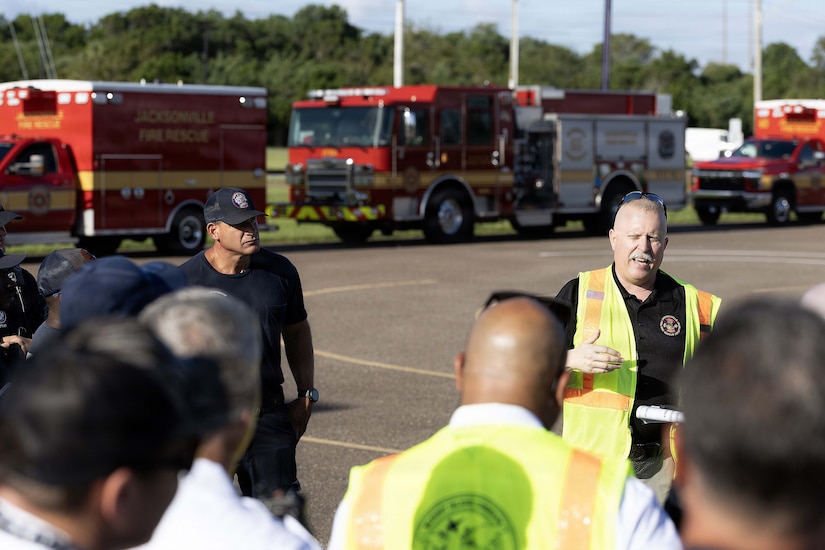
A man in business casual attire and a reflective vest talks to a dozen people in similar attire standing in a parking lot outside; there are three emergency vehicles parked in the background.

The attack was part of Exercise Urgent Response, a four-hour, full-scale force protection exercise that brought the Marine Corps facility together with Jacksonville fire and law enforcement agencies, state emergency managers and federal investigators. 
 
Participants tested how they share information, treat simulated mass casualties, respond to explosive hazards and preserve the military installation's mission during a complex emergency. 
 
The facility provides infrastructure, maritime access and workforce support for Blount Island Command. The tenant command, under Marine Corps Logistics Command, generates and distributes ready-for-issue equipment and supplies across the global positioning network. 
 
A high-decibel blast simulated gunfire as exercise role players portraying active assailants moved through stairwells, hallways, offices and cubicles.

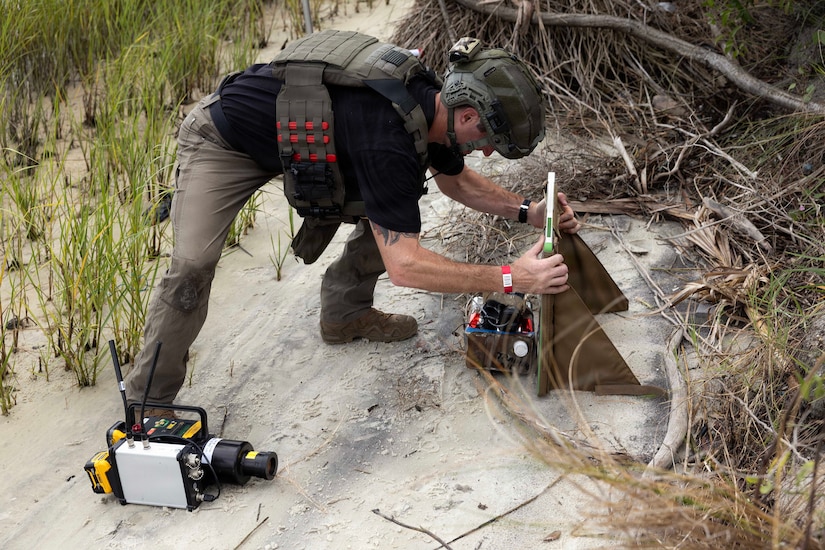
A man in emergency response gear puts an X-ray machine next to a simulated explosive sitting in the sand.

As occupants evacuated, sheltered in place or prepared to defend themselves, Marine Corps police department officers coordinated their response with the Jacksonville Sheriff's Office. The scenario tested individual preparedness, requiring those inside to recognize the threat, identify primary and alternate exits, report concerning activity and respond appropriately when law enforcement entered the building. 
 
Jacksonville Fire and Rescue Department crews entered once law enforcement secured access, triaging and treating simulated casualties before transport. 
 
"It was a lot of great communication on all sides," said Jacksonville Fire and Rescue Department Capt. Shawn Hall. "By the time we arrived, the Marine Corps police department was already in place, already taking lifesaving steps and giving trauma care, so we could get in with medical treatment and transport." 
 
The exercise also reinforced the Marine Corps' 2026 National Preparedness Month theme, "Prepare Today. Protect Tomorrow." The annual September observance encourages individuals and communities to plan ahead and strengthen their readiness for emergencies. 
 
The scenario later expanded to include a simulated explosive threat near the shoreline. The Jacksonville Sheriff's Office hazardous devices unit assessed and rendered the device safe.

Inside the installation's emergency operations center, participants tracked the evolving scenario, shared information and maintained a common operating picture for decision-makers and responders. Florida Division of Emergency Management representatives supported state-level situational awareness and resource coordination from the center. 
 
Naval Criminal Investigative Service personnel supported intelligence sharing and exercise control. 
 
Together, participants tested incident command, interoperable communications, threat and triage information sharing, resource coordination and emergency medical response while maintaining connectivity with the emergency operations center as multiple situations unfolded. 
 
The exercise expanded on a January operational planning effort that brought the installation, Blount Island Command and local, state and federal partners together to examine how they would protect the Marine Corps facility and sustain operations during a complex incident. 
 
"The exercise successfully validated installation defense plans, mutual aid agreements and real-world interoperability with local, state and federal partners," said Marine Corps Lt. Col. Beau Pillot, Blount Island Command operations director. "Exercise Urgent Response bridged the gap between deliberate planning and real-world execution." 
 
Evaluators from participating organizations observed performance against established objectives throughout the exercise. Their findings will inform a formal review and help refine response plans and future training events.

Thursday, July 16, 2026

DHA Partners With Marines to Refine Portable TBI Assessment Technology for Austere Battlefield

Team members assigned to the Defense Health Agency's Warfighter Readiness, Performance and Brain Health team hosted an end user touchpoint at the Tactical Medicine Training Center, Camp Lejeune, North Carolina, June 30.

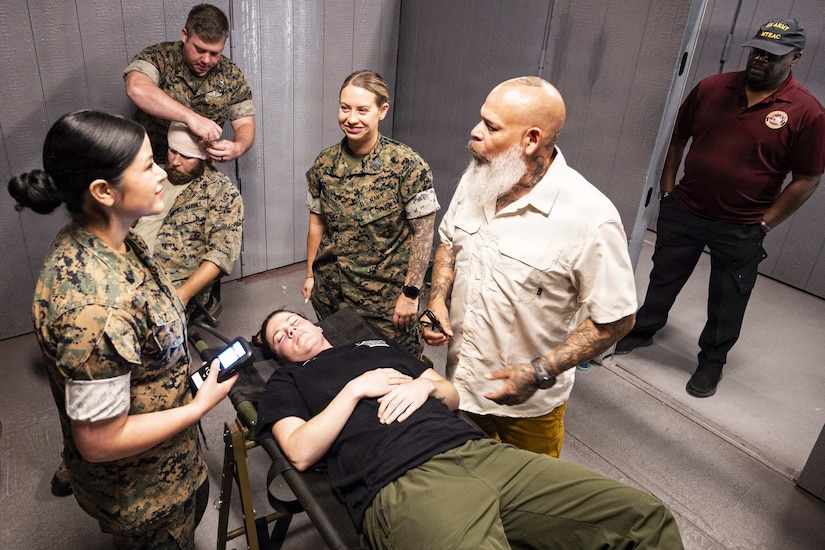
A person lies on a cot as other people, some wearing camouflage military uniforms, stand and speak to each other.

The event brought together Navy corpsmen and medical officers from across the II Marine Expeditionary Force to assess new capabilities for evaluating traumatic brain injuries on the battlefield. Participants evaluated Traumatic Brain Injury Field Assessment Program devices in a hands-on session, providing TBI-FAP developers with critical feedback directly from front-line medical providers who may one day use the equipment in austere environments.

The TBI-FAP program is managed by brain health experts within the WRPBH Project Management Office in collaboration with partners at the North Carolina Center for Optimizing Military Performance. This event, the latest in a series, was designed to gather feedback on TBI assessment technology prototypes being developed for use in a far-forward operational environment. Feedback from prospective end users is a vital step in the early development of any program, according to Damien Hoffman, a product manager with WRPBH.

"Collaborating with stakeholders across the military services and from key organizations in a systematic, routine way is imperative to our team's success," Hoffman said. "These touchpoints allow us to gather an array of feedback from end users with varying degrees of experience and expertise, an invaluable resource as we develop products for the warfighter."

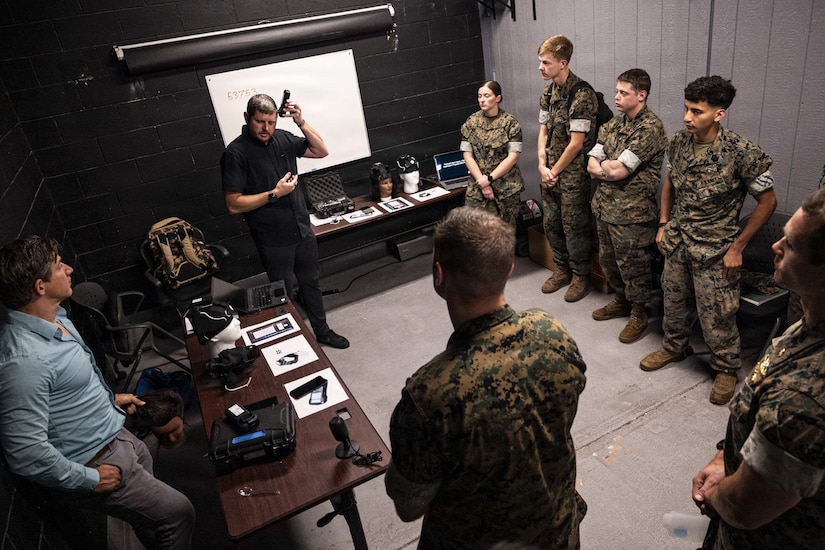
A man wearing a black shirt stands near a white board in front of a room with multiple people wearing camouflage military uniforms.

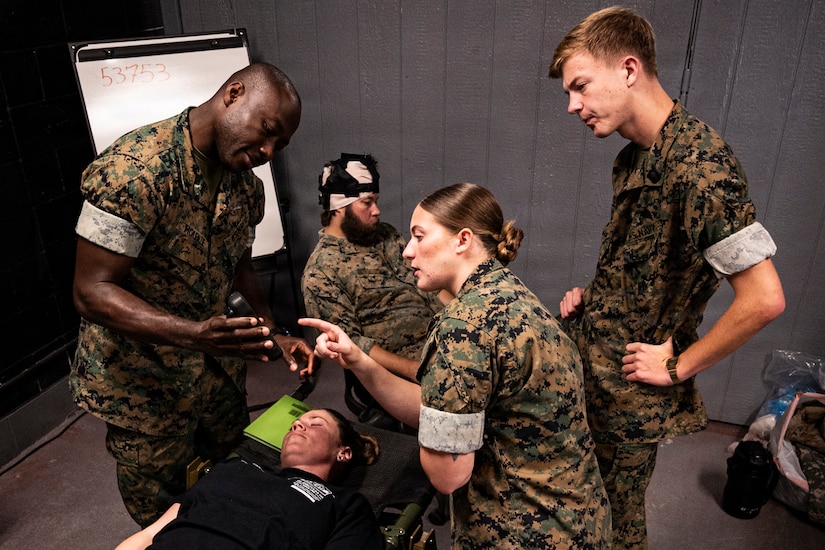
During the assessment, Navy corpsmen and medical officers got hands-on experience with the candidate technologies to test usability, durability and integration into existing tactical combat casualty care workflows.

"It is great, for me as a corpsman, to see what types of technologies are being developed for medical providers who operate at the front lines," said Navy Petty Officer 3rd Class Aspen Mitchell, a hospital corpsman assigned to the Marine Wing Communications Squadron 28 at Marine Corps Air Station Cherry Point, North Carolina. "Because of our expeditionary mission, we could literally be deployed anywhere in the world, and healthcare is vital for mission success. It is important for us, as medical providers, to give input on technologies during the development process to make the candidate technologies better and ensure they meet our needs as possible end users."

A group of people dressed in camouflage military uniforms stand over a person lying on a cot.

As the War Department continues to prepare for possible large-scale combat operations in austere environments worldwide, ensuring that warfighters have immediate access to neurological assessments is a top priority for military health leaders within the DHA. In future conflicts, medical providers anticipate a high likelihood of prolonged field-care scenarios. Unlike operations over the last two decades, where aeromedical evacuation was often rapid and guaranteed, near-peer conflicts in austere, remote locations will likely feature highly contested airspace and limited aviation resources.

For the Navy-Marine Corps team, these challenges are compounded by their unique role as the nation's premier amphibious force. Marines and their embedded Navy medical providers frequently operate in distributed, maritime environments — moving from ship to shore or securing expeditionary advanced bases across vast littoral regions. In these decentralized operational areas, the "golden hour" for traditional medical evacuation is often unattainable.

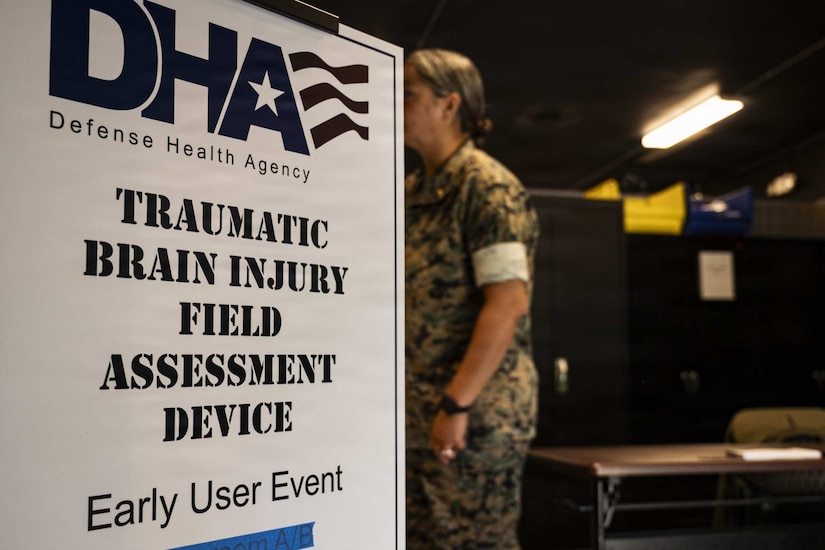
A sign for a traumatic brain injury training event stands in a small room as a woman wearing a camouflage military uniform walks by.

Because of these unique amphibious and logistical constraints, Navy corpsmen must be equipped to hold, monitor and treat casualties at or near the point of injury for extended periods. The ability to accurately assess traumatic brain injuries on the front line using lightweight, organic tools — like those developed through the TBI-FAP — is critical. It empowers first responders to make vital triage decisions, manage complex neurological trauma while isolated on distant shores and prioritize limited maritime medical evacuation assets for the most critical cases.

"Our process is a continuum, with flexibility to evolve alongside emerging threats and meet the needs of front-line warfighters, combatant commands and joint staff," Hoffman said. "Our goal is to rapidly develop a TBI assessment capability at the speed of relevance and these touchpoints are imperative to achieving that goal."

Monday, December 01, 2025

Medal of Honor Monday: Marine Corps Staff Sgt. William Windrich

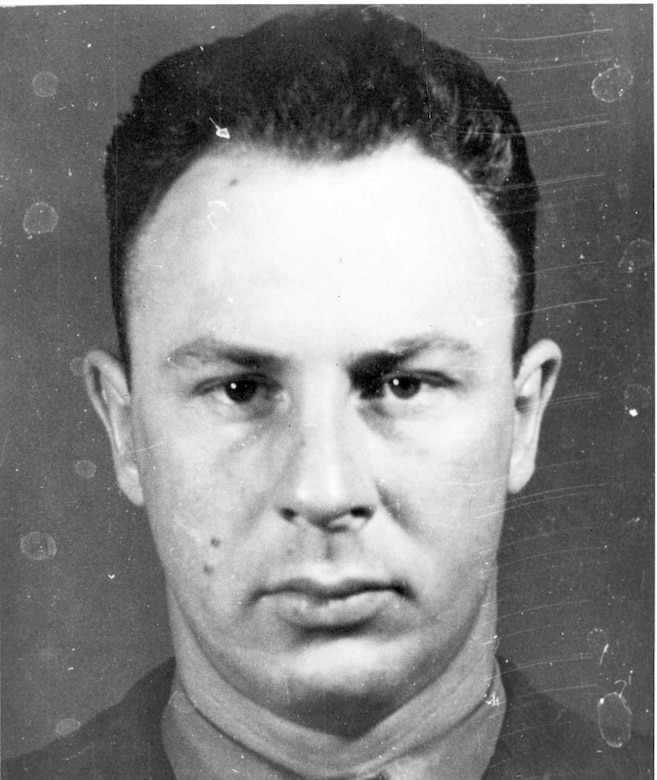
Marine Corps Staff Sgt. William Gordon Windrich was only in Korea for a short time, but the skills he'd honed during World War II helped him lead his cold, dirty and disheveled comrades to freedom during one of the most savage battles in modern military history.  

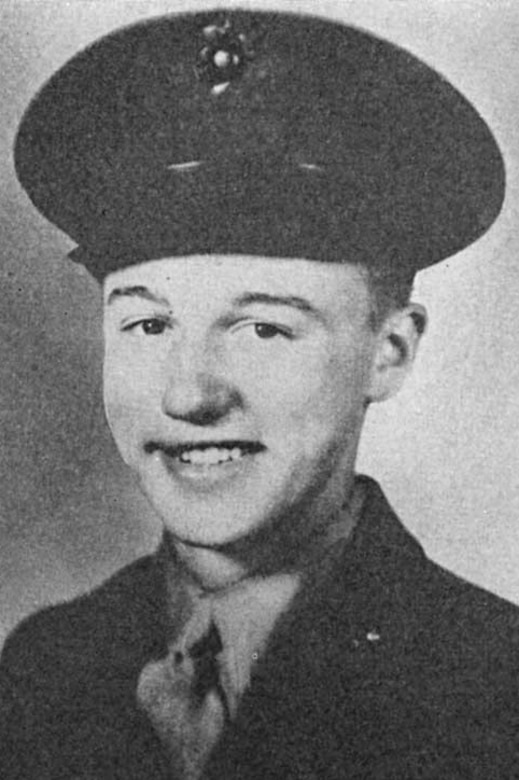
A man poses stoically for a photo.

Windrich didn't survive the Battle of Chosin Reservoir to tell his own story, but his heroics led him to posthumously receive the Medal of Honor.  

Windrich was born May 14, 1921, in Chicago to World War I veteran Herman Windrich and his wife, Marguerite. He had a sister named Virginia. 

When Windrich was young, the family moved to nearby Hammond, Indiana, where their father worked as a foreman at the city's only oil refinery.  

Windrich attended several public schools before dropping out and enlisting in the Marine Corps Reserve in June 1938. By November 1940, he was called up to active duty. 

During World War II, "Windy," as he was called, spent nearly two years in the South Pacific as a machine-gunner, seeing action during the Battle of Tarawa in the Gilbert Islands. He was discharged soon after the war ended and, after returning home, earned his GED diploma. At some point, he married his hometown girlfriend, Margaret. They had a daughter named Alita.  

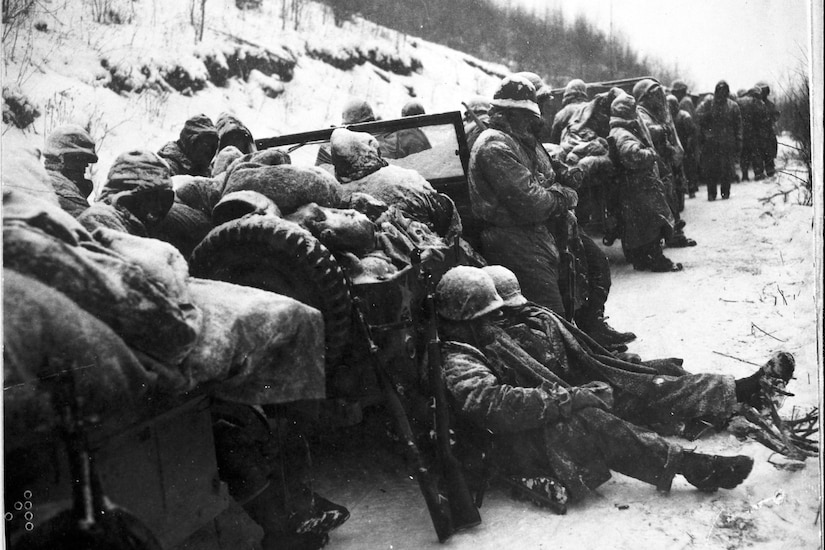
Dozens of men in cold-weather gear lounge near a line of military vehicles in the snow.

Civilian life didn't suit Windrich, however. So, in February 1946, he reenlisted in the Marine Corps. That summer, while serving aboard the USS Mount McKinley, Windrich took part in the atomic bomb testing at Bikini Atoll. In the years that followed, he served in positions in around Washington and in China.  

Windrich was on military police duty at Camp Pendleton, California, when the Korean War broke out in the summer of 1950. As part of the 1st Provisional Marine Brigade, he was one of the first Marines to see action in the conflict. He took part in the Inchon landing and the capture of Seoul before being transferred to Company I of the 3rd Battalion, 5th Marines, 1st Marine Division.  

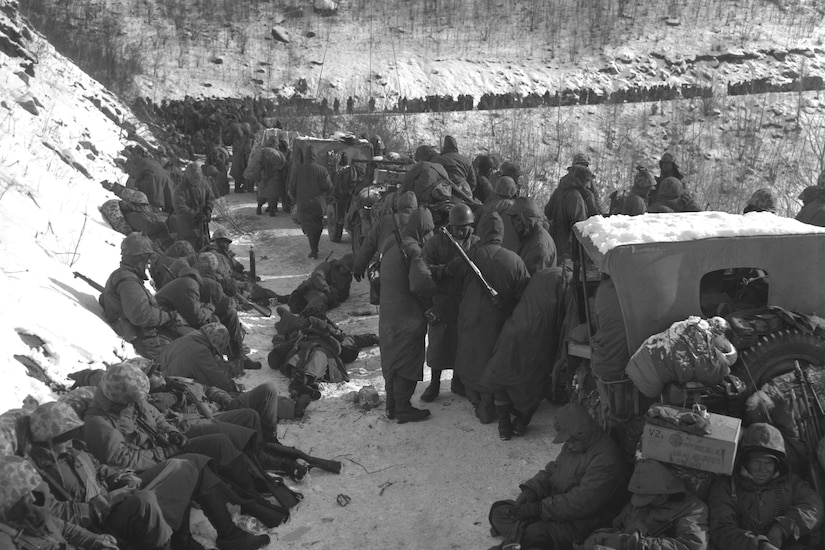
Windrich was the company's platoon sergeant during the infamous Battle of Chosin Reservoir, where about 30,000 troops from the United Nations, many of whom were U.S. Marines and soldiers, chased defeated North Korean army soldiers up the Korean Peninsula to try to force them over the border into China. When they reached the Chosin Reservoir, however, about 120,000 Chinese troops surged south over the border instead, ambushing U.N. troops and cutting them off from their main supply route.  

The nearly three-week battle was one of the most brutal in military history, waged in below-zero temperatures, heavy snow and frigid winds.  

Hundreds of men in cold-weather gear sit and stand alongside a line of military vehicles on a mountainside in the snow.

On the night of Dec. 1, 1950, the enemy launched a sudden attack on the forward elements of Company I's position on Hill 1520. As Marines fell, Windrich organized a group of men and spearheaded an assault toward the top of the hill to confront the enemy forces.  

Despite intense enemy automatic weapons, mortar and grenade fire, the group was able to effectively hold back the attackers while the remaining troops withdrew to safer ground. However, the assault group was decimated in the process. Most of the men were either wounded or killed, including Windrich, who suffered a head wound from a bursting grenade.

Windrich fell back to where his company had repositioned themselves. After refusing medical attention, he organized a new group of volunteers to evacuate the fallen Marines on the frozen hillside.  

Windrich then placed the rest of the troops on the left flank of the defensive sector as the enemy attacked again. Windrich was severely wounded in the leg and couldn't stand, but he refused to leave the fight, shouting words of encouragement and directing his team's fire until the attack was pushed back. Even then, he continued to direct his platoon to set up defensive positions. Eventually, Windrich succumbed to the bitter cold and excessive blood loss.  

"He allowed himself to be placed on a stretcher, and as he lay down, he told one of the men carrying him that he just wanted to go to sleep. Then he died," read a 1985 article on Windrich in his hometown newspaper, The Times. 

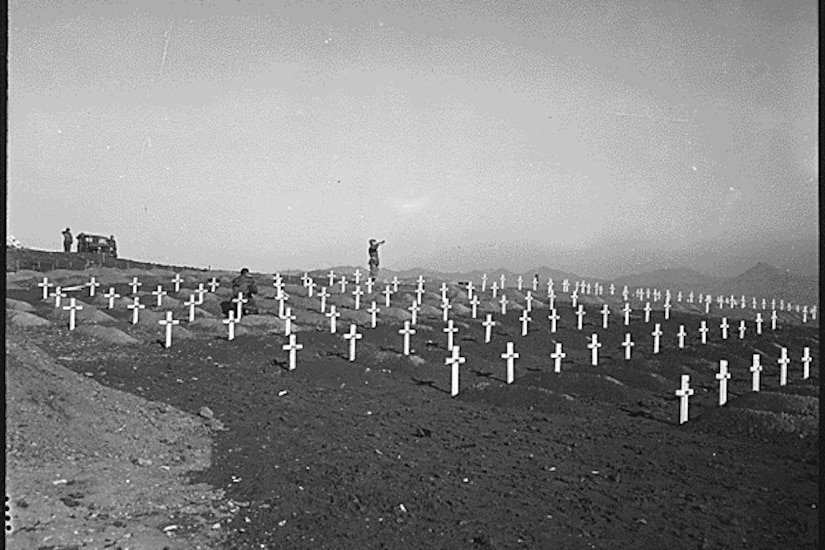
A man plays a bugle in the middle of a graveyard full of white crosses.

Windrich's bravery and devotion to duty inspired the men around him to hold the line despite the tremendous odds against them. Eventually, they were able to fight their way south to freedom. But the battle took its toll. The U.S. reported more than 12,000 casualties, including more than 3,000 dead. 

Windrich's fellow Marines weren't able to carry his body down the 70 miles of mountainous terrain, so he was left behind with the promise from commanders that they would come back for all the fallen Americans when they could.  

Windrich is one of 17 men who received the Medal of Honor for valiant actions during the battle. On Feb. 8, 1952, his widow and daughter received the nation's highest honor for valor on his behalf during a Pentagon ceremony.  

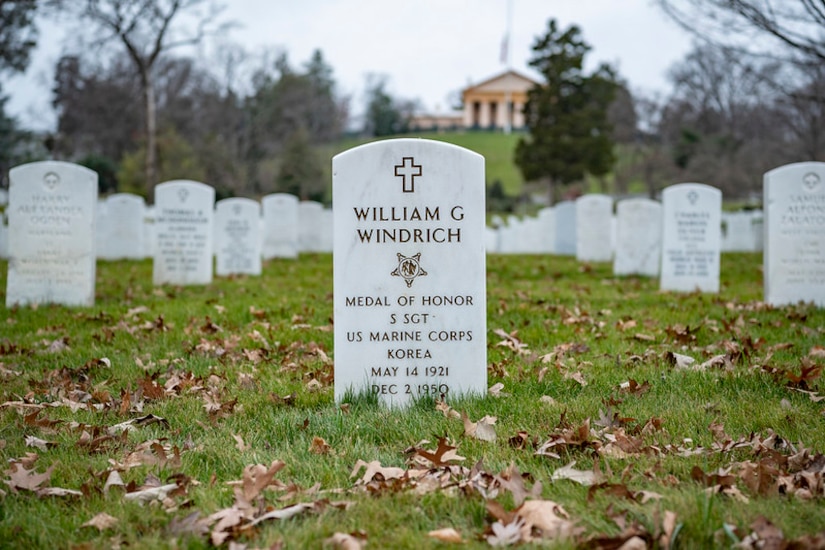
A grave marker is highlighted prominently among a field of other matching grave markers.

More than four years after the Battle of Chosin Reservoir ended, the promise to bring Windrich's body home was fulfilled, and his remains were repatriated. On July 29, 1955, he was buried in Arlington National Cemetery, Virginia. 

Near his hometown in Lake County, Indiana, residents and visitors can read about Windrich's heroics on a section of the Korean War veterans memorial that's dedicated to him. The National Museum of the Marine Corps in Triangle, Virginia, has also erected a Chosin Few Battle Monument in honor of those who fought there. 

Tuesday, November 18, 2025

Medal of Honor Monday: Marine Corps Pfc. Richard Kraus

Marine Corps Pfc. Richard Edward Kraus had only been overseas for three months during World War II when he gave his life to save his fellow Marines. For making the ultimate sacrifice, the 19-year-old received a posthumous Medal of Honor.  

A man wearing a military dress uniform and cap poses for a photo.

Kraus was born Nov. 24, 1925, in Chicago to Hazel and August Kraus. He had a sister, Yvonne. When his mother later remarried, he gained two sisters, Gail and Marlys.  

When Kraus was 7, his family moved to Minneapolis. His parents described him as an average boy who attended church, liked sports and was "full of fun," according to a July 1945 article in the Minneapolis Star newspaper.  

Kraus graduated from Edison High School in 1943, as World War II raged. By the end of that year, he'd turned 18 and enlisted in the Marine Corps Reserve. Kraus spent the first half of 1944 training in San Diego at Camp Pendleton. In early July 1944, he was deployed to the Pacific, where he served with the 8th Amphibious Tractor Battalion, 3rd Amphibious Corps, Fleet Marine Force. 

The first and only major offensive in which Kraus took part was the Palau Islands campaign. By mid-September, Kraus landed on the island of Peleliu. Within weeks, Marines and soldiers made headway in securing the island from Japanese forces.  

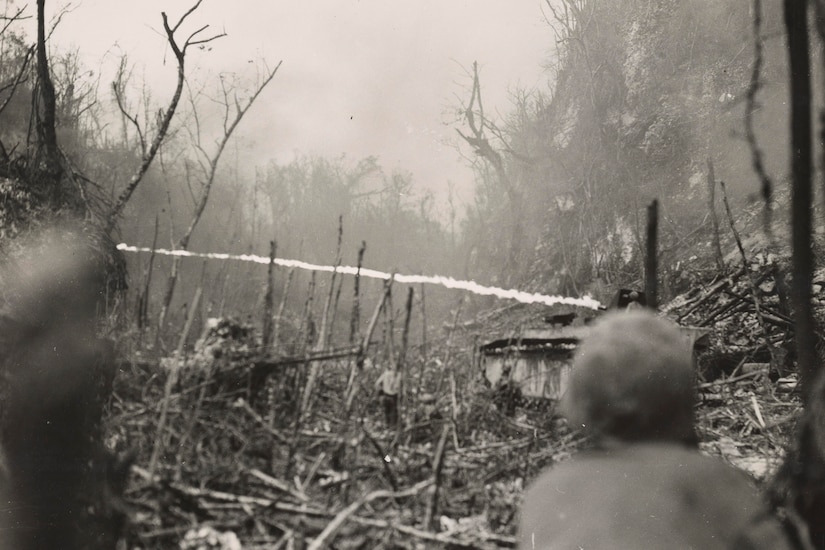
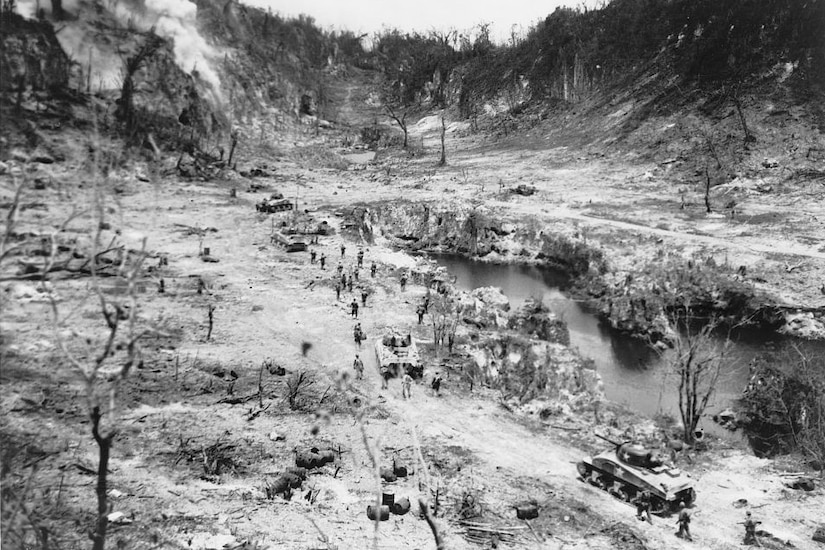
A person wearing a military uniform looks forward at the edge of a burned-down forest. Another person in a military uniform walks in the distance, and a line of flame from a flamethrower rips from a tank sitting in the middle of the carnage.

On Oct. 5, 1944, Kraus and three other Marines volunteered to evacuate a wounded comrade from the front lines. Despite the extreme danger, the small group courageously made their way across enemy lines with a stretcher. They made it a good distance before the enemy began throwing a barrage of hand grenades in their direction, forcing them to take cover before eventually abandoning the mission.  

As the four men headed back, two men dressed like Marines approached them. When Kraus asked them for a password to prove they were who they said they were, the pair didn't answer. Instead, one of them threw a grenade into the middle of the four Marines.  

Without hesitating, Kraus threw himself on top of the explosive device, covering it with his body so he would absorb the impact of the blast, sparing his comrades. Kraus gave his life to save his fellow Marines.  

An aerial view of tanks and people walking through a burned-out ravine.

On Aug. 2, 1945, Kraus' mother received the Medal of Honor on her son's behalf during a ceremony in downtown Minneapolis. Seven other Marines received the nation's highest honor for valor for their actions in Peleliu.  

Kraus was initially buried in an American cemetery on Peleliu, but his remains were repatriated in 1948. He was reburied in Fort Snelling National Cemetery in Minneapolis.  

Kraus has not been forgotten. The destroyer USS Richard Kraus was commissioned in his name in May 1946. It served through the Vietnam War and remained in service until its decommissioning in July 1976.  

A main street on Camp Pendleton was also named in Kraus' honor.  

Tuesday, September 23, 2025

From Combat Veteran to TV Star

Actor Larry Wilcox, best known for his leading role as a California Highway Patrol motorcycle officer and later as a captain in the TV series CHiPs, which aired from 1977 to 1983, was also a Marine Corps combat veteran.

In May 1967, Wilcox went to boot camp at Marine Corps Recruit Depot San Diego. 

He served as a field artilleryman assigned to 2nd Battalion, 12th Marine Regiment, from 1967 to 1970. 

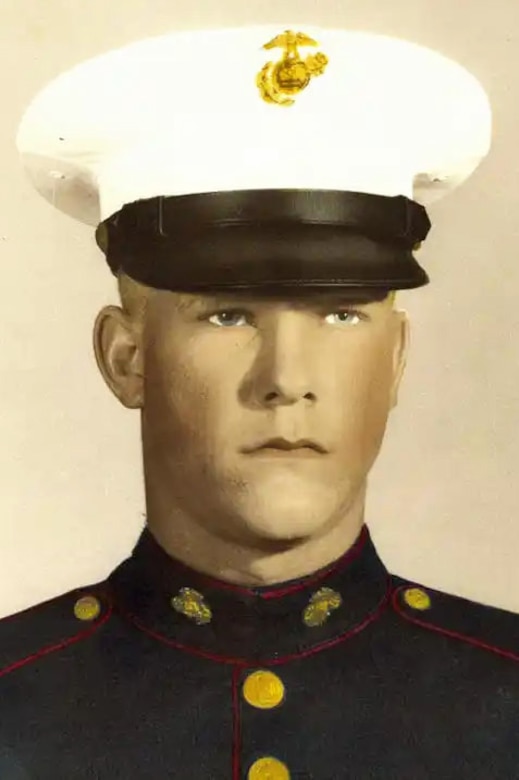
A Marine in a military dress uniform poses for a photo.
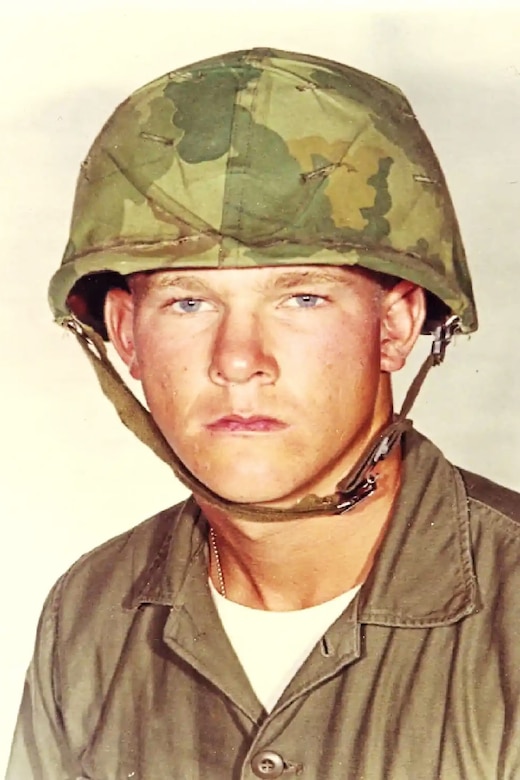
A Marine is pictured in a military uniform and helmet.
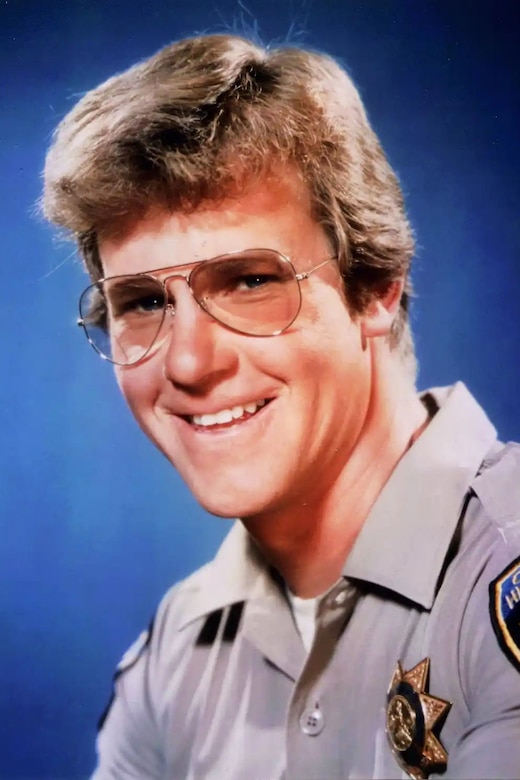
A man poses for a photo in sunglasses and a police uniform costume.
Those years included a 13-month deployment to South Vietnam, where he served in the northernmost region of the country, in places such as Dong Ha, Con Thien and the demilitarized zone bordering North Vietnam.  

Also, he fought in the Tet Offensive, which started Jan. 30, 1968, and lasted until September 1968.

Like many Vietnam War veterans, Wilcox's homecoming was not joyous. 

"My memories of my returning home to San Francisco were ugly, and I did not understand why people spat on you for risking your life," he said, referring to people at the airport. 

 During his final year of military service, he was stationed at Marine Corps Air Ground Combat Center in Twentynine Palms, California, where he was honorably discharged as a staff sergeant in 1973. 

Wilcox, born Aug. 8, 1947, in San Diego, still lives there. 

His older brother, Randy, also served in the Marine Corps, including during the 1962 Cuban missile crisis.

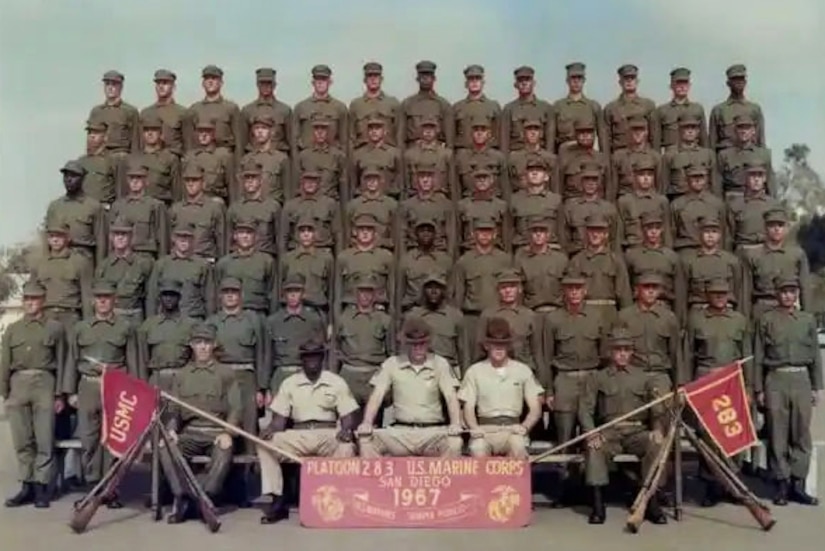
A platoon of Marines wearing military uniforms sitting and standing on bleachers.

Monday, September 22, 2025

In the Cockpit: Docuseries Captures Intensities of Elite Fighter Pilot Training

 Sept. 22, 2025 | By Katie Lange, Pentagon News

While movies like "Top Gun" and "Top Gun: Maverick" show people a glamorized version of military fighter pilot life, most people really have no idea what it takes to become an elite aviator, until now.  

A new National Geographic docuseries called "Top Guns: The Next Generation," follows a handful of Navy and Marine Corps officers as they go through advanced strike fighter training — the last, hardest and most unforgiving phase of fighter pilot qualification training.

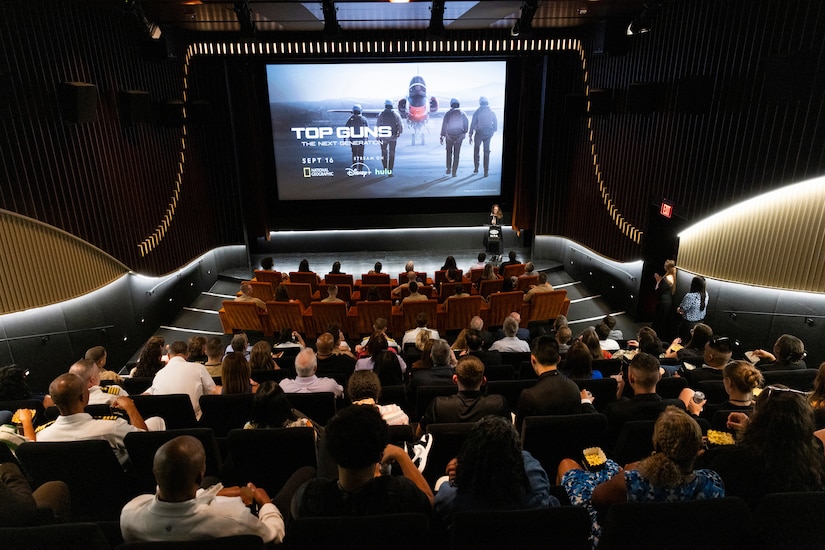
A person stands at a podium at the front of a movie theater filled with people. The screen reads, “Top Guns: The Next Generation” and depicts four people walking toward an aircraft.

The show's producers chose to film that phase because of its intensity, but it's also what audiences are most familiar with. The show skips past the classroom training and highlights when students go beyond being "just a pilot" to what it takes to become a fighter pilot.  

"It's the most crucial point of their training. It's really the point in which they can fail, and their dreams of becoming a fighter pilot are over," said Karen Edwards, the series' showrunner. "They spent years getting to this point, and now it's all on the line." 

When choosing candidates for the show, Edwards said they met with about 30 trainees assigned to Training Wing One, based at Naval Air Station Meridian, Mississippi, where most of the series was shot for more than a year. They selected a variety of students with different backgrounds, experience levels and skills.  

"One of the participants used to be a yoga teacher and is now a Marine," Edwards said. "Another guy talked about how he was adopted at birth and how that has impacted him and his religion. For others, it's in the family blood."  

Marine Corps Capt. Micah Nissly was the adoptee Edwards mentioned. He said his dad, a pastor, impressed upon him the importance of public service and giving back, so he enlisted in the Marines. After eight years of service, he went to officer candidate school before starting aviation training. 

"I think it's important for individuals to know that, regardless of their upbringing and how they came into this, they have this opportunity," Nissly said. "Naval flight training is truly the great equalizer: you give it all. You make it or you don't. And I think your background matters so little … what matters is your performance." 

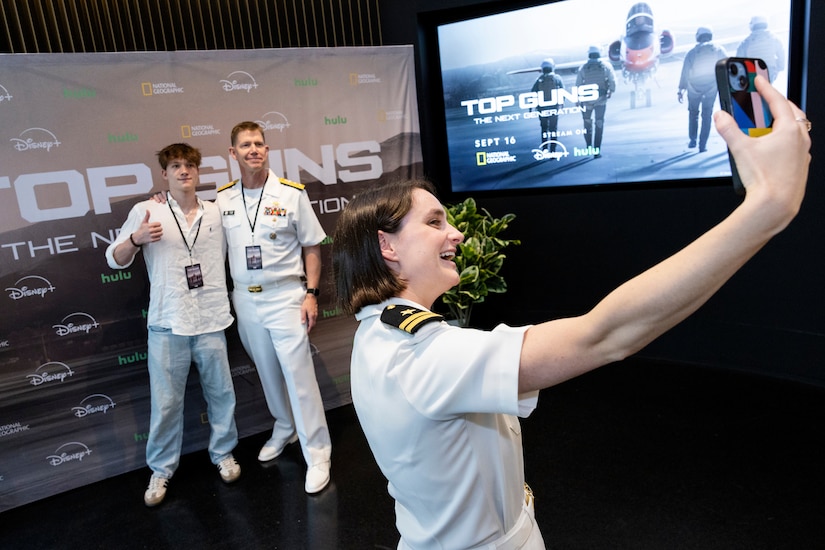
A woman wearing a formal military uniform takes a selfie with two men in the background, standing in front of a large poster. One of the men is dressed in casual attire, and the other is wearing a formal military uniform.

Initial Reluctance

When the documentary opportunity arose, Nissly said he initially denied the offer to preserve the legacy of the "quiet professional," as he knew most in the jet community to be. But then his wife convinced him that it's something his 6-year-old daughter could one day look back on with pride. 

"I really hope the viewers … see that behind every flight is a naval aviator committed to teamwork, integrity and self-improvement. They'll see our ups and downs, but humility and accountability define us way more than the egos," Nissly said.

Marine Corps Capt. Stephanie Harris was also reluctant to be part of the production because she didn't want it to take away from her focus on training. But she eventually agreed. 

"I've looked up to so many people who walked this path before me," she said. "Providing an example of the kind of people that do this — and not just your stereotypical version — felt important to me."

Stunning Cinematography With a Focus on Accuracy

Some of the series' filming also took place at Naval Air Facility El Centro in the California desert. El Centro specializes in teaching trainees strike training — how to accurately drop bombs and other ordnance. A small portion of filming also took place at Naval Air Station Key West, so the students could access the aircraft carrier USS Dwight D. Eisenhower. These locations helped crews capture stunning aerial visuals that included precision bombing drills, dogfighting, evasive maneuvers and carrier landings.  

"[Students learn this] in a really short period of time, and it's a lot to ask, which makes it all the more amazing when they achieve it," Edwards said.

To get the shots, the production team put cameras inside T-45 Goshawk training aircraft using in-cockpit mounts designed, fabricated and installed by Naval Air Systems Command and the Naval Air Warfare Development Center. When the students are flying, the audience can hear minute by minute what they're saying. 

"Everything that happens inside the jet is caught in real time," Edwards said. "You hear them being taught — what they get right, what they get wrong, how they can improve." 

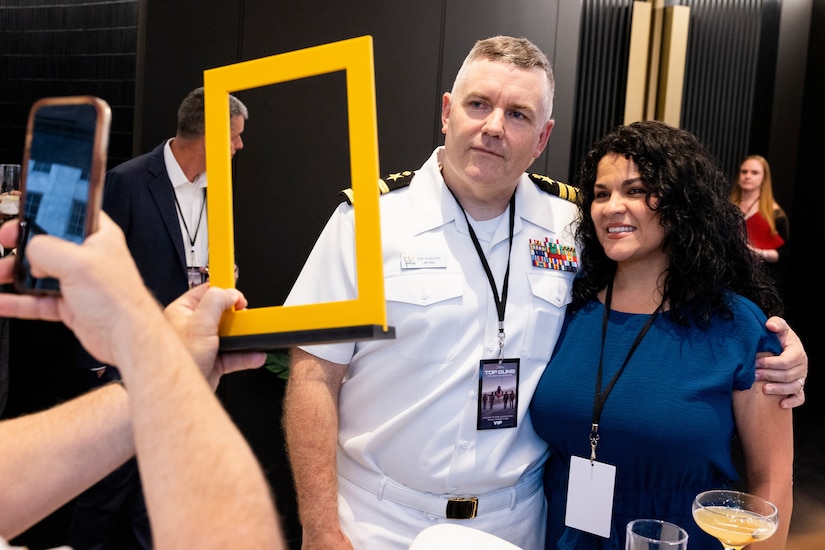
A man in a formal military uniform poses for a photo with a woman in business attire as another person, not pictured, holds up a phone and a yellow, square picture frame.

To ensure safety wasn't compromised, the production team had instructors and professionals fly the aircraft for the external cockpit-to-cockpit scenes, recreating the flights the students had taken. 

"We filmed them externally using the same film crew as they used for 'Top Gun: Maverick' … because that is so dangerous," Edwards said.  

Nissly said he thinks the series did a great job of focusing on authenticity.  

"They did an amazing job filming the honest struggles. There's no do-overs for this," he said. "This is real life, and the stakes were as high for us then. What you see is what you get." 

"It's inspiring to hear and see up close the authentic stories of those serving in our Navy today," said Navy Rear Adm. Ryan M. Perry, the service's chief of information. "It's about young men and women chasing a dream to fly, and the intense training and challenges they go through to achieve their goals."                    

Emotions Run High 

For many of the participants, the high-stakes, life-or-death training takes an emotional toll, which is also captured on camera.

"All of them come back and share and have moments where it's like, 'Am I good enough? Am I going to pass tomorrow? Will I make the grade?'" Edwards said. "That is crucial to their training. They can never become complacent or confident. They're always being pushed to the next level." 

At one point in the series, Nissly gets sick while practicing dogfighting with a senior officer in the jet with him. The fact that it was an incident beyond his control was something he struggled with.  

"Getting through that mental block of, 'Will this happen again? Is this going to be a common occurrence? How am I going to fight through that?' It was definitely something I had to get over," Nissly said, before joking, "Humility also comes in and will always keep me on the straight and narrow."  

Nissly said he's driven by the desire to support enlisted troops — which he was, once — fighting on future battlefields. Similarly, Harris said the hardest part of her training was the thought of those troops on the ground someday and knowing that she needed to hit her targets for them.  

"[Strike training] is one of the most difficult missions that we do. So that phase, for me, felt the most intense," she said.  

When asked what drives her, Harris said some of it is the fear of letting other people down. "Not being prepared enough when the moment comes," she said. "Fear that I won't be ready, and that drives me in tremendous ways."  

The Takeaway 

For the Navy and Marine Corps, the goal of capturing the intense demands of this program on film was to highlight what it truly takes to be a naval aviator — even if it shows failure that inevitably happens.

"These are real human beings, real people who are really giving it their all," said Navy Lt. Cmdr. Joseph "Bones" Pfaff, entertainment liaison at Navy Office of Information West, which led the project. Based in Los Angeles, the office works with entertainment industry professionals to ensure an authentic, accurate portrayal of the Navy's assets, policies and people in television and film. 

"We have a very strenuous and challenging pipeline to go from being an unwinged aviation student to actually earning their wings. Not everybody succeeds, and that’s OK," Pfaff continued.  

"It doesn't end when they finish fighter pilot school," said Marine Corps Maj. Hector Alejandro, director of the Marine Corps Entertainment Office in Los Angeles. He explained that the trainees who earn their wings continue training at their squadrons in the fleet. "Someday, a 19-year-old Marine is going to be pinned down on a hillside, and he'll be looking to the sky for help. The person in that cockpit has to be the one who won't fail him. Our selection and training pipeline is ruthless because we're building pilots worthy of that trust." 

Series producers said they expect the audience to connect with the dedicated men and women highlighted in the show — and learn that it’s not like what they see in the movies.  

"It's not just about going up and having some fun in the jets on a daily basis. This is a job. They are careful. They're trained by very, very experienced people," Edwards said. "You take the audience into a privileged world that they would never, ever be able to see." 

"Top Guns: The Next Generation" airs on Tuesdays on National Geographic and streams the following day on Disney+ and Hulu. 
Medal of Honor Monday: Marine Corps Cpl. Jack Davenport

Do I save others or save myself?  

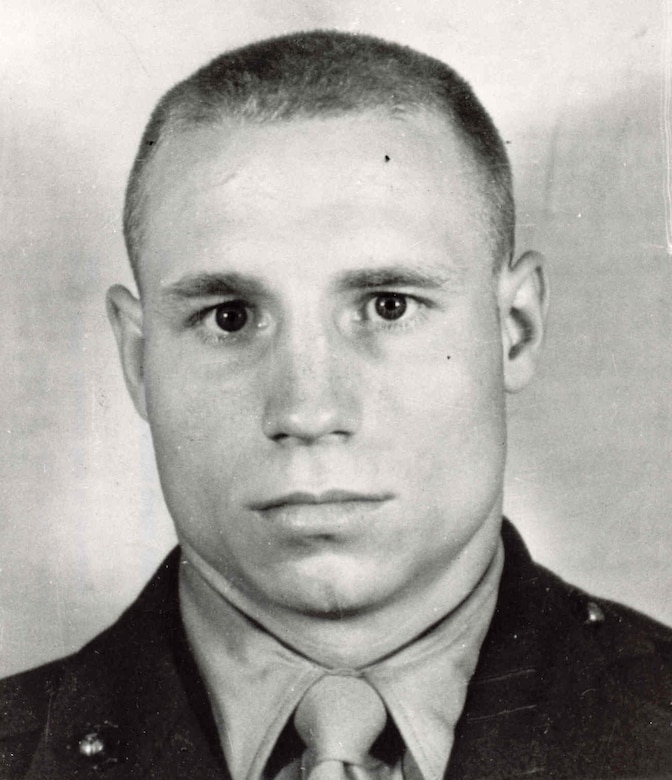
That's a question an unknown number of service members have asked themselves during battle throughout the ages. It's one Marine Corps Cpl. Jack Arden Davenport didn't hesitate on. During an attack in Korea, he chose to save his comrade's life instead of his own. That selfless decision led him to receive a posthumous Medal of Honor.  

A man looks stoically at the camera for a photo.

Davenport was born Sept. 7, 1931, in Kansas City, Missouri, to Fred and Gloria Davenport. He had a sister named Jane and a twin brother, Karl, who served in the Navy.  

Davenport was an active child who always liked to be on the go, his parents told the Kansas City Times in 1952. Throughout high school, he played baseball and was a paperboy for the Kansas City Star newspaper, where his father worked.  

After graduating from Paseo High School in 1949, Davenport studied for a year at the University of Kansas, where he played on the school's football team. He was also an amateur boxer who participated in at least one Golden Gloves tournament.  

However, when the Korean War broke out, Davenport decided to trade in studying for the fight against communism. He enlisted in the Marine Corps July 1950. After basic training, he was stationed at Camp Pendleton outside of San Diego, where he earned the nickname "Dynamite" from other Marines. In December of that year, he was deployed to join the 3rd Battalion, 5th Marine Regiment, 1st Marine Division in Korea.  

According to newspaper reports of the time, Davenport was on the front lines almost continuously until the day he made the ultimate sacrifice.  

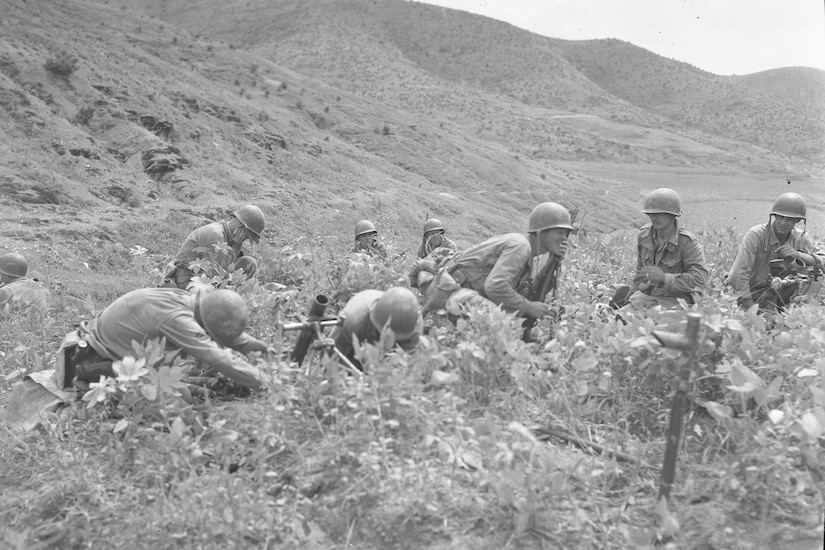
Early on Sept. 21, 1951, Davenport was serving as a squad leader with Company G in the Songnae-dong area of Seoul, South Korea, when they were attacked by enemy troops trying to infiltrate their sector.  

Nearly a dozen people in combat uniforms and helmets huddle in tall grass.

Davenport directed his comrades to defend their position. He and a fellow Marine, Pfc. Walter Barfoot, were doing so from a foxhole. Suddenly, an enemy grenade fell at their feet.  

Without any concern for his own life, Davenport jumped on the deadly projectile, which killed him. Barfoot was spared, however, and their unit managed to repulse the enemy, largely in part to Davenport's calm leadership.  

Many of Davenport's fellow Marines wrote to his family after his death, according to a December 1952 issue of the Kansas City Times.  

"He was the best. They didn't come finer or more courageous that little ole Dynamite," one Marine wrote to Davenport's mother.  

The fallen 20-year-old's body was returned to the U.S. in January 1952 and buried in Mount Moriah Cemetery in Kansas City.  

About a year later, Davenport posthumously received the nation's highest honor for valor. The Medal of Honor was presented to his father on his behalf during a Pentagon ceremony. Davenport's brother, Karl, was flown in by the Navy from Japan on special leave for the ceremony.  

In the late 1980s, a gymnasium at Camp Pendleton was named in Davenport's honor.  

Monday, September 18, 2023

Building Legacies: Freemasonry and Marine Family Support

In 1925, John A. Lejeune Lodge No. 350, chartered by the Grand Lodge of Virginia, became a living testament to both Freemasonry and the legacy of Lieutenant General John Archer Lejeune, a distinguished Marine Corps leader. General Lejeune's remarkable career, spanning WWI and his role as the 13th Commandant of the Marine Corps, intertwined with Freemasonry when he became a Master Mason in post-WWI Coblenz, Germany.

Fast forward almost a century, and the San Dimas Masonic Lodge proudly continues the tradition of linking Freemasonry and the Marine Corps by supporting the Pelican Pantry on 29 Palms Marine Corps Base. This pantry assists junior enlisted Marine Corps and Navy families. 

On September 30th, from 9 AM to 3 PM, our Lodge will host the Food Drive organized by the Satellite Rotary Club of Military Family Support for the third time. We call on all to contribute food staples, hygiene products, and baby supplies. Help us make a difference for the families of those who have serve. 

For more information, contact Raymond E. Foster, PM, at 909-599-7530 or sandimasrotary@gmail.com. 

Facebook Event

https://www.facebook.com/events/1257254725081232

LinkedIn Event:

https://www.linkedin.com/events/7081443171058024449/comments/

Join us in this vital mission to support our military families.

Monday, June 19, 2023

Leatherneck: Unraveling the Origins and Symbolism of the Term for the Marine Corps


The United States Marine Corps is renowned for its rich history and distinguished tradition. Among the many facets that define the Marine Corps' unique identity, the term "Leatherneck" holds a significant place. In this article, we will explore the origins, historical context, and symbolic meaning behind this iconic nickname, with a particular focus on the distinctive 18th-century Marine Corps uniform.

Origins of the Term: 

To comprehend the significance of "Leatherneck," we must delve into the Marine Corps' early days during the late 18th century. Marine soldiers wore a distinct uniform that included a high, stiff leather collar. These leather collars were designed to protect Marines from saber strikes during close-quarters combat while also promoting an upright posture, symbolizing discipline and resilience. This unique feature of the uniform became the foundation for the enduring nickname "Leatherneck."

The 18th-Century Marine Corps Uniform: 

The uniform worn by Marines in the 18th century embodied both functionality and symbolism. Beyond the leather collar, Marines donned blue coats with white trim, buff-colored waistcoats, and breeches, along with black gaiters and shoes. This distinctive attire established a visual identity for the Marine Corps and marked them as a separate and elite fighting force.

Symbolism and Identity: 

The term "Leatherneck" carries profound symbolism, encapsulating the Marine Corps' core values and warrior ethos. The leather collar, with its rigid and protective nature, embodied the Marines' commitment to defending the nation's interests and upholding the ideals of honor and duty. It became a symbol of the Marine Corps' tenacity, toughness, and unyielding determination.

Historical Significance: 

Throughout history, Marines wearing the distinctive 18th-century uniform have demonstrated their valor and resilience on numerous battlefields. From the Revolutionary War to the conflicts that followed, including the War of 1812, Marines earned a reputation for their unwavering bravery and exceptional discipline. The "Leatherneck" nickname became synonymous with the Marines' heroic actions, highlighting their role as a formidable fighting force in defense of the nation.

Evolution and Legacy: 

While the 18th-century Marine Corps uniform has undergone significant changes over time, the term "Leatherneck" continues to carry its symbolic weight. Marines embrace the legacy of their predecessors, recognizing the collar's historical significance and the values it represents. Today, the term "Leatherneck" serves as a unifying symbol that fosters camaraderie, instills pride, and reinforces the enduring spirit of the Marine Corps.

Conclusion:

 The term "Leatherneck" stands as a testament to the Marine Corps' storied past and enduring legacy. Rooted in the distinctive 18th-century uniform, it symbolizes the Marines' toughness, resilience, and unwavering dedication to duty. From its origins on the battlefield of the Revolutionary War to the modern-day Marine Corps, the term "Leatherneck" continues to inspire and define the Marines' commitment to honor, courage, and sacrifice. It serves as a reminder of their distinguished heritage and the timeless values that have shaped the Marine Corps into the revered institution it is today.

Sunday, June 04, 2023

The History and Development of the United States Marine Corps Drill Team


The United States Marine Corps Drill Team is an iconic and highly respected ceremonial unit within the Marine Corps. Renowned for their precision and discipline, the Drill Team showcases the highest standards of military drill and serves as a symbol of excellence for the entire Marine Corps. In this article, we will delve into the rich history and development of the United States Marine Corps Drill Team, exploring its origins, evolution, and the rigorous training that makes them an elite force in the world of military drill.

Origins of the Marine Corps Drill Team: The roots of the Marine Corps Drill Team can be traced back to the early years of the Marine Corps. Drill and ceremony have always been essential components of military training, ensuring discipline, cohesion, and attention to detail among the troops. However, it was not until the 1930s that the concept of a specialized drill team within the Marine Corps began to take shape.

Development and Evolution: In 1934, under the command of Major General John H. Russell, the first official Marine Corps Drill Team was formed. Initially, the team consisted of 50 Marines and was known as the "Russell's Rifles." Their precision and flawless execution of drill movements quickly gained attention and admiration, earning them a reputation as the epitome of military drill excellence.

Over the years, the Marine Corps Drill Team continued to evolve and refine their performances. They introduced new and intricate drill movements, incorporating bayonet-tipped rifles, swords, and other ceremonial elements. The team's dedication to perfection and their commitment to upholding the highest standards of discipline and professionalism propelled them to the forefront of military drill worldwide.

Training and Selection Process: Becoming a member of the Marine Corps Drill Team is no easy feat. Marines who aspire to join the team undergo a rigorous selection process. Candidates must demonstrate exceptional physical fitness, discipline, and mastery of basic drill movements. Only the most highly skilled and disciplined Marines are selected to represent the Marine Corps as part of the Drill Team.

Once selected, the Marines undergo intensive training, honing their skills and perfecting their drill movements. Countless hours are spent practicing and rehearsing to achieve the level of precision and synchronization for which the Drill Team is renowned. The demanding training regimen instills discipline, teamwork, and a deep sense of pride in every member of the team.

Performances and Impact: The United States Marine Corps Drill Team performs at numerous high-profile events, both nationally and internationally. Their performances include military ceremonies, parades, sporting events, and public demonstrations. Each display of precision and discipline not only pays tribute to the Marine Corps but also serves as an inspiration to audiences, showcasing the dedication and professionalism of the men and women in uniform.

The Marine Corps Drill Team's performances have left a lasting impact on spectators and have become an iconic representation of the Marine Corps' commitment to excellence. Their flawless execution of intricate drill movements, combined with the distinctive sound of bayonet-tipped rifles striking in unison, creates a visual and auditory spectacle that captures the attention and admiration of all who witness it.

Conclusion: The United States Marine Corps Drill Team stands as a testament to the Marine Corps' core values of honor, courage, and commitment. Through their relentless training and unwavering dedication, the members of the Drill Team embody the highest standards of military drill and serve as ambassadors of the Marine Corps. Their precision, discipline, and unwavering professionalism leave a lasting impression on all who witness their performances, reflecting the Marine Corps' legacy of excellence in every movement.

Thursday, November 05, 2015

Dunford: U.S. Engagement in Pacific ‘Unprecedented’


By Jim Garamone DoD News, Defense Media Activity

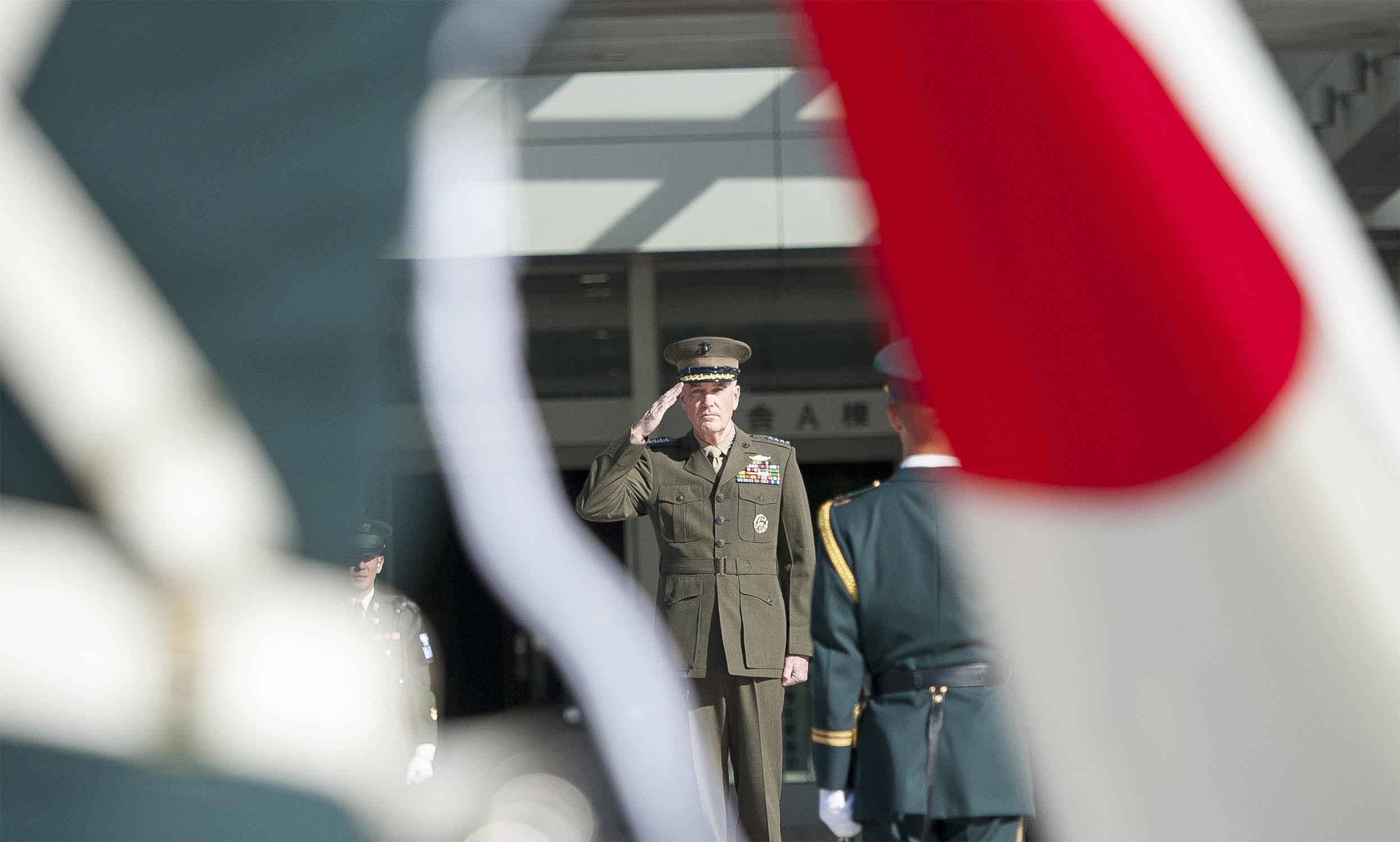
TOKYO, November 4, 2015 — Marine Corps Gen. Joseph F. Dunford Jr. met with Japanese leaders here today to discuss freedom of navigation, changes to the U.S.-Japan alliance and threats and opportunities in the region.

Dunford met with Japanese Prime Minister Shinzo Abe, State Minister of Defense Kenjo Wakamiya and Maritime Self-Defense Force Adm. Katsutoshi Kawano, the chief of defense, during a round of visits.

“We talked about the Pacific, we talked about their assessment of the challenges in Asia,” the chairman of the Joint Chiefs of Staff said in an interview following the meetings. “Frankly, they line up pretty well with how we see it.”

Freedom of Navigation

Dunford said he discussed the issue of freedom of navigation with Prime Minister Abe. The general referred to last week’s passage of the USS Lassen within 12 miles of Subi Reef -- an artificial island China has built in the Spratly archipelago.

The passage, the chairman said, “was not provocative. We made it very clear that the Global Commons is accessible to everybody in accordance to international laws.”

Dunford added, “The Japanese support what we did and they believe what we did is important. They believe we ought to continue to do that.”

The chairman said he and the Japanese leaders also discussed the challenges posed by China, Russia and North Korea.

The threats are pushing Japan to more closely cooperate with others in the region, Dunford said, adding that he dug deep in discussing Japan’s trilateral relationships. These are the United States, Japan and Australia; the U.S., Japan and the Philippines and the U.S., Japan and South Korea.

His meeting with Japanese leaders was the first since Japan passed legislation in September that will allow the country to play a greater role in global security affairs.

“Clearly everyone recognizes that we had a very good relationship with the Japanese before this,” Dunford said. “But this will open up possibilities for more integration in areas that we were proscribed from actually dealing with them in the past.”

The legislation will take effect in the spring and the chairman believes it will allow U.S. and Japanese troops to take their cooperation to new levels.

Alliance’s Importance on the Rise

Kawano hosted a full-honors arrival ceremony at the defense ministry for Dunford. The Japanese admiral told the chairman he wanted to deepen the military-to-military relationship between the two countries.

“The situation in the Asia-Pacific region is severe and that is why the importance of the U.S.-Japan alliance is increasing,” Kawano said through an interpreter at the start of the meeting with the general.

“I believe this alliance will contribute to maintaining peace and stability through the region,” he said. “So we would like to make the effort to contribute to the peace and stability not only in this region, but throughout the world.”

Also at the meeting, Dunford said this visit, just a month into his term as chairman, reflects of the importance the United States places on the alliance.

“We have had a relationship with the Japanese Self-Defense Forces for many years, but I don’t think it has ever been more important than it is today,” the chairman said.

There are many challenges in the region, he said, and Japan and the United States must work together to overcome them. But, Dunford added, “there are also opportunities, and those are based on the strength of our alliance.”

Dunford said he was pleased with the overall state of U.S. relations in Northwest Asia. Before coming to Japan, he visited South Korea for the annual Military Committee Meeting.

“My perspective on the trip … is that the relationships at every level were really in pretty good shape,” he said. “The amount of engagement that we have in the Pacific … is unprecedented.”