Showing posts with label 3rd infantry division. Show all posts

Monday, June 29, 2026

Medal of Honor Monday: Army Pvt. Elden Harvey Johnson

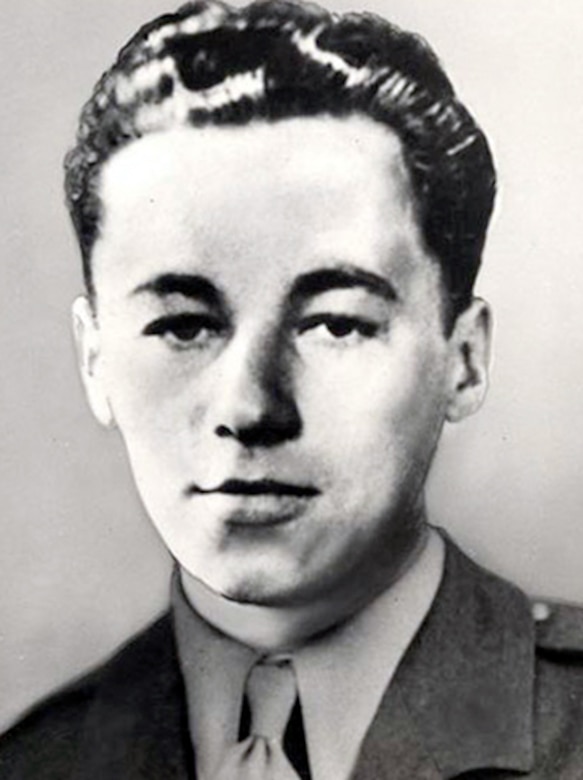
Army Pvt. Elden Harvey Johnson fought in the 1944 Italian Campaign of World War II as an infantryman and was posthumously awarded the Medal of Honor for his extraordinary heroism.
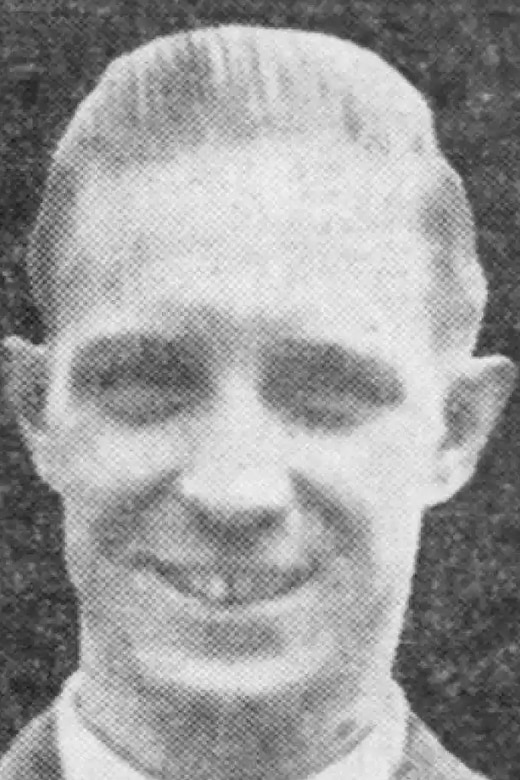
A man smiles and poses for a photo.

Johnson was born in Bivalve, New Jersey, Feb. 13, 1921, and grew up in East Weymouth, Massachusetts.

He enlisted in the Army in April 1943, at age 22, shortly after the United States entered World War II. Later that year, after completing basic training, he shipped out to Italy as a replacement soldier assigned to Company H, 15th Infantry Regiment, 3rd Infantry Division.

Johnson was part of the Rome-Arno Campaign, which began Jan. 22, 1944, and lasted until Sept. 9, 1944.

While on patrol June 3, 1944, his unit was attacked near Valmontone, Italy, about 30 miles southeast of Rome — three days before the D-Day invasion of Normandy, France.

It was night, but the area was brightly illuminated by enemy flares. Despite the enemy fire directed at him, Johnson advanced beyond the enemy in a slow, deliberate walk. He fired his rifle from his hip, distracting the enemy enough for 12 of his fellow soldiers to escape. Once he was within about 5 yards of the German machine gun position, Johnson killed the crew.
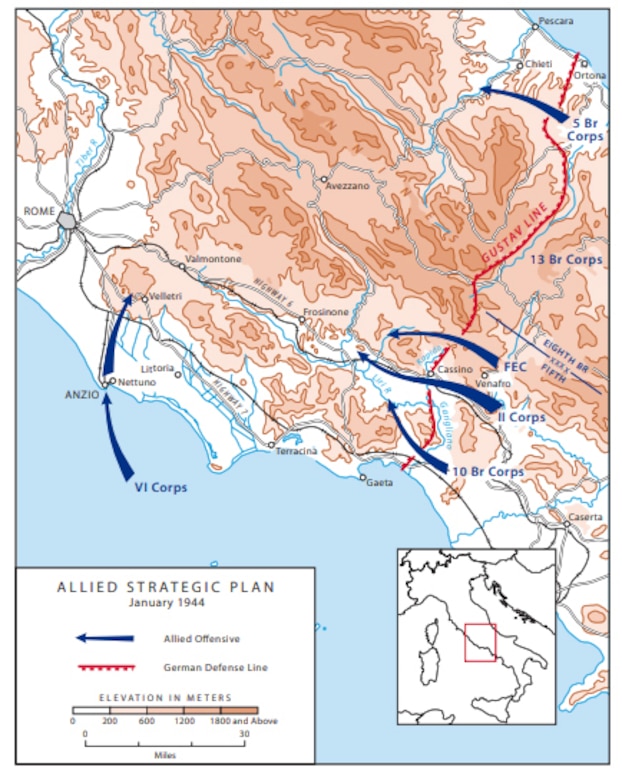
A map depicts terrain and military movements during World War II. The key in the corner reads, "Allied Strategic Plan, January 1944."

His Medal of Honor citation reads in part:

"Johnson elected to sacrifice his life in order that his comrades might extricate themselves from an ambush. Braving the massed fire of about 60 riflemen, three machine guns and three tanks from positions only 25 yards distant, he stood erect and signaled his patrol leader to withdraw."

Standing in full view of the enemy, Johnson reloaded, turned to the riflemen to the left and fired directly into their positions.
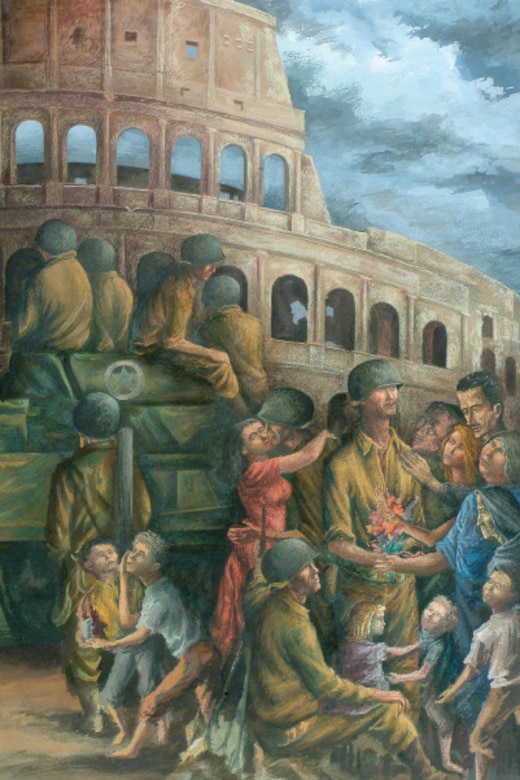
A painting depicts World War II-era soldiers near the Coliseum in Rome.
"He either killed or wounded four of them. A burst of machine-gun fire tore into Johnson, and he dropped to his knees. Fighting to the very last, he steadied himself on his knees and sent a final burst of fire crashing into another German. With that, he slumped forward dead," the citation states, noting that Johnson's acts of valor were an inspiration to the entire command.

Army Gen. Sherman Miles presented Johnson's Medal of Honor to his mother, Althea Bernice Johnson, May 30, 1945, in Boston.

Johnson was buried at Union Cemetery in Scituate, Massachusetts.

The former transport ship USS Pinkney was transferred to the U.S. Army Transportation Service in 1946 and recommissioned as the USAT Private Elden H. Johnson in 1947. The ship was reacquired by the Navy in 1950 and placed in service as the USNS Private Elden H. Johnson under the Military Sea Transportation Service. It went out of service in 1957.

For nearly 50 years, Johnson Barracks in Fürth, Germany, was named for him. The Army installation housed the 16th Engineer Battalion, quartermaster offices and other administrative and support functions. The installation was sold back to the Germans in the early 2000s and is now a business park. Additionally, Weymouth is the only town in the U.S. with five Medal of Honor recipients: Johnson, Thomas W. Hamilton, William Seach, Frederick C. Murphy and Ralph Talbo.
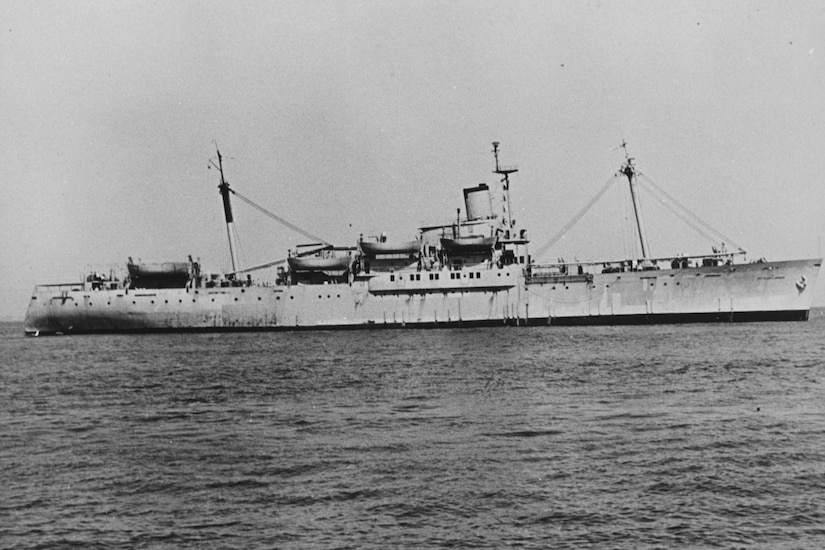
A large ship sails in the ocean.

On May 26, 2025, the city dedicated five bronze statues to honor them at the Ralph Talbot Amphitheater in Weymouth, which is adjacent to a veterans memorial wall that lists the names of city residents who have served during times of war.

Monday, January 26, 2026

Medal of Honor Monday: Army Tech. 5th Grade Eric Gibson

Army Tech. 5th Grade Eric Gibson served as a cook during World War II, but his desire for more led him to work out a deal with his superiors to fight on the front lines. During one intense battle in Italy, Gibson consistently went ahead of the soldiers he led and took out threats in their path. He didn't survive the ordeal, but his bravery and leadership earned him the Medal of Honor.

A man in a military dress uniform poses stoically for a photo.

Gibson was born Oct. 3, 1919, in Nysund, Sweden, to Erland and Agda Gibson. In 1924, after his younger brother, Sven, was born, the family moved to Chicago, where Gibson grew up.

Few details of his early life have been published. Still, by February 1941, Gibson had enlisted in the Army as troop numbers soared ahead of America's inevitable involvement in World War II. After basic training, he was assigned as a cook for the 30th Infantry Regiment, 3rd Infantry Division.

In November 1942, the division deployed to North Africa, where Gibson, as part of Company I, took part in that invasion and the subsequent invasion of Sicily.

As the division plowed through enemy territory, Gibson decided he wanted to make a bigger impact than just being a cook. So, he worked out a deal with his commanding officer that allowed him to serve as a rifleman in an infantry squad whenever the company went into battle, according to the U.S. Army Quartermaster Museum.

In the mountainous terrain of Sicily, where motorized Army vehicles weren't useful, Gibson is credited with leading a pack of mules carrying supplies across several miles of rugged landscape. Later, as the company's main scout, he located several enemy positions and even killed and wounded two German soldiers during ensuing firefights.

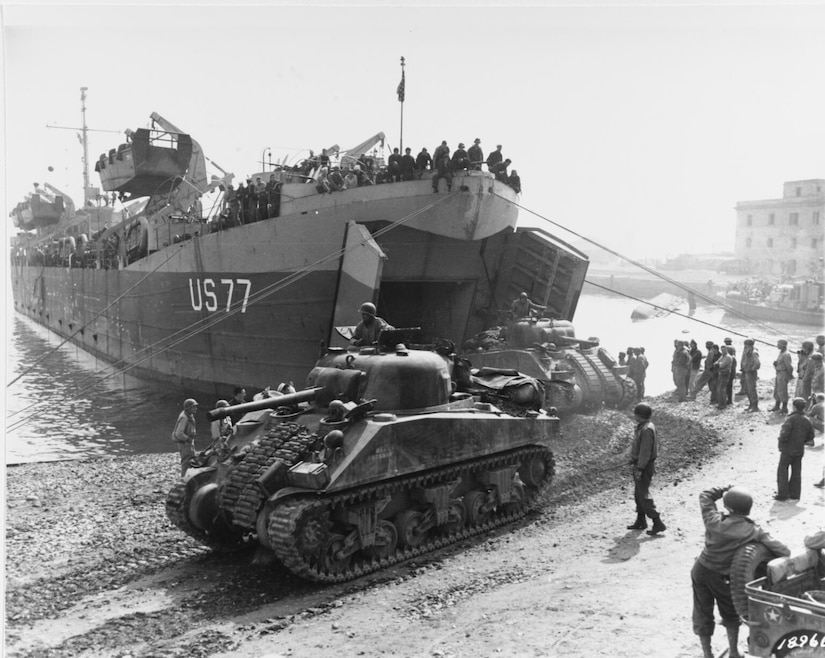
A large ship with ropes coming from its bow and an open front sits on a beach. In front of it sits a large tank as another one rolls off the ship. Dozens of men in military uniforms stand on the ship while several others in similar attire stand on the beach.

In mid-January 1944, the division landed on the Anzio beachhead in Italy. As Gibson's company moved up the coastline, he continued with his dual missions, repeatedly distinguishing himself in combat, according to the museum.

On Jan. 28, 1944, Gibson's company had made it all the way to northern Italy and was near the island of Isola Bella when they came under attack. Gibson quickly mobilized and led a squad of unseasoned soldiers — those sent to the front lines to fill vacancies left by casualties — through a "baptism by fire," his Medal of Honor citation stated. But their efforts bore fruit. They managed to destroy four enemy positions, kill five and capture two German soldiers, all while also securing their company's left flank.

Gibson then continued ahead of his fellow soldiers, moving through a wide stream ditch until he came within 20 yards of a concealed enemy soldier, who opened up on him with automatic fire. Several bullets nearly hit Gibson, but that didn't stop him. He charged, firing his submachine gun every few steps until he got to the enemy position and fired at point-blank range, killing his opponent.

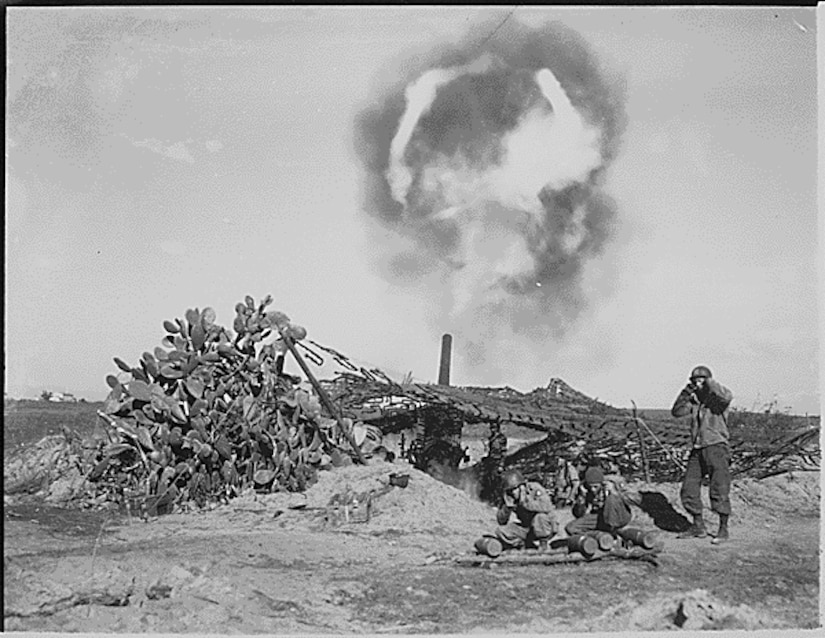
A long gun aimed skyward lets off a plume of flames. Two men in military uniforms kneel as a third man in similar attire stands while covering their ears. Foliage can be seen around them in a barren landscape.

As a smattering of artillery landed in and around the ditch, the impact from one knocked Gibson flat. As soon as he got to his feet, he was fired on by two enemy soldiers who were about 75 yards away. Gibson immediately raced toward them and didn't stop, even when machine gun fire opened up on him about halfway to the position. Gibson killed one foe and captured the other.

Shortly after that, during another spray of heavy machine gun fire coming from about 200 yards further down the ditch, Gibson crawled back to his squad and ordered them to direct as much fire as possible toward the enemy so he could flank that machine gun nest.

Getting to the emplacement required Gibson to crawl 125 yards through an intense artillery barrage that included crossfire from two machine guns, which showered dirt all over him. He made it, however, and once he reached the nest, he threw two hand grenades into it before charging forward with his submachine gun, killing two enemy soldiers and capturing a third.

When his squad got to a bend in the ditch, Gibson moved forward alone to scout out the situation. That's the last time his fellow soldiers saw him alive.

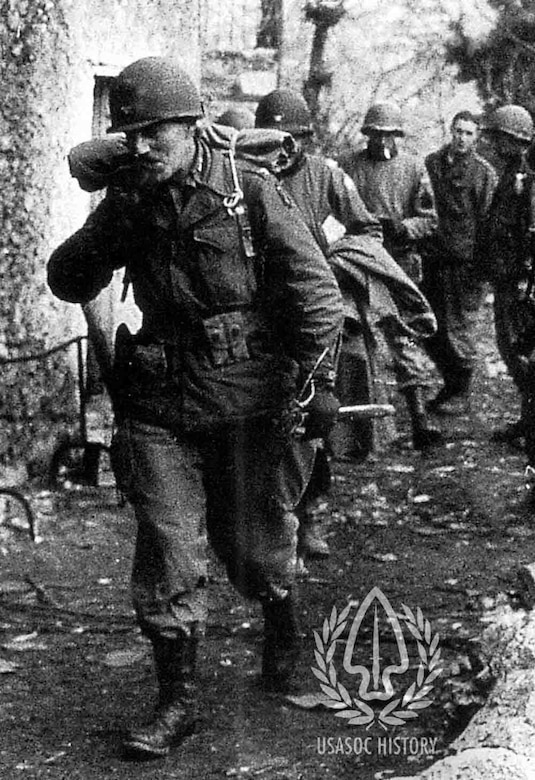
A group of men in military combat gear walk single file along a dirt path.

Gibson's squad later told officials that when they heard an exchange of gunfire, they moved around the bend. About 35 yards toward an enemy outpost, they found Gibson dead. However, before he fell, he managed to kill one more German soldier.

Gibson's fearless actions kept the men in his squad alive, even if it meant his own death. For that, he was posthumously awarded the Medal of Honor. His parents were gifted it on his behalf Sept. 15, 1944, during a ceremony at Camp McCoy, Wisconsin.

When Gibson's body was returned to the U.S. in 1948, he was buried in Nora Cemetery in Rice Lake, Wisconsin, where his parents had moved while he was overseas.

Gibson has not been forgotten. Over the years, an Army Reserve center in Berwyn, Illinois, and a dining facility on Fort Lee, Virginia, were named in his honor. In 1995, a Navy container ship was renamed for the fallen soldier, and in 1999, Gibson was inducted into the Quartermaster Hall of Fame. 

Sunday, June 29, 2025

The 3rd Infantry Division at the Battle of the Marne: Rock of the Marne in World War I

The First World War, often called "The Great War," was a global conflict that reshaped the political and military landscape of the 20th century. Among the many heroic contributions made by Allied forces, the actions of the United States Army's 3rd Infantry Division during the Second Battle of the Marne in July 1918 stand as a defining moment in the war's final chapter. Through their steadfast defense along the Marne River, the 3rd Infantry Division earned the enduring nickname "Rock of the Marne" and played a crucial role in halting the last major German offensive of the war. Their bravery not only helped turn the tide of battle but also solidified America's growing military reputation on the world stage.

Formation and Early History of the 3rd Infantry Division

The 3rd Infantry Division was activated on November 21, 1917, at Camp Greene, North Carolina, as part of the American Expeditionary Forces (AEF) organized under General John J. Pershing (Wilson, 2018). Composed initially of fresh recruits and veterans from various states, the division underwent intensive training in modern warfare tactics, with an emphasis on trench fighting, marksmanship, and combined arms coordination. The United States had only recently entered the war in April 1917, and American forces were urgently needed to bolster the exhausted Allied lines on the Western Front. By the spring of 1918, the 3rd Infantry Division was deployed to France, ready to join the fight.

The Second Battle of the Marne: Strategic Context

By mid-1918, the German Army had launched a series of aggressive offensives aimed at breaking the stalemate on the Western Front before American forces could fully arrive in Europe. One of the most significant of these was the German attempt to cross the Marne River and advance toward Paris (Gilbert, 2014). The Second Battle of the Marne, which began on July 15, 1918, represented Germany's last major push to seize a decisive victory.

The Marne River line, located near Château-Thierry, was of immense strategic importance. A successful German breakthrough would have exposed the Allied rear and potentially forced France to negotiate peace. To prevent this, French, British, and newly arrived American troops were positioned along the Marne to repel the German advance. The 3rd Infantry Division was assigned to a critical sector along the river's southern bank.

The 3rd Infantry Division at the Marne

When the German offensive commenced on July 15, 1918, the 3rd Infantry Division faced overwhelming artillery barrages and massed infantry assaults. Despite being under relentless attack, the soldiers of the division maintained their positions along the Marne River, refusing to retreat (Persico, 2001). Their disciplined resistance prevented the Germans from establishing a bridgehead across the river, blunting the momentum of the offensive.

It was during these fierce engagements that the 3rd Infantry Division earned the nickname "Rock of the Marne." French commanders, impressed by the Americans' determination and resilience, praised the division for standing firm when other units had been forced to fall back (Hallas, 2009). The steadfastness of the 3rd Infantry Division not only safeguarded the immediate sector but also provided critical time for Allied forces to organize a counterattack.

Outcome and Legacy

The failure of the German assault at the Marne marked a significant turning point in World War I. With their offensive stalled, German forces were forced onto the defensive, and the Allies seized the initiative. In the weeks following the battle, a coordinated Allied counteroffensive, including French, British, and American troops, drove the Germans back, setting the stage for the Hundred Days Offensive that would ultimately bring the war to an end (Keegan, 1999).

The actions of the 3rd Infantry Division at the Marne became legendary within military circles. Their heroism not only contributed to the Allied victory but also established a reputation for courage and tenacity that the division would carry into future conflicts, including World War II and beyond. To this day, the division's motto, "Rock of the Marne," symbolizes the strength and reliability of American soldiers under pressure.

Conclusion

The 3rd Infantry Division's performance during the Second Battle of the Marne exemplifies the courage, discipline, and sacrifice of American troops during World War I. Their unwavering defense along the Marne River was instrumental in halting the last major German offensive and preserving the Allied position on the Western Front. The legacy of the "Rock of the Marne" endures as a powerful testament to the critical role played by American forces in securing victory during one of history's most devastating conflicts.


References

Gilbert, M. (2014). The First World War: A Complete History. RosettaBooks.

Hallas, J. W. (2009). Doughboy War: The American Expeditionary Force in World War I. Stackpole Books.

Keegan, J. (1999). The First World War. Vintage.

Persico, J. E. (2001). Pershing's Lieutenants: American Military Leadership in World War I. Osprey Publishing.

Wilson, J. B. (2018). Maneuver and Firepower: The Evolution of Divisions and Separate Brigades. Government Printing Office.

Sunday, July 22, 2012

World War II Veterans Honored for Their Part in Operation Dragoon


By Army Sgt. 1st Class Tyrone C. Marshall Jr.
American Forces Press Service

WASHINGTON, July 22, 2012 – A group of World War II veterans received recognized yesterday in a ceremony held here for their gallantry during a 1944 combat operation in southern France.

Operation Dragoon lasted from Aug. 15 until Sept. 14, 1944. It was the second largest amphibious invasion of World War II, with over 1,000 ships delivering three divisions of troops to the beaches of France. Additionally, an airborne division parachuted into the country to help secure beach heads along with Greek, Polish and Dutch forces, according to retired U.S. Army Lt. Col. Timothy Stoy, historian for the Society of the 3rd Infantry Division.

The Society of the 3rd Infantry Division hosted the ceremony honoring veterans who fought during the operation. French Army Col. Brice Houdet, military attaché from the French Embassy, presented the French Legion of Honor during the ceremony to retired U.S. soldiers John Singlaub, Paul Donlon, Darryl Egner, Elias Hernandez, Michael Halik and the son of Stanley Siemrzuch.

Before presenting the French awards, Houdet thanked the group of veterans on behalf of the people of France.

“I would like to salute all of the American allied veterans who took part in that momentous operation 68 years ago,” he said. “We are deeply honored to have some of you with us today.”

“I will have the distinct honor to present six of these highly deserving former service members with the Legion of Honor, France’s highest national honor and distinction, for their outstanding services during World War II,” Houdet said.

The six award recipients were all accompanied by members of the Military District of Washington’s Sgt. Audie L. Murphy Club, representing the connection to Murphy and the 3rd Infantry Division in which he served.

During the ceremony, U.S. Army Command Sgt. Maj. Edd Watson, currently the command sergeant major of the 3rd Infantry Division, narrated a Missing in Action presentation, and explained the items on a table displayed to honor fallen soldiers.

U.S. Army Maj. Gen. Randy E. Manner, Joint Staff director for the chief of the National Guard Bureau, said Operation Dragoon may not be as well known as some other World War II operations, but it should be remembered for its strategic importance.

“Sometimes, the voice of history does not speak as loudly about some events such as Operation Dragoon,” Manner said.

“So that’s our job today … to be that voice and to speak loudly about those great successes all those many years ago,” he said. “Those gathered here … know the strategic value of Operation Dragoon.”

Manner, whose father served under Singlaub, a retired Army major general, noted Operation Dragoon was critical because it opened a much-needed supply line into France for the allies to “continue to smash the Nazis.”

“History records that over 90,000 soldiers and over 11,000 vehicles were on the beach, on the ground, within days,” he said. “The bottom line is the operation significantly contributed to the shortening of the war in Europe, which meant, of course, the shortening and the lessening of the number of lives that were lost and the number of the families that were affected.”

U.S. Army Maj. Gen. Thomas S. Vandal, director of operations, readiness and mobilization for the Department of the Army, thanked all of the veterans present for their sacrifice and “tremendous” service to the country.

“Although not as well known as Operation Overlord, Operation Dragoon was a highlight of the second World War for many in our military,” he said. “[It was] one of the most successful combined joint operations in the European theater.

“Today, we take fighting as a joint team, alongside our sister services, for granted, just as we’ve come to count on our multi-national allies to be there in operations around the world today,” Vandal said. “But on Aug. 15, 1944, in the early days of the liberation of Europe, such a level of cooperation was far from commonplace.”

Vandal called the allied forces a “vanguard” of history who forged a path “for all of us to follow.”

“Some historians have mistakenly called Operation Dragoon the ‘forgotten D-Day,’ particularly in comparison to the larger and more famous invasions of Normandy,” he said. “In fact, some have even gone so far as to imply that the operation was easy – merely a cakewalk.

“Sgt. Audie Murphy, from the 3rd Infantry Division, might disagree with this characterization,” Vandal said. “Given that he earned a Distinguished Service Cross during Operation Dragoon, I think it speaks for itself [and what troops] did.”

Vandal noted allied forces of Operation Dragoon advanced more than 500 miles in less than a month and took more than 100,000 Germans prisoner.

“Overlooked by history or not, Operation Dragoon was a pivotal moment in the history of France, a fact well understood by all of you veterans sitting here today,” he said.

Vandal, a former member of 3rd Infantry Division himself, expressed his appreciate for all World War II veterans.

“All of our veterans are a national treasure, and we are all fortunate to be in their presence,” he said. “They have left a legacy for our Army and our nation to follow.”

Thursday, June 21, 2012

Senior Enlisted Leader, Namesake Club Honor Audie Murphy


By Army Sgt. 1st Class Tyrone C. Marshall Jr.
American Forces Press Service

ARLINGTON, Va., June 21, 2012 – The military’s top enlisted member joined a local chapter of the Sgt. Audie L. Murphy Club here yesterday in honoring the club’s namesake on his birthday.

Marine Corps Sgt. Maj. Bryan B. Battaglia, senior enlisted advisor to the chairman of the Joint Chiefs of Staff, joined the Military District of Washington Sergeant Audie L. Murphy Club in a wreath-laying ceremony to pay tribute to the American war hero, a Medal of Honor recipient, who is buried at Arlington National Cemetery.

“Eighty-eight years ago today,” Battaglia said at the event, “we see a young man like Audie Leon Murphy who would become such a great American hero … through his life – especially the life he served protecting our nation. [It’s] quite impressive.”

Battaglia noted that Murphy attained the rank of staff sergeant just a year and a half after joining the Army. He received a battlefield commission in October 1944, and rose to the rank of major.

“[But] Sergeant Audie Murphy wasn’t someone about awards,” Battaglia said. “He was about taking care of his men and women and getting the mission accomplished. And that’s why I say … it’s befitting of me to … recognize Sergeant Audie Murphy on his birthday, a very monumental date in the history of our … armed forces. But [I’m also here to] thank the members of his club and the loyal and dedicated soldiers that continue to serve honorably and with distinguished contributions and volunteerism throughout their communities and neighborhoods.”

Battaglia was joined by Army Sgt. 1st Class Jessica Taylor, president of the local chapter, who serves in the Office of the Secretary of Defense Mess.

“It is my honor today to honor the leader of our charge in the Sgt. Audie Murphy Club – Audie Leon Murphy,” she said. “Today would be his 88th birthday. We welcome you all.”

Other club members played prominent roles during the ceremony, including treasurer Army Staff Sgt. Tanner Welch, who recited Murphy’s biography.

“Audie Murphy was killed in a plane crash on a mountain top in Roanoke, Va., May 28, 1971,” Welch said. “Fittingly, his body was recovered two days later on Memorial Day.”

“Audie may have been the last American war hero,” he added. “He was the best combat soldier in the 200-plus year history of the United States.”

Battaglia said Audie Murphy is buried next to “thousands and thousands of great American service men and women,” but is special in his own right.

“I think his service in the Army goes beyond just that in the Army,” he said after the ceremony, reflecting on what he has read about Murphy. “I’d like it to resonate throughout all the services. He wasn’t worried about awards and decorations. The man was there to accomplish a mission, he was there to protect his country, and he was there to protect his men and women. And that’s all he really cared about.”

Club member Army Master Sgt. Flora McKnight, operations officer for the Military District of Washington, agreed with the sergeant major.

“We do this in order to honor Sergeant Audie Murphy,” she said. “Through his abilities as a noncommissioned officer, he took care of soldiers, and that’s what we do – we take care of soldiers and give back to the community.

“Through selflessness … we have an opportunity to give back to others and to show others the correct way doing that,” McKnight continued. “The selflessness comes from us giving back to our community – not only the military community, but our civilian community -- because we all form a bond.”

Battaglia noted a personal connection. He served a year-long deployment in Iraq, starting in February 2007, with one of the 3rd Infantry Division brigades to which Murphy was assigned.

“He set a legacy that carries on today. … I think all of our service members, not just soldiers … can use Audie Murphy as an example to emulate,” Battaglia said.

Sunday, May 06, 2012

Panetta: Service Members Must Represent Best of America


By Jim Garamone
American Forces Press Service

WASHINGTON – It is more important than ever that service members exercise judgment in the age of Twitter, You Tube, Flickr, I-Phones and Facebook, Defense Secretary Leon E. Panetta told troops at Fort Benning, Ga., today.

The secretary spoke to the men and women of the 3rd Heavy Brigade Combat Team of the U.S. Army’s 3rd Infantry Division. He spoke about how the actions of a very small number of service members have affected crucial operations.

Today, it can take only seconds for a photo to become an international headline, Panetta said.

“And those headlines can impact the mission that we’re engaged in,” the secretary said. “They can put your fellow service members at risk. They can hurt morale. They can damage our standing in the world, and they can cost lives.”

When videos can go viral overnight, the actions of a few can impact the lives of many, Panetta said. For example, he said, once word that soldiers at Bagram Airfield, Afghanistan, had accidently burned Muslim holy books got out, more than 30 Afghans died in the rioting that followed. The Taliban seized that incident -- and others such as Marines urinating on enemy corpses, and soldiers posing with body parts of suicide bombers -- to recruit Afghans to their side.

“I know that none of you … deliberately acts to hurt your mission or to put your fellow soldiers at risk,” the secretary said. “You are the best. And that’s why I’m here today. To tell you that I need you, that I need your leadership, that I need your courage -- that I need your strength to make sure that we always abide by the highest standards.”

The incidents that occurred in Afghanistan are the work of a tiny percentage of service members, Panetta said.

“I represent 3 million people, 2 million in uniform,” he said. “It’s a very small percentage of people who sometimes make these terrible mistakes.”

Still these incidents concern leaders all the way to the Pentagon and White House. This is because “a few, who lack judgment, lack professionalism, lack leadership can hurt all of us and can hurt all of those men and women who serve this country with distinction,” the secretary said.

Panetta stressed that the incidents concern leaders because “our enemies will seek to turn … these incidents in their favor at the very moment that they are losing the war.”

The 3rd Brigade will deploy again -- the unit deployed to Iraq for four tours -- and the secretary said he needs all service members to live the values of the United States. “Always remember who you are and the great country that you serve and that we are all part of,” he said. “You are part of the best fighting force on the face of the earth. Never forget that.”

Panetta emphasized that the members of the brigade have a responsibility to look after their comrades and to properly represent the American people.

“I know that all of you can meet this challenge,” he said to the gathered troops. “You are the best, and I have the greatest confidence in your ability to make all Americans proud by demonstrating the very finest character, integrity and judgment and willingness to fight.”

The secretary also discussed recent events in Afghanistan, noting last year was a “turning point” there.-

The Taliban, he said, have lost momentum as coalition and Afghan forces have secured many areas in Afghanistan. And despite great efforts, he added, the Taliban and their terrorist allies were not able to recapture a single square acre.

“Al-Qaida’s leadership, including bin Laden, has been decimated,” the secretary said. “We recognized the first-year anniversary taking down bin Laden. Let me tell you, that was due to the military professionalism of soldiers who went in there and did a mission that they do time and time and time again in Afghanistan. It was for that reason that I was confident that that mission would be accomplished.”

Afghan forces have grown in size and capabilities, Panetta said. Today, Afghan forces protect more than 50 percent of the population. Later this month a further tranche of areas will begin the transition process.

“By the end of summer will mean that 80 percent of the Afghan population will be under Afghanistan security and control,” the secretary said.

The Strategic Partnership Agreement signed by President Barack Obama and Afghan President Hamid Karzai earlier this week “sends a clear signal to our enemies and to our partners that we will finish the job right in Afghanistan,” Panetta told the troops.

Service members need to keep their minds in the game, the secretary said.

“If we keep our eye focused on this mission … we will defeat al-Qaida,” Panetta said. “We will deny them the ability to rebuild; we will deny them the safe haven that they used to plan an attack on our country.

“Too much precious blood has been spilled, too much progress has been made to lose sight of the mission now,” he added.