Tuesday, February 17, 2026

Marines Bring Amphibious Vehicles Back to Life With One Simple, Critical Component

When a shortage of critical single-use consumable suspension washers resulted in multiple amphibious combat vehicles being taken out of service, Marines assigned to the Fabrication Platoon, 2nd Maintenance Battalion, at Marine Corps Base Camp Lejeune, North Carolina, stepped in, turning a potentially yearlong delay into a one-hour fix.
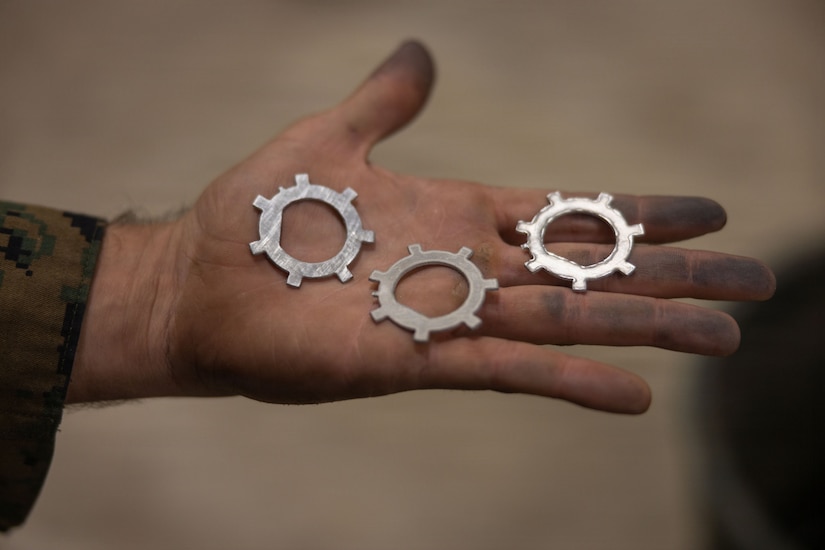
A close-up of a dirty hand holding three metal washers.
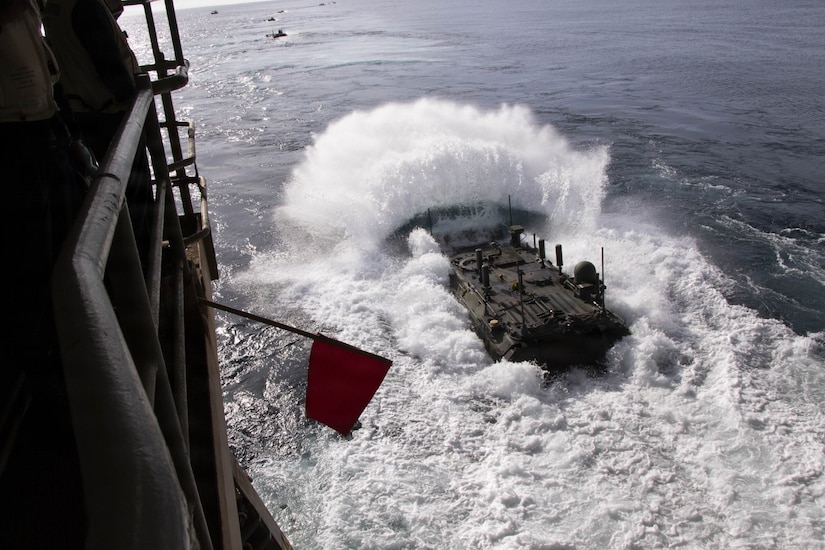
An amphibious combat vehicle splashes into the water after departing from a large ship on the left. There are several other combat vehicles floating in the background.
The initial problem was identified at the 2nd Assault Amphibian Battalion, 2nd Marine Division, where ACVs were being taken out of service due to the lack of a specific suspension locking washer. The part, a mandatory replacement item for the vehicle's suspension system, was unavailable through the standard supply system due to a backlog, hindering unit readiness. 

The solution came when Marine Corps Chief Warrant Officer 2 Anthony Juedes, a ground ordnance vehicle maintenance officer with the assault battalion, approached the II Marine Expeditionary Force Innovation Campus with the problem.  

Each suspension lock washer has square teeth that bend when torqued into place and when suspension components are taken apart or put back together. Due to this, the washers cannot be reused and become damaged once removed from an ACV's suspension system.  

Juedes presented a damaged washer to Marine Corps Chief Warrant Officer 3 Matthew Pine, the campus's officer in charge, who tasked his 2nd Maintenance Battalion team with finding a solution. They immediately went to work. By using aluminum sheets and a water jet, they reverse engineered the part and produced a working prototype, showcasing the immense value of advanced manufacturing. 

"It took less than 30 minutes to create it, and in less than an hour, we had a working prototype," Pine said. "The part itself took less than a minute and a half to cut."
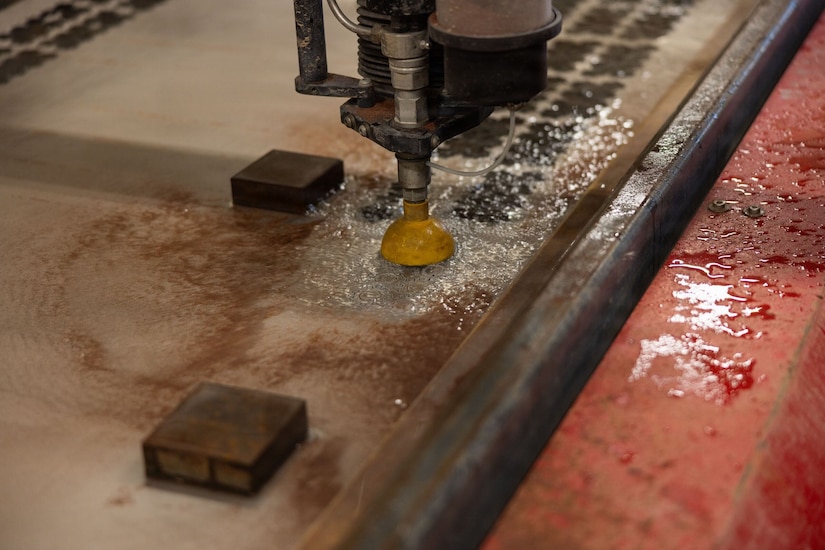
A piece of equipment cuts washers out of a large metal sheet. There are little pieces of metal all around the bottom of the machine.
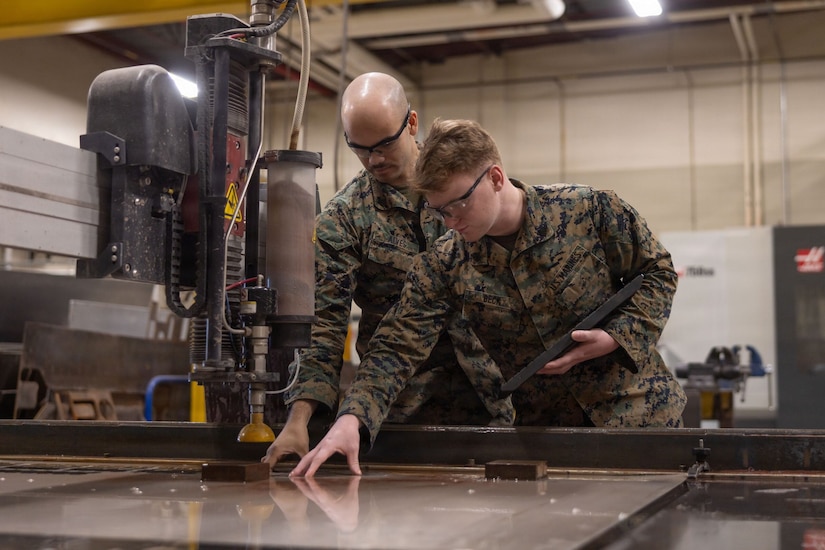
Two men in camouflage military uniforms and safety glasses put their hands on a piece of metal under a machine. The men are working in a large maintenance building.
With a potential solution in hand, the next step was validation. Contractors were used to strengthen the reverse engineering process, help lower risk, ensure quality control and create a more thorough part-review for the fabrication process.  

After a successful test, Marine Corps Lt. Col. Matthew Ludlow, the 2nd Assault Amphibian Battalion commander, decided to formally assume the risk of using the nonstandard part to get his vehicles back in the fight. By signing an official assumption-of-risk letter, he authorized the use of the fabricated washers to restore his unit's operational capability. 

Once approved, 10 ACVs were brought back into service in a single morning, showcasing how this capability can be used not only on base, but also while forward deployed. 

The impact was immediately noticed. As of December 2025, the 2nd Maintenance Battalion has produced more than 80 washers, bringing 15 nonoperational ACVs back into service. For a part that costs less than $2 to make, the effort bypassed a supply shortage that could have sidelined the fleet indefinitely, saving the Marine Corps countless days of lost training and readiness. 

This success, however, highlights a different issue: the lack of access to technical data for parts. According to Pine, without the manufacturer's original blueprints, his Marines must reverse engineer components, a process that involves determining exact dimensions, material composition and strength requirements. This process can become especially problematic for load-bearing components.
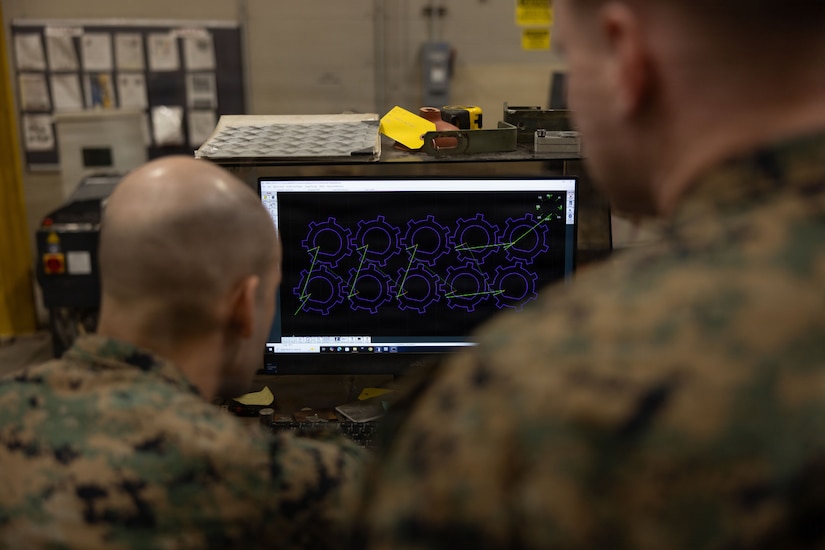
Two men in camouflage military uniforms look at a computer screen with a design for several metal washers displayed on it.

The problem, Pine explained, is that the battalion doesn't have the testing parameters for the parts.  

To mitigate this, the 2nd Maintenance Battalion now creates its own technical data packages from its reverse-engineered parts, a process validated by civilian engineers and machinists to ensure quality. 

By demonstrating their capability to produce reliable parts under controlled processes, the maintenance battalion proves that even with contested supply lines, Marine ingenuity can provide a mission-focused solution. Their work builds a robust case for the organic capabilities that Marine innovation can bring to units, both on base and overseas.

The Hidden Hunger in Our Ranks: Why Military Families Are Lining Up at Food Pantries

Food insecurity inside the United States military is not a fringe issue. It is a documented, measurable, and growing reality.

Approximately 25.8% of active-duty service members experience some level of food insecurity, with junior and mid-grade enlisted families disproportionately affected. Today, an estimated 22,000 active-duty families, 213,000 National Guard and Reserve members, and 1.2 million veterans rely on federal food assistance. On many installations, food pantries now operate specifically to support junior enlisted families.

That fact alone should stop us.

Behind these statistics are families—not abstractions. Spouses stretch each paycheck to cover rent, gas, childcare, and groceries. Children quietly accept smaller portions. Service members carry the additional burden of financial strain while remaining mission-ready. They stand watch, deploy, train, and defend the nation—while worrying about what’s in the refrigerator at home.

When We Saw It Up Close

In 2022, the San Dimas Rotary Club was approached by the Diamond Bar Woman’s Club, which operated a military outreach effort called Making Spirits Bright, providing Christmas gifts to junior enlisted families.

That same year, Rotary members visited the Marine Air Ground Combat Center (MAGCC) at Twentynine Palms. There, we met with representatives of the Armed Services YMCA, which operates a food pantry on base. It was in that conversation—standing in the high desert—that the scope of the problem became real.

This wasn’t theoretical. It was immediate.

Young Marine families were walking into a pantry on base because their pay, after housing, childcare, and the cost of relocation, simply wasn’t enough.

From One Food Drive to a Lasting Mission

In March 2023, we organized a major food drive. The response was strong. The need was stronger.

We quickly realized that a single event would not solve a structural problem. What was required was permanence.

In response, we formed the Satellite Rotary Club of Military Family Support, a sole-purpose Rotary club dedicated entirely to supporting active-duty, Reserve, and veteran families. We also established the San Dimas Rotary Foundation, a 501(c)(3), to provide the charitable framework necessary for growth and accountability.

As regional partnerships expanded, we created Feeding Military Families as a DBA under the Foundation, supervised by the Satellite Club.

What began as a community response became an organized mission.

Where the Help Has Gone

Since launching Feeding Military Families, we have collected and distributed more than forty (40) tons of food and household supplies to military communities across California, including:

  • Marine Air Ground Combat Center (29 Palms)

  • Camp Pendleton

  • Fort Irwin

  • Los Angeles Air Force Base

  • Coast Guard Base Los Angeles/Long Beach

Each installation presents different challenges.

Fort Irwin sits in a remote high-desert region with limited surrounding infrastructure. Families there face isolation and restricted access to affordable off-base resources.

Twentynine Palms serves thousands of Marines and families in similarly remote conditions.

Camp Pendleton supports one of the largest concentrations of Marines in the country.

Los Angeles Air Force Base and Coast Guard Base Los Angeles/Long Beach represent urban military communities where high housing costs place extraordinary pressure on junior enlisted families.

In every location, the story is consistent: strong families under strain.

Hunger Is Only Part of the Story

Through the integration of Making Spirits Bright, our mission expanded beyond food alone.

Last December, in addition to supporting families at Camp Pendleton and MAGCC Twentynine Palms, we extended significant assistance to Fort Irwin. There, we delivered:

  • Hundreds of toys

  • More than 70 bicycles

  • $7,000 in direct financial relief through gift cards

For families stationed in one of the most isolated installations in California, the holidays became a season of celebration—not stress.

Because food insecurity is not only about calories. It is about morale. It is about stability. It is about ensuring that when a service member trains, deploys, or stands duty, they are not distracted by worry at home.

Readiness Begins at Home

Military readiness does not start on the battlefield. It begins in the kitchen.

If a service member is worrying about groceries, unpaid bills, or whether their spouse can find employment after yet another relocation, readiness is compromised.

Addressing food insecurity strengthens:

  • Family stability

  • Mental health

  • Morale

  • Retention

  • Community trust

This is not charity alone. It is an investment in readiness.

The Hidden Hunger

Military culture values self-reliance. Pride runs deep. Asking for help can feel like failure. That stigma is one reason many families struggle quietly.

But the food pantries on base tell the truth.
The federal assistance numbers tell the truth.
The young Marine couple with two children tells the truth.

The hunger is real.

The question is whether we choose to see it.

Join Us – March 14, 2026

The solution is not complicated. It is community.

Feeding Military Families – March Food Drive 🇺🇸
Date: Saturday, March 14, 2026
Time: 9:00 AM – 1:00 PM
Location: TBA
Website: www.feedingmilitaryfamilies.org

Join us as we collect food and essential supplies for military families in need.

Every month, thousands of active-duty service members, veterans, and National Guard families struggle with food insecurity. Since 2022, you have helped us collect and distribute over 40 tons of food and supplies to military families at 29 Palms, Camp Pendleton, Fort Irwin, Los Angeles Air Force Base, and Coast Guard Base Los Angeles/Long Beach.

This March, we are back with another major Food Drive—and we need your help.

What to Bring:

  • Non-perishable food items

  • Hygiene and toiletry products

  • Baby and household essentials

Whether you donate a bag of groceries, volunteer your time, or simply help spread the word, your support matters.

➡️ Visit www.feedingmilitaryfamilies.org and click on “Events” for full details and volunteer information.

Please share this event. Together, we can ensure no military family goes hungry.

Let’s serve those who serve us.

#FeedingMilitaryFamilies #FoodDrive #SupportOurTroops #MilitaryFamilies

DOW's New Chief Information Officer Seeks to Put the Warfighter First

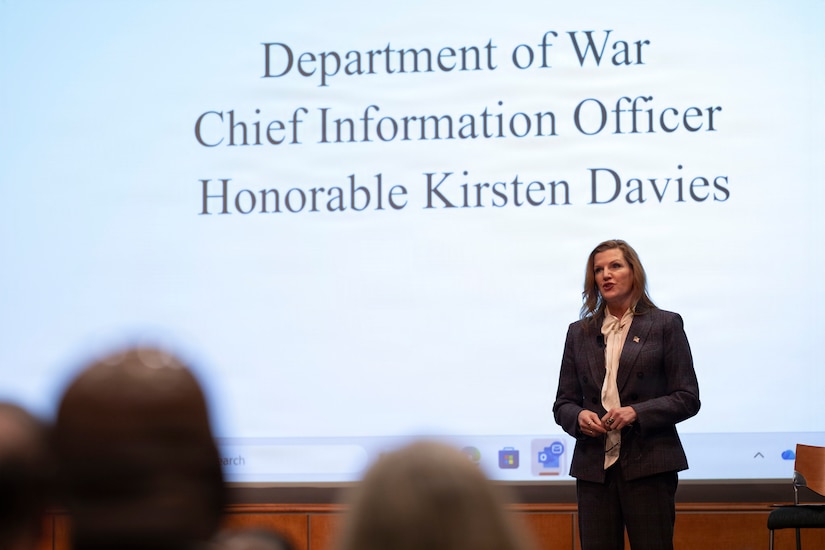
The Pentagon's newest chief information officer, Kirsten Davies, gathered her department's senior leaders and staff together at the War Department's Mark Center in Alexandria, Virginia, Feb. 10, where she laid out a vision for her office that focuses strongly on supporting America's warfighters.

A woman in business attire stands on a stage speaking to an audience that is mostly off-screen. Behind her is a slide projected on the wall that reads, “Department of War Chief Information Officer Honorable Kirsten Davies.”

"Our mission is to support the National Defense Strategy … and the warfighters," Davies told those assembled in the Mark Center's auditorium. "Everything we do should be supporting the warfighter community and their mission."  

Just six weeks into the job, Davies is responsible for serving as the principal staff assistant and senior advisor to the secretary of war and deputy secretary of war for information technology — including national security systems and defense business systems — information resources management and efficiencies. 

This means that Davies is responsible for all matters related to the War Department's information enterprise, including cybersecurity, communications, information systems and more. 

With all those responsibilities under her purview, Davies expanded on the Office of the Chief Information Officer's vision statement, "[building] an information enterprise that is resilient, modern, secure and agile; one that is worthy of the warfighter."

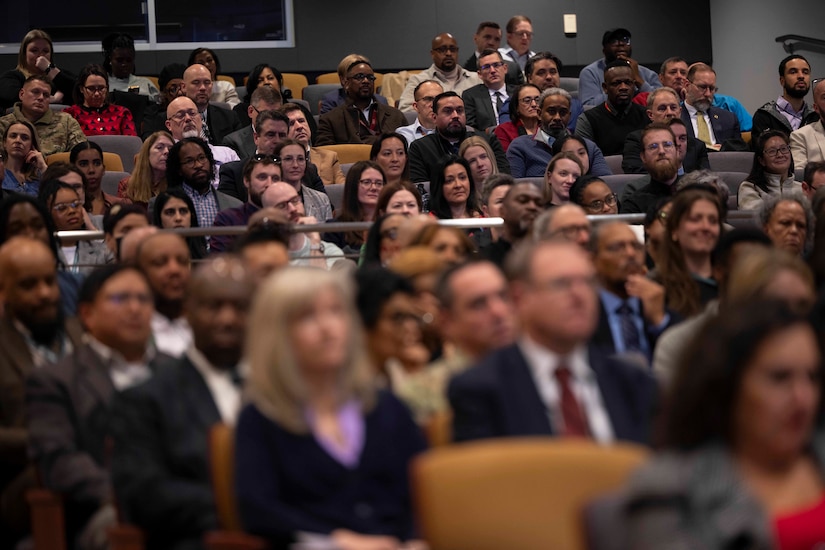
A large crowd of people in business attire seated in an auditorium observing someone speaking to them from off-screen.

"We need ruthless prioritization of all of our initiatives. There are some things we're just simply not going to do because [they don't] serve the warfighter mission," Davies said, adding that she will be seeking her team's help in identifying those initiatives and prioritizing items to pursue immediately, versus what can be pushed further downstream. 

Next, she spoke about OCIO visibility and the need to share it across the entire War Department, including the department's military and civilian-manned field activities. 

"We can't defend what we can't see, [and] we can't optimize something if we don't know what's there," Davies said. "So, [visibility] becomes a real priority."  

Visibility can help OCIO determine if the office's money is being spent appropriately throughout the department and serving the warfighter most effectively, especially as it relates to tactical agility, she added.  

Davies also spoke about additional topics not listed in OCIO's vision statement, including accountability.  

"If you want to own something, own it. There's accountability that's attached to that," she told the group of leaders.   

"We will measure outcomes, not activity," Davies added.

Additionally, she spoke about transforming OCIO's technology landscape in a rapidly evolving information environment.

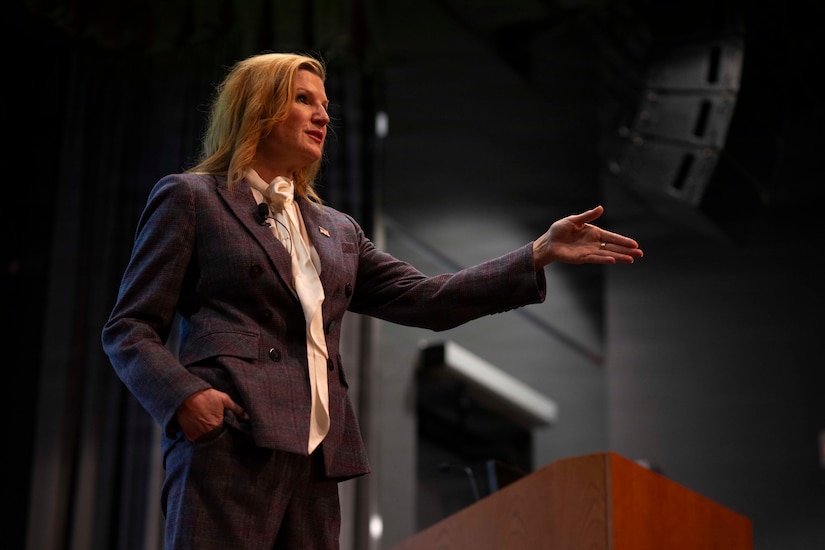
A woman in business attire stands on a stage, gesturing with her left hand while speaking to an audience off-screen.

"We need to execute on data analytics and AI. … We need to secure our advantage in the spectrum … This is a long-term play for us, for national security and for our partners and allies," Davies said. 

Two topics she would like to prioritize for all OCIO leaders immediately are getting up to speed on the recently published National Defense Strategy and becoming familiar with Secretary of War Pete Hegseth's ongoing Arsenal of Freedom tour.  

The tour represents Hegseth's initiative to transform the department's acquisition system and processes to accelerate delivery of capabilities to the warfighter and revitalize America's manufacturing might. 

"Our mission is to support the warfighter," Davies reiterated.  

"You've heard [the secretary] talk about us being on a war footing [and] again, we are not a technology company — we are part and parcel of the warfighter's mission," Davies said, adding that it is essential OCIO align with the warfighter in the realm of cybersecurity and cyber defense. 

As her remarks wound down, Davies encouraged those in attendance to be bold while participating in OCIO's journey from that point forward. 

"Change requires boldness; it requires courage," she said. "We have a window of opportunity to do some really interesting, exciting, transformative work. I want you to embrace the opportunity and also know that I've got your back."

Secretary of War Pete Hegseth Travels to Missouri for Arsenal of Freedom Tour

Secretary of War Pete Hegseth will depart tomorrow for St. Louis, Missouri, to visit Boeing and administer the oath of enlistment to new recruits at the Naval Reserve Officer Recruiting Station.

Secretary of War Pete Hegseth is continuing on the nationwide "Arsenal of Freedom" tour, a call to action to revitalize America's manufacturing might and re-energize the nation's workforce. The tour's message will emphasize that our national security and the peace of the world move at the speed of our Defense Industrial Base (DIB) and rely on the hard work of our American workforce.

The tour will highlight the urgent need to rebuild our DIB to ensure that we continue President Trump and Secretary Hegseth’s peace through strength agenda.

American manufacturing is the bedrock of American strength. The men and women fueling this work are on the frontlines, alongside our warfighters, furthering the nation’s efforts every day they show up to work.

The tour will champion a new approach to defense acquisition, one that prioritizes and awards speed, innovation, and a "commercial-first" mindset.

This includes cutting bureaucratic red tape, empowering program leaders, and providing the stable, long-term contracts necessary for industry to invest and expand.

The goal is to create a defense ecosystem that is more agile and accountable, capable of delivering the tools our warfighters need, when they need them.

The "Arsenal of Freedom" tour is more than a series of speeches; it is a movement to restore our nation's industrial prowess and secure our freedom for generations to come. It is a reminder that the strength of our nation is not just in our military, but in the ingenuity and spirit of the American people.

Riding High: Meet the Military's Last Remaining Mounted Color Guard

For the individuals who serve in the Marine Corps Mounted Color Guard, every day is a test of composure, discipline and adaptability — essential skills they demonstrate alongside wild palominos that were specifically domesticated for the job.

These Marines are unique in that they're the last mounted color guard remaining in the military.

"The unit perseveres because it consistently demonstrates value: connecting the American public to the Corps' legacy while constantly reinforcing Marine professionalism and core values," explained Marine Corps Capt. Elizabeth Kemp, the unit's officer in charge.

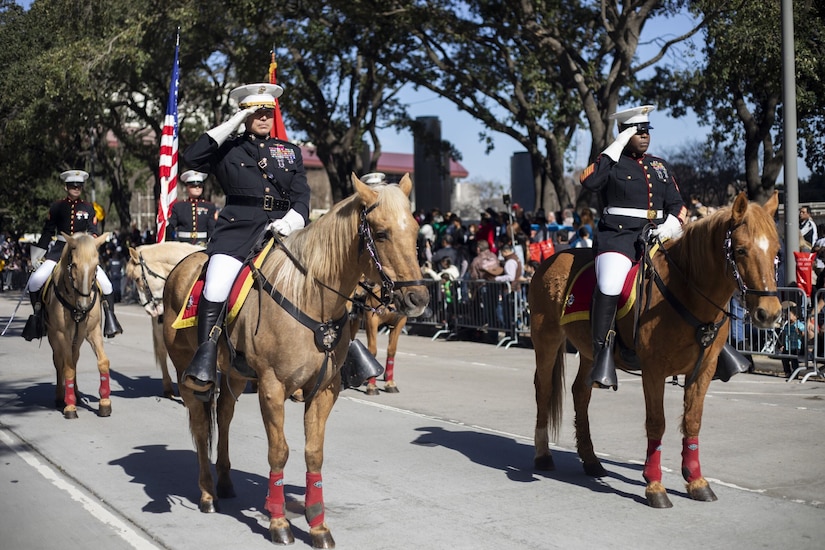
Two men in military dress uniforms salute as they sit stoically on horses while on a parade route. Three other people in similar attire on horses are behind them carrying flags.

Based at Marine Corps Logistics Base Barstow in California's Mojave Desert, the Marine Corps Mounted Color Guard allows a few dedicated Marines the rare but honorable opportunity to present the service's colors and U.S. flag on horseback at military-related parades, ceremonies, commemorations, civic events, and other activities.

Their work is a show of dignity and respect for those who have served the nation, but being selected for the role itself is also considered an honor.

"Marines are entrusted with representing the Corps' history, traditions and standards in front of national and international audiences," Kemp said. "The level of trust and confidence embedded in the unit's core, coupled with the [increased] visibility, makes this a prestigious assignment for all Marines who serve here."

Dedication, Reliability Required

The mounted unit consists of a senior Marine who carries the U.S. flag, known as the color sergeant; a Marine who carries the Marine Corps colors; and two rifle bearers.

Any mid-level enlisted Marine from any career field can be selected for the role. They must possess an outstanding professional reputation and a high level of physical fitness, discipline and reliability. Candidates are screened for maturity, attention to detail and their ability to represent the Corps at the highest level.

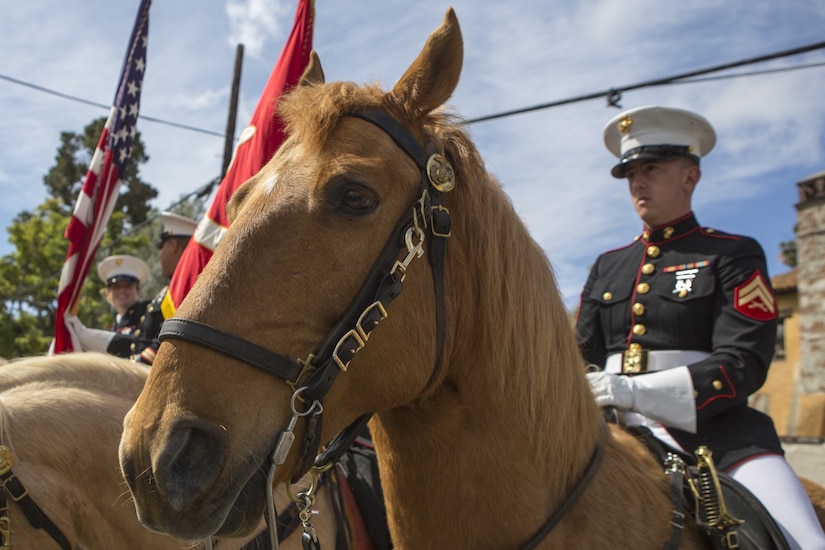
A close-up shot of a horse wearing a bridal. A man in a military dress uniform is seated on the horse’s back.

And if you're a Marine who doesn't know much about horses, that's not a problem. Kemp said many qualified Marines come to the stables with little to no experience in horsemanship or ranch operations.

"What matters most is character, work ethic and the ability to learn quickly while operating as part of a team," she said. "Prior experience is beneficial, but is far less important than discipline, patience, humility and commitment."

Marines selected for the prestigious role spend hours working with the base's civilian horse trainer to learn maintenance and how to ride, as well as all the duties required to work on a ranch.

High-Level Performances

The mounted unit is invited to all sorts of events, including the famed New Year's Day Rose Parade in Pasadena, California. The unit has appeared in every iteration of the parade since 1990, and it's had the honor of leading it several times as the first military unit.

The unit also takes part in rodeos, which can help with recruiting efforts.

"Rodeos combine high energy, unpredictable environments and large crowds. Performing in this setting highlights the Marines' ability to stay composed, disciplined and professional under pressure — skills that translate well beyond ceremonial contexts," Kemp said.

The Mounted Color Guard is currently on tour at various rodeos throughout Texas until March 7.

The team mostly performs in the western U.S. However, in 2024, it made its first trek to the East Coast in about a decade. They presented the colors at the Preakness Stakes, participated in the National Memorial Day Parade and visited various historical sites, including the Marine Corps War Memorial in Arlington, Virginia.

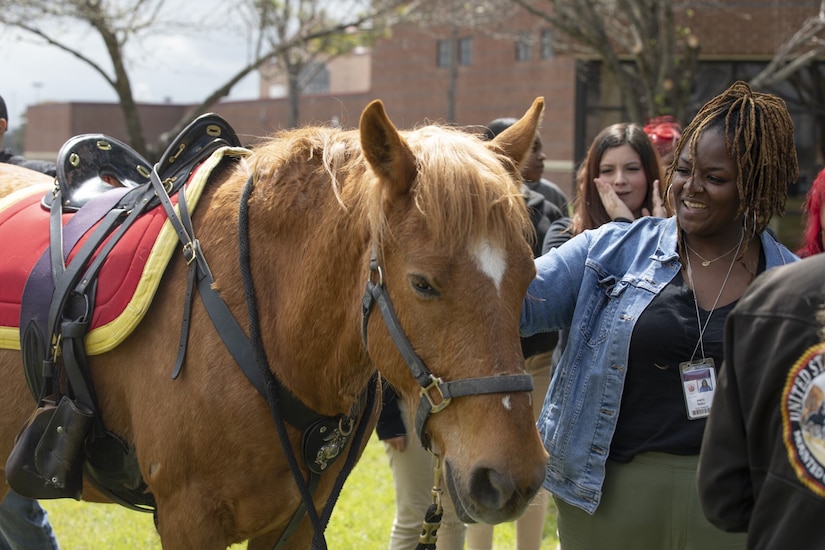
A woman in casual attire smiles while petting a horse. Another woman in similar attire in the background looks excited, placing her hands on her face.
A man on horseback jumps a foot-high obstacle in a grassy area. Two other people on horseback ride behind him.
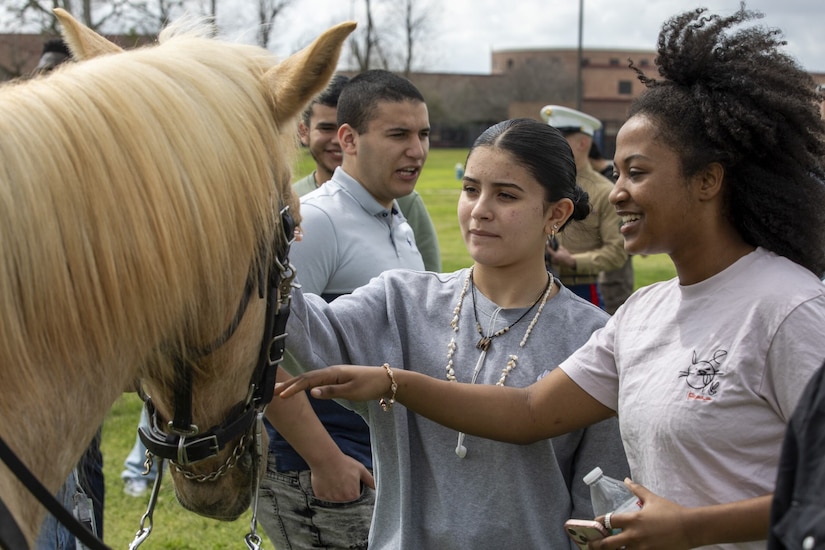
Two women in casual attire pet the head of a horse. Men in casual attire mingle in the background.
The unit also works with public schools, including through the Junior ROTC and the Young Marines Program. The team used to participate in competitions in the 1980s and 1990s, where they received several national awards; however, they no longer do so because of military regulations.

From Wild and Free to Tame and Disciplined 

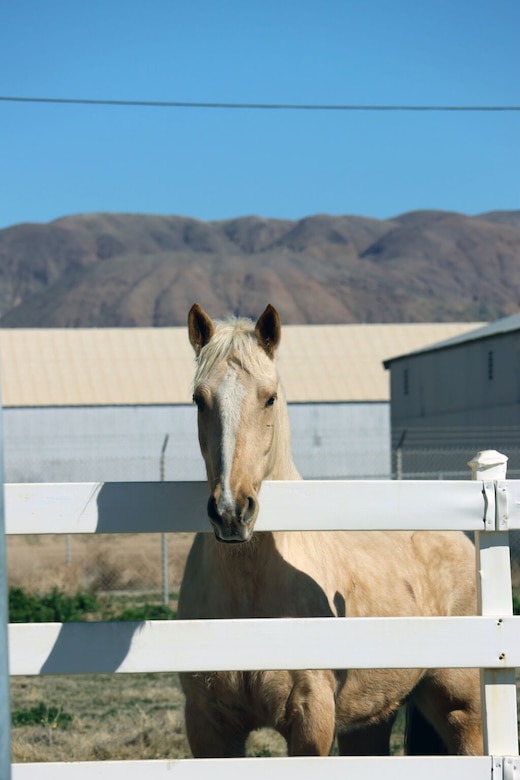
Another unique aspect of the job is that these active-duty Marines ride wild palominos adopted from the Bureau of Land Management's Wild Horse and Burro Adoption Program, which protects wild equines on public lands. When there are too many animals to manage, the bureau finds qualified private care for them through adoption or sales. 

According to the color guard's website, stablemen initially found the wild horses on their own and trained them. But a chapter of the 1st Marine Division Association eventually got involved and started the process of adopting the horses through the bureau. That eventually became the official process.

A horse rests its head over a fence. Mountains and a large barn are shown in the background.
A horse grazes in a pasture. Desert mountains rise in the background.
Adopted horses are tamed and progressively trained to meet the unit's performance standards. They're then slowly integrated into ceremonial presentations. Kemp said the horses are handled with a strong emphasis on safety and welfare by trainers and experienced stablemen.

Developing Ready, Lethal Marines

Kemp said the unit directly supports Secretary of War Pete Hegseth's focus on readiness and lethality by developing Marines who are disciplined, adaptable and can represent the force with credibility.

"It strengthens recruiting, public trust and institutional pride, all of which directly support the Marine Corps' ability to attract and retain high-quality warfighters," she said.

The Marine Corps Mounted Color Guard received its official designation in November 1968. The Army, the only other branch with dedicated mounted color guards, deactivated its last unit in 2023.