Monday, September 21, 2026

Mental Grit Propels Champions at 2026 Air Force Marathon

Every mile of a race is a physical negotiation — a stark reminder that while the human body has limits, the mind can be trained to push past them. 

More than 9,000 people across 50 states registered for the 2026 Air Force Marathon, testing their mental and physical endurance across several race categories Sept. 18-19. Races took place at Wright-Patterson Air Force Base, Ohio, and outside of the National Museum of the U.S. Air Force at Wright-Patterson Air Force Base, and Wright State University in Dayton, Ohio. 

A woman smiles as she reaches a marathon finish line. Two people wearing camouflage military uniforms hold a red, white and blue finish line ribbon with “U.S. Air Force Marathon 2026” on it.
A man reaches a marathon finish line. Two people wearing camouflage military uniforms hold a red, white and blue finish line ribbon with “U.S. Air Force Marathon 2026” on it.

Leading the charge were full marathon champions Space Force 1st Lt. Nicholas McKenzie, assigned to Vandenberg Space Force Base, California, with a time of 2:34:31, and Kayla Rice, a Wright-Patterson Air Force Base employee, with a time of 2:56:39. 

"I'm ecstatic — it's a great day with super energy out on the course and beautiful weather," McKenzie said. "This is my second time running the Air Force Marathon, and I'm super grateful for all the volunteers, the support and all the other runners out here getting it done today."

However, for McKenzie, the mental turning point came during the race's most solemn stretch. 

"Around mile 21, it definitely starts to get hard. But running and seeing the tributes to our fallen service members was emotional and heartwarming. It really helped me stay motivated to get to the end," he said. "Seeing that helps you realize the ultimate sacrifice they gave, and it motivated me to dig a little deeper."

For Rice, crossing the finish line as the women's champion marked the culmination of years of dedicated training right on her home base at Wright-Patterson Air Force Base. 

"I feel incredible. This has been a goal I've been working toward for the past few years, and it's great to finally achieve it," Rice said. "This is my fourth time running it, so every year it's been my goal to just get a little bit faster and eventually get where I am today. It was a big personal record for me, and getting to see all my friends, family, coworkers and teammates out on the course was amazing."

Sharing the spotlight were half-marathon champions Simon Heys, a civilian runner at 1:05:45, and Air Force 2nd Lt. Allyson Peterson, assigned to Ramstein Air Base, Germany, with a time of 1:19:10. 

For Heys, pushing through the half-marathon course was a personal way to show gratitude for military service members. 

"It was special," Heys said. "I really wanted to come here and just run as hard as I could. I wanted to put the grind out there, like the men and women who fight for this country do every day."

Peterson, competing in her first half marathon, relied on strategic pacing and late-race momentum to win. 

"I've been looking forward to this race," she said. "I had a great group of guys to chase coming down for the last like 6 miles. So, I was just focusing on closing that gap."

Beyond individual determination on the course, Air Force leaders underscored how physical discipline and community support directly reinforce the strength and readiness of the joint force. 

"If I have one message for you today, thank you for showing up to do hard things," said Matthew L. Lohmeier, Air Force undersecretary. "Thank you for working together as a community, both to support the 30th Air Force Marathon and to make the Department of the Air Force and the entire joint force a better place to work, a more lethal, ready force. And thank you for taking care of yourselves to be a part of our ready force."

As the cheers from the finish line festival filled the air and the champions took their places at the awards ceremony, the legacy of the 2026 race extended beyond the trophy stands. For the thousands who crossed the finish line, the race was more than an athletic showcase. It was a masterclass in mental readiness, proving that when the mission demands endurance, disciplined preparation always carries you through. 

Here's a look at the top three men's and women's finishers in the full marathon and half marathon: 

Unofficial times according to RacePenguin, the Air Force Marathon's race tracker: 

  • Men's Full Marathon — first: Nick McKenzie 2:34:31; second: Hunter Boyer 2:40:01; third: Jack Walker 2:41:24 
  • Women's Full Marathon — first: Kayla Rice 2:56:39; second: Lindsay Babish 3:09:12; third: Kristen Petrosky 3:14:06 
  • Men's Half Marathon — first: Simon Heys 1:05:45; second: Peter Allegre 1:11:01; third: Patrick Konecny 1:11:13 
  • Women's Half Marathon — first: Allyson Peterson 1:19:10; second: Kelsi Harris 1:24:52; third: Corinne Yorkman 1:26:26 

Military Spouse Commission Holds First Meeting, Identifies Top Issues

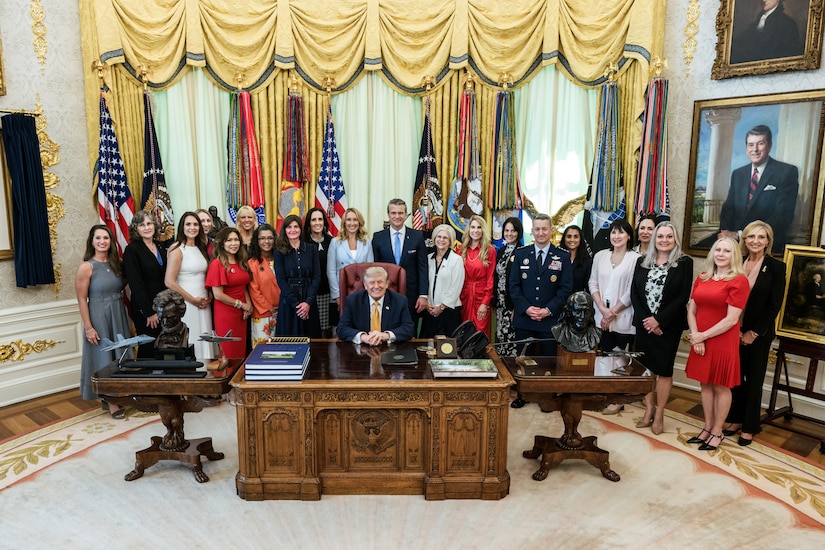
The Military Spouse Commission held its first meeting today at the White House. 

The commission, which President Donald J. Trump established via executive order Aug. 3, is tasked with advising and assisting the president on policies that affect military spouses and families.

A man in business attire sits at a large wooden desk inside an office, surrounded by roughly two dozen men and women.
 

Secretary of War Pete Hegseth, who attended the meeting as a guest, spoke briefly to the roughly 20 attendees. 

“A lot of things that need to happen in our department happen with the stroke of a pen from either your husbands, at [their] level, and if not, up at the office of secretary of war level; and we are prepared to wield that pen,” Hegseth told the commission, which comprises the spouses of the War Department’s most senior military leaders.   

His wife, Jennifer Hegseth, chairs the commission and spoke about its establishment. 

“We're here to help President Trump improve the lives of America's nearly 1 million military spouses, which you all are a part of. And as you know firsthand, military spouses make a sacrifice for our nation together with the sacrifice of your warrior,” she said. 

She went on to explain that the commission will work to tackle big issues like employment, housing, education and healthcare, as well as micro issues that also need addressing. 

“Many of those solutions will be new, but some already exist and have gotten stuck in the bureaucracy — and we'll find those too,” she said. 

Jennifer Hegseth noted that some of those issues will need to be revived from past efforts to fix them, and that some solutions will require Congressional legislation.  

“We will work to find solutions to all of them, so thank you all again for being willing to serve,” she said. 

Each commission member then introduced themself and spoke about the issues that they prioritize the most. As the meeting continued, it became clear that the three most referenced issues were: healthcare, employment and housing. 

Donna Caudle, the wife of the chief of naval operations, said that as a licensed healthcare professional, she has seen firsthand and heard from countless Navy families about the challenges they face when accessing healthcare. 

“I look forward to working with the commission to help President Trump improve continuity of care and capacity, reduce appointment wait times, and close the gaps in specialty care and mental health services for our military families,” she added. 

Debbie Schiess, the wife of the chief of space operations for the Space Force, said she would love to see legislation that allows spouses who are licensed in any state to practice on federal installations.  

“This would tackle two issues at once: aiding in spouse employment and increasing our mental health providers,” she said. 

Regarding employment, Angie Perryman — who’s married to Master Chief Petty Officer of the Navy John Perryman — explained that spousal employment is near and dear to her. 

“I've been a full-time federal employee with the Department of War for almost 20 years as a licensed clinical social worker, and I know firsthand that military spouse employment is not simply about finding a job; it's about preserving a career,” Angie Perryman said. 

She noted the importance of allowing spouses to maintain their jobs despite frequent changes of location. 

“My goal is to help make military-directed moves as close to career-neutral as possible through portable work, remote work, meaningful license, portability, and employment policies that allow spouses to build careers that move with their families,” she further explained. 

Katrina Isom, the wife of the senior enlisted advisor to the chairman of the Joint Chiefs of Staff, explained that experiencing numerous moves over her husband’s nearly 40-year career has led her to focus on the quality of military housing. 

“During our time in the military, I've seen and experienced firsthand the struggles of increasing costs of housing, and the challenges of ensuring [the basic allowance for housing] meets the needs of our service members. As a member of this commission, I look forward to helping ensure that we are doing everything possible to ensure the housing needs of our military members is adequately met,” Isom said.

A silhouette of two adults and two children standing with their backs to the camera, holding hands while watching the sun set over a beach.

Following all the introductions, the secretary of war had high praise for the quality of talent among the commission members, as well as the 544 years combined of active-duty spouse experience the members share. 

“What an incredible background of human beings — Americans who gave the entirety of your lives to the whims of where the government sent your family,” he said. “And the least we can do is try to look back on that [time] and give.” 

The commission is scheduled to meet monthly at the White House.

Medal of Honor Monday: Army Cpl. Luther H. Story

Army Cpl. Luther H. Story, an infantryman, posthumously received the Medal of Honor for his heroic actions during the Korean War.

A man, wearing a military dress uniform, smiles.

Story was born July 20, 1932, in Buena Vista, Georgia. His parents were Mark and Florence, both sharecroppers in Plains, Georgia, on land owned by James Earl Carter Sr., the father of future President Jimmy Carter. 

The family later moved to Americus, Georgia, where Story attended Americus High School. He left school during his sophomore year in 1948 when he was only 16 to enlist in the Army. His mother falsified his birthdate so he could join.  

Story completed basic training at Fort Jackson, South Carolina, and his first duty station was Fort Lewis, Washington, where he was assigned to Company A, 9th Infantry Regiment, 2nd Infantry Division.

A ship with two smokestacks sails the sea.

His unit departed Seattle, July 17, 1950, aboard the troop transport ship USNS General John Pope and arrived in Busan (formerly Pusan), South Korea, July 23, 1950. The Korean War had started June 25, 1950, just a month earlier.  

Pfc. Luther Story was a squad leader. On Sept. 1, 1950, the date of his Medal of Honor valorous action, his company was near Agok, a village on the Nakdong River, during the Battle of Yongsan. 

His citation notes that the 9th Infantry Regiment was attacked by three divisions of the North Korean People's Army. 

Company A fought off several banzai attacks but was bypassed and in danger of being cut off and surrounded.  

Story was heavily engaged in stopping the early attacks and had just moved his squad to a position overlooking the Nakdong River, when he observed a large number of enemy soldiers crossing the river to attack his company.  

Seizing a machine gun from his wounded gunner, he used it to kill or wound an estimated 100 enemy soldiers, according to his citation. Facing certain encirclement, the company commander ordered a withdrawal.  

During the withdrawal, Story noticed an enemy truck approaching, loaded with troops and towing an ammunition trailer. Alerting his comrades to take cover, he fearlessly stood in the middle of the road, throwing grenades into the truck.

When he ran out of grenades, he crawled to his squad, gathered additional grenades and attacked the vehicle again. The company was attacked by superior numbers and forced to deploy into a rice field. Story was wounded in this action, but, disregarding his wounds, rallied his men, who repelled the attack.  

Realizing that his wounds would hamper his comrades' movements, he refused to retire to the next position, remaining to cover the company's retreat, which was successful. When last seen, he was firing every weapon available and fighting off another hostile assault. It was assumed he died at his position. 

On June 21, 1951, General of the Army Omar Bradley presented the Medal of Honor to Story's father at the Pentagon. Story was posthumously promoted to corporal. 

For decades, Story's remains were unaccounted for. The Army issued a presumptive finding of death Sept. 1, 1953, and his remains were determined to be nonrecoverable. 

In October 1950, 11 sets of remains were recovered near Sangdepo, South Korea, and eight sets were identified. One set of remains was thought to be Story, but investigators at the Central Identification Unit in Kokura, Japan, did not have enough identifying data to identify him positively. Those unknown remains were later buried at the National Memorial Cemetery of the Pacific, also known as the Punchbowl, in Honolulu. 

On April 6, 2023, the Defense POW/MIA Accounting Agency announced that Story's remains had been identified. 

To make the identification, DPAA scientists used dental and anthropological analysis. Additionally, Armed Forces Medical Examiner System scientists used mitochondrial DNA analysis obtained from relatives.

A soldier salutes and six others hold an American flag over a coffin.

Story was buried at Andersonville National Cemetery in Andersonville, Georgia, May 29, 2023. Army Maj. Gen. Thomas Carden, adjutant general of the Georgia National Guard, spoke at the funeral.  

"Cpl. Story left us a legacy that we must honor and uphold if we hope to remain the most free and prosperous nation on Earth," Carden said. "Today is a physical demonstration that America never forgets its heroes."  

Story's Medal of Honor is displayed at the National Infantry Museum in Columbus, Georgia, just outside the United States Army Maneuver Center of Excellence at Fort Benning, Georgia. 

President Joe Biden and South Korean President Yoon Suk Yeol attended a ceremony April 25, 2023, at the Korean War Veterans Memorial in Washington, and met with Story's relatives.