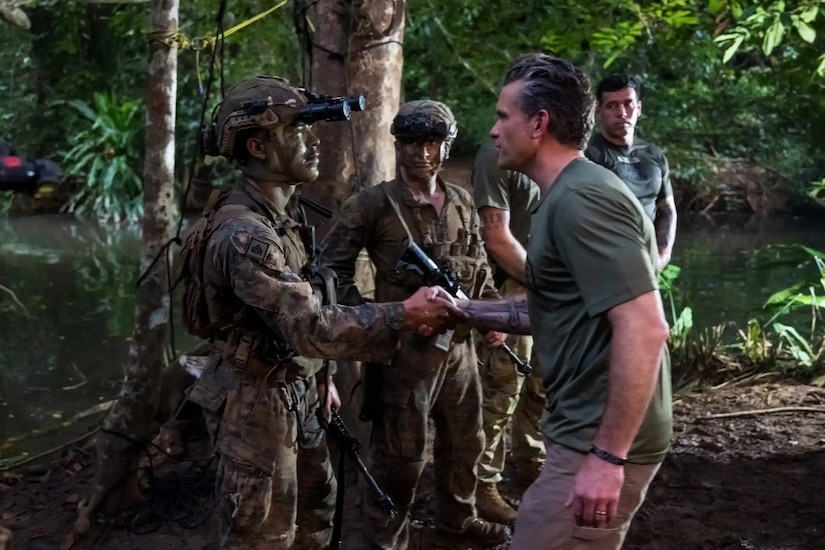
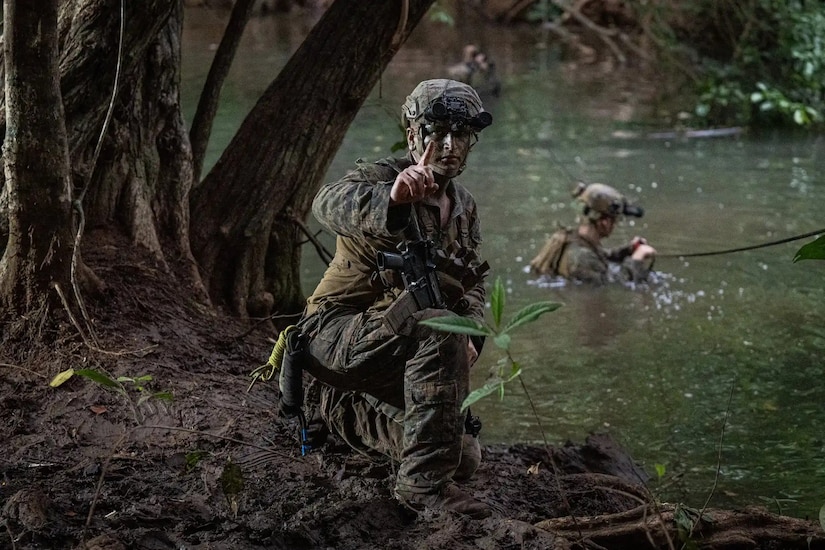
At the Combined Jungle Training Center-South in
Cristobal Colon, Panama, yesterday, Secretary of War Pete Hegseth met
with U.S. service members who are learning how to survive in the most
brutal, unforgiving jungles of the Western Hemisphere, all while
retaining their combat effectiveness.
The visit coincided with the secretary's address during the Americas
Counter Cartel Coalition, a U.S.-led multinational security and
political alliance formed to combat transnational drug cartels, reduce
illegal migration across the Western Hemisphere and limit foreign
geopolitical interference. It also coincided with Exercise Panamax 2026, a multinational military exercise hosted by Panama and sponsored by U.S. Southern Command.
In the dense jungle on the northern side of the Panama Canal, Hegseth
told service members at the training center that what they are doing is
exactly what he likes to see when he meets with warfighters.
"I think this is what ... the warrior ethos looks like; it's what
reestablishing it looks like," he said. "It happens in training centers
like this, with Americans like this, who do really difficult things in
really tough places."
While at the training center, Hegseth met with instructors assigned
to the Jungle Operations Training Course-Panama, along with Marines
assigned to Littoral Combat Force-24, who were in Panama to participate
in Panamax.
The secretary said the service members who train at the center are
willing to do things no other Americans are willing to do, to include
helping U.S. allies in both Central and South America protect the
nation's backyard.
"That's what we're doing here with the A3C [and with] Panamax ...
expanding peace through strength in our hemisphere, right here in the
jungles with our partners," he said.
Noting a big shift in the Southcom mission, Hegseth said that just 18
months ago, the command was less focused on protecting the Americas and
deterring threats.
"This is a different Southcom; this is a different mission," he said.
"We are focused on military capabilities against real threats who need
to be deterred and defeated, and we're going to give them everything
they need to do it, on behalf of the American people."
The secretary said that under President Donald J. Trump, Southcom's
mission has focused on working with partners in the region to keep
everybody safe from a variety of shared threats.
"We know exactly what that mission looks like," he said. "We're
empowering commanders like [Marine Corps Gen. Francis L. Donovan] to do
it in Southcom; we're working with partners like Panama, like Ecuador,
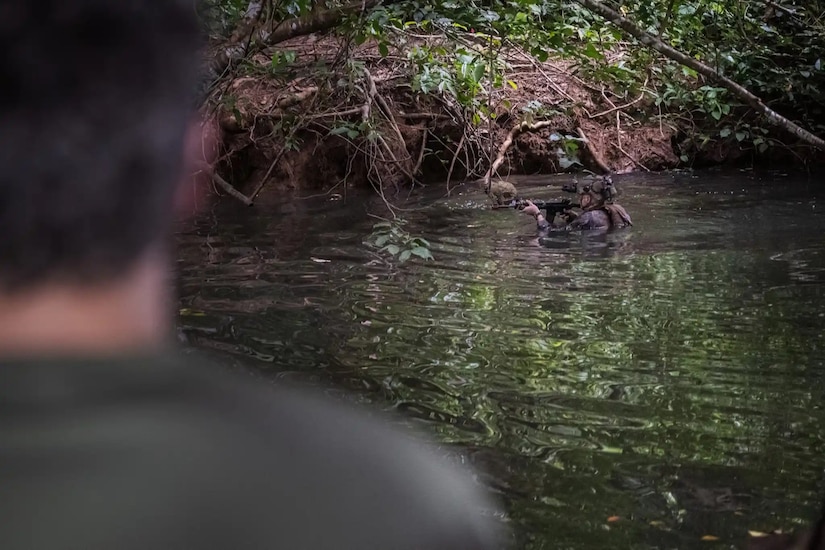
like Colombia ... they're going to send students here soon to swim
across this very same river, [to] be a part of this very same
training."
The nations involved in the Americas Counter Cartel Coalition — 19
nations in all, with Colombia signing on just yesterday — are going to
be involved in the same training as U.S. service members in Panama. The
secretary said that the same things that necessitate American jungle
training also motivate every other nation in the region.
"It turns out, in the [Western] Hemisphere, they face the very same
security challenges, the same threat of drugs, the same threat of
criminal cartels that threaten their citizens, the same ones that
threaten our citizens," Hegseth said.
U.S. law enforcement personnel stationed at the U.S. southern border
to stop illegal immigration and drug traffickers, combined with training
across Central and South America in places such as Ecuador, Colombia
and Panama, puts increasing pressure on shared threats.
"That's going after the enemies of our country — designated terrorist organizations — unabashedly," Hegseth said.
Earlier in the day, the secretary announced the new motto of the
Americas Counter Cartel Coalition: "We do bad things to bad people."
"For too long, bad people did bad things to good people, inside the
United States of America and across Central and South America," he said.
"We're going to empower great Americans and great partners to do really
good stuff and be very capable about bringing violence against drug
cartels and designated terrorist organizations, because we're dead
serious about securing the homeland."
A big part of that is the Trump corollary to the Monroe Doctrine. In
1823, President James Monroe articulated a foreign policy, now known as
the Monroe Doctrine, which declared that the Western Hemisphere was
off-limits to further colonization efforts or interference by European
nations. Later, that expanded to include interference by any foreign
power.
In 1904, President Theodore Roosevelt added to that doctrine that the
U.S. could intervene in the affairs of Latin America to protect U.S.
interests.
And now, Hegseth said, there is Trump's corollary to the Monroe Doctrine.
"It is a recognition that [designated terrorist organizations] ...
will not control our hemisphere ... and we will not allow foreign malign
influence to take over ... key terrain like the Panama Canal," he
said.
Hegseth said Colombia's inclusion in the Americas Counter Cartel Coalition is significant.
"The A3C had formed, but in some ways, it missed part of its core,"
he said. "Colombia is going to be [an] incredible partner. They offered
to be a headquarters or a hub for the A3C as the brand-new 19th member.
They've got ... hundreds of thousands of capable members of their
military and decades of training with the United States ... that
mil-to-mil relationship has been long-standing, and that's why they're
coming to this jungle course soon."




 Posts
Posts

