Wednesday, February 04, 2026

Face of Defense: Brothers Commission as Naval Flight Officers

Standing side by side at their Officer Candidate School graduation, brothers Zachary and Samuel Melvin, now Navy ensigns, marked the culmination of two very different journeys that converged at the same moment: commissioning as officers in the same class and earning selection as naval flight officers.

Navy Ensigns Zachary Melvin and Samuel Melvin
Two men in U.S. Navy uniforms stand side-by-side outside on a clear day next to a parked military aircraft.
Job: Naval Flight Officers
Stationed: Naval Air Station Pensacola, Fla.
Unit: Naval Aviation Schools Command
Hometown: Pensacola, Fla.
For the Melvin brothers, the milestone represented more than the completion of OCS. It was the meeting point of family legacy, personal transformation and a shared commitment to service — witnessed firsthand by their father, Navy Cmdr. Eric Melvin, the command chaplain aboard the aircraft carrier USS Theodore Roosevelt.

A U.S. Navy officer administers the oath of office to two other officers; all three men are in dress uniforms with their right hands raised.

From the Corporate World to the Quarterdeck 

Samuel Melvin, a native of Pensacola, Florida, entered the Navy directly from civilian life after leaving a corporate career as a business analyst. Though he initially set out to forge his own path, service ultimately called him back to familiar ground. 

"I wanted to follow in my father's footsteps, which is why I joined the Navy," Melvin said. "I tried the corporate world, but I felt unfulfilled. I wanted something more meaningful — something challenging — and I wanted to serve my country like my family was doing." 

A sailor sits next to a civilian outside on a bench during the day; they are pointing to one another.

The decision crystallized during an ordinary workday. 

"I was sitting at my desk, staring at yet another spreadsheet and feeling completely unfulfilled. I called my brother and said, 'I cannot do this anymore,'" he recalled. "He gave me the recruiter's number, and I called on my lunch break." 

Learning to Lead Under Pressure 

Transitioning from civilian life into OCS proved to be an adjustment. 

"The level of attention to detail we were taught really surprised me. I learned that big achievements start with careful attention to the small things," Melvin said. 

Officer Candidate School, the Navy's commissioning pipeline, is designed to test candidates mentally, physically and emotionally. For Melvin, one of the most challenging moments came during the officer personnel inspection, a high-pressure one-on-one evaluation with an instructor that requires precise uniform preparation and mastery of naval standards. 

"It taught me that I can learn under pressure," he said. 

Having his older brother, Zachary, in the same class made the experience more manageable. 

"We leaned on each other a lot," Melvin said. "He helped me with everything from uniform ribbons to encouragement on the hard days."

Two sailors stand side-by-side outside in front of building during a sunny day.

A Mustang's Road to Commissioning 

Zachary Melvin's path to commissioning followed a different route. A prior-enlisted sailor and former mass communication specialist, Melvin was assigned to the Naval Education and Training Command before being selected for OCS. 

A sailor sits outside on a bench during a sunny day in front of a building.

"I wanted more leadership opportunities," he said. "A chief once told me it is important for enlisted sailors to become officers because it gives the enlisted a voice on the other side. That stayed with me." 

Unlike his brother, Zachary Melvin viewed commissioning as a long-term goal from the beginning of his Navy career. 

"I knew early on that I wanted to become a mustang," he said, referring to the informal term for commissioned officers who began their career as enlisted sailors.  

From Sailor to Officer 

While Zachary Melvin entered OCS with fleet experience, the transition still demanded growth. 

"I already knew how to be a sailor," he said. "At OCS, I had to learn how to be an officer. That adjustment took time." 

His enlisted background, however, became an asset. 

"It gave me perspective," Melvin said. "I could help classmates understand the 'why' behind the training and how it was shaping us into warfighters." 

Sharing OCS with his brother, Samuel, added a unique dynamic. 

"It was fun," Zachary Melvin said. "We shared the humor and the adversity — the planned stress — and grew through it together." 

Selecting Naval Aviation 

Both brothers selected naval flight officer, a competitive warfare specialty within naval aviation. 

"I chose aviation because they are an elite fighting force that sets the standard for the best," Zachary Melvin said.  

For Samuel Melvin, aviation represents a developing passion. 

"I am still undecided on an airframe," he said. "Right now, my focus is working hard and doing the best I can." 

A Father's Honor, A Family's Legacy 

Their commissioning ceremony carried special significance. Eric Melvin administered the oath of office to both of his sons in a private ceremony following graduation. Also attending the ceremony was their brother Nathaniel, a captain in the Marine Corps, currently stationed at Marine Corps Base Quantico, Virginia.

A U.S. Navy officer administers the oath of office to two other officers; all three men are in dress uniforms with their right hands raised.

"It was the honor of a lifetime," Eric Melvin said. "They wanted to be commissioned together, at the very same moment. Watching my oldest and youngest sons take that step was incredibly humbling." 

The moment brought his own Navy journey full circle. 

"I thought back to when I reported to boot camp in 1989 and later, being commissioned into the Chaplain Corps," he said. "Now, all three of my sons are serving on active duty."

Four men in U.S. Navy and U.S. Marine Corps uniforms stand together for a group photograph indoors.

Eric Melvin also delivered the invocation for OCS Class 03-26, a moment he described as deeply emotional.  

"As a chaplain, I was reminding them to rely on faith and values beyond themselves," he said. "As a father, it was sobering, knowing my sons may one day be placed in harm's way." 

Looking Ahead 

For Zachary Melvin, the family connection deepened the meaning of the milestone.

Two men in U.S. Navy uniforms and their wives smile for a group photograph in front of a naval seal.

"It means more because my family is part of it," he said. "You have your Navy family and your real family serving alongside you, which ultimately raises the stakes on how you perform." 

Looking ahead, both brothers will report to flight school, where their paths will continue — possibly diverging again — but grounded in the same foundation.

"I want to be an officer my sailors can trust and rely on," Zachary Melvin said. 

For Samuel Melvin, the moment represents a decisive turn toward purpose. 

"This feels like closing the loop after all the hard work," he said. "It's just the beginning." 

Following their commissioning, both brothers reported to Naval Aviation Schools Command in Pensacola, Florida, where they will begin flight training as naval flight officers. 

Friday, January 30, 2026

1976 Bicentennial Celebrations Featured Military Participation Across the Nation

Once every 50 years, the United States holds milestone Independence Day celebrations. This year marks the nation's 250th birthday and fifth semicentennial celebration. 

A man in a suit rings a large ceremonial bell on a ship as another man in similar attire stands beside him. There are four people in military dress uniforms standing in the background.

The bicentennial was celebrated nationwide, July 4, 1976. It was celebrated only a year after the last U.S. troops left South Vietnam during the fall of Saigon, April 30, 1975. 

President Gerald R. Ford's administration stressed the themes of healing and rebirth, as well as nostalgia for the nation's founding. Ford was a World War II Navy officer, serving in the Pacific aboard the aircraft carrier USS Monterey. 

New York City celebrated the bicentennial with a parade of ships that included dozens of historic and current ships. Operation Sail, as it was called, began in New York Harbor and moved up the Hudson River.

Two men in suits hold an old-style American "Don't Tread on Me" flag, as people in military dress uniforms stand in formation in the background.

One of the ships, the aircraft carrier USS Forrestal, carried Ford, Vice President Nelson Rockefeller and State Secretary Henry Kissinger.  

The event was also attended by 70 foreign ambassadors and chiefs of naval operations from 35 countries.

An oil painting depicts people at night pulling on ropes attached to a statue, atop which is a man on a horse. Other people in colonial attire are standing around the statue, observing.

A statue of King George III was beheaded, reenacting when his statue was beheaded during the Revolutionary War and melted down to make bullets. 

During the celebration in the city, bands and ceremonial units from all of the military services marched down Constitution Avenue.

A postage stamp with a soldier dressed in a colonial uniform and playing a drum, as people in the background dance.
A postage stamp with people on a sailing vessel throwing boxes overboard as others in row boats holding lanterns row at night. Another ship is in the distance, and people are standing on a pier watching the activities.
In Greenfield Village, Michigan, members of the military dressed in Revolutionary and Civil War period uniforms. Military parades like these took place across the nation. 

In 1976, Donald Rumsfeld was the defense secretary; Martin Richard Hoffmann was the Army secretary; Gen. Frederick C. Weyand was the Army chief of staff, followed by Gen. Bernard W. Rogers in October of that year; J. William Middendorf II was the Navy secretary; Adm. James L. Holloway III was the chief of naval operations; Thomas C. Reed was the Air Force secretary; David C. Jones was the Air Force chief of staff; and, Gen. Louis Wilson was the Marine Corps commandant. 

The military wasn't involved in any conflicts in 1976, the last being the Mayaguez incident in May 1975, in Kampuchea, now called Cambodia.

A red, white and blue star graphic with the words, “American Revolution Bicentennial” encircling it.

The U.S. was involved in the Cold War, which lasted from 1947 until the dissolution of the Soviet Union in 1991. 

During this timeframe, the U.S. military maintained a large presence in West Germany, Japan and South Korea.

A steam locomotive painted in red, white and blue pulls a passenger train through a flat landscape under a blue sky.

At Panmunjom, South Korea, Aug. 18, 1976, two U.S. soldiers were killed by North Korean soldiers while trying to chop down part of a tree in the Korean Demilitarized Zone, which had obscured their view of North Korea. Three days later, Operation Paul Bunyan took place with a show of force made up of dozens of U.S. and South Korean troops, who completed cutting down the rest of the tree. 

On Nov. 2, 1976, Jimmy Carter, a former naval officer like Ford, was elected president. 

Thursday, January 29, 2026

Coast Guard Cutter Polar Star Marks 50 Years of Service, Begins Operation Deep Freeze

The U.S. Coast Guard cutter Polar Star began icebreaking operations in the Southern Ocean in support of Operation Deep Freeze 26 and marked its 50th year of commissioned service Jan. 17 by freeing and escorting a cruise ship trapped in a pack of ice.

A large ship with the words, “U.S. Coast Guard” written on the side, sails through icy water, leaving a trail of broken ice and open water behind it.

The Australian-owned cruise ship contacted the Polar Star at approximately 11 p.m., local time, Jan. 16, after becoming beset in a pack of ice roughly eight nautical miles from McMurdo Sound, Antarctica. The Polar Star's crew conducted two close passes to break the vessel free, then escorted it approximately four nautical miles to open water. 

The Polar Star departed Seattle in November for its 29th deployment to Antarctica in support of Operation Deep Freeze. 

The operation provides logistical support for the U.S. Antarctic Program, which is managed by the National Science Foundation. The mission includes strategic and tactical airlift, airdrop, aeromedical evacuation, search and rescue, sealift, seaport access, bulk fuel supply, cargo handling and other transportation requirements.

Dozens of people in winter attire and two penguins walk on ice as a large ship is docked in the background with the words, “U.S. Coast Guard,” written on the side.

These efforts enable critical scientific research in one of the most remote regions on Earth. The ship's role in Operation Deep Freeze includes breaking a navigable channel through miles of dense Antarctic ice to allow fuel and cargo deliveries essential for sustaining research stations and operations.

Commissioned Jan. 17, 1976, the Polar Star is the nation's only active heavy icebreaker and has served as a cornerstone of the U.S. presence in the polar regions. For five decades, the cutter has executed missions including Antarctic resupply, search and rescue, environmental protection and national defense. 

As the cutter transits the Southern Ocean en route to Antarctica, its crew reflected on a half-century of service defined by resilience, adaptability and dedication.

A large ship sails through icy water. There is a trail of broken ice behind the ship.

"I am constantly amazed at this crew's tremendous energy and enthusiasm," said Coast Guard Capt. Jeff Rasnake, CGC Polar Star commanding officer. "Despite the many challenges associated with getting and keeping this ship on mission, they remain eternally positive and committed to meeting the high standards we've set for ourselves."

Throughout its service life, the Polar Star has completed dozens of Operation Deep Freeze missions and numerous Arctic deployments, defending U.S. sovereignty, securing critical shipping lanes, protecting energy and mineral resources, and countering adversarial presence in the polar regions. Despite its age, the cutter continues to demonstrate unmatched heavy icebreaking capability, routinely operating in conditions few vessels can navigate.

A large ship sails through icy water as a cruise ship follows close behind. There are snow-covered mountains in the background.

"At 50 years old, [the] Polar Star remains the world's most capable non-nuclear icebreaker," said Coast Guard Cmdr. Samuel Blase, the ship's executive officer. "That's a testament to the crews that have maintained it over the decades. With years of service left to give, [the] Polar Star will continue to guide the way in the high latitudes well into the future." 

As the cutter undertakes another demanding deployment, its 50th anniversary underscores both the ship's enduring capabilities and the professionalism of its crew.

A person in winter attire stands on the deck of a ship looking across icy water at a cruise ship.

"While the term 'historic' has lost meaning through overuse, there is no doubt that this is an amazing ship," Rasnake said. "[The] Polar Star's 50 years of service in the polar regions puts it in the discussion with other great Coast Guard icebreakers." 

As the Polar Star presses south through freezing seas and thickening ice, the crew carries forward a proud tradition of service. The 50th anniversary serves as both a celebration of the past and a reminder of the cutter's ongoing role at the forefront of U.S. polar operations. 

National Guard Repair Depot Key to Army Aircraft Maintenance

At the Connecticut National Guard's 1109th Aviation Classification and Repair Depot, workers refurbish and maintain the Army's fleet of rotary-wing aircraft. This unique job can save the War Department millions of dollars a year.

A man and a woman in camouflage military uniforms stand on a helicopter as they repair the rotor blade.

Unlike field units that are trained and equipped to conduct basic maintenance on their aircraft, the repair depot is capable of stripping a helicopter — whether it's a UH-60 Black Hawk, a CH-47 Chinook or an AH-64 Apache — to its nuts and bolts and rebuilding it to factory standards, as if it just rolled off the assembly line.

"We are considered a sustainment-level facility in that we can do the highest-level maintenance comparable with any Army aviation depot," said Army 1st Sgt. Jarod Meekhoff, a quality control inspector for aircraft and aviation maintenance at the repair depot. "The kind of work that we do is highly technical, which is why we have a lot of specialized tools, equipment and specialized individuals here with the knowledge and skills capable of doing that."

Connecticut is home to some of the country's largest military-industrial businesses. It is fitting, then, that Connecticut is also home to the repair depot. The facility, based in Groton, Connecticut, employs highly skilled uniformed mechanics and some of the industry's most experienced civilian contractors to refurbish and maintain the aircraft. 

A man in a brown T-shirt adjusts hoses in a military helicopter engine.

 
"In doing depot maintenance, we can basically take an aircraft and overhaul it from the ground up," Meekhoff said. "That's removing all the components, stripping all the paint, doing significant structural upgrades, structural repairs, component repairs [and] component overhauls." 
 
One of the best examples of this facility's cost-saving capability came in 2019, when the repair depot received two battle-damaged Chinooks that were deemed inoperable. In just two years, even with the constraints imposed by the COVID-19 pandemic, these two helicopters were stripped down, analyzed, repaired, repainted and returned to the fleet as fully functional machines, sparing the military millions of dollars in buying new helicopters. 
 
Holding important certifications qualifies the repair depot to bid on special aviation maintenance projects offered by the Army. This allows soldiers and contractors at the facility to develop skills and knowledge comparable to those of their civilian defense industry counterparts. 

A large military helicopter hovers above a tarmac. There is a wooded area in the background.

 
Working at the depot provides an opportunity for those interested in the aviation or aerospace industries to acquire skills and experience that will help advance their careers. 
 
"Because of the level of maintenance and the kind of very technical maintenance that we do, our maintainers will walk away with a much better understanding of not just helicopters and aircraft, but general maintenance and procedures, which absolutely translates to all the civilian companies that do any sort of production, manufacturing or assembly," Meekhoff said. 
 
In addition to the repair depot, the facility is home to the 1109th Theater Aviation Support Maintenance Group, the traditional National Guard unit to which many of the uniformed personnel are assigned. These soldiers are capable of going downrange and performing high-level depot maintenance on aircraft on the front lines of the War Department's efforts to maintain peace and stability worldwide.

Tuesday, January 27, 2026

National Guardsmen Activated in Response to Winter Storm Fern

More than 5,400 National Guard members are on duty in 15 states in the aftermath of winter storms that dropped snow and ice from the Midwest to the mid-Atlantic and the South over the weekend.

Three men dressed in camouflage military uniforms pull tree branch debris away from a road.

"[I'm] proud of our incredible National Guardsmen who are stepping up once again," said Air Force Gen. Steven Nordhaus, chief of the National Guard Bureau, in a post shared on his official social media account before the storm. "To everyone in the storm's path: take all precautionary measures to stay safe. The National Guard is always ready, always there."  

Arkansas National Guard soldiers have been driving along icy roadways alongside state police officers, assisting motorists who slid off the road and using military vehicles to recover disabled vehicles.  

North Carolina Army National Guard soldiers performed similar missions.

A man dressed in a camouflage military uniform uses a hand saw to cut a tree branch.
"We used our high-mobility vehicles to pull those individuals back onto the road and get them on their way," said Army Lt. Col. Ellis Parks, North Carolina National Guard Public Affairs director.  

Guard members have also assisted with traffic management, conducted health and welfare checks, and transported local first responders and emergency personnel as they responded to calls for assistance.  

In Delaware, that meant more than 100 Guard members on duty with vehicles positioned throughout the state. In Kentucky more than 2,000 Guard members were activated to respond to icy and snowy conditions.  

In Maryland and other affected areas, Guard members began staging vehicles, equipment and other resources in the days leading up to the storm.  

"The safety and well-being of Maryland residents is our top priority," said Army Brig. Gen. Craig Hunter, Maryland National Guard Joint Staff director. "By preparing our personnel and equipment before the winter storm, we can respond immediately to requests for assistance from local jurisdictions and help ensure our communities remain safe during this weather."

A man wearing a hazard vest and camouflage military uniform stands by a roadside to direct a car away from a work zone.
Two men dressed in camouflage military uniforms remove broken branches.
Guard officials said soldiers and airmen will remain on duty helping communities recover from severe winter weather as long as they are needed.  

In total, National Guard units from 15 states were activated in response to Winter Storm Fern, including Alabama, Arkansas, Delaware, Indiana, Kentucky, Maryland, Missouri, North Carolina, Oklahoma, Pennsylvania, South Carolina, Tennessee, Texas, Virginia, and the District of Columbia.  

Guard members in six additional states are on alert to support state and local officials if needed.  

Air Force, Navy Aircraft to Fly Over Super Bowl LX

To commemorate America's 250th birthday, the Air Force and the Navy are conducting a joint flyover during Super Bowl LX at Levi's Stadium in Santa Clara, California, Feb. 8, 2026. 

The formation, featuring two Air Force B-1 Lancers, from Ellsworth Air Force Base, South Dakota, and two F-15C Eagles, from Fresno Air National Guard Base, California, alongside a pair of Navy F/A-18E Super Hornets and two F-35C Lightning IIs, from Naval Air Station Lemoore, California, is a symbol of the nation's journey and independence.

While this flyover features the Air Force and Navy, a powerful symbol of America's  airpower and maritime strength, it symbolizes the entire joint force — Army, Marine Corps, Navy, Air Force, Space Force and Coast Guard — working together across every domain to defend the nation, safeguarding 250 years of American independence.

A graphic of military jets flying in formation at the top of a Super Bowl LX logo that has a San Francisco landscape inside it. The bottom of the graphic reads "USA 250."

A Military District of Washington joint armed forces color guard will render military honors during the national anthem. This prestigious interservice team from the capital region provides unparalleled ceremonial precision and national representation. The service members of the Air Force and Navy flyover will participate in community outreach events leading up to game day, including public displays of the aircraft, search and rescue demonstration and backseat flights on the F/A-18F Super Hornet with community leaders.
 
As the nation celebrates the country's 250th birthday throughout 2026, the joint community outreach efforts throughout the Super Bowl week demonstrate the joint force's shared history and enduring commitment to defending freedom and supporting the nation's independence.

Two military jets fly through the air. The closest aircraft has trails of water vapor coming off the wings.

 
At one of the most-watched events in the world, the flyover will be a visible reminder that America's military remains united, ready and dominant — 250 years strong.

Monday, January 26, 2026

U.S., Italy Commemorate 82nd Anniversary of Operation Shingle

Army Master Sgt. Joshua Van Horn walked through the curved rows of white marble crosses at the Sicily-Rome American Cemetery in Nettuno, Italy, his steps slowing as he searched for a familiar unit.

A man in a military dress uniform inspects a wreath during a ceremony at a monument in Italy. There eight people in military dress uniforms standing in a line with wreaths in between them. There are four other people in business attire standing in the background.

His eyes settled on the headstones of soldiers from the 504th Parachute Infantry Regiment, 82nd Airborne Division, also known as the "devils in baggy pants," a name given to them by a German officer during World War II. Van Horn grazed his hand across the smooth marble and paused at the grave of Army Pvt. James Warren, the name etched permanently into the stone. 

Van Horn once served in the 504th PIR, deploying with the unit to Afghanistan. Standing among the graves offered a moment to reflect not only on their sacrifice, but on his own service.

A man wearing a military dress uniform renders a salute while two men in business attire stand with hands over their hearts during an outdoor commemoration ceremony in Italy. Another man and a woman in business attire stand beside them in a row. The American flag is displayed in the background.

"Coming here gives you a sense of purpose," Van Horn said. "It reminds me why we do what we do." 

Van Horn participated in the 82nd anniversary commemoration of Operation Shingle at the cemetery in Nettuno, Jan. 22. He led the 173rd Airborne Brigade honor guard during the ceremony, which honored the service and sacrifice of U.S. and Allied forces who fought during the World War II landings at Anzio, Italy, and Nettuno.

The back of a monument of two men with their arms over each other's shoulders is displayed during a commemoration ceremony in Italy. There is a wreath displayed on a stand in front of the monument.

"This cemetery is a testament to what makes America great," Van Horn continued. "Eighty-two years later, these graves are still cared for. What other country does that? Honoring soldiers who died liberating others."

U.S. and Italian officials delivered remarks throughout the ceremony, including U.S. Ambassador to the Holy See Bryant Burch, Italian Deputy Premier and Foreign Minister Antonio Tajani, and U.S. Army Maj. Gen. John L. Rafferty Jr., U.S. European Command chief of staff. 

Local students from Nettuno schools sang, read poetry and laid roses in remembrance of those buried at the cemetery, followed by a ceremonial wreath-laying. The ceremony also honored the life of Army 1st Lt. Carl Hood, the first service member buried at the cemetery.

A portrait of a man in a military dress uniform is displayed on an easel during a commemoration ceremony in Italy. An elderly man in a military dress uniform stands in the background.

Speakers echoed the message that the cemetery is not only a resting place for the fallen, but a space meant to guide the living. Burch and Rafferty also reflected on the upcoming 250th anniversary of the Declaration of Independence and its continued relevance. 

"Two hundred and fifty years of dedication to a universal proposition, grounded in human dignity and fundamental rights, that we continue to strive to live up to," Burch said. "Marking this day during such a historic anniversary carries even greater significance."

A man in a suit speaks behind a lectern as four people in military dress uniforms stand behind him. One of them in holding the American flag while another holds the Italian flag.

As the ceremony concluded, Van Horn and others moved quietly through the rows of marble crosses and Stars of David, reflecting on the cost of freedom. 

These cemeteries are not only places of mourning, but also places of memory, meant to remind the living what service demands and what liberty costs.

Steady in the Storm: Guardsmen Support D.C. Through Winter Weather

Snow fell steadily as a military Humvee eased through Washington's streets with tires crunching over packed ice and traffic lights reflected off slush-covered pavement. Inside the vehicle, Army Col. Larry Doane, commander of Joint Task Force District of Columbia, scanned a digital map, tracking patrols spread across the city as a winter storm tightened its grip.

Two people in camouflage military uniforms walk along a snow-covered sidewalk in front of the U.S. Capitol.

"Slow and steady," Doane said, watching a civilian vehicle struggle for traction nearby. "Interesting driving choices out there today." 

The storm transformed the mission almost instantly. What began as routine presence patrols in support of the D.C. Safe and Beautiful mission shifted toward life-safety priorities — mobility, visibility and helping people navigate a city slowed by snow and ice. 

Across the district, National Guard soldiers and airmen moved deliberately through metro stations, neighborhoods and key corridors. Some checked on patrol teams braving long shifts in freezing temperatures. Others used high-mobility vehicles to assist first responders, transport personnel and help stranded motorists clear snowbanks and regain traction. 

Four people in camouflage military uniforms stand outside in the snow, inspecting a black vehicle under a bridge.

"This is where the Guard fits naturally," Doane said, as the Humvee turned toward Union Station. "When conditions get tough, we bring mobility, manpower and discipline to support our partners and the community." 

Throughout the ride-along, Doane stopped repeatedly to speak with guardsmen on post — asking about their gear, their feet, their food and their radios. He reminded leaders to rotate personnel inside warming areas, keep one soldier alert at all times and watch for signs of cold-weather injuries.

"Those basic leadership things still work," he said. "Feet, hands, communication — take care of each other — and the mission takes care of itself." 

Outside, the storm revealed a different side of the mission. Guardsmen pushed vehicles out of snowbanks, guided pedestrians through icy intersections and checked on individuals waiting in the cold. In several cases, teams coordinated with district partners to escort people to warming shelters or help them reach safe transportation. 

"We're providing a lot of mobility today," Doane explained. "That's really what our partners need — getting officers, firefighters and medical personnel where they need to be, and helping civilians move safely through the city." 

A person in a camouflage military uniform walks along a snow-covered street with rows of trees on either side.

Inside a metro station, Doane paused to observe soldiers standing watch near the turnstiles. Trains continued running despite the weather, and commuters moved through what one passerby called "the safest metro station in America right now." The guardsmen nodded, adjusted their posture and continued scanning the space — visible, calm and unintrusive. 

"That presence matters," Doane said. "Just being here brings the temperature down. People feel reassured." 

The winter storm did more than slow traffic; it tested systems, patience and readiness. Snow and ice complicated response times, narrowed streets and forced constant reassessment of risk. Guardsmen adapted quickly, shifting patrol routes, coordinating with law enforcement partners and prioritizing safety over speed. 

"Safety is No. 1," Doane reminded a team sheltering near a metro entrance. "No reason to stand out here and freeze. We'll get back to normal patrols when conditions allow." 

Despite the conditions, morale remained steady. Guardsmen shared hot drinks, swapped stories and laughed about snowball fights that never materialized. Civilians waved as the Humvee passed, some offering thanks, others simply relieved to see help nearby. 

Four people in camouflage military uniforms walk along a snow-covered city street.

"I've gotten more waves today than I have in a long time," Doane said. "People remember what the Guard does during storms like this." 

As the night wore on, the mission continued, quietly, steadily and without ceremony. Patrols remained in place. Vehicles stayed ready. And across the city, guardsmen stood watch while Washington dug itself out. 

"What we do is important," Doane said as the Humvee rolled back into traffic. "But how we do it matters more. The way our soldiers carry themselves, the way they treat people — that's what builds trust." 

In a city shaped by movement and unpredictability, the storm underscored the Guard's enduring role: ready when conditions worsen, visible when reassurance is needed and committed to serving the community — no matter the weather. 

Medal of Honor Monday: Army Tech. 5th Grade Eric Gibson

Army Tech. 5th Grade Eric Gibson served as a cook during World War II, but his desire for more led him to work out a deal with his superiors to fight on the front lines. During one intense battle in Italy, Gibson consistently went ahead of the soldiers he led and took out threats in their path. He didn't survive the ordeal, but his bravery and leadership earned him the Medal of Honor.

A man in a military dress uniform poses stoically for a photo.

Gibson was born Oct. 3, 1919, in Nysund, Sweden, to Erland and Agda Gibson. In 1924, after his younger brother, Sven, was born, the family moved to Chicago, where Gibson grew up.

Few details of his early life have been published. Still, by February 1941, Gibson had enlisted in the Army as troop numbers soared ahead of America's inevitable involvement in World War II. After basic training, he was assigned as a cook for the 30th Infantry Regiment, 3rd Infantry Division.

In November 1942, the division deployed to North Africa, where Gibson, as part of Company I, took part in that invasion and the subsequent invasion of Sicily.

As the division plowed through enemy territory, Gibson decided he wanted to make a bigger impact than just being a cook. So, he worked out a deal with his commanding officer that allowed him to serve as a rifleman in an infantry squad whenever the company went into battle, according to the U.S. Army Quartermaster Museum.

In the mountainous terrain of Sicily, where motorized Army vehicles weren't useful, Gibson is credited with leading a pack of mules carrying supplies across several miles of rugged landscape. Later, as the company's main scout, he located several enemy positions and even killed and wounded two German soldiers during ensuing firefights.

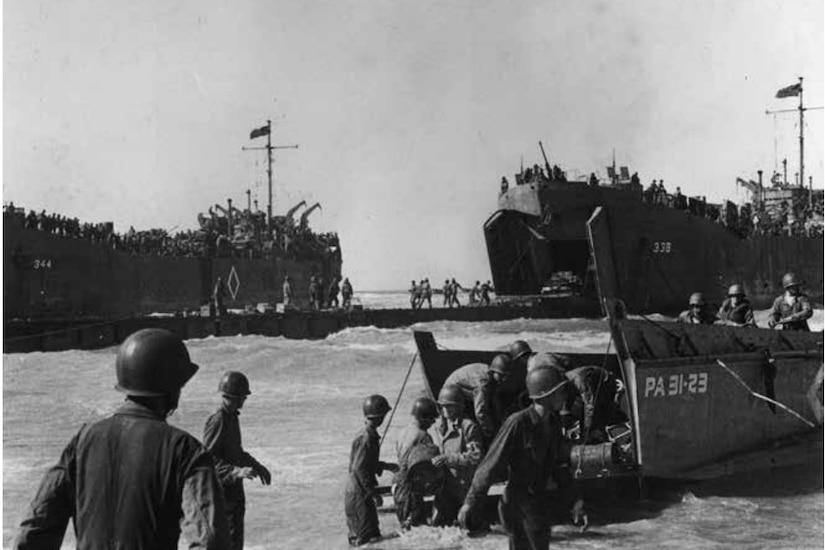
A large ship with ropes coming from its bow and an open front sits on a beach. In front of it sits a large tank as another one rolls off the ship. Dozens of men in military uniforms stand on the ship while several others in similar attire stand on the beach.

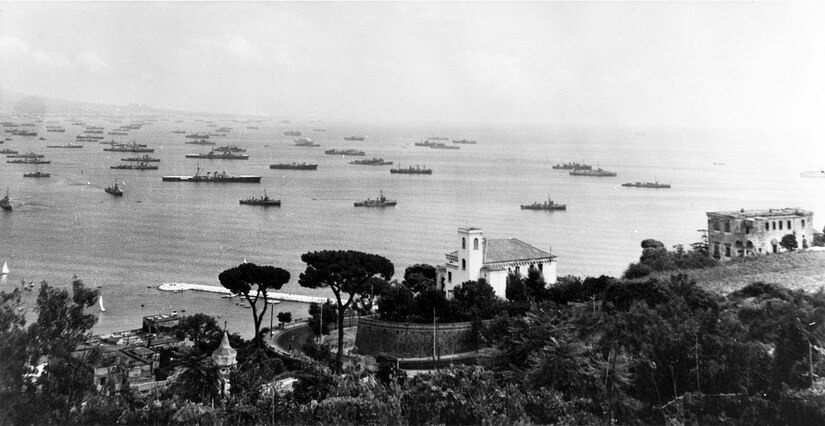
In mid-January 1944, the division landed on the Anzio beachhead in Italy. As Gibson's company moved up the coastline, he continued with his dual missions, repeatedly distinguishing himself in combat, according to the museum.

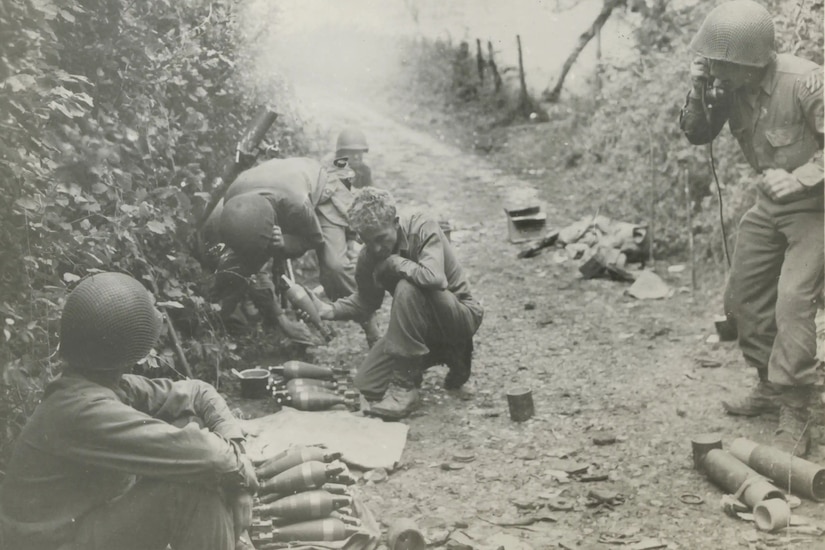
On Jan. 28, 1944, Gibson's company had made it all the way to northern Italy and was near the island of Isola Bella when they came under attack. Gibson quickly mobilized and led a squad of unseasoned soldiers — those sent to the front lines to fill vacancies left by casualties — through a "baptism by fire," his Medal of Honor citation stated. But their efforts bore fruit. They managed to destroy four enemy positions, kill five and capture two German soldiers, all while also securing their company's left flank.

Gibson then continued ahead of his fellow soldiers, moving through a wide stream ditch until he came within 20 yards of a concealed enemy soldier, who opened up on him with automatic fire. Several bullets nearly hit Gibson, but that didn't stop him. He charged, firing his submachine gun every few steps until he got to the enemy position and fired at point-blank range, killing his opponent.

A long gun aimed skyward lets off a plume of flames. Two men in military uniforms kneel as a third man in similar attire stands while covering their ears. Foliage can be seen around them in a barren landscape.

As a smattering of artillery landed in and around the ditch, the impact from one knocked Gibson flat. As soon as he got to his feet, he was fired on by two enemy soldiers who were about 75 yards away. Gibson immediately raced toward them and didn't stop, even when machine gun fire opened up on him about halfway to the position. Gibson killed one foe and captured the other.

Shortly after that, during another spray of heavy machine gun fire coming from about 200 yards further down the ditch, Gibson crawled back to his squad and ordered them to direct as much fire as possible toward the enemy so he could flank that machine gun nest.

Getting to the emplacement required Gibson to crawl 125 yards through an intense artillery barrage that included crossfire from two machine guns, which showered dirt all over him. He made it, however, and once he reached the nest, he threw two hand grenades into it before charging forward with his submachine gun, killing two enemy soldiers and capturing a third.

When his squad got to a bend in the ditch, Gibson moved forward alone to scout out the situation. That's the last time his fellow soldiers saw him alive.

A group of men in military combat gear walk single file along a dirt path.

Gibson's squad later told officials that when they heard an exchange of gunfire, they moved around the bend. About 35 yards toward an enemy outpost, they found Gibson dead. However, before he fell, he managed to kill one more German soldier.

Gibson's fearless actions kept the men in his squad alive, even if it meant his own death. For that, he was posthumously awarded the Medal of Honor. His parents were gifted it on his behalf Sept. 15, 1944, during a ceremony at Camp McCoy, Wisconsin.

When Gibson's body was returned to the U.S. in 1948, he was buried in Nora Cemetery in Rice Lake, Wisconsin, where his parents had moved while he was overseas.

Gibson has not been forgotten. Over the years, an Army Reserve center in Berwyn, Illinois, and a dining facility on Fort Lee, Virginia, were named in his honor. In 1995, a Navy container ship was renamed for the fallen soldier, and in 1999, Gibson was inducted into the Quartermaster Hall of Fame. 

Sunday, January 25, 2026

A 'Tail' of Service: Famous Military Working Dog Retires

The beloved military working dog, known across the force for greeting users when they log in to military devices, is now retired from active service.

A man dressed in a camouflage military uniform and a woman wearing casual winter attire sit in chairs in a large room. The man is holding a leash attached to a German shepherd that is standing in front of them. There are dozens of people in similar attire sitting and standing behind them.


Affectionately called "Doggles," MWD Nick served eight years in the Army, seven of those at Fort Meade, Maryland. Nick specialized in explosives detection, helping technicians confront and defeat explosives around the world.

Some of the biggest assignments that Nick and handler Army Staff Sgt. Justin Peyton, assigned to the 2nd Military Working Dog Detachment, have worked include 58 Secret Service missions, a North Atlantic Treaty Organization summit, a Democratic National Convention, the Army's 250th anniversary celebration, state funerals and the United Nations General Assembly.

"My favorite assignment was the United Nations meeting in New York City," Peyton said. "We got to walk around the city, see sights and meet lots of people."

The famous photo came from Nick's nine-month deployment to Al Asad Air Base, with his previous handler, Army Spc. Joseph J. Lane. During the deployment, Lane and Nick supported the 5th Infantry Regiment, 1st Brigade Combat Team, 25th Infantry Division.

A German shepherd military working dog wearing goggles sits in the dirt with his mouth open. There is a leash coming off the back of the dog that goes out of the frame.

 
"The goggles are worn to protect MWDs from debris and harsh weather," Lane said in a 2023 interview. "In that photo, Nick was wearing them at the range for familiarization. We were at the range for night fire and we flew in [UH-60] Black Hawks with night vision goggles."

Nick's photo was selected from among hundreds to be used by the War Department's global directory.

A person holds a colorful patch of a dog wearing protective goggles. The top of the patch reads "Sign in with CAC/PIV," while the bottom reads "Please enter your PIN."
"When they saw Nick's photo, the creators knew that was the one they wanted," Peyton said.

Since becoming the face of the global directory, Nick garnered a cult following among service members and department civilians. A morale patch made by a small artist has been sold thousands of times.

"It has been nice to see lots of people take to him and fall in love with him," Peyton said. 

"This dog's career is a direct reflection of the high standards and operational lethality we demand from every team in our unit," said Army Capt. Patricio Quezada, 2nd Military Police Detachment commander, as he reflected on Nick and Peyton's time with the unit. "Their success was built on the relentless work of a dedicated handler who exercised patience and translated that into an unbreakable bond between dog and handler."

A German shepherd stands with his mouth open next to a man dressed in a camouflage military uniform holding a leash. The dog has a medal pinned to a harness around his body.


When adopting a military working dog after their service, handlers have priority. Nick will spend the rest of his years with Peyton and his family.

"Knowing that Nick kept Justin safe for so long, knowing that he protects my husband, has given me a lot of comfort," Lauren Peyton said. "We are looking forward to giving him a comfortable life in retirement."

Spouses Experience a Day of Marine Corps Training

Spouses of 4th Marine Regiment and 3rd Reconnaissance Battalion participated in an "In Their Boots" event at Camp Schwab, Okinawa, Japan, Jan. 15. The one-day event was designed to give spouses a firsthand look at the training their Marine spouses conduct to sustain a ready and capable combat force.

A woman in civilian clothing drags another woman dressed in jeans and a T-shirt, while holding her under the arms and from behind. They are both laughing. Other people, dressed in military uniforms and civilian clothing, mill around in the background.

By participating in a series of hands-on activities, spouses can better understand daily challenges while building a stronger connection to their Marine and with other families throughout the commands.

The day included multiple events modeled after standard Marine Corps requirements. Spouses fired rifles on a live-fire range, conducted the obstacle course, completed a modified combat fitness test, descended a rappel tower and rode in a combat rubber reconnaissance craft.

A woman dressed in civilian hiking gear rappels down a wooden wall as two men in military uniforms look down at her.

"Our spouses can see not only what their significant other does throughout the day and throughout the year, but the other opportunities that are available in the Marine Corps," said Marine Corps 1st Lt. William Rebert, Headquarters Company executive officer, 4th Marine Regiment.

Throughout the day, Marines assigned to 4th Marine Regiment and 3rd Reconnaissance Battalion served as instructors and safety guides, explaining each task and encouraging spouses. Through their involvement, spouses gained insight into Marine Corps training standards and unit culture.

Two men dressed in military physical fitness clothing push a rubber boat into a body of water. People with military vests on are sitting in the boat.

For many spouses, the experience was both challenging and rewarding.

"It's harder than I thought, and I definitely [have] a lot more respect for the Marines that are able to finish the O-course and the CFT," said Isabelle Rebert, Rebert's wife. "They planned out the schedule really well to show us as much as they could in a one-day span and we got to do a lot of really cool stuff."

A woman dressed in dark clothing smiles as she holds up a certificate in one hand and a yellow box in another. A man wearing a camouflage military uniform stands next to her and claps.

Leaders of 4th Marine Regiment emphasized that family readiness is a critical component of mission readiness. Events like "In Their Boots" reinforce the idea that spouses play an essential role in supporting Marines, both at home and during deployments. By the end of the day, participants left with a deeper appreciation for the training that their Marine spouse endures and a deeper connection to their spouse's service.

"It is not often that military spouses can see the intricate complexities and professionalism of their Marine spouse on the job, and this event helped demonstrate how much their Marine is capable of and ready to do on behalf of our nation," said Marine Corps Col. Richard Barclay, commanding officer, 4th Marine Regiment. "This was a great opportunity for the spouses, across several commands, to spend the day together doing high-quality Marine training and foster a greater sense of community amongst our families here in Okinawa. Given the opportunity, I would highly encourage any military spouse to take full advantage of events like this."