Monday, July 13, 2026

USS San Antonio Assumes Relief Mission in Venezuela

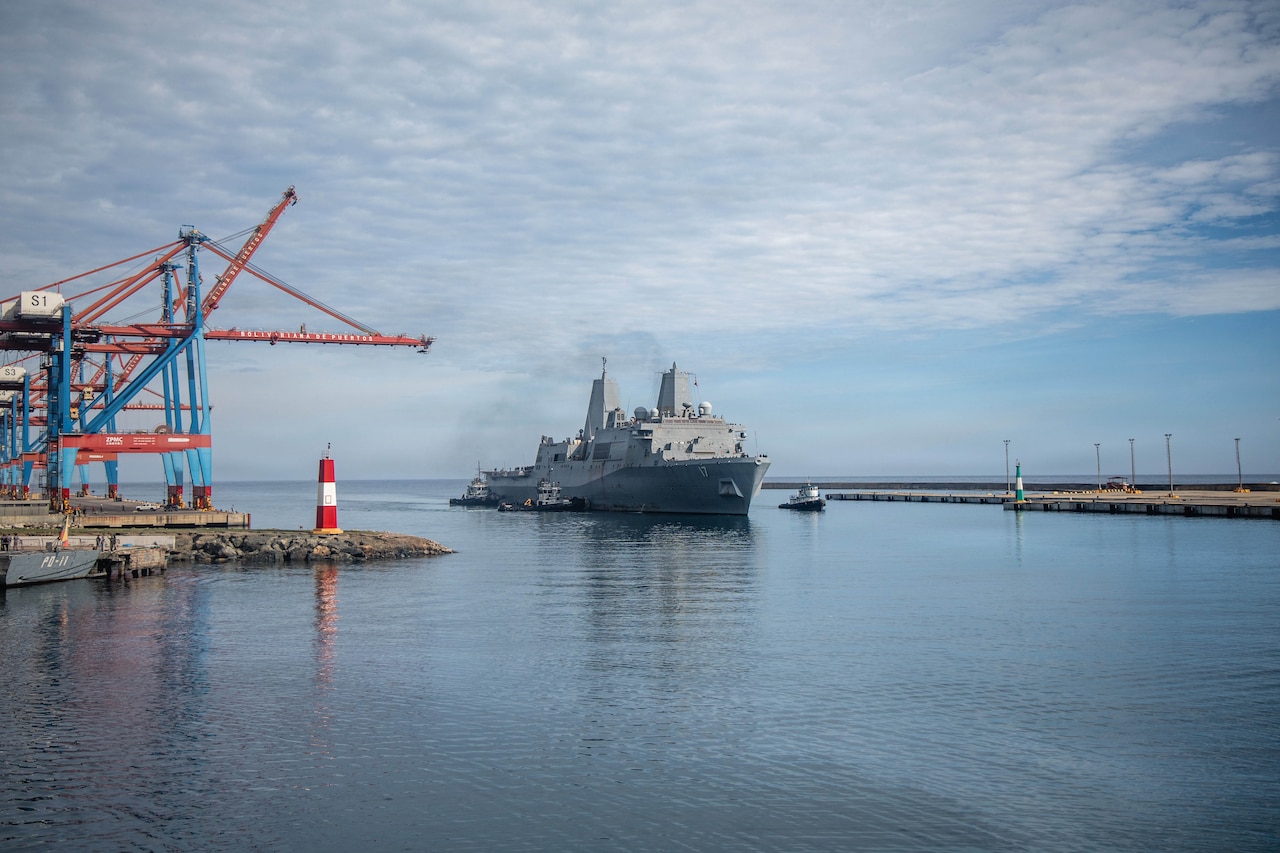
A large military ship sails in a harbor while being guided by three tugboats.

Supporting ongoing disaster relief efforts, the amphibious transport dock USS San Antonio arrived at the port in La Guaira, Venezuela, July 9, relieving the USS Fort Lauderdale as the primary maritime component of the State Department-led humanitarian assistance mission following the devastating June 24 earthquakes. 

After the Fort Lauderdale's historic arrival June 28 — the first Navy port call to Venezuela in decades — the San Antonio will now take over as the primary afloat coordination hub and continue sustained recovery efforts. The ship's robust command-and-control infrastructure enables U.S. Southern Command to work seamlessly with the State Department, interagency partners and Venezuelan authorities to distribute resources and direct rapid relief operations across the affected areas. 
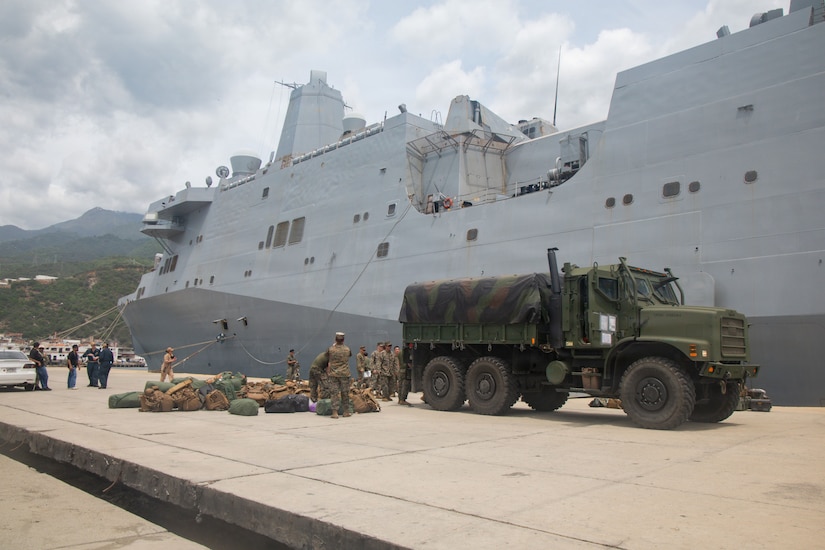
A small group of people in camouflage military uniforms take equipment off the back of a military vehicle parked on a pier; there is a large ship docked in the background.

"The sailors and Marines of [the] USS Fort Lauderdale and Littoral Combat Force 24 have worked tirelessly to deliver humanitarian assistance to the people of Venezuela," said Navy Capt. Jiwan Mack, USS Fort Lauderdale commanding officer. "Our Navy-Marine Corps team remains ready to respond rapidly to emerging crisis." 
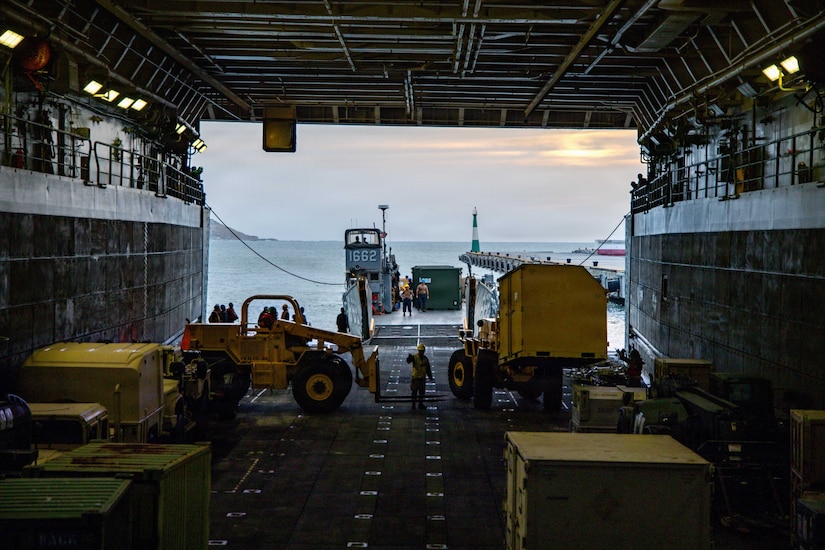
A dozen people in military uniforms and hard hats use forklifts to transport containers from the cargo bay of a large military ship onto another transport dock ship.
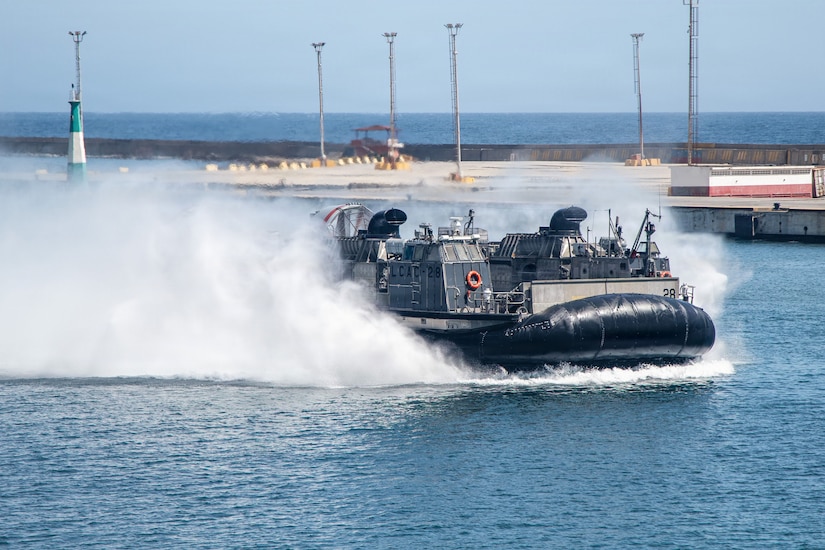
A landing craft sprays water in the air as it sails in the water.
The continuous presence of a San Antonio-class amphibious transport dock in port is a critical force multiplier for the interagency relief operation. Designed for extended, self-sustaining operations, the ship requires minimal local security, logistical support or port resources. This approach ensures that all local Venezuelan assets can remain entirely focused on domestic recovery rather than supporting the U.S. presence. 

Beyond serving as a communication hub, the San Antonio brings advanced onboard medical facilities, an expansive flight deck to support ongoing rotary-wing search and rescue operations, and a well deck capable of launching amphibious landing craft to deliver heavy cargo and vital supplies directly to damaged coastal infrastructure. 

"We are prepared to continue the vital mission that [the] USS Fort Lauderdale began," said Navy Capt. Tom Uhl, USS San Antonio commanding officer. "The presence of [the] USS San Antonio and Littoral Combat Force 24 in La Guaira represents more than just a transition of ships; it demonstrates the resolve and inherent capabilities of the Navy-Marine Corps team in supporting Department of State-led disaster response efforts to bring relief to the Venezuelan people."

The transition between the two Navy vessels was executed safely and efficiently, with the San Antonio immediately integrating with U.S. aviation assets already operating in the region, including elements of Helicopter Maritime Strike Squadron 48 and Marine Medium Tiltrotor Squadron 365.
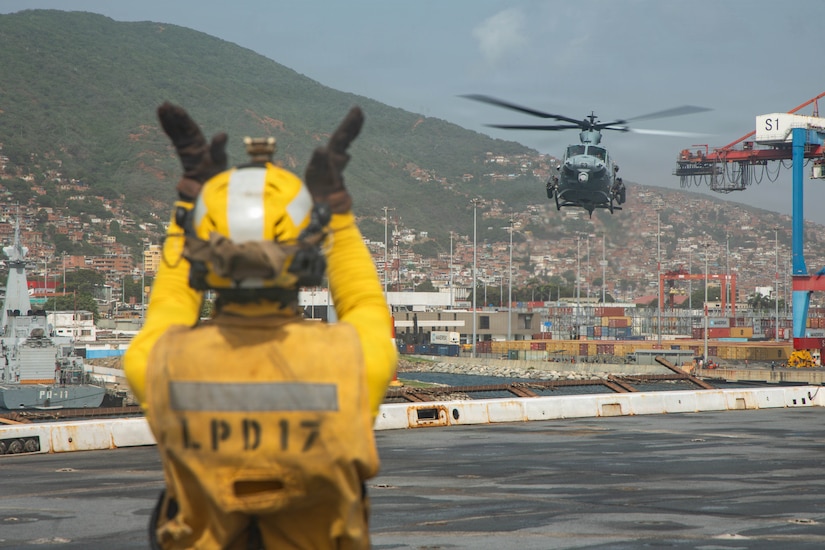
A person in a military flight deck uniform gives hand signals to helicopter pilots as they prepare to land on the deck of a ship in the water.
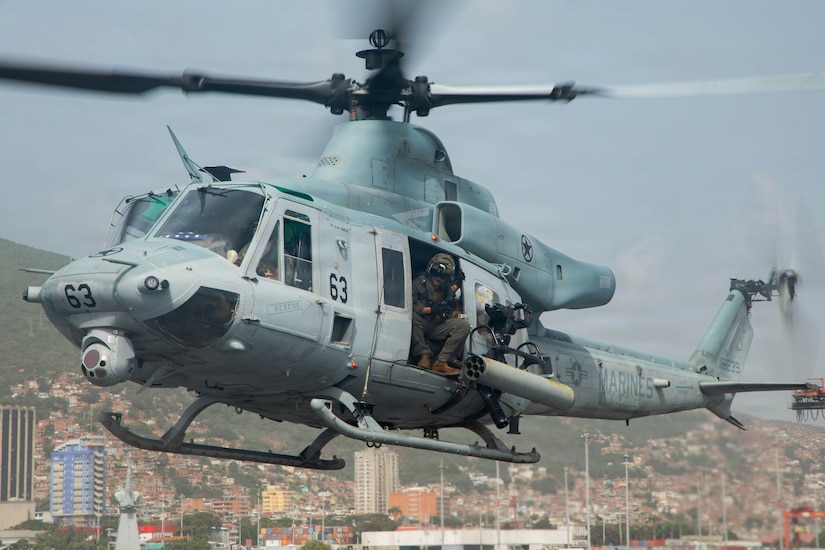
A person in a flight suit looks out the door of a military helicopter as it prepares to land on the deck of a ship in the water.
At the direction of Southcom, assigned U.S. military forces are supporting State Department-led U.S. disaster assistance to the people of Venezuela. Planning for continued U.S. military support remains ongoing in close coordination with the State Department, the Venezuelan government and international partners contributing to the relief effort. 

The U.S. military forces supporting Venezuela are built for rapid, short-term response to stabilize a crisis, minimize immediate suffering and save lives. This presence is temporary, remaining active for as long as requested, ready to transition relief tasks to nongovernmental organizations, international aid groups and local authorities as soon as the immediate crisis is stabilized.

Reduction Expected for Japan Cost-of-Living Allowance Rates

Service members based in Japan will likely see a reduction in their overseas cost-of-living allowance in the coming weeks because of a long-term drop in the value of the Japanese yen and a corresponding increase in the value of the dollar.

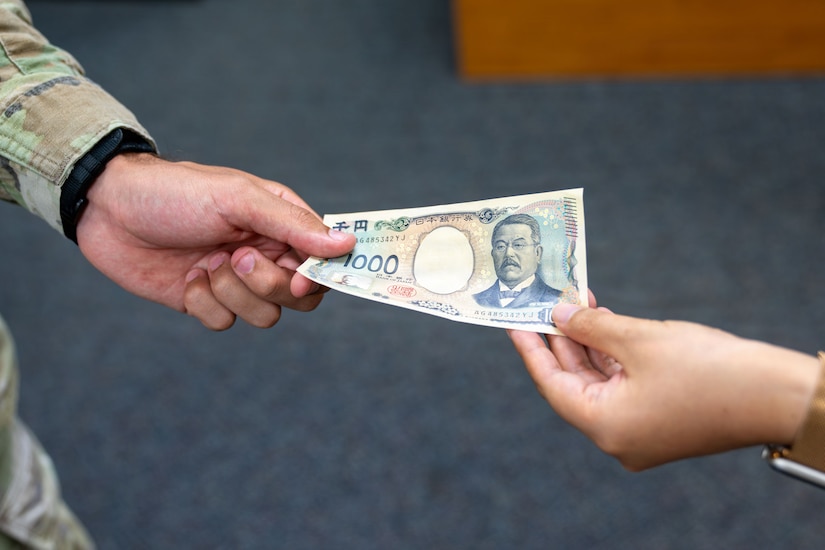
A close-up of a person handing another person a Japanese currency note.

The yen recently reached a 40-year low against the dollar. Because the U.S. currency now buys significantly more goods and services on the local economy than it did previously, the supplemental allowance required to equalize purchasing power, commonly known as COLA, is shrinking.

Overseas COLA is a nontaxable supplemental pay allowance designed to offset overseas prices of goods and services, ensuring purchasing power remains equal to service members stationed in the contiguous U.S. It is not a fixed pay entitlement and is explicitly designed to fluctuate with currency exchange rates.

The COLA index for many installations in Japan is projected to drop to 100 and below, meaning the allowance will be zero. If that number is below 100, no pay is deducted from service members and the allowance simply remains at zero until economic conditions warrant an increase.

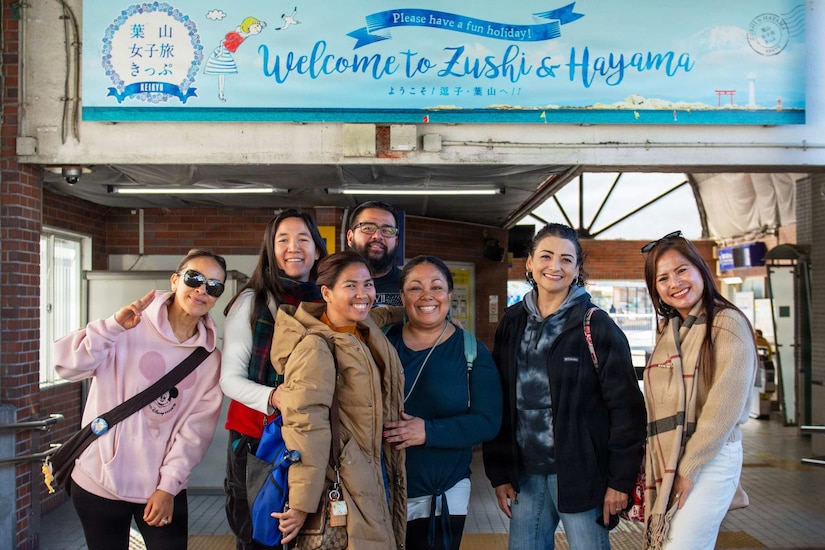
A group of people dressed in casual attire pose for a photo outside.

While the dollar amount on a member's leave and earnings statement regarding COLA will decrease, their actual ability to purchase goods on the local economy remains the same or better because of the highly favorable exchange rate.

"With the dollar this strong compared to the yen, service members can find a lot of value buying food and household goods on the local economy," said Air Force Col. John Severns, U.S. Forces Japan Public Affairs director.

Medal of Honor Monday: Army Pfc. William Kenzo Nakamura

Army Pfc. William Kenzo Nakamura was a World War II hero. He received the Medal of Honor for risking his life to save his platoon during combat in Italy, July 4, 1944.

Nakamura was born in Seattle, Jan. 21, 1922, and grew up with a brother and a sister. His parents worked as barbers in Seattle after immigrating from Japan.

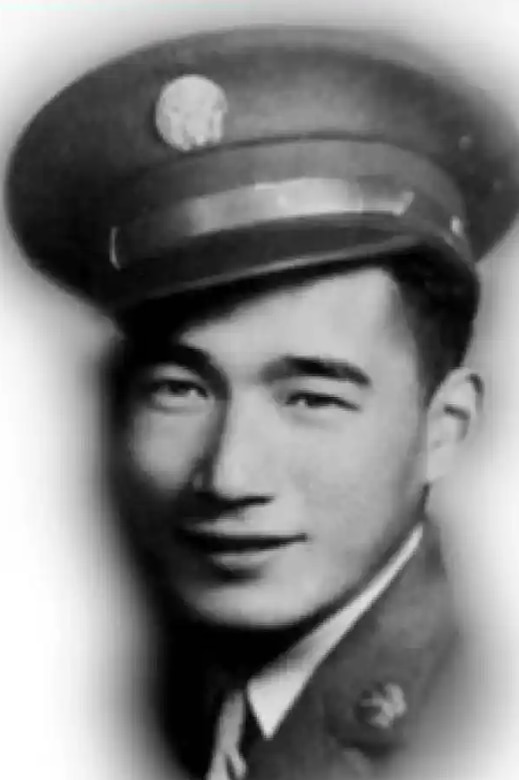
A black and white photo of a man wearing a military dress uniform and hat posing for a photo.
After graduating from Garfield High School in 1939, he attended the University of Washington.

His mother died of cancer in January 1942, two months before Japanese Americans living in the Puget Sound area were moved to relocation centers.

Nakamura and the rest of his family arrived at the Minidoka War Relocation Center in Jerome County, Idaho, Aug. 21, 1942, according to the final accountability roster from the War Relocation Authority.

His father and sister remained in the center until 1945, but Nakamura and his brother left the center for military service in July 1943.

On the day of his Medal of Honor action, Nakamura was assigned to Company G, 442nd Regimental Combat Team, in the hilly countryside near Castellina, Italy.

According to his Medal of Honor citation, his platoon became pinned down by enemy machine-gun fire from a concealed position during a firefight. On his own, he crawled 20 yards toward the hostile position with enemy machine-gun fire barely missing him.

After getting within 15 yards of the enemy, he threw four grenades, killing or wounding at least three of them. With their weapons silenced, Nakamura crawled back to his platoon, which was able to continue its advance thanks to his courageous action.

Later, his company withdrew from their position so a mortar barrage could occur. However, Nakamura remained in position to cover his comrades' withdrawal.

While moving toward the safety of a wooded area, his platoon again became pinned down by machine-gun fire. Nakamura acted quickly, crawling to a point where he could fire on the enemy. He engaged and pinned them down, allowing his platoon to withdraw safely.

Nakamura was not so lucky, he was killed during this heroic stand.

In the years after the war, only one Japanese American soldier received the Medal of Honor: Army Pfc. Sadao Munemori, who died in battle. Nakamura instead posthumously received the Distinguished Service Cross, the nation's second-highest military award for valor.

During the war, the approximately 14,000 Japanese American soldiers who served in the 442nd received 18,143 awards, including seven Presidential Unit Citations.

In 1996, legislation sponsored by Sen. Daniel Akaka of Hawaii led to an official review of the many Distinguished Service Crosses received by Japanese Americans for their heroics during World War II, despite the discrimination they faced at the time. The review resulted in the military upgrading 19 of the 52 Distinguished Service Crosses to Medals of Honor, as well as one Silver Star Medal.

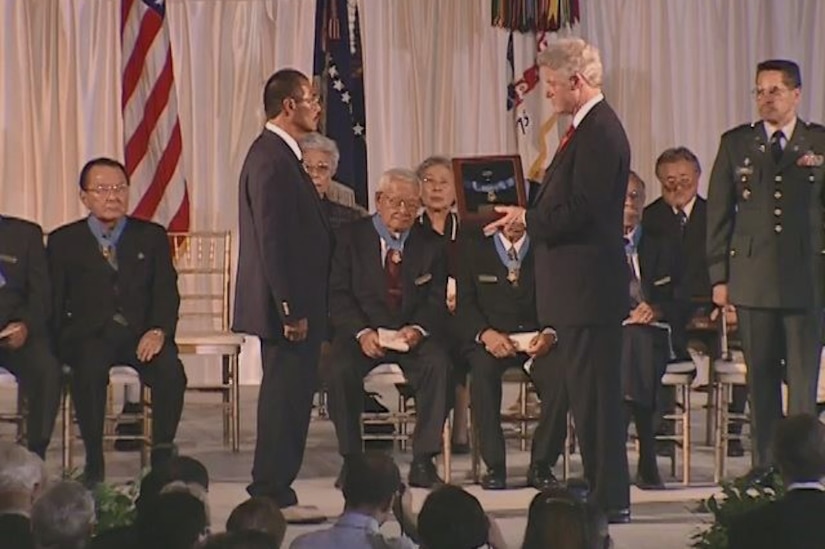
The Medal of Honor was awarded to several Japanese American soldiers assigned to the 100th Infantry Battalion and the 442nd Regimental Combat Team during a June 21, 2000, White House ceremony.

June Oshima, Nakamura's sister, was at the ceremony to accept the medal on his behalf from President Bill Clinton.

She gave an interview to the Longview Daily News newspaper, which was published in the May 29, 2000, issue.

They, Nakamura and his brother, "thought if they joined, they could get rid of the prejudice," she said. "They wanted to show that Japanese Americans were not the enemy. It makes me sad to think of it."

Decades since Nakamura's brave actions, tributes have continued. In 2000, Congress voted unanimously to pass legislation officially naming the Seattle federal courthouse the William Kenzo Nakamura United States Courthouse. There's also a memorial for him at the University of Washington.

Nakamura is buried at Evergreen Washelli Memorial Park in Seattle.