Monday, December 22, 2025

Trump Announces New Class of Battleship

President Donald J. Trump today announced the Navy's intent to develop a new class of American-designed, 30,000 to 40,000-ton large surface combatants, or battleships, that will be employed to meet the realities of modern maritime conflict. 
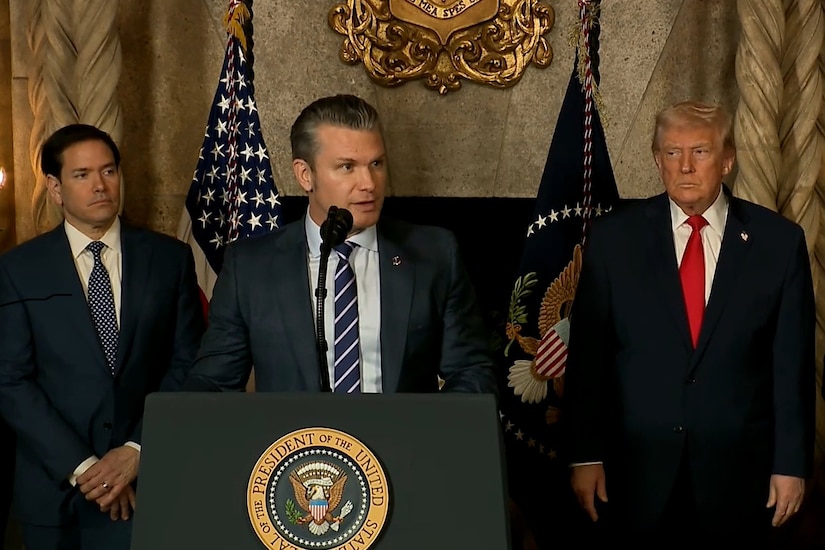
A man in business attire stands and speaks at a lectern with the American flag to the left behind him. Three men in similar attire stand behind him.

"As commander in chief, it's my great honor to announce that I have approved a plan for the Navy to begin the construction of two brand-new, very large — largest we've ever built — battleships," Trump announced from his Mar-a-Lago residence in Palm Beach, Florida. He was joined by Secretary of State Marco Rubio, Secretary of War Pete Hegseth and Navy Secretary John Phelan. 

The new Trump-class of ships — which the president said will contribute to a new "golden fleet" of advanced warships — are currently in the design phase, with construction of the first battleship, the USS Defiant, targeted for the early 2030s. 

Phelan said that the new class of battleship is something the Navy "desperately needs." The president noted that the Navy aims to have a fleet of 20 to 25 ships eventually. 

"The future Trump-class battleship, the USS Defiant, will be the largest, deadliest and most versatile and best-looking warship anywhere on the world's oceans," Phelan said, adding that he wanted to thank the president for his vision to make the future battleship a game-changing capability for the U.S. Navy.    

Phelan also compared the future Trump-class battleships to the former Iowa-class battleships, which were a cornerstone of the Navy's warship fleet for much of the 20th century. 

"The Iowa was designed to go on the attack with the biggest guns, and that's exactly what will define the Trump-class battleships: offensive firepower from the biggest guns of our era," Phelan said.  

"This ship isn't just to swat the arrows; it is going to reach out and kill the archers," he added. 

During his remarks, Hegseth said that strengthening the Navy's fleet ties directly to the War Department's key goals of restoring the warrior ethos, rebuilding the military and reestablishing deterrence.  

"American strength is back on the world stage, and the announcement of the golden fleet anchored by new battleships — the biggest and most lethal ever — accomplishes all three of those things and marks a generational commitment to American sea power across the entire department," Hegseth said.  

During the announcement, Trump made clear that the new battleships are intended to be constructed entirely in the U.S. by American citizens. 

"The construction will create thousands of American jobs. We're going to have the jobs be created," he said. 

Along with standard guns and missiles, Trump said the new battleships will be equipped with hypersonic weapons, electronic rail guns and high-powered laser-based weaponry. 

He added that the Navy will take the lead in the ships' design, while partnering with the U.S. defense industrial base. 

"We're going to make battle groups great again, and this is just one piece of the president's golden fleet that we're going to build with the investments," Phelan said.  

The new Trump-class battleships will replace the Navy's previous plans to develop a new class of destroyer, the DDG(X). However, the sea service intends to incorporate the capabilities it had planned to employ on that platform into the new Trump-class ships.  

The last time the Navy used battleships in combat was in 1991 during the first Gulf War, when the now-decommissioned Iowa-class battleships USS Missouri and USS Wisconsin provided naval gunfire support against Iraqi targets along the coast of Kuwait.   

Today's announcement of the Trump-class battleships comes on the heels of the Navy's Dec. 19 announcement of the FF(X), a new class of frigates intended to replace the Navy's recently cancelled Constellation-class frigate program. 

The War Department Announces First Round of FY 2026 APFIT Projects, Surpassing $1 Billion Awarded to Small Businesses

The War Department today announced the first round of Accelerate the Procurement and Fielding of Innovative Technologies (APFIT) projects selected for Fiscal Year (FY) 2026, marking a historic milestone in advancing defense innovation and small business engagement for the program. With this announcement, APFIT has now awarded more than $1 billion to small businesses and non-traditional defense contractors across the nation, accelerating groundbreaking capabilities, strengthening the U.S. industrial base and enhancing warfighter readiness.

The FY 2026 project slate represents the next wave of innovative technologies rapidly transitioning from development to fielding and initial production. These awards continue to focus on delivering mission-critical capabilities at scale while expanding opportunity for small businesses in every region, including those in traditionally underrepresented and remote states.

"Crossing the billion-dollar threshold underscores APFIT’s commitment to America’s small business innovators," said Emil Michael, Under Secretary of War for Research and Engineering, "and we are proud to accelerate the delivery of these critical capabilities to our warfighters."

This year’s initial selections reflect the growing scale and maturity of the APFIT portfolio, with the average FY 2026 award now exceeding $30 million per project. The program also recorded its highest single award to date at $49.7 million, issued just under APFIT’s $50 million maximum statutory cap, demonstrating both the depth of operational need and APFIT’s ability to efficiently transition and scale mature technologies.

APFIT remains a cornerstone of War Department’s strategy to accelerate innovation and ensure the United States maintains its technological advantage. Additional FY 2026 projects will be announced throughout the fiscal year as they are selected.

The initial round of FY 2026 selections include*:

  • Autonomous Unmanned Ground Vehicle (UGV) for Ground Based Air Defense (GBAD), $20.00 million, U.S. Marine Corps
  • Deployable, Attritable Optical Systems, $22.15 million, U.S. Space Force
  • Domestic High Performance UAS Batteries, $28.00 million, U.S. Navy
  • Gremlin Low-Cost Munition, $35.00 million, U.S. Marine Corps
  • High Frequency Intercept Direction Finding and Exploitation (HIDES), $21.66 million, U.S. Army
  • Kraken 18 Communications Pod, $33.00 million, U.S. Navy
  • Miniaturized Gyroscope for Resilient Navigation, $20.00 million, U.S. Marine Corps
  • Mobile Smart Manufacturing for Airframe Spares, $25.00 million, U.S. Air Force
  • Augmented Maneuver Vehicle for Satellites, $48.50 million, U.S. Space Force
  • Real-Time Command and Control at the Tactical Edge, $49.70 million, U.S. Army
  • Small Uncrewed Maritime Vessels, $24.00 million, U.S. Navy/U.S. Marine Corps
  • Tactical High-Bandwidth, Low-Latency, high-capacity data network, $10.00 million, U.S. Marine Corps
  • Trolling Uncrewed Navigation Assistant (TUNA) Seeker, $35.00 million, U.S. Marine Corps
  • Whaleshark Autonomous Low-Profile Vessel (ALPV), $29.49 million, U.S. Marine Corps

*Does not include classified selections.

The Department of War Releases the 2026 Continental U.S. Cost-of-Living Allowance Rate

The Department of War released the 2026 Continental United States Cost-of-Living Allowance rates today. These new rates will go into effect Jan. 1, 2026. As a result of the 2026 adjustment, $99 million will be paid to approximately 127,000 uniformed service members stationed within Continental United States next year.

Continental United States Cost-of-Living Allowance is a supplemental allowance provided to service members and designed to help offset higher living expenses in the highest-cost locations in Continental United States. An area is considered high-cost if the non-housing cost of living for that area, inclusive of categories such as transportation and goods and services, exceeds a threshold of 107% of the national average. 

By law, a Continental United States Cost-of-Living Allowance rate is only prescribed when the index meets a certain threshold above the Continental United States average. Service members assigned to duty stations where the non-housing cost of living is at least seven percent above the national average are eligible for Continental United States Cost-of-Living Allowance. Data is adjusted to account for Basic Allowance for Subsistence, which is meant to offset the costs for a service member's meals and cost savings gained from shopping at commissaries and exchanges. 

For 2026, these are the Continental United States Cost-of-Living Allowance changes:

  • Six military housing areas will begin receiving Continental United States Cost-of-Living Allowance; 
  • Eight military housing areas will receive an increase in Continental United States Cost-of-Living Allowance; 
  • Two military housing areas will continue receiving the Continental United States Cost-of-Living Allowance; 
  • Two military housing areas will receive a decrease in Continental United States Cost-of-Living Allowance;
  • Nine military housing areas will no longer receive Continental United States Cost-of-Living Allowance; and
  • 21 counties will lose Continental United States Cost-of-Living Allowance for non-military housing areas in non-metropolitan counties. 

Military housing areas with the highest Continental United States Cost-of-Living Allowance rates:

  • San Francisco, California        8%
  • Oakland, California            6%
  • Santa Clara County, California    5%
  • Staten Island, New York        5%
  • Seatle, Washington            5%

Military housing area with the largest decrease: 

  • Humboldt County, California    5% to 0%

Military housing area with the largest increase: 

  •  Seattle, Washington            0% to 5%

The total amount of Continental United States Cost-of-Living Allowance a service member receives varies based on geographic duty location, pay grade, years of service, and dependency status. Service members can calculate their Continental United States Cost-of-Living Allowance rate at https://www.travel.dod.mil/Allowances/CONUS-Cost-of-Living-Allowance/CONUS-COLA-Rate-Lookup/.  

Additional information about Continental United States Cost-of-Living Allowance can be found on the Defense Travel Management Office website at https://www.travel.dod.mil/Allowances/CONUS-Cost-of-Living-Allowance/

FY25 Sees Best Recruiting Numbers in 15 Years

 Dec. 22, 2025 | By Matthew Olay, Pentagon News

In fiscal year 2025, the military's recruiting efforts returned to levels not seen in more than a decade. 

"Since November 2024, our military has seen its highest recruiting percentage of mission achieved in more than 15 years," stated Chief Pentagon Spokesman Sean Parnell. 

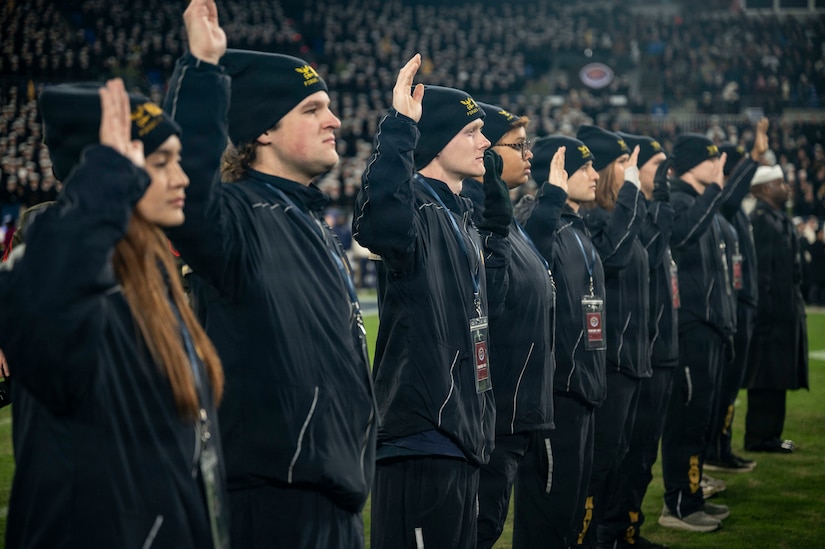
About a dozen people in winter athletic clothing stand on a field of grass, raising their right hands.

This fiscal year, all active-duty services made mission. Most reserve components also met their mission goals, with the exception of the Army Reserve, which met 75% of its goal. 

How the active-duty components of each branch met their goals breaks down as follows: 

  • The Army had a goal of 61,000 recruits and attained 62,050, totaling 101.72% of its goal. 
  • The Navy had a goal of 40,600 recruits and attained 44,096, totaling 108.61% of its goal. 
  • The Air Force had a goal of 30,100 recruits and attained 30,166, totaling 100.22% of its goal. 
  • The Space Force had a goal of 796 recruits and attained 819, totaling 102.89% of its goal. 
  • The Marine Corps had a goal of 26,600 recruits and attained 26,600, totaling 100% of its goal. 

All told, the five service branches collectively accomplished their mission with an average completion rate of 103%. 

Department leaders noted several factors that contributed to the strong recruitment numbers.  

"In 2025, the department exceeded our annual active-duty recruitment accession goals across all five services. ... Why? Because we have a commander in chief and a secretary of war who are focused on our troops and our mission, and on ensuring that we remain the most lethal fighting force on the planet," Undersecretary of War for Personnel and Readiness Anthony J. Tata said during a speech at a defense forum earlier this month.  

"Our nation's young people are responding," he added. 

Two women in casual attire stand in a room, their right hands raised, facing a woman in a camouflage military uniform who is also raising her right hand.

Parnell also noted that leadership was a major factor in this year's recruiting results.  

"If you look at the data from November, from the election of President Trump and then Secretary Hegseth's confirmation thereafter, the numbers that we've seen during that time period have been historic." 

Tata and Parnell co-chair the department's Recruitment Task Force. 

Beyond the quality of leadership in recruitment, driving up numbers, the services have instituted practical improvements that are supporting recruiting gains. These changes include courses that help improve overall aptitude among recruits and enhanced medical screening processes.  

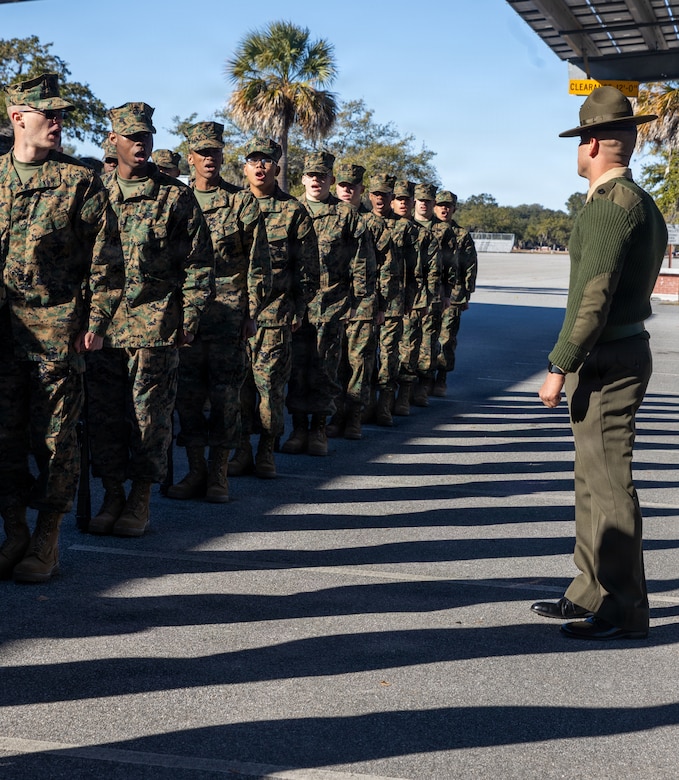
Ten people in camouflage military uniforms stand in line outdoors as a man in a formal military uniform observes them.
As an example of the latter, a medical records accession pilot program has significantly cut down on waiting times from when a recruit's initial paperwork is submitted to when they are allowed to be taken in by their local Military Entrance Processing Station. 

As little as a year ago, it could take up to 10 days between when a recruiter submits a recruit's initial accession paperwork and when that individual could find out if they have been cleared. Today, it takes one day or less. The new focus on speed helps avoid potential recruits from losing interest in serving.  

Regarding the current fiscal year, the department's recruiting efforts are already off to a strong and promising start, with the department having met nearly 40% of its delayed entry program accession mission at the start of fiscal year 2026.

"This is a historic figure and a testament to our support from the president and the secretary, as well as the great work being done by each of the services," said Tata. "The department is on track to once again meet our recruiting mission." 

There are always challenges in recruiting, with recruiters continuously working to increase interest among the youth market and medical disqualifiers plaguing the potential recruiting pool among them. 

To address some of these, the department is working to counter any pervasive misconceptions among the youth market about what it means to serve by highlighting the benefits of wearing the country's cloth. 

"Recruiting is a no-fail mission," Tata said. "We will continue to maintain focus on sustaining our momentum, meeting our targets and securing the warriors we need to achieve peace through strength."

Medal of Honor Monday: Army Tech. Sgt. Peter Dalessandro

By valiantly fighting his way through Europe and surviving as a prisoner of war, Army Tech. Sgt. Peter Joseph Dalessandro became one of the most highly decorated soldiers of World War II. When he started a career as a state senator afterward, he did so as a Medal of Honor recipient.

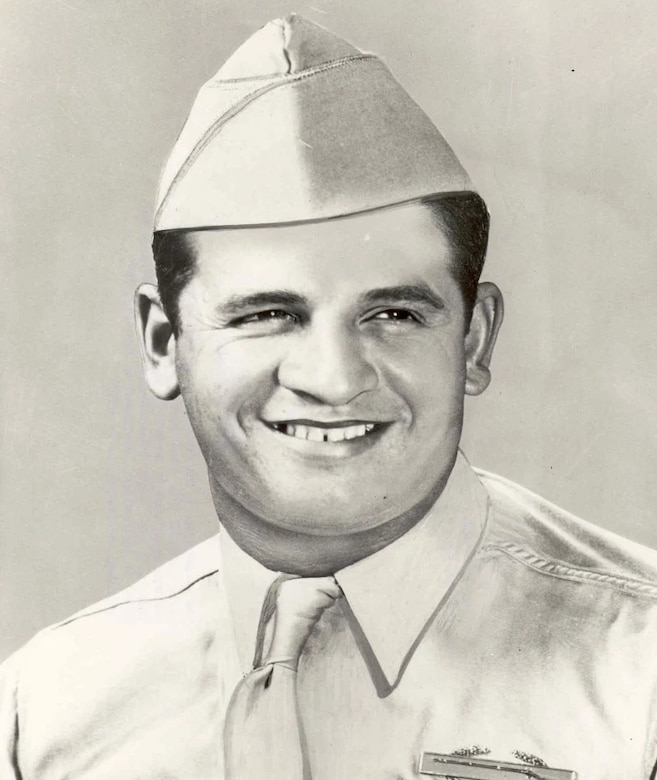
A man in a cap and military dress uniform smiles for a photo.

Dalessandro was born May 19, 1921, in Watervliet, New York, to Emilio and Maria Dalessandro. He had three brothers and two sisters and was educated in public schools. Little else has been published about his childhood.

When World War II broke out, Dalessandro joined the Army, and it didn't take long for him to get involved in combat overseas. He took part in the invasions of North Africa, Sicily and Normandy, France, before fighting his way across Europe toward Germany.

Dalessandro was part of Company E, 1st Battalion, 39th Infantry Regiment, 9th Infantry Division, during the winter of 1944. Around Christmastime, his unit was ordered to replace another on the Belgian-German border during what became known as the Battle of the Bulge, Germany's last major offensive that surprised exhausted Allied troops in the region.

Several men in military uniforms ride on the outside of two tanks as they move along a paved road lined with trees. Several other soldiers in similar attire march behind the tanks.

On Dec. 22, 1944, Dalessandro's platoon was preparing to hold the line at an important road junction on high ground near Kalterherberg, Germany. They had only been there for about two hours when three enemy companies fired an intense round of artillery and mortars in their direction. Soon after, enemy soldiers charged at them in an attack that threatened to overwhelm the platoon's position.

Dalessandro saw his men faltering, so he braved the intense fire and made his way through the group to give them encouragement. Dalessandro then moved to a fully exposed observation post, where he adjusted mortar fire onto the enemy soldiers while firing at them with his rifle. The whole time, he continued to encourage his platoon to push back the attack.

When the enemy launched a second attack later that day, Dalessandro again took control of the situation by rushing to a forward position and calling for mortar fire.

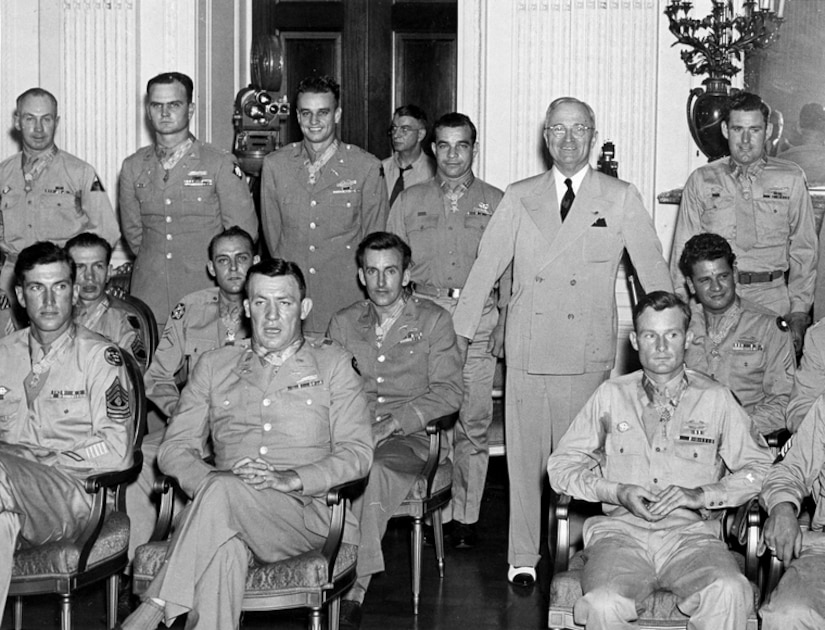
A man in a suit stands next to seated and standing men in military dress uniforms as they pose for a photo.

When he ran out of rifle ammunition, Dalessandro crawled 30 yards across exposed ground to grab a light machine gun, which he took back to his position and fired toward the enemy at nearly point-blank range until it jammed. Thankfully, Dalessandro managed to get the gun to fire one more burst, which took out four German soldiers who were about to kill two wounded U.S. soldiers and a medical corpsman in a nearby foxhole.

As the enemy moved in, Dalessandro didn't retreat. Instead, he hurled grenades and called for mortar fire that came closer and closer to his position, all while covering his platoon so they could withdraw. As German soldiers swarmed him, Dalessandro was heard calling for yet another barrage, yelling, "OK, mortars, let me have it right in this position!"

Dalessandro's bravery and fearlessness allowed his fellow soldiers to escape. However, he was captured and held prisoner for about five months until the war ended. He was then sent back to the U.S.

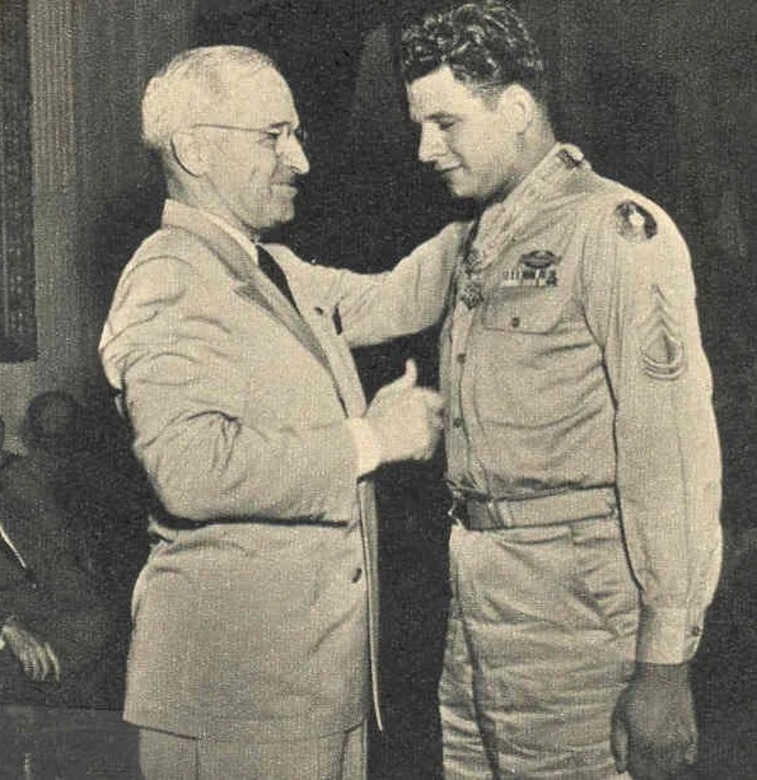
An older man in a suit puts his hand on the shoulder of a younger man in a military dress uniform.
During a White House ceremony Aug. 23, 1945, Dalessandro received the Medal of Honor from President Harry S. Truman for his courage in Europe. He was one of 28 service members who received the honor that day. Dalessandro had also received three Purple Hearts, two Silver Stars, a Bronze Star and the French Croix de Guerre, making him one of the most decorated soldiers of World War II.

Soon after returning home, Dalessandro turned to politics. He was elected as a Democrat to the New York state senate in 1946 and served six terms in that capacity until resigning in 1957 to become the secretary to the Senate minority leader, according to a 1997 article in the Massachusetts newspaper the North Adams Transcript.

That same year, Dalessandro married Patricia Farley. The pair had two daughters, Maribeth and Bernadette.

Dalessandro moved to Latham, New York, in 1969, where he remained until he died on Oct. 15, 1997. The World War II veteran is buried in Saratoga Springs National Cemetery in Saratoga Springs, New York.

In 1987, Dalessandro Boulevard in Albany County, New York, was dedicated in his honor.