Friday, February 06, 2026

Army Marksmanship Instructors Increase Lethality During M7 Training

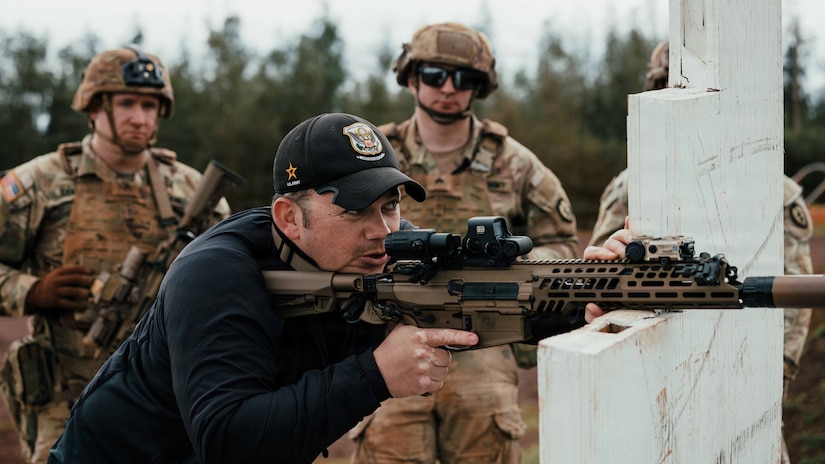
Soldiers assigned to the 25th Infantry Division trained at the Schofield Barracks, Hawaii, in January on the Army's newest service rifle, the M7, with instructors from the U.S. Army Marksmanship Unit providing hands-on support focused on marksmanship fundamentals.

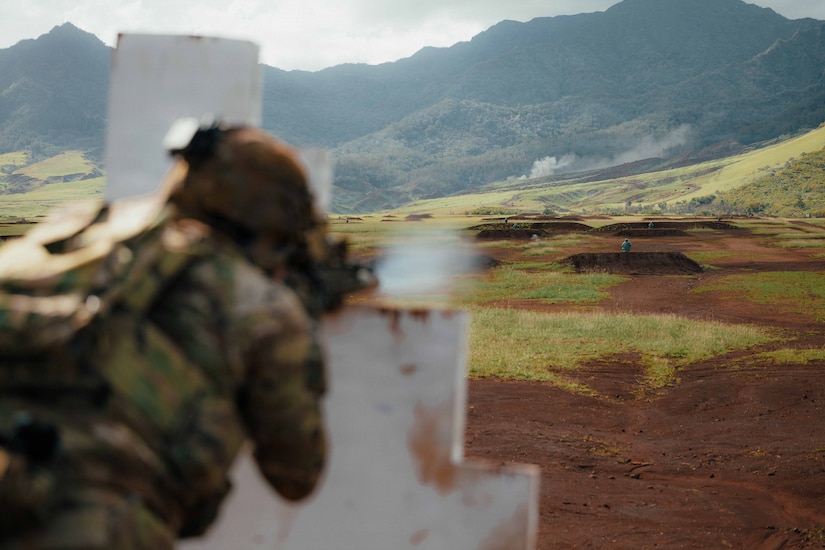
Three people in camouflage military uniforms and helmets stand and observe a man wearing casual attire and a baseball cap as he stands and aims a military rifle out of frame; the rifle is balanced on a white support structure, and trees are in the background.

The instructors worked alongside soldiers to reinforce proven shooting techniques that apply across weapon systems and assisted with ongoing M7 fielding efforts alongside program partners.

"We are working with instructors from [the program executive office] and [the U.S. Army Tank-automotive and Armaments Command] to assist in the net fielding efforts and provide marksmanship instruction and guidance to both the students and instructors as they field the next generation squad weapon," said Army Sgt. 1st Class Alexander Deal, team chief for the U.S. Army Marksmanship Unit Service Rifle Team, adding fundamentals remain critical when soldiers transition to a new platform.

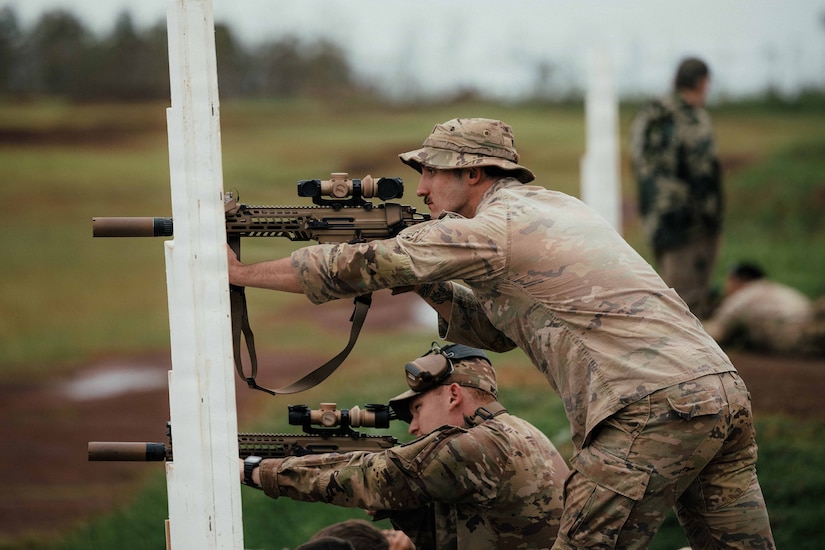
Two men in camouflage military uniforms, one standing and one kneeling in a grassy terrain, aim military rifles out of frame; the rifles are balanced on white support structures. Three other people in similar attire are doing the same in the background.

"It's hard to say what fundamentals matter the most. They're all equally important, but establishing a consistent and stable position, consistent head placement, proper sight alignment, and trigger control are going to make shooting a new weapon system a lot easier," Deal said.

According to Deal, competition-style training exposes shooters to stressful and unfamiliar scenarios that highlight their strengths and weaknesses.

"[It] can help soldiers' combat effectiveness by putting them into new scenarios they may not have been in before and putting them under the stress of time, speed or accuracy to assess their level of training and where there may be room for improvement," he said.

Deal emphasized that consistency must come before speed, especially for developing shooters.

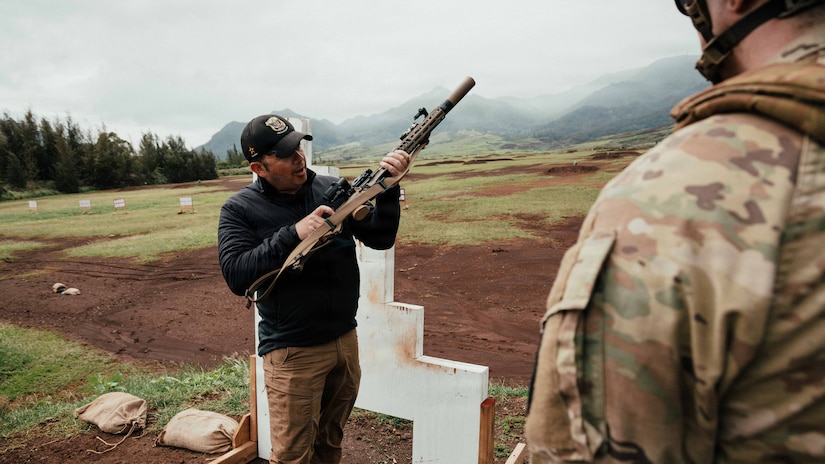
A man in casual attire and a baseball cap holds a military rifle outside in grassy terrain on a cloudy day with trees in the background, as a person in a camouflage military uniform stands partially out of frame and observes.

"It's hard to start fast and figure out what you're doing wrong versus slowing things down, assessing fundamentals and building up speed and distance [over time]," he said.

The training course is focused on noncommissioned officers returning to their units.

"The NCOs are getting familiarized with the weapon systems and optics so they can go back and train other NCOs, officers and their soldiers, and begin proper marksmanship training," Deal said, adding that the long-term goal is to sustain improvement across Army units.

Two men in camouflage military uniforms, one standing and one kneeling in a grassy terrain, aim military rifles out of frame; the rifles are balanced on white support structures. Three other people in similar attire are doing the same in the background.

"They're going to transfer that knowledge to their soldiers and peers and hopefully make improvements to their marksmanship programs that carry over into better practices and increased lethality," he said.

Naval Installation Optimizes Warfighter Fitness

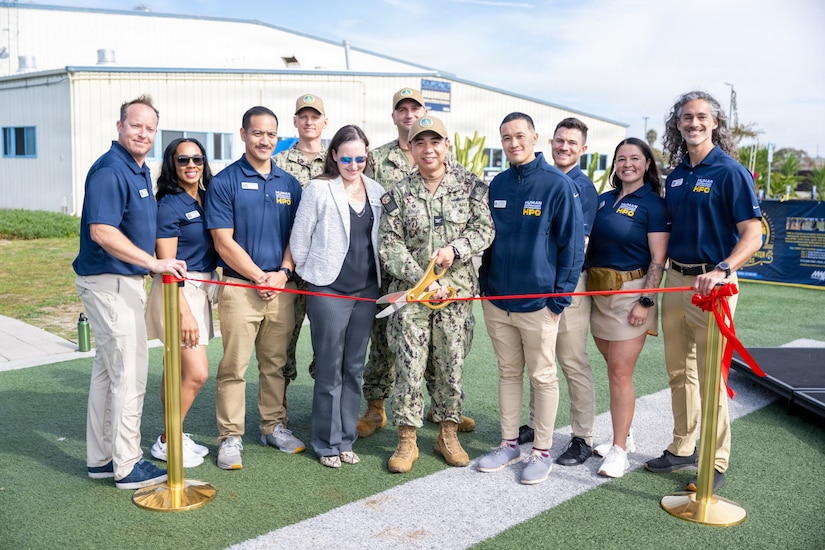
The Navy's first and only Human Performance Optimization Program is officially open for business on board Naval Base San Diego. Navy Capt. Brian Bungay, base commanding officer, marked the milestone during a ribbon-cutting ceremony at the Harborside Sports and Fitness Complex Feb. 2.

About a dozen people in athletic attire and camouflage military uniforms stand in front of a ribbon as a man in a camouflage military uniform uses large scissors to cut the ribbon. There is a large building in the background.

The program is a comprehensive, performance-based initiative designed to enhance an individual's physical, mental, emotional and nutritional capabilities in order to maximize effectiveness, productivity and overall well-being. 

"The Navy's vision is clear — to enhance individual and team effectiveness by ensuring the health and viability of our warfighters," Bungay said. "We must treat our sailors like world-class athletes, and the HPO initiative is a direct reflection of that vision." 

Navy fitness is expanding beyond traditional gym access and group exercise by introducing specialized staff, performance education and recovery-focused services specifically tailored to support warfighter readiness and resilience. 

"As we move forward with the Total Sailor: Fit to Fight initiative, we must have the tools in place to ensure sailors remain our top priority and are postured for maximum combat readiness," said Navy Master Chief Petty Officer Brian S. Metzger, Naval Surface Force, U.S. Pacific Fleet, command master chief. "The HPO Program brings top experts in nutrition, cognitive performance and fitness together under one roof — right near the waterfront — which is exactly what our sailors need and something that has never been done before."

Bungay emphasized that the program is designed to provide sailors with the resources necessary to build and sustain peak physical and mental performance.

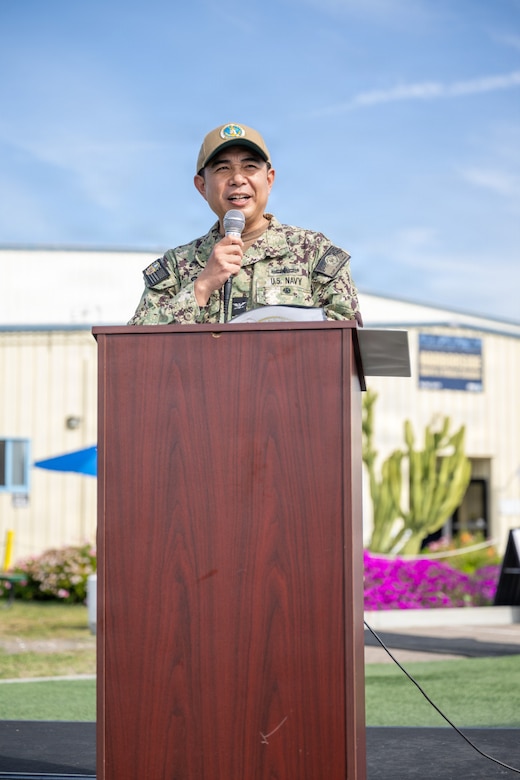
A man in a camouflage military uniform speaks into a microphone while standing behind a lectern. There is a large building in the background.
"While Navy fitness focuses on general facility access, group exercise and standard routines, HPO delivers the Navy's first performance-based program that supports the warfighter both inside and outside traditional brick-and-mortar facilities," Bungay said. "It's a place where sailors can push their limits, build resilience and develop the physical and mental toughness required to meet any challenge." 

Mary Kirby, Fleet and Family Readiness regional program director for Navy Region Southwest, echoed that sentiment, highlighting what sets HPO apart from existing programs. 

"Our [morale, welfare and recreation] fitness programs are outstanding, but sailors typically choose their own path," Kirby said. "What's different here is that sailors begin with a series of evidence-based assessments." 

Those assessments — conducted by specialized, credentialed staff operating within defined professional scopes — include body composition analysis, recovery modalities, physical training evaluations, sleep and recovery strategies, stress management tools and nutrition fueling education. 

"This model has been available at off-base commercial businesses and within select special warfare communities, but we're excited to be the first to offer it at the installation level," Kirby said. "Once metrics are collected and evaluated, the intent is to expand this program across the enterprise."

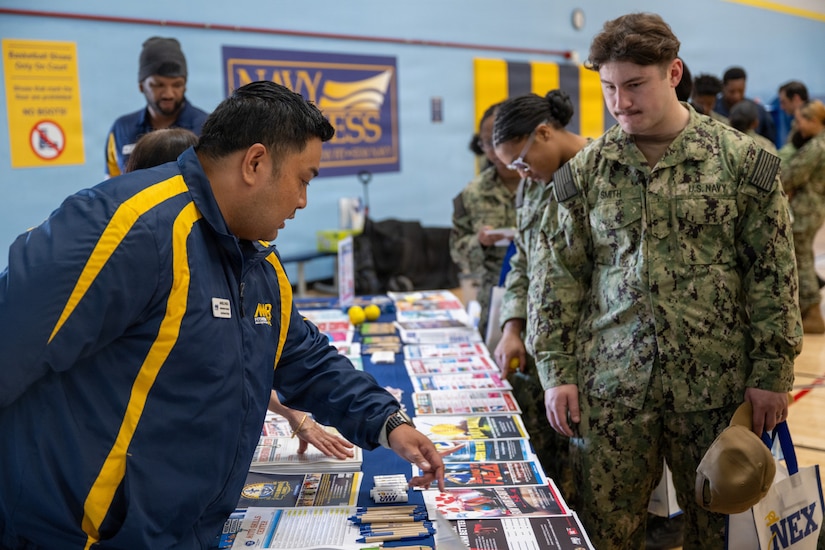
A man in athletic attire points to pamphlets on a table as another man in a camouflage military uniform looks down at the table. There are several people in camouflage military uniforms standing in the background.

Navy Petty Officer 2nd Class Troy Torres, an intelligence specialist assigned to Expeditionary Strike Group 3, encouraged fellow sailors to take advantage of the program. 

"Step one is easy — come to the [Harborside Sports and Fitness Complex]," Torres said. "Step two, talk with an HPO specialist. You'll quickly realize that fitness isn't just about gym equipment, sets and reps." 

Marines Establish Refueling Point in Indo-Pacific

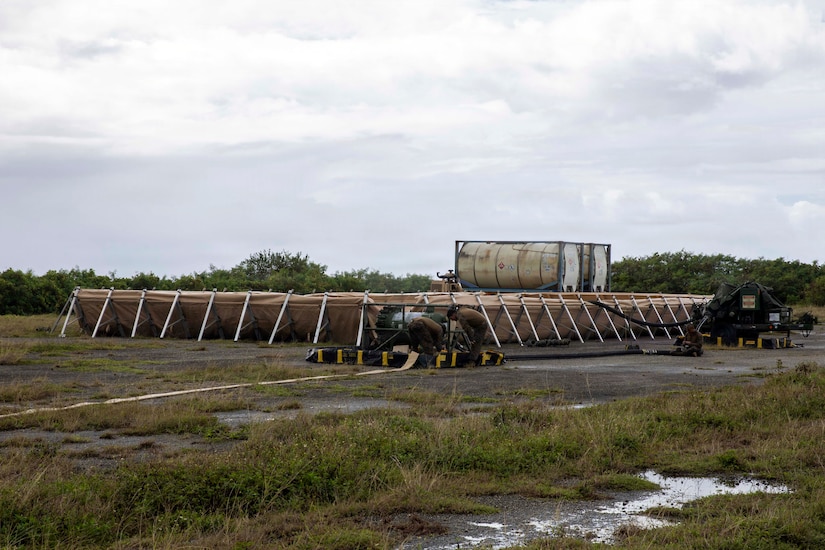
Marines assigned to Marine Wing Support Squadron 171 and Marine Fighter Attack Squadron 232 traveled to Tinian, one of the Northern Mariana Islands, to establish and operate a forward arming and refueling point during an aviation training relocation program aimed at developing expeditionary aviation capabilities and ensuring security throughout the Indo-Pacific region.

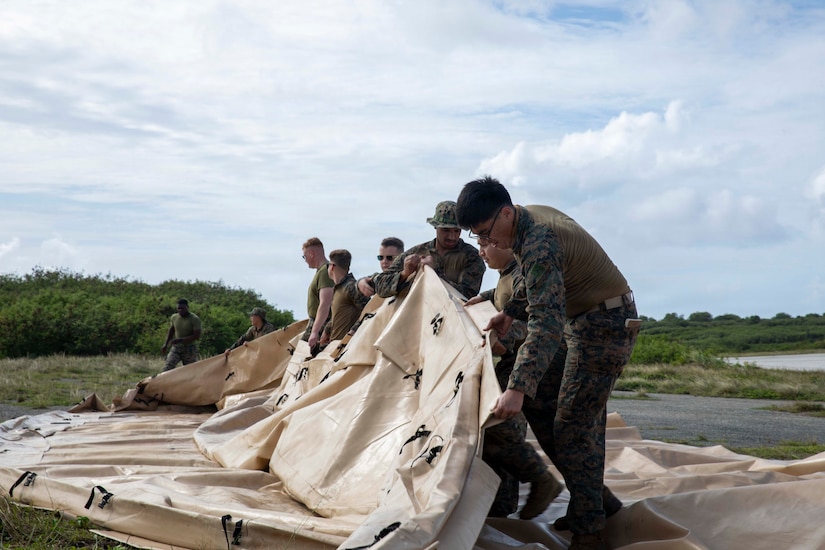
Nearly a dozen people in camouflage military uniforms lift a large beige tarp in a grassy terrain on a cloudy day.

"We are out here training to show we can set up a FARP anywhere quickly and provide support wherever the fight is happening," said Marine Corps Sgt. Kuyler Brown, an expeditionary fuels technician assigned to the support squadron.

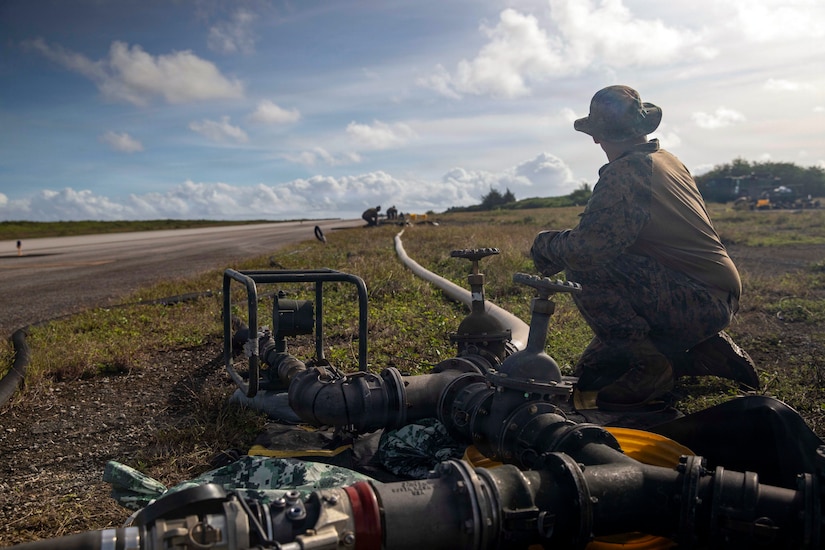
The FARP was used to conduct simulated real-world scenarios that gave Marines on the ground experience operating a live FARP and pilots the ability to operate away from their main operating base while receiving continuous support.

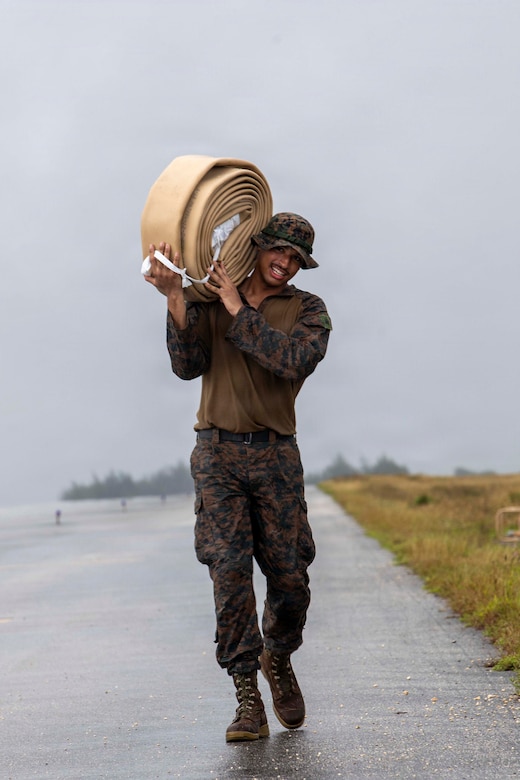
A man wearing a camouflage military uniform smiles while walking on a paved road and holding a large, wrapped water hose on his shoulder.

"Having a FARP allows us to stay in the fight," Brown said. "It cuts down on flight time, keeps our jets in the air longer and shows we can set up anywhere and operate." 

Tinian is located near Andersen Air Force Base, Guam, which provides the ability to rapidly refuel and support aircraft, making it a valuable training area for aviation training relocation operations and projecting power throughout the Indo-Pacific region.  

Conducting training from island locations like Tinian allows Marines to gain real-world experience practicing FARP assembly, disassembly and sustained aviation operations in austere environments — a key aspect of the expeditionary execution of a FARP.  

"This kind of training builds the Marines' confidence not only in their own capabilities but in each other," Brown said. "Our Marines know how to do their jobs, and exercises like this prove we can make it happen."

Two people in camouflage military uniforms set up a square structure outside in a grassy terrain on a cloudy day.
A man in a camouflage military uniform looks off into the distance while turning on the faucet of a long water hose in a grassy terrain on the side of a road under a blue sky with clouds; other military personnel are at the far end of the hose.
The successful setup and operation of the FARP at Tinian demonstrated Marine Wing Support Squadron 171's ability to deploy and support aviation operations in austere environments. Training events like this give Marines the chance to develop their skills and remain ready to support future operations focused on ensuring a free and open Indo-Pacific region.

Meet the Military Athletes Competing in the 2026 Winter Olympics

The 2026 Winter Olympic Games in Milan and Cortina, Italy, are fast approaching. As always, there's a contingent of U.S. military athletes who have qualified to represent their country on the biggest sports stage in the world.

While this Olympics will not feature any athletes from the Navy or Marine Corps, there are plenty of World Class Athlete Program participants from the Army and Air Force — including one who was named as a flagbearer for the opening ceremony.

Secretary of War Pete Hegseth is looking forward to speaking with several of these athletes during morale calls ahead of the games.

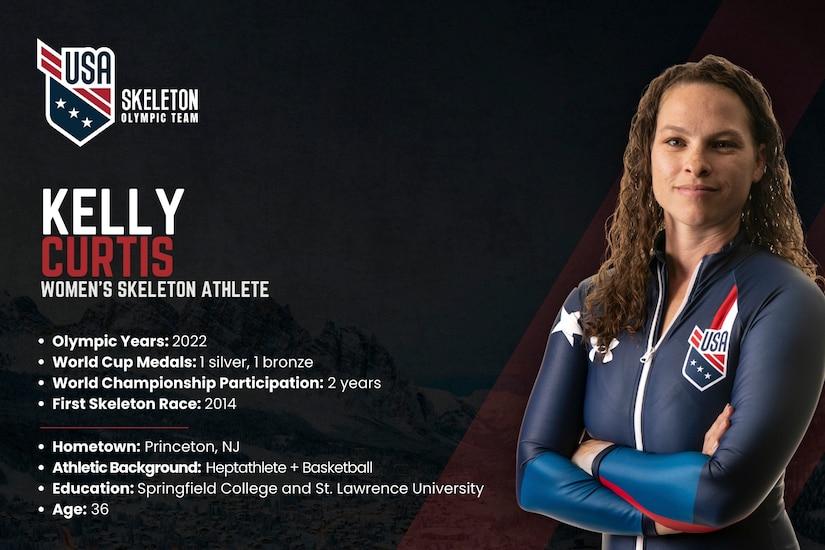
A graphic shows a photo of a woman wearing sports attire with her arms crossed over her chest. Statistics are listed beside the photo.

Air Force Staff Sgt. Kelly Curtis: Skeleton

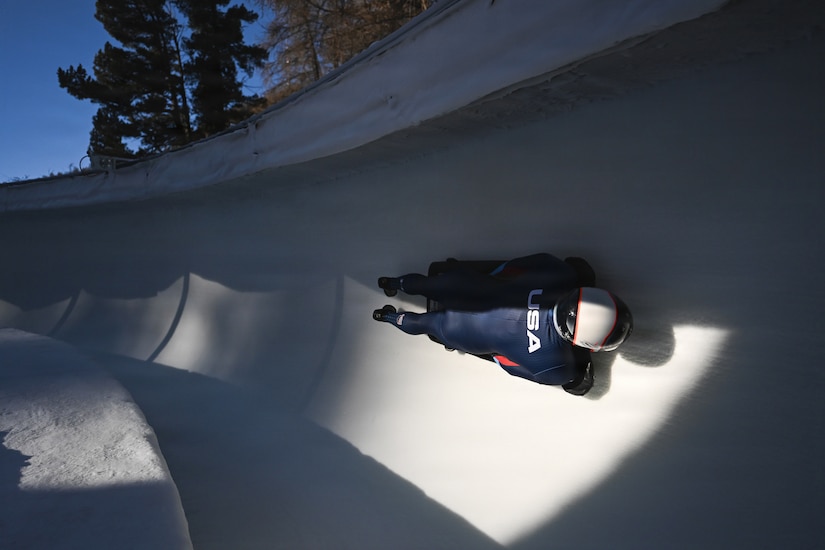
Air Force Staff Sgt. Kelly Curtis, 37, of Princeton, New Jersey, ranks 16th in the world in skeleton, a daring sliding sport in which athletes lie head-first and face-down on a small sled as they fly down a steep, icy track. Curtis happens to be the sport's top-ranked U.S. athlete.

Being athletic is a bit of a Curtis family trait. Her father, John, was an All-American football player, while her two brothers also played college sports. At Springfield College in Springfield, Massachusetts, Curtis competed in the heptathlon and won the event at the 2011 Penn Relays.

Soon after graduating in 2012, one of her coaches introduced her to bobsled, which she tried out for in 2013. But during her training, she saw skeleton athletes practicing and decided to switch to that sport.

A person glides quickly down an icy track in a tiny sled.

When she's not racing, Curtis serves her country and trains at Aviano Air Base, Italy, where she works in information management. She joined the Air Force and its World Class Athlete Program in August 2020 to support her career as an athlete, which seems to have paid off. Her talents took her to the 2022 Beijing Olympic Games, where she became the first Black athlete to represent Team USA in skeleton.

Just last month, Curtis earned silver at an International Bobsleigh & Skeleton Federation World Cup event in St. Moritz-Celerina, Switzerland, climbing her way to the podium after initially being in ninth place. In the same competition in December 2022, she came in third. She's also raced in multiple world cup and international competitions, consistently ranking among the top competitors.

Curtis has a master's degree from Saint Louis University, St. Louis, Missouri, and is married with one daughter.

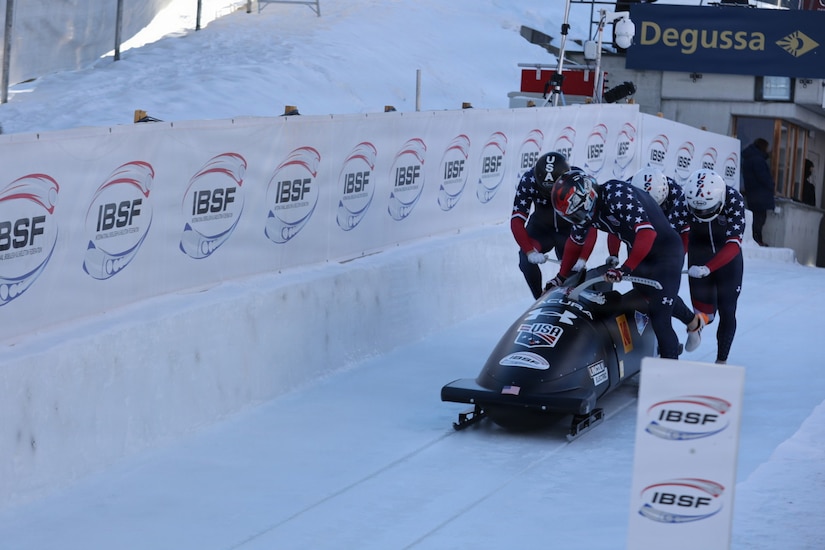
Four men wearing sports attire and helmets push a bobsled down a large, icy track.

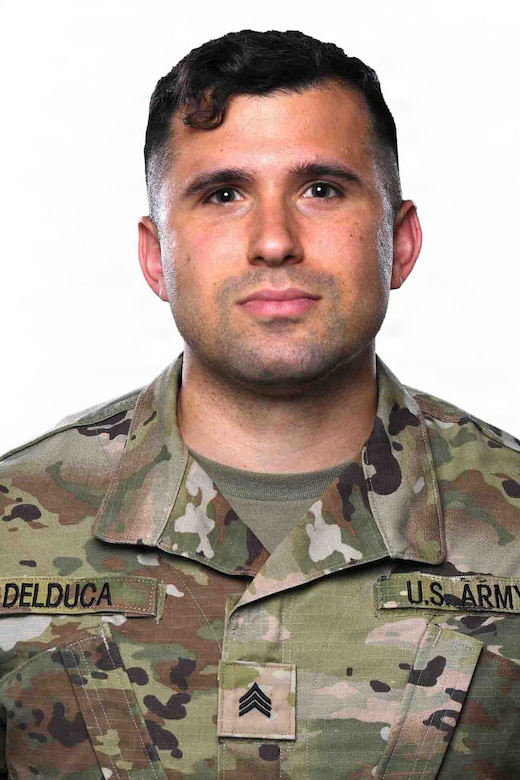
Army Sgt. Frank Del Duca: Bobsled

Army Sgt. Frank Del Duca, 34, of Bethel, Maine, will compete in the two-man and four-man bobsled events in Milan Cortina. This will be his second Olympics, having competed in the 2022 Beijing Games, where his four-man team placed 13th. His experience as an Olympian may be why he was named as one of the two U.S. flagbearers for the opening ceremony alongside veteran speed skater Erin Jackson.

Del Duca grew up as a world-class athlete, earning accolades as a high school state champion in alpine skiing before becoming a sprinter and long jumper at the University of Maine in Orono, Maine.

A man wearing a camouflage military uniform poses for a photo.

According to the Team USA website, Del Duca joined the U.S. Bobsled Team as a brakeman after college in 2016, but after failing to make the 2018 Olympics, he switched to pilot. That's also what brought him into the Army World Class Athlete Program, which he joined shortly after enlisting in 2019 as an infantryman. Del Duca said he witnessed the unit's discipline and leadership and thought it would upgrade his training. It turns out, he was right.

"I've learned so much about leadership, team building, accountability, setting standards, scheduling, punctuality — big things and small things that matter when you're part of a group working toward a common goal," Del Duca told Army writer Steve Warns.

At the March 2025 International Bobsleigh & Skeleton Federation World Championships in Lake Placid, New York, where Del Duca happens to train, he piloted his team to a fourth-place finish in two-man and four-man bobsled events. He told Warns he's excited for what's to come in Italy.

"When the cameras and lights are on, I find another gear," he said. "I push better and focus harder because the competition demands it. There are so many great teams, and everyone has to have their best day."

Del Duca is married with two sons.

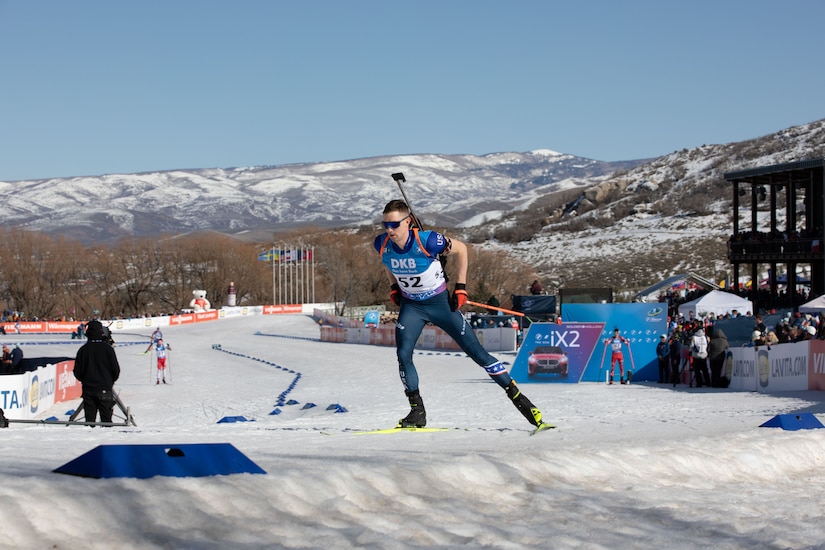
A man wearing sports attire skis along a flat, snowy course. Other skiers and spectators can be seen in the distance.

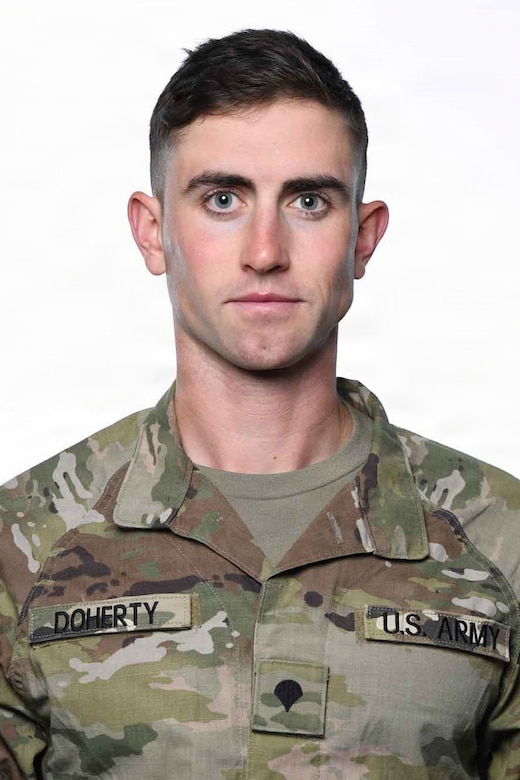
Army Spc. Sean Doherty: Biathlon

Army Spc. Sean Doherty, of Center Conway, New Hampshire, might be the most experienced military athlete this year, as he will compete on his fourth Olympic team in as many as six events.

A man wearing a camouflage military uniform poses for a photo.

Doherty began competing in biathlon, a sport that combines cross-country skiing with rifle shooting, at age 12. By the time he was 18, he was competing in the 2014 Sochi Olympics, becoming the first teenager and the youngest U.S. athlete to compete in the sport.

In 2018, Doherty enlisted in the Army as a carpentry and masonry specialist and is now a member of the Vermont National Guard. However, he didn't join the WCAP until after he competed in the 2022 Beijing Games. Now 30, Doherty said the experiences he's had with the WCAP continue to shape him.

"WCAP supports you not just as an athlete, but as a person and a soldier," he told Warns. "They care about my athletic performance, but they also care about my development as a whole person, and I'm grateful for that."

Doherty trains at the Ethan Allen Firing Range in Jericho, Vermont, which is home to the Army Mountain Warfare School. Outside of biathlon, he's an avid hunter, archer, fisherman and woodworker.

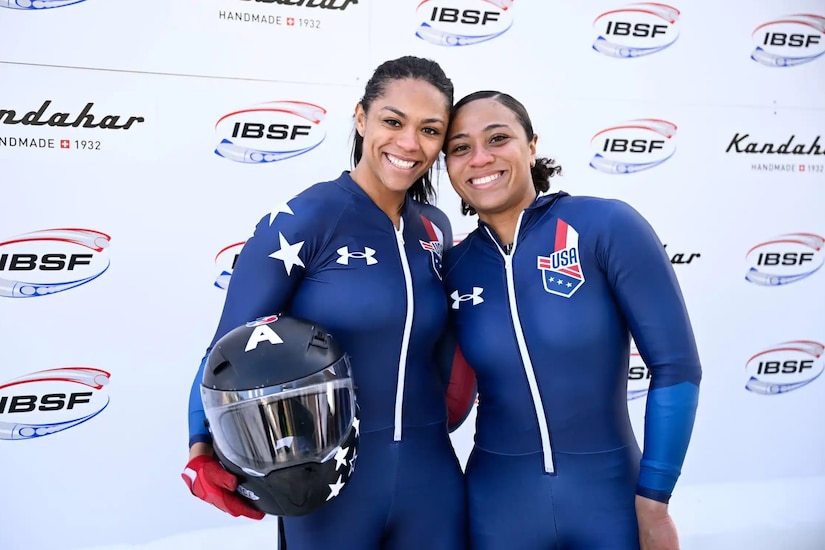
Two women in matching sports attire hug and smile for a photo in front of a wall with sponsorship logos on it.

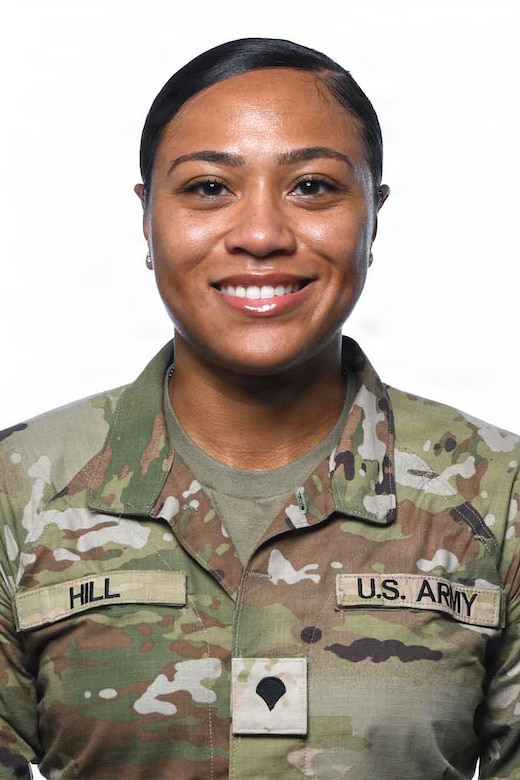
Army Spc. Azaria Hill: Bobsled

Army Spc. Azaria Hill, 27, of Santa Clarita, California, comes from a family of Olympians. She's the daughter of track and field star Denean Howard-Hill, a three-time Olympian who won gold and two silver medals; and Virgil Hill Sr., who earned the silver medal for boxing in the 1984 Los Angeles Olympic Games. Hill's aunt, Sherri Howard, is also a three-time Olympic medalist in track and field relay competitions.

"I just knew ever since I was a little girl ... I wanted to be like my mom and aunt," she said in her Team USA biography.

A woman wearing a camouflage military uniform smiles for a photo.

Hill was a sprinter on the track and field team at California State University, Long Beach, California, before finishing her college athletic career at the University of Nevada, Las Vegas. While there, she met U.S. bobsled pilot Kaysha Love, who competed in the 2022 Beijing Games. Love talked Hill into trying out for the bobsled brakewoman position after graduation.

Hill first competed with Love for Team USA in bobsled at the North American Cup in Lake Placid, New York, November 2023, finishing in first place. The pair went on to finish fourth at the 2024 IBSF World Championships.

Hearing the WCAP could provide benefits to support her athletic and professional career, Hill enlisted in 2024 as a motor transport operator and joined the unit.

"It provides resources, such as going back to school to obtain my master's and helping to become an officer," Hill said. "We work on all aspects of ourselves, not just athletics. They make sure we stay on top of classes and training, even overseas. They push us to grow professionally and athletically."

Like Del Duca, Hill is stationed in Lake Placid, New York.

A man and a woman wearing ice skates and figure skating costumes hold hands and smile as they glide across ice, each on one leg with the other kicked behind them into the air.

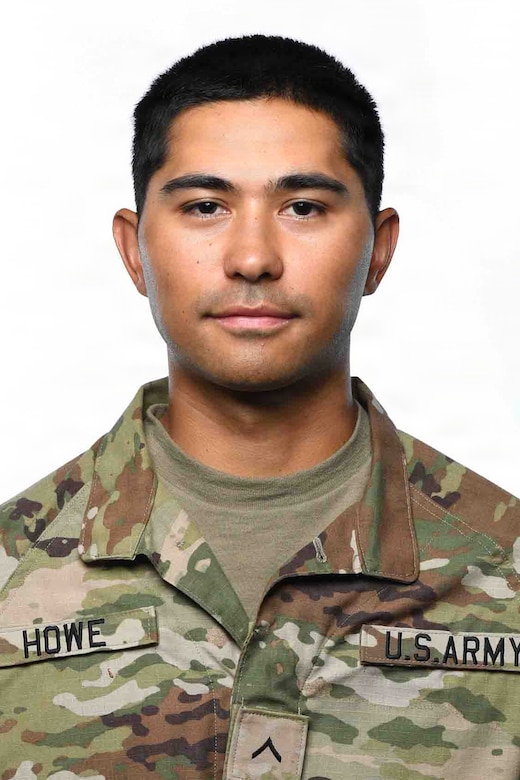
Army Pvt. Spencer Howe: Pairs Figure Skating

Army Pvt. Spencer Howe, 29, of Los Angeles, followed his sister into the sport of figure skating starting at age 9. By the time he was 18, he'd transitioned from a solo skater to pairs and was making a name for himself.

Unfortunately, in the spring of 2023, Howe needed surgery to repair a torn labrum, and it took a lot of time for him to recover before he could make a serious return to the sport.

During that downtime, Howe learned about the WCAP program. So, he enlisted in February 2025 as a motor transport operator and joined the unit shortly thereafter. He's the first figure skater to be a part of the program.

A man wearing a camouflage military uniform poses for a photo.

Last month, during the 2026 U.S. Figure Skating Championships, Howe and his skating partner of seven years, Emily Chan, qualified for the Olympic team for the first time. Howe told Warns that they finished eighth in the short program but secured their spot on the team by placing third in the free skate.

"We're grateful and honored," he said afterward. "Being able to serve my country and participate in my sport at the same time is an unbelievable opportunity that I am incredibly grateful to have."

Howe said his initial military training helped shape him into a better athlete.

"I started looking at skating from a soldier's perspective and not just an athlete," Howe said. "Taking on the responsibility to compete at the highest level — not just for Team USA but also for the Army — is a different level of commitment."

After continuing his education, Howe eventually wants to join the Chaplain Corps.

In his spare time, Howe coaches figure skating and hockey at The Skating Club of Boston, near where he and Chan train.

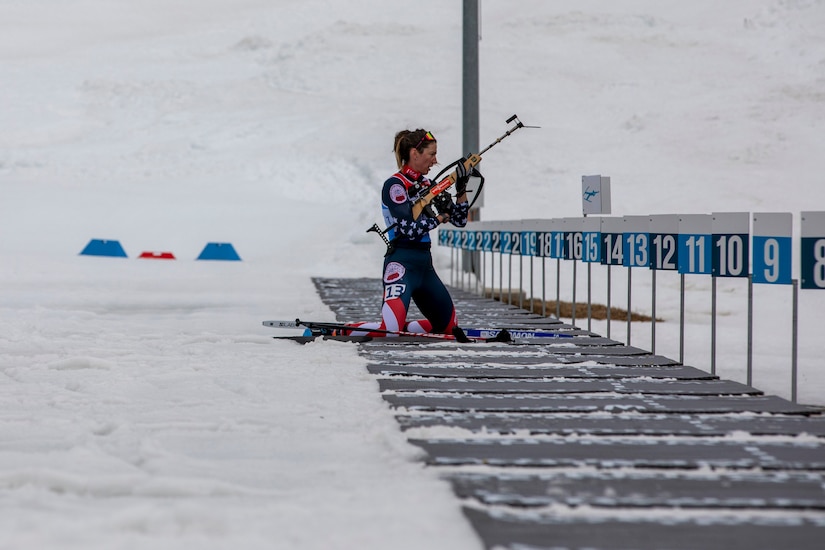
A woman wearing athletic attire and skis kneels in front of a line of numbered columns in the snow while preparing to aim a long gun.

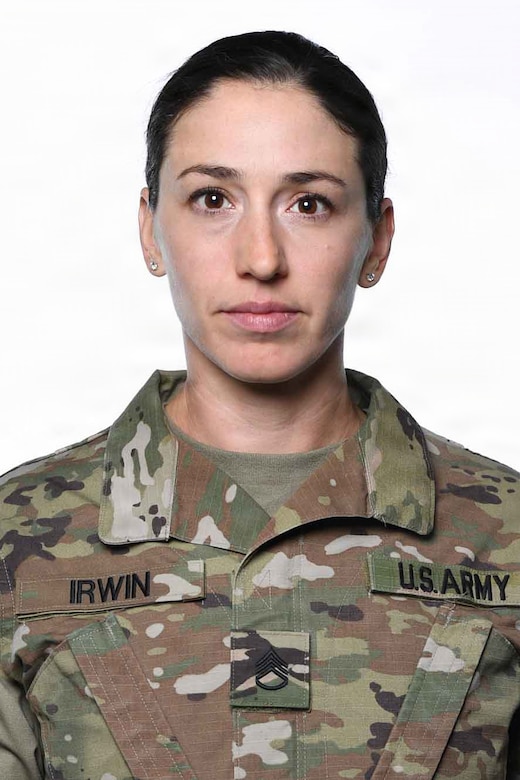
Army Staff Sgt. Deedra Irwin: Biathlon

In her first Olympics in 2022, Army Staff Sgt. Deedra Irwin placed seventh in the women's 15-kilometer individual biathlon — the highest finish for an American in biathlon history. Irwin is now the top female athlete for the U.S. Biathlon Team, and she could compete in six events in Milan.

Irwin, 33, of Pulaski, Wisconsin, is a human resource specialist with the Vermont National Guard. She enlisted in the Army in 2019 and competed for the National Guard Biathlon Team in the 2022 Games. In 2023, she joined the WCAP for its consistent support, which she said has made all the difference in both careers.

A woman wearing a camouflage military uniform poses for a photo.

"With WCAP, I have full-time orders, full-time benefits and direct access to resources," Irwin said. "Being both a platoon sergeant and an athlete have pushed me to learn a lot.

Growing up, Irwin wanted to be a track and field athlete. She picked up cross-country skiing in the winter during high school to stay in shape between the fall cross-country and spring track and field seasons. Irwin then went to Michigan Technological University in Houghton, Michigan, where she competed in all three sports.

After college, Irwin tried her hand at a professional skiing career. She didn't get started in biathlon until she was 25, when a fellow cross-country skier talked her into attending a talent camp. She told Team USA she instantly fell in love with the sport.

"It has been an honor to be able to represent my country as both a U.S. Olympian and a U.S. Army soldier," she said. "I hope to inspire the next generation to serve and represent our country, too."

Outside of biathlon, Irwin enjoys knitting, baking, puzzles and music.

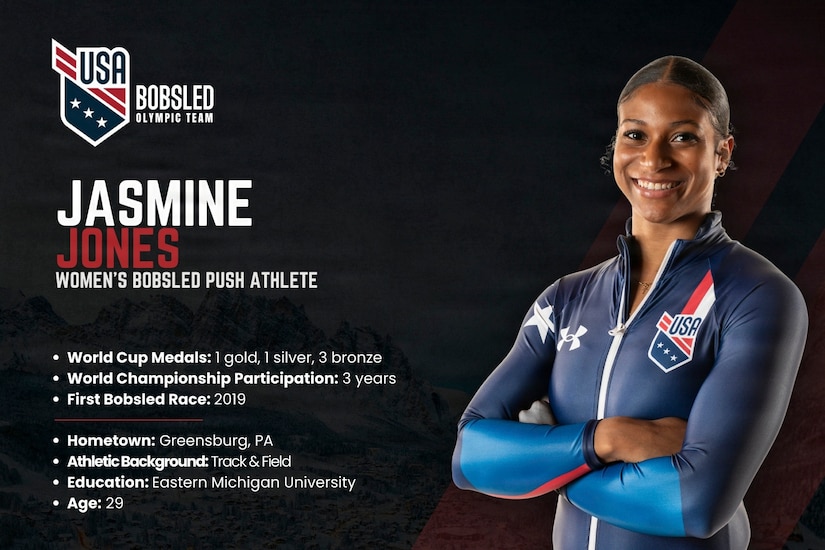
A woman wearing sports attire has her arms crossed over her chest while posing for a photo on a graphic that includes several stats about her and her sport.

Air Force Senior Airman Jasmine Jones: Bobsled

Air Force Senior Airman Jasmine Jones, 29, of Greensburg, Pennsylvania, is a brakewoman in the two-woman bobsled event. After competition this January in the St. Moritz World Cup in St. Moritz, Switzerland, the first-time Olympian can now say she's a gold-medal champion.

In high school, Jones was a standout basketball player and a two-time state champion in the 4x100-meter relay. She went on to become a sprinter for Eastern Michigan University in Ypsilanti, Michigan, where she was a five-time individual conference champion.

Jones' success led five-time Olympic medalist Elana Meyers Taylor to reach out, encouraging her to try out for the U.S. bobsled team. Jones took that advice. In the years since, she's competed in world championships and made the National World Cup team.

Jones enlisted in the Air Force in April 2023 as a material management specialist. She joined the WCAP to help bring stability to her busy life filled with work, training and raising her daughter, Jade.

"They allowed me to … have the support from the military as far as pay and benefits so I can truly focus on my sport. Then, on the back end of my contract, I give my time back, which is fine with me because I want a career in the military," she told the Amsterdam News out of New York City.

Just last month, Jones and her teammate, Kaillie Armbruster-Humphries, earned gold at the aforementioned IBSF World Cup two-woman bobsled race in St. Moritz, Switzerland. A few weeks later, they took silver at another IBSF World Cup race in Germany.

"[The] Olympics has always been a dream I've had. Now I can achieve those dreams by representing my country while being an airman," she said in her Air Force biography.

Jones trains in Lake Placid, New York.

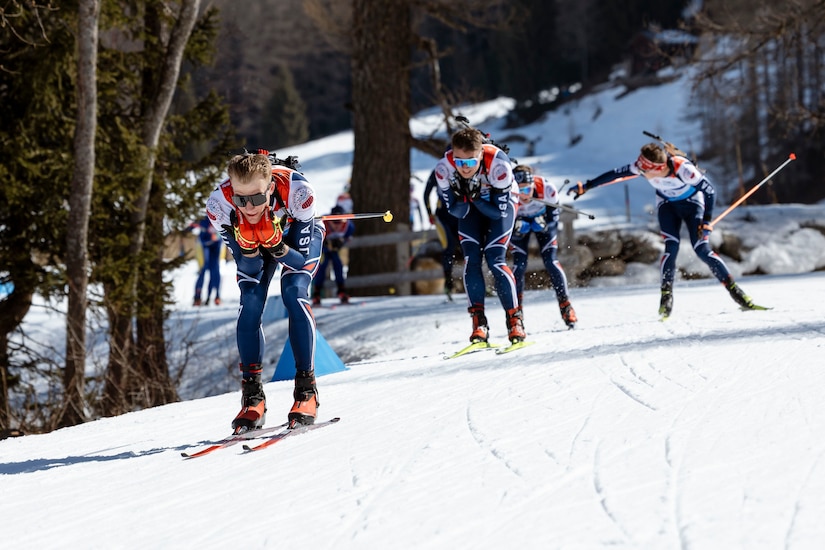
A man wearing sports attire hunches low on skis while leading a pack of racers down a snowy hill.

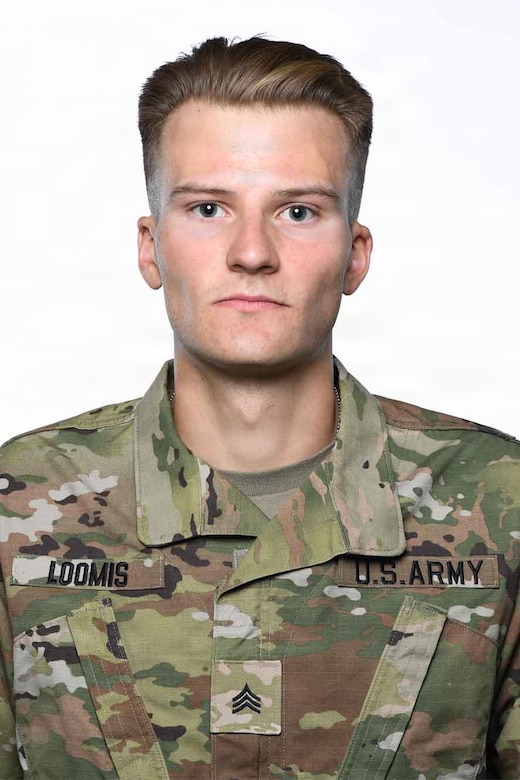
Army Sgt. Ben Loomis: Nordic Combined

Army Sgt. Ben Loomis, 27, of Eau Claire, Wisconsin, will compete in his third Olympics in the Nordic Combined event, which combines ski jumping and cross-country skiing. Loomis competed in the 2022 Beijing Games and the 2018 Pyeongchang Games in South Korea.

According to Nordic Combined USA, Loomis started ski jumping at age 5. His talents grew so quickly that, at 15, he moved to Park City, Utah, to find higher-caliber training and competition.

A man wearing a camouflage military uniform poses for a photo.

In 2019, after high school, Loomis enlisted in the Utah National Guard as a motor transport operator to join the WCAP for its opportunities. He told the Army that training for his sport requires power, endurance and strength — physical traits that are also required to carry out his military duties.

"Being an athlete and a soldier go hand in hand," Loomis said. "What I've learned in the military has helped my athletic career, and my athletic background has helped me as a soldier."

He said his experience in the military has been incredibly positive.

"I want to stay in after my athletic career, maybe even for a full career," Loomis said. "My reasons for joining and my reasons for staying are completely different now."

After earning silver in the 2016 Youth Olympic Games, Loomis was named the U.S. Ski and Snowboard Association's Nordic combined athlete of the year. He's been a member of four world championship teams, and his brother, Adam, is also a former world champion in the sport.

When Loomis isn't on the snow, he enjoys hiking, fishing, biking and water skiing.

Marines Prepare for Exercise Cold Response in Norway

A technical assistance and advisory team assigned to Blount Island Command, Marine Corps Support Facility Blount Island in Jacksonville, Florida, issued thousands of items to II Marine Expeditionary Force during a two-week cave draw in late January, marking a key step in unit preparations for Exercise Cold Response 26. 
 
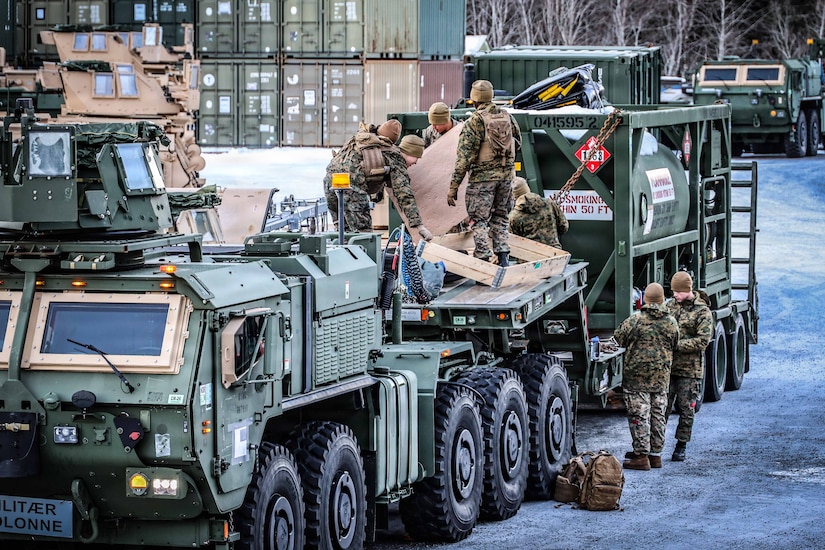
Marines preparing for the Norwegian-led winter exercise were equipped and supplied to operate in extreme cold-weather conditions. More than 14,000 items were issued, ranging from ready-to-eat meals and cold-weather gear to tactical vehicles and heavy trucks.

Six people in camouflage military uniforms load equipment onto a military vehicle, outside on an ice-covered road.

 
By drawing equipment and supplies from prepositioned stocks in Norway rather than shipping from the United States, the Marine Corps significantly reduced both time and cost. 
 
According to Buddy Cote, technical assistance and advisory team officer in charge, using prepositioned assets saves more than a month compared to a transatlantic shipment, including time in transit, staging, loading and unloading, while avoiding more than $2 million in transportation costs. 
 
"Blount Island Command's ashore prepositioning department directly supports the Marine Corps' doctrine for the rapid employment of expeditionary forces," Cote said.

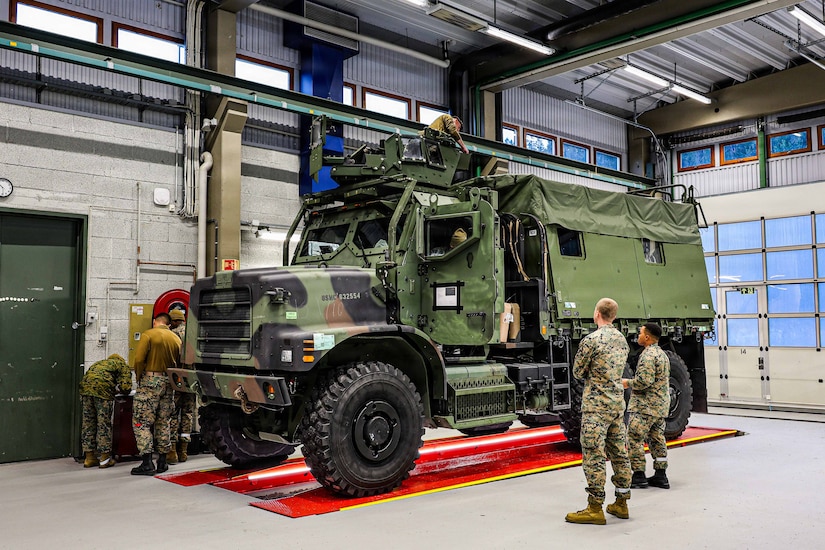
A large military vehicle sits on top of an inspection zone inside a warehouse as several people in camouflage military uniforms walk around it, and another person in similar attire stands on the roof of the vehicle.

 
The equipment is part of the Marine Corps Prepositioning Program Norway, which maintains combat-ready assets in climate-controlled caves across Norway. The program has sustained an over 90% equipment readiness rate for several years through rigorous life-cycle management, including proactive maintenance, repair and modernization. 
 
"The Marine Corps Prepositioning Program Norway reduces reaction times by providing combatant commanders with scalable and tailorable forces capable of executing limited objective missions across a wide range of military operations," Cote said. 
 
"This ongoing support strengthens NATO partnerships and ensures prepositioned assets are available for immediate use when called upon."

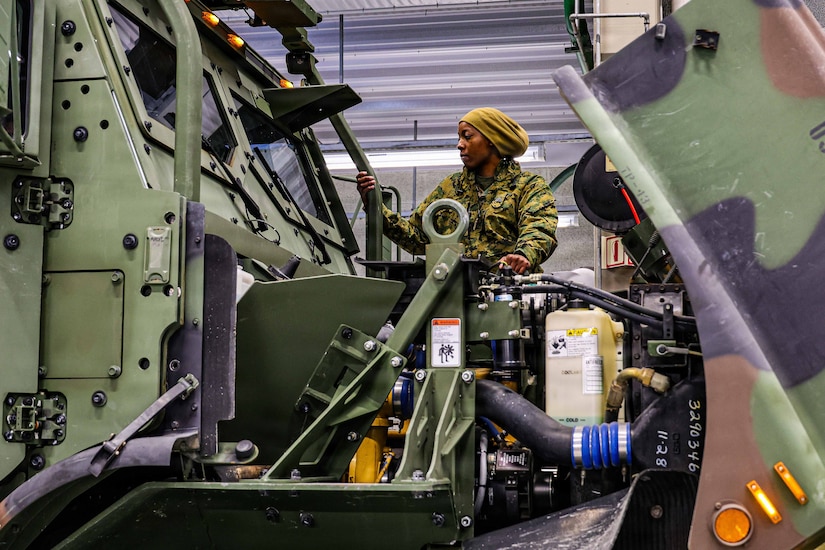
A woman in a camouflage military uniform stands on the ledge of a large military vehicle and looks to her right into the windshield of the vehicle.

 
Norwegian partners maintain and account for the prepositioned equipment on a day-to-day basis, a partnership that enhances interoperability and enables rapid integration during joint operations. The equipment is tailored to NATO standards, allowing Marines and allied forces to operate together seamlessly during exercises and contingency operations.