Friday, December 05, 2025

Air Force Celebrates 75 Years of Honor Guard Drill Team Excellence

For 75 years, the U.S. Air Force Honor Guard Drill Team has represented the discipline, precision and professionalism of the service to audiences around the world. 
 
Founded in 1950 to perform ceremonial honors in the National Capital Region, today the drill team operates from Joint Base Anacostia-Bolling, Washington, and performs more than 100 exhibitions each year across the globe. 
 
The team's legacy of precision has been built by seven and a half decades of airmen who refined every crisp movement to reflect the Air Force's commitment to excellence.

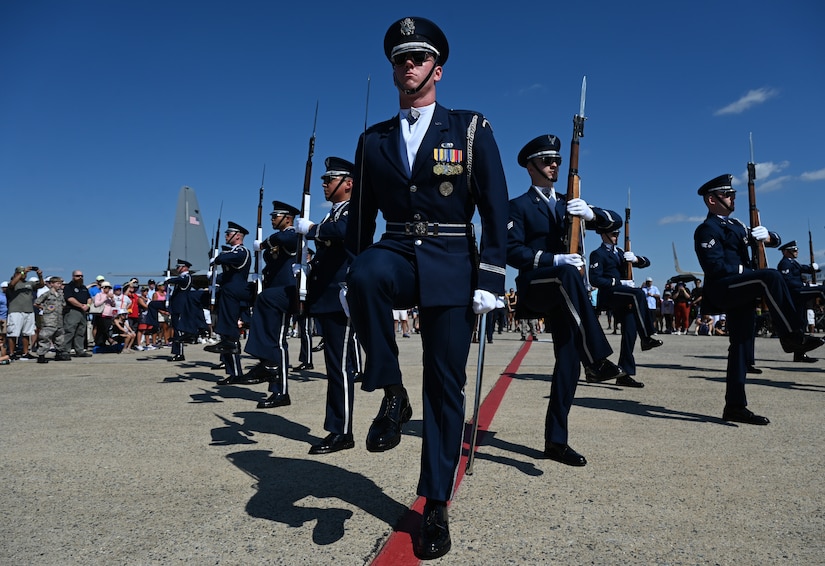
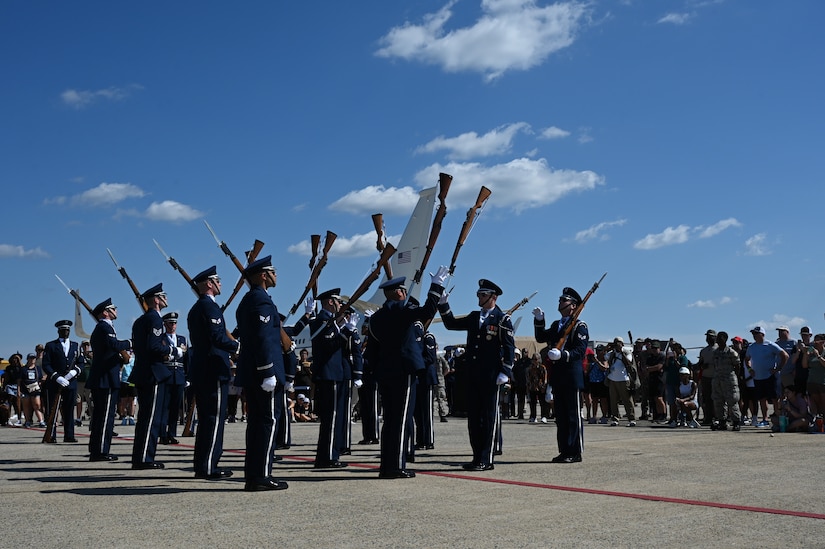
Airmen dressed in honor guard uniforms perform in a letter V formation. Several of the service members are holding rifles. There are people in casual attire observing in the background.

 
"We have been the living embodiment of that commitment," said Air Force Capt. Andrew Paquin, honor guard flight commander of ceremonial operations. "The core theme has been the same since the beginning. It's the relentless pursuit of perfection." 
 
Each member trains full time to master the team's seven-minute routine. Behind every public performance are thousands of hours of repetition and technical correction. 
 
"We break down every movement into its smallest components until the sequence becomes muscle memory," Paquin said. 
 
That dedication to excellence was evident during the 2025 Royal Edinburgh Military Tattoo in Scotland, where the team performed alongside international partners during driving rain and heavy winds. 
 
"Seeing the team perform in those conditions was a reminder of their resilience and ability to adapt and push through discomfort," Paquin said. "Being there on the ground with them created a bond built on mutual trust." 
 
That standard of excellence extends to mentorship and development within the team.  
 
"The main mission [of the honor guard] is to honor the individuals being buried at Arlington [National Cemetery]," said Air Force Senior Airman Richard Miles, honor guard drill team trainer. "Drill is the traveling component of that mission, the part that connects the public to who we are and what we represent." 
 
Miles wanted to join the unit after seeing a drill team performance during his time in Air Force technical training. After he was accepted, he spent more than a year working to become a trainer. 

Airmen dressed in honor guard uniforms pass their rifles to each other during a performance on a tarmac. There are people in casual attire observing in the background.

 
"I failed my first evaluation," he said. "I passed my second and from then on spent a lot of extra hours practicing by myself after group training ended." 
 
The extra hours he spent training paid off when he earned the position of drill team trainer and that perseverance now guides how he trains others. 
 
"We have a big-brother, big-sister program, where experienced drillers mentor new members," Miles said. "As a trainer, the best part is seeing people accomplish what they once thought they couldn't. It's about being a hands-on leader who sets the tone for excellence." 
 
The perfection that audiences see during drill team performances directly reflects the accountability and trust built in training. 
 
"We train to perform under fatigue, stress and pressure, because that's where excellence becomes habit," Paquin said. 
 
That high standard is recognized by symbols on each member's white ascot; the most advanced level of competency is represented by two stars. 
 
"The stars represent the best of the best," Miles said. "You can't earn them through just drills. You have to be the airman that leadership knows they can rely on, no matter what." 
 
While the uniforms, movements and routines have undergone changes during the 75-year history, the mission to represent the Air Force with honor remains steadfast. 

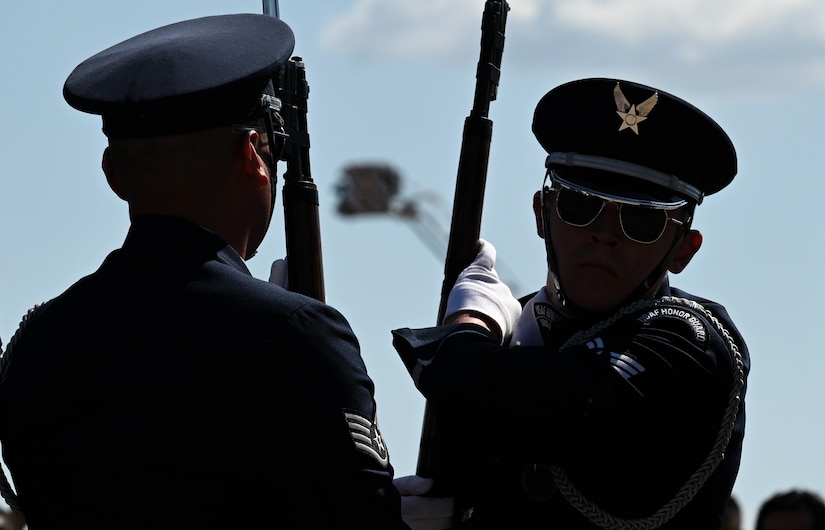
Two Airmen dressed in honor guard uniforms hold rifles while performing.

 
"When the team arrives at a performance, they're impressive, but the real magic happens afterward with the crowd interaction," Paquin said. "People see that the airmen behind the uniforms are young men and women from towns just like theirs. That's what builds trust with the American public." 
 
In an age of rapidly evolving technology, the human element is what continues to keep the drill team relevant. As the team looks ahead to its next major milestone, a centennial in 2050, Paquin said the focus will stay the same. 
 
"The Air Force Honor Guard Drill Team is needed now more than ever," he said. "It humanizes the Air Force mission, builds trust with the American public, and inspires future generations." 
Hegseth Presents Purple Heart to Soldier, Emphasizes Honoring Heroes

Secretary of War Pete Hegseth presented a soldier with the esteemed Purple Heart during a brief ceremony attended by just under two dozen service members and civilians in an aircraft hangar at the Dominican Republic's San Ysidro Air Base, Nov. 27.

A man in civilian attire pins a medal on a woman in a camouflage military uniform inside an aircraft hangar. The Secretary of War flag is next to the woman, and the nose of a fighter aircraft is in the background.

Army Master Sgt. Amy Vreeland qualified for the award as a result of a mild traumatic brain injury she suffered while deployed to Afghanistan in 2019. However, an administrative backlog resulted in her not receiving the award until January 2023 — roughly three and a half years after she sustained her injury. 

To make matters worse, the award was mailed to her instead of being presented.  

Prior to pinning the Purple Heart on Vreeland, Hegseth made clear that such stories are very relatable to him.  

He then spoke about an Army infantry leader of his in Iraq years earlier who, despite having shown great bravery and valor in combat, received his award — a Silver Star — in the mail, much like Vreeland. 

"And I remember how much that kind of stung him. … And it stuck with me," Hegseth said. 

He then explained that, since assuming the top leadership role at the Pentagon in January, his philosophy is that all awards based on valor should be presented in person, regardless of the unit the awardee is attached to or where in the world they are stationed.

A man in civilian attire and a woman in a camouflage military uniform stand inside an aircraft hangar holding an award certificate. The American flag and the Secretary of War flag are behind them

"Wherever you are, someone [should take] the time. It doesn't have to be a big ceremony; it could be something intimate like this," Hegseth said, noting that what's most important is that commands take the time to "recognize heroism [and] recognize excellence" in person.  

"Thank you, sir, for being here today; it's truly an honor that you have … taken your Thanksgiving to be here," Vreeland told Hegseth after he presented her with the Purple Heart. "I am truly humbled that you would take time out of your day to come here and recognize me. Thank you very much."   

Hegseth noted that the origin of the decoration — the oldest military device still given to military members — dates back to George Washington and the Revolutionary War. 

"So, it's as old as our country," Hegseth said of the Purple Heart, before reemphasizing the importance of presenting the decoration to Vreeland in person. 

"And I hope you'll do the same in your units," he told those in attendance. 

Vreeland continues to serve on active duty after 20 years of service despite ongoing complications from her injury. 

Hegseth Directs Task Force to Oversee Department-Wide Barracks Improvement

Secretary of War Pete Hegseth directed in an Oct. 6 memorandum that a barracks task force be stood up to develop a departmentwide investment plan for barracks improvements and report its progress to him within 30 days. 

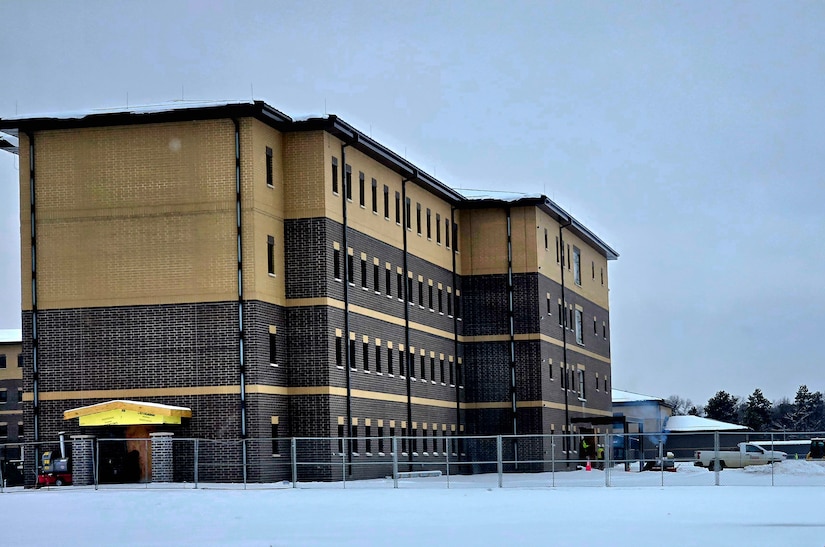
A four-story two-tone barrack is shown with snow on the ground.

"For far too long, this department has failed too many of our warfighters. Every member of our joint force deserves housing that is clean, comfortable and safe," he said in a Nov. 25 video posted to department social media sites. 

Too often, barracks are shabby and without basic modern amenities, Hegseth said. 

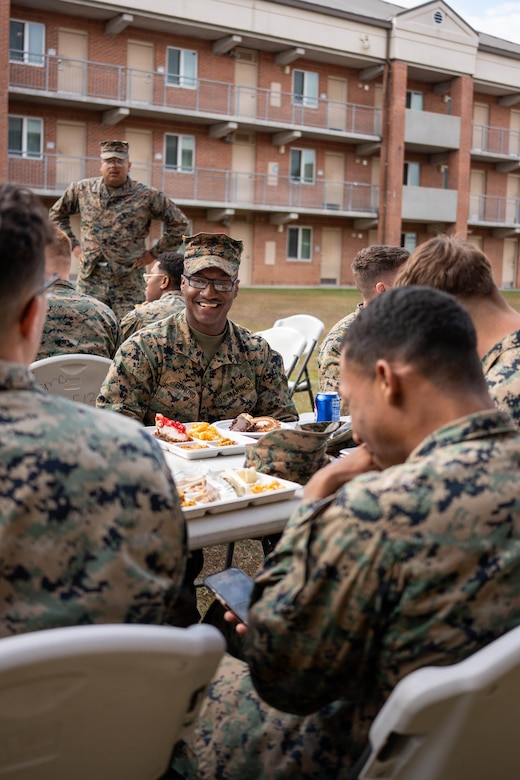
Troops in camouflage uniforms are seated at a table eating outside in front of a building.

"But this isn't just about creature comforts. This impacts morale, readiness and our ability to recruit and retain the best warriors. Quality of life for our warriors is a critical component of reviving the warrior ethos and rebuilding our military," he added.

Barracks are where warriors live, rest and recover, Hegseth said. 

"How can we expect them to be ready for anything on the battlefield when their own living space is a constant source of stress and frustration? That all ends now," the secretary said. 

The barracks task force includes representatives from across the War Department, including experts in contracting, leaders from military installations, and experts in personnel, readiness and finance. 

Hegseth expects the task force to deliver results and cut through the bureaucracy to bring immediate solutions, as well as a long-term plan to keep barracks at the standard warriors deserve. 

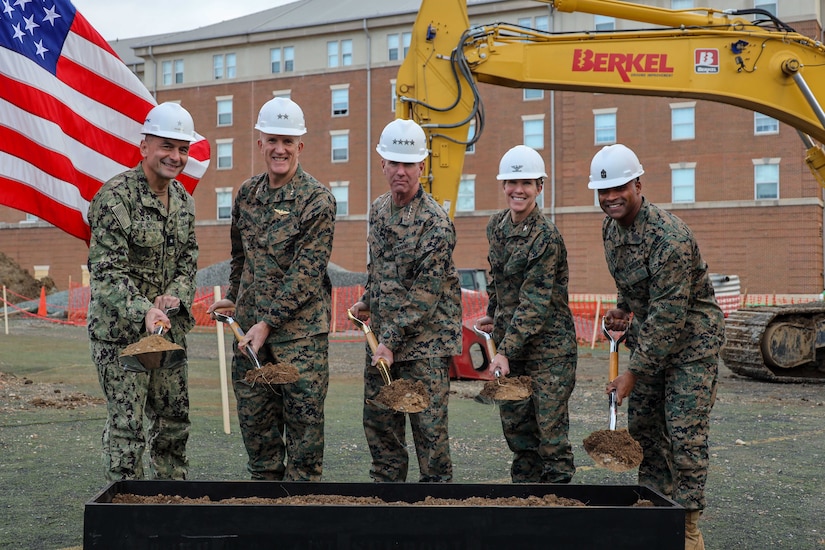
Five troops in camouflage uniforms and white hardhats smile as they hold shovels of dirt.

"No delays, no excuses, and no more business as usual. The standards will be enforced, and accountability will be nonnegotiable. This is not just another study over the course of years," he said. Items the task force will expedite include, he said.

  • Leverage the expertise of private industry to deliver innovative technologies and contracting strategies that accelerate construction and renovation.  
  • Consolidating, when possible, contracts for maintenance, services and equipment.  
  • Empowering unit commanders and senior enlisted leaders to fix issues at their level without having to wait on Pentagon bureaucracy. 
  • Working across the federal government to gather even more tools that will help ensure this happens quickly.  
  • Working with the Office of Management and Budget on new solutions to renovate and maintain barracks to the standards that warriors deserve. 
  • Where possible, using the kinds of rapid processes found in the private industry. 

The Office of Acquisition and Sustainment; Office of Energy, Installations and Environment; Office of Personnel and Readiness and others are involved in planning and execution of the secretary's directive.