Thursday, February 26, 2026

Hegseth: National Guard Aligned With National Defense Strategy – Homeland First, Borders Secured, Peace Through Strength

Secretary of War Pete Hegseth addressed National Guard leaders today at the Herbert R. Temple Army National Guard Readiness Center in Arlington, Virginia, where he underscored the War Department's top priorities: restoring the warrior ethos, rebuilding the military and reestablishing deterrence.

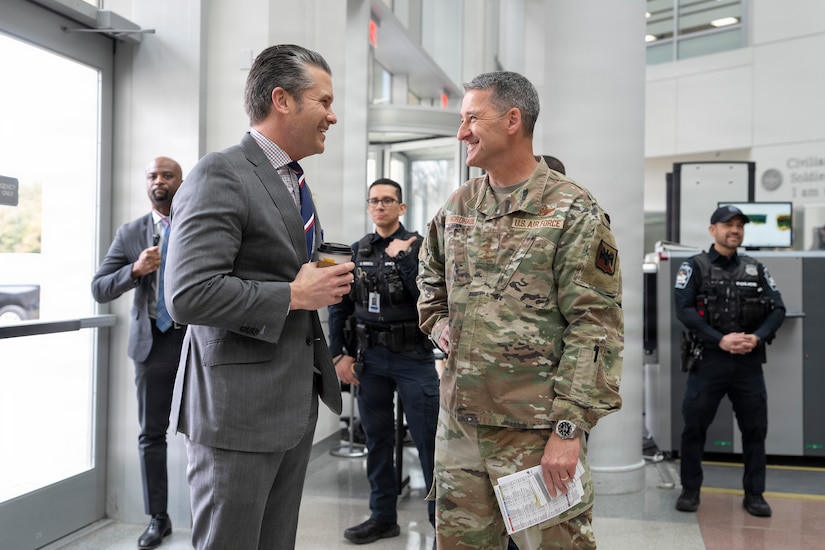
A man wearing a business suit smiles as he speaks with a man in a camouflage military uniform. There are people dressed in police gear and one man in a business suit standing in the background.

In attendance were: the National Guard adjutants general — the senior Army and Air National Guard officers representing each state, three territories and the District of Columbia; along with Air Force Gen. Steven Nordhaus, National Guard Bureau chief,  and Senior Enlisted Advisor John Raines; as well as Army Gen. Thomas Carden, National Guard Bureau vice chief. 

During the meeting, Hegseth outlined the guard's critical alignment with the 2026 National Defense Strategy — the War Department's guiding document for implementing the core pillars of President Donald J. Trump's National Security Strategy: America first, peace through strength and common sense. 

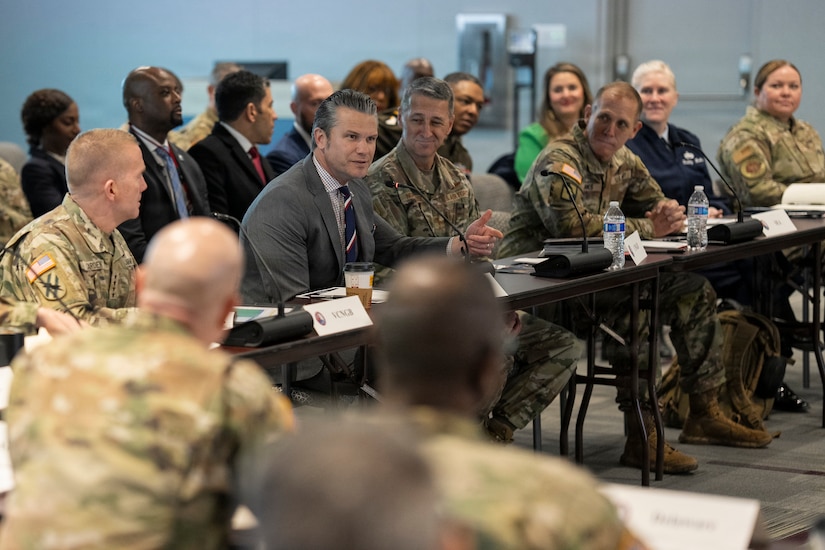
A man wearing a business suit sits at a table surrounded by people, also seated, dressed in camouflage military uniforms; one woman is wearing a blue military dress uniform. There are people in business attire seated in the background.

Hegseth praised the "great work being done" by the National Guard in support of the NDS, which prioritizes homeland defense first, deterring China in the Indo-Pacific region through strength rather than confrontation, increasing burden-sharing with allies and partners and supercharging the U.S. defense industrial base. 

"This group is central to reestablishing the United States' deterrence," Hegseth told the adjutants general. "That charge fell quickly to the National Guard, which has been instrumental in establishing 100% operational control of our southern border — the baseline of our deterrence. The guard fills gaps as we are layering more effects to close them."  

Hegseth emphasized that the U.S. cannot be a sovereign country without control of its own borders. Since January 2025, more than 18,000 National Guardsmen have supported operations on the southern border, contributing to the lowest level of U.S.-Mexico border crossings in over 50 years. 

The secretary also highlighted cities like Memphis, Tennessee, New Orleans and Washington, which have each seen sharp reductions in violent crime, due in part to a uniformed National Guard presence working alongside law enforcement partners, as Trump spotlighted in yesterday's State of the Union.

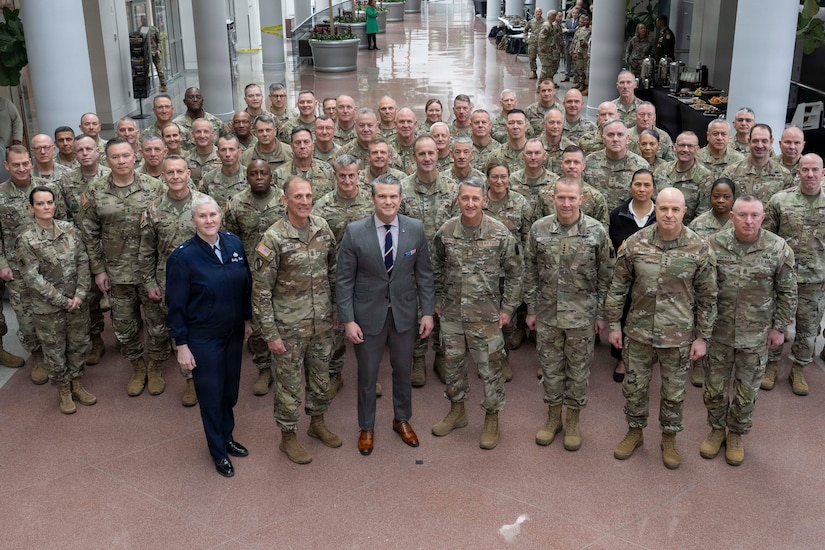
A man wearing a business suit poses for a photo with a group of people, mostly dressed in camouflage military uniforms. There is also a woman dressed in a blue military dress uniform and another woman in civilian attire.

"I salute those who embraced coming alongside law enforcement agencies to make our cities safer," Hegseth said. "It's just like in the aftermath of natural disasters — the guard adds huge value, and they make people feel safer where they live. Their incredible professionalism goes a long way." During the State of the Union, Trump awarded two West Virginia National Guardsmen, Air Force Staff Sgt. Andrew Wolfe and Army Spc. Sarah Beckstrom, the Purple Heart, following the attack in Washington that took Beckstrom's life while both were on duty as part of the D.C. Safe and Beautiful Task Force.

"President Trump showcased our best warriors, past and present," Hegseth said. "They don't do it to be recognized." 

The secretary reminded the generals that the National Guard is vital to homeland defense.  

Army Guardsmen in Alaska, California and Colorado operate the department's only capability to defeat intercontinental ballistic missile strikes with defensive interceptor missiles. Sixteen of the 17 Aerospace Alert Control sites are operated by Air Guardsmen in conjunction with North American Aerospace Defense Command, to launch fighters at any time to intercept, inspect, influence and defeat potential airborne threats, 24/7. National Guardsmen also sustain enduring missions in counter-drug operations and cyber defense. 

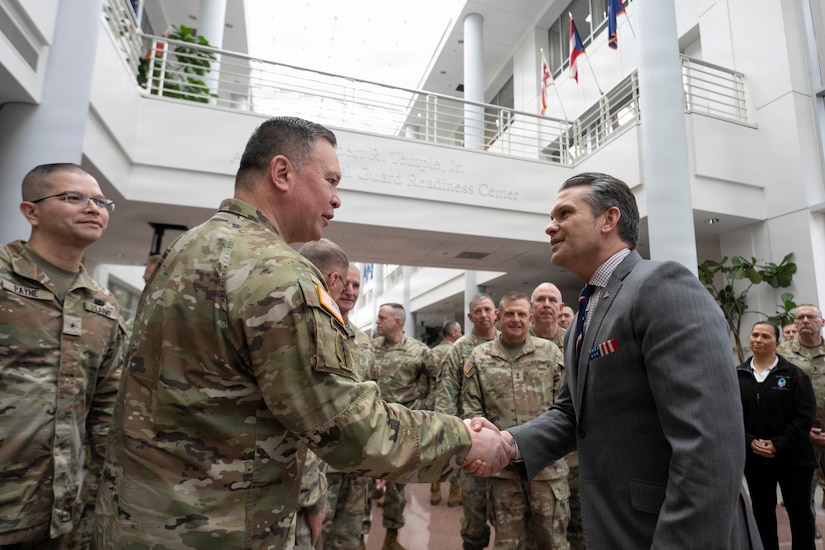
A man dressed in a business suit shakes hands with a man wearing a camouflage military uniform. There are people in camouflage military uniforms surrounding them.

With 435,000 total service members, the National Guard provides 20% of the U.S. joint force at about 4% of DOW's budget. Regarding force strength, the Army Guard constitutes 40% of the Army's operational force, fielding eight full divisions, while the Air National Guard provides 30% of the Air Force's operational forces across 90 wings. Hegseth applauded the National Guard's integral role in high-profile missions such as Operation Midnight Hammer, which showcased exquisite warfighting capabilities and combat experience. 

"I don't have to remind you all of that," he said. "[Midnight Hammer] and Operation Absolute Resolve demonstrated the ripple effect of American power. You have to prove you can TKO again and again." 

Hegseth, a former Army National Guard infantry officer who served in units across six states, noted the unique skill sets that reside in the National Guard, where members balance civilian careers with service.  

He stressed the guard also advances both the second and third pillars of the NDS — deterring China in the Indo-Pacific region through strength rather than confrontation and increasing burden-sharing with allies and partners — through DOW's National Guard State Partnership Program. The SPP now encompasses partnerships with 116 nations linked to the National Guard of a state, territory or D.C. Of those, 18 are in the Indo-Pacific area of operations, and 30 are in Central and South America, supporting counter-narco-terrorism efforts and enabling partners to lead regionally. 

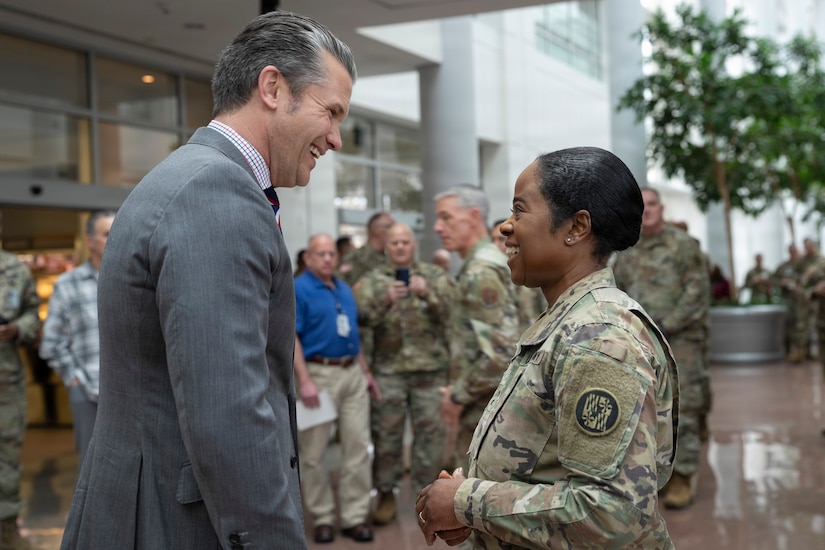
A man wearing a business suit smiles as he converses with a woman, who is also smiling, dressed in a camouflage military uniform.

Globally, the U.S. is enabling allies and partners to "step up and take the lead" in their own defense. Hegseth applauded the guard's partnerships in the Western Hemisphere, where he said the department has "only just begun to counter narco-terrorists and cartels." 

"Military-to-military partnerships pay off in spades, and the SPP is a bedrock of that," he said. "Countries are ready to go when they see we are with them." 

He noted the ingenuity of guard soldiers and airmen in leveraging skills and experience to help shape future warfighting equipment.  

"We welcome your feedback and bottom-up input from the troop-level to know we're fielding the right systems, when and where we need them." 

On the personnel side, Hegseth said one facet of restoring the warrior ethos is to reduce or eliminate unnecessary "mandatory" trainings and slideshow briefings and instead, empower commanders and noncommissioned officers to lead lethality-focused training. 

"We hope it makes drill weekend and annual training a little better," he said.

Hegseth Inducts Naval Aviator, Medal of Honor Recipient Into Pentagon Hall of Heroes

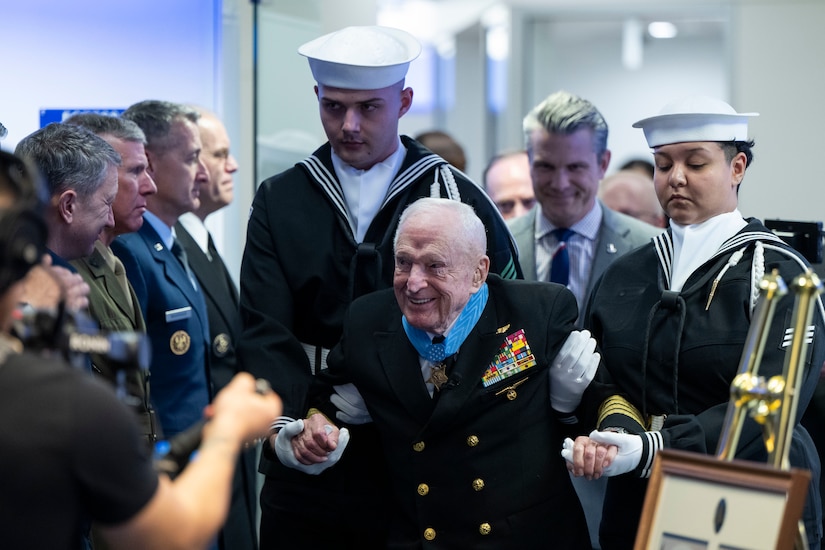
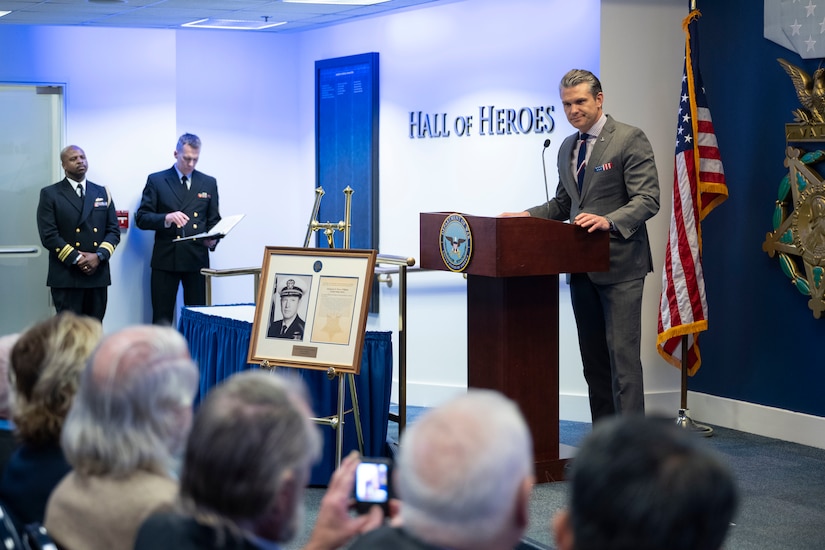
Last night, retired Navy Capt. Elmer Royce Williams received the Medal of Honor from President Donald J. Trump during the State of the Union address at the U.S. Capitol. Today, Secretary of War Pete Hegseth, Secretary of the Navy John Phelan and Chief of Naval Operations Adm. Daryl Caudle inducted Williams into the Pentagon's Hall of Heroes for his heroic actions during the Korean War.

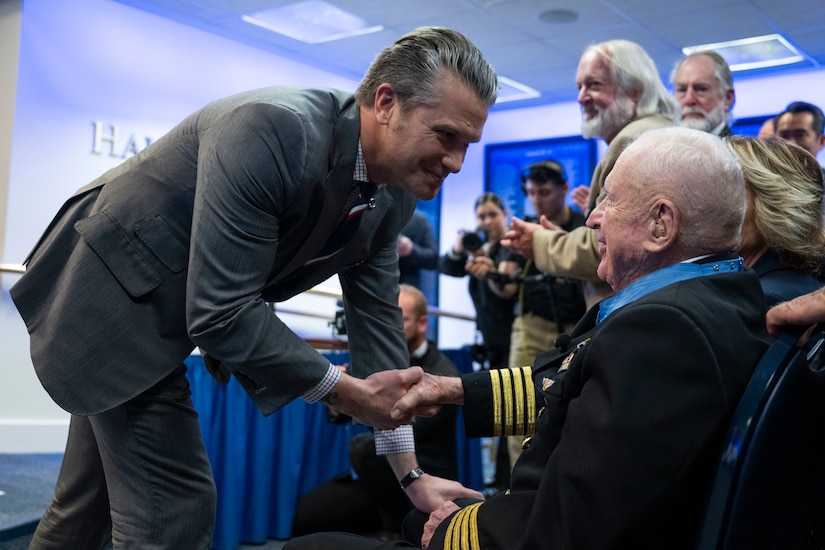
A man in business attire leans down to shake hands with a seated man in a formal military uniform; a crowd of people stands and claps inside a large ballroom.

"Capt. Royce Williams did what warriors are called to do when the moment comes — he stood his ground, took the fight to the enemy and protected his fellow Americans. Outnumbered, outgunned and alone in the sky, he prevailed through sheer skill, courage and will," said Hegseth. "Today, we honor not just a remarkable dogfight, but a lifetime of quiet strength and service. Capt. Williams embodies the fighting spirit of the United States Navy and the warrior ethos that keeps this nation free."

Williams was joined by an audience of family, friends, fellow Naval Aviators and senior Navy leaders.

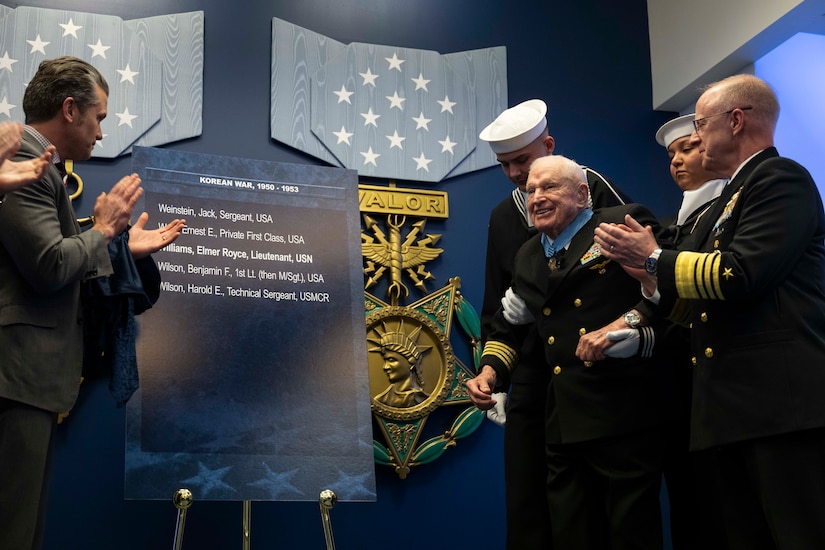
An older man in a formal military uniform smiles and stands with the assistance of another man in similar attire, as people in business attire and formal military uniforms clap. On the left of the man is a large sign displayed on an easel with the names of several service members.

"Capt. E. Royce Williams represents the very best of the United States Navy," said Phelan. "On Nov. 18, 1952, flying from USS Oriskany and outnumbered in the skies over North Korea, he chose to engage to protect the ships of Task Force 77 and the sailors aboard them. In a 35-minute dogfight, he shot down three MiG-15s and severely damaged a fourth one. For decades, much of this story remained classified, but the facts never changed. His courage, airmanship and devotion to duty saved lives and upheld the highest traditions of the Naval service. Today, we are proud to formally recognize a Naval Aviator whose example will endure for generations."

Yet when reflecting on that historic day and the recognition it brought, Williams did not speak of skill or courage, but of humility and faith.

An older man in a formal military uniform smiles and walks with the assistance of two people in similar attire. Behind them is a man in business attire, and to the left is a crowd.

"I know how momentous this moment is, and I never imagined myself or allowed myself to think it was going to happen to me," Williams said. "I imagined it as God reaching in and dipping his hand in to pick somebody up for the most unusual reasons and displaying him in front of his fellow citizens."

He continued, emphasizing that the honor was never something he expected or sought.

"And to be entirely amazed and appreciative for the accommodations and accolades. But that's so unusual that you don't fool around thinking that it's ever going to come your way," he said. "This is God doing something usual, with his finger in the pie and with his influence. And what did I have to do with it? Well, I was the principal, in a way, that is receiving the recognition, but maybe some of that recognition misses the influence that really caused this special recognition."

A man in business attire stands at a lectern and talks to an audience in a ballroom. In front of him is an easel with a framed picture displayed on it, and behind him is the American flag.

Williams was born in Wilmot, South Dakota, and enlisted in the Army at 16 years old in Ortonville, Minnesota. Upon completion of basic training, he returned to Ortonville to train with his unit in a reserve status until he finished high school. Once he turned 17, Williams was eligible for the Naval Aviation Cadet program and joined the Navy, where he began flight training in 1943. Among many other aviation platforms, Williams learned to fly the F9F-5 Panther jet and was assigned to active duty in the Korean War, during which he flew 70 missions. Williams went on to serve in the Vietnam War, flying over 110 missions in the A-4 Skyhawk and F-4 Phantom from the USS Kitty Hawk. Williams later served as commanding officer of the command ship USS El Dorado from September 1969 to January 1971. He retired from the Navy as a captain in 1980.

His Medal of Honor is an upgrade of the Navy Cross he was previously awarded in January 2023, which was an upgrade to the Silver Star Medal he was previously awarded while assigned to the "Pacemakers" of Fighter Squadron 781 in 1953.