Friday, February 20, 2026

86th Maintenance Squadron Metal Technicians Melt Limits, Shape Readiness

Inside a shop tucked away between the hangars and flight line, sparks glow bright against steel while steady hands maneuver equipment with precision, as airmen assigned to the 86th Maintenance Squadron Metals Technology Shop quietly forge the foundation of operational capabilities.
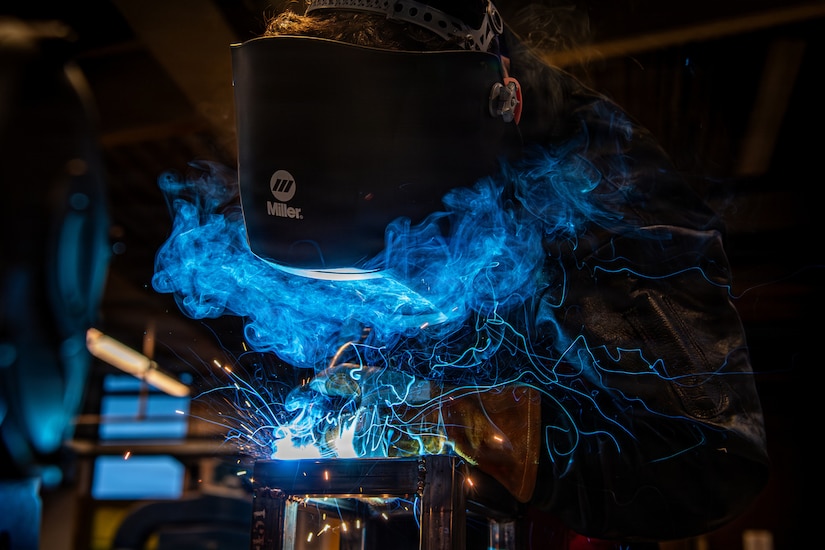
A person wearing a welding face shield bends over to use a tool to fuse metal, as blue sparks and smoke emit from the reaction.

Metal technicians are responsible for fabricating, welding and machining components that help keep aeronautical ground equipment and aircraft functional. When a part is unavailable or damaged, metal techs step in to provide solutions that keep maintenance timelines moving and aircraft in the air. 
 
"If we're not here, a lot of other jobs slow down," said Air Force Senior Airman Noah Dunn, a metals technician journeyman. "Crew chiefs and other shops rely on us. We're usually the last stop before something has to go to the depot." 
 
The work is technical, deliberate and often misunderstood. Welding on aircraft is not simply striking an arc and fusing metal. It requires awareness and adherence to technical orders, approved materials and knowing the exact procedures.
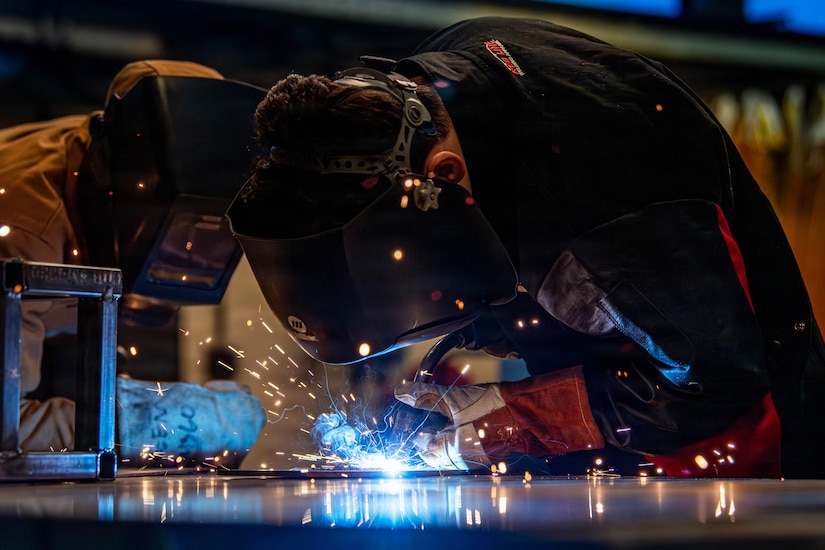
Sparks fly as airmen, wearing protective gear, weld metal on a table in a dimly lit room.

"People think it's just metal, so you can just weld it," said Air Force Senior Airman Jordan Green, a metals technician journeyman. "You have to know the material, the authorized filler rod, what heat settings to use and what processes are approved. Even the weld bead has to meet specific standards." 
 
Preparation alone can take longer than the weld itself. Areas must be cleaned and inspected, and fire safety measures must be in place. In some cases, engineering approval is required before work even begins. 
 
"Welding is mostly prep work," said Air Force Staff Sgt. Richard Forney, the aircraft metals technology noncommissioned officer in charge. "If you rush that part, you'll see it in the final product."  
 
Forney emphasized that machining follows the same disciplined approach.

"It's not just putting a block in a [computer numerical control] machine and pressing go," he said. "You have to review the program, run simulations, verify your tooling and make sure your feeds and speeds are correct. If something is off, you can break a tool or scrap materials." 
 
The satisfaction is evident in the finished products that leave the shop. Each completed weld and machined component represents more than craftsmanship. It showcases how one can discover strengths within themselves that they did not see before. 
 
"This job taught me that I can handle more complex procedures than I thought," Green said. "If you stay focused and don't overwhelm yourself, you can get through it." 
 
Though the metals technology shop may operate away from the spotlight, its contribution is unmistakable. Every aircraft that launches from Ramstein's runway and lands safely carries with it the work of airmen who shaped, repaired and fabricated parts that made the mission possible. 

Battle of Yorktown Leads to Treaty With Great Britain

This year marks the nation's 250th birthday, celebrating the Declaration of Independence.

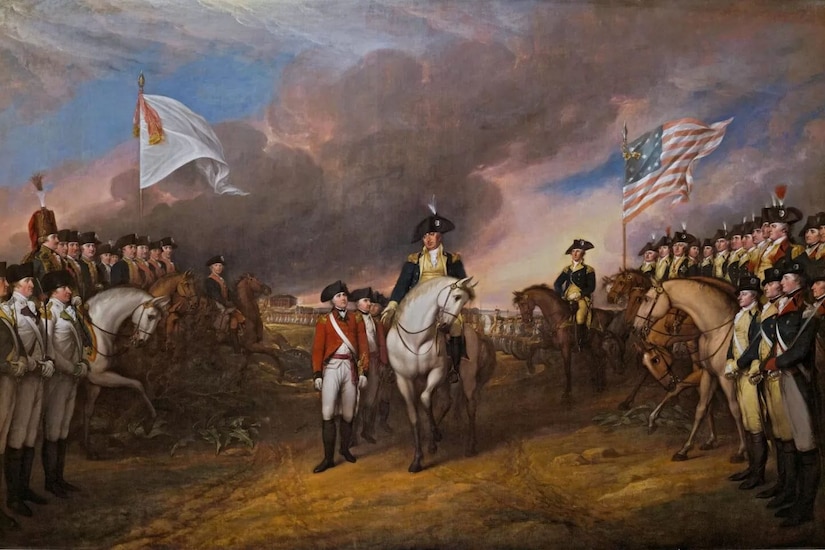
A painting depicts several men in Revolutionary War uniforms outside under a blue sky with gray clouds. One man stands next to another man sitting on a horse, as soldiers stand in two formations on either side of them.

To attain independence, the Americans would have to win the Revolutionary War against Great Britain, which previously governed the 13 colonies. The war lasted from April 19, 1775, to Sept. 3, 1783. 

The final decisive battle of the war took place in the vicinity of Yorktown, Virginia, from Sept. 28 to Oct. 19, 1781. 

The victory persuaded King George III and the government of Great Britain to begin negotiations to end the war, resulting in the 1783 Treaty of Paris, which formally acknowledged the independence of the United States. 

The Siege of Yorktown, as it is sometimes called, pitted the British army, led by Gen. Charles Cornwallis, and the British navy, led by Adm. Thomas Graves, against the Continental Army, led by Gen. George Washington, and the French navy, led by Adm. Francois Joseph Paul de Grasse and the French army, led by Lt. Gen. Jean-Baptiste-Donatien de Vimeur, Comte de Rochambeau.

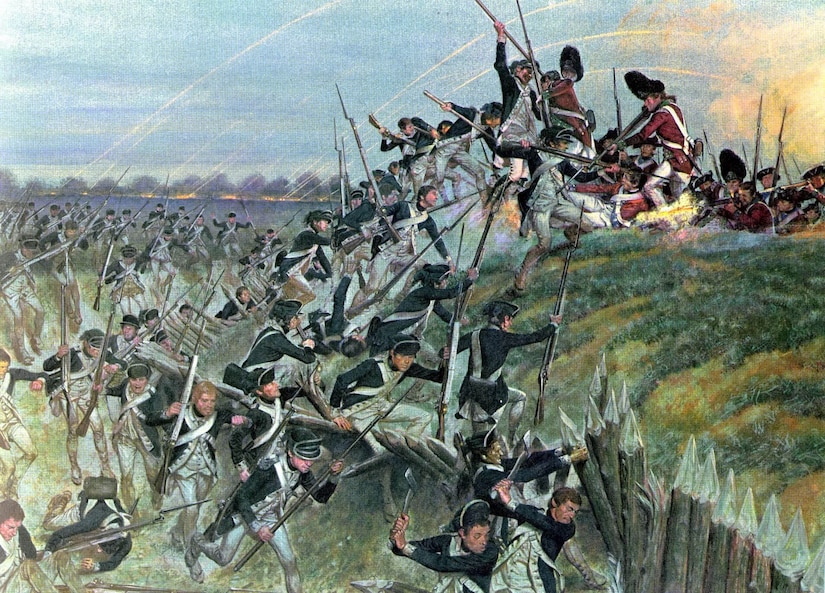
A painting shows dozens of soldiers in Revolutionary War uniforms charging at each other in a grassy field under a blue sky with bayonets affixed to muskets.

The total land and naval forces of Great Britain were about 8,000 personnel, and the combined American and French land and naval forces numbered about the same. 

Washington's Continental Army, aided by French land and naval forces, surrounded the British army, compelling the surrender of Cornwallis and his entire force. 

Interesting facts:

A very tall marble statue topped with a figure at the top rises in a park-like setting under mostly blue skies.

  • Marquis de Lafayette, a French major general, was so passionate about the American cause that he was given senior positions in the Continental Army and commanded Americans at Yorktown. The most famous quote when American troops arrived in France during World War I in 1917 was: "Lafayette, we are here!" Lafayette Square in Washington is named for him, and there's also a statue of him there. 
  • In a strange twist of fate, after Yorktown, de Grasse returned with his fleet to the Caribbean, where a British fleet under Adm. George Rodney defeated and captured de Grasse at the Battle of the Saintes. De Grasse was widely criticized for his defeat, ending his naval service. Cornwallis later had a successful career as a civil and military governor in Ireland and then in India. 
  • Yorktown was the site of a second battle during the Civil War, also called the Siege of Yorktown, fought from April 5 to May 4, 1862, with neither Federal nor Confederate forces achieving a victory.

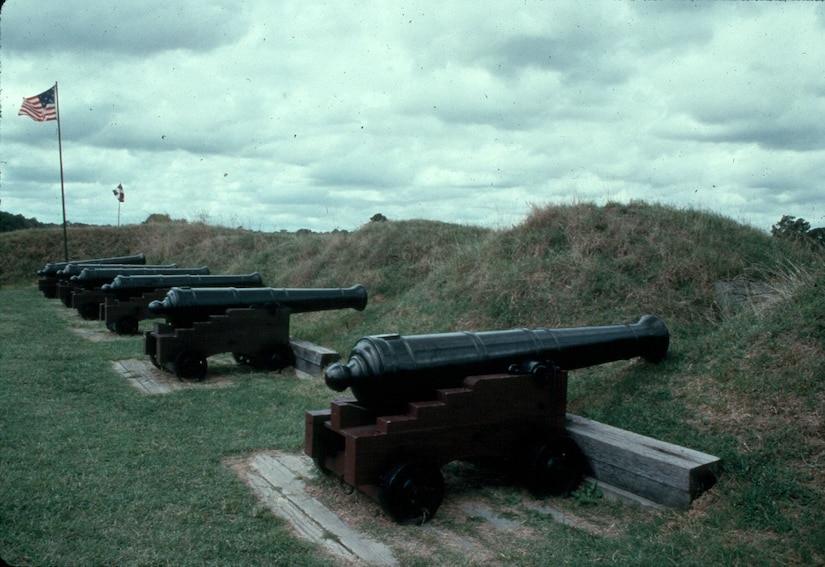
    Six cannons on a grassy field point through openings in a berm.
  • Today, the site of the Yorktown battlefield is part of the Colonial National Historical Park, administered by the National Park Service. Nearby is the state-operated American Revolution Museum. Also in Yorktown is the Coast Guard Training Center.
  • The Navy's first USS Yorktown was a sloop-of-war, launched in 1839 and wrecked on an uncharted reef off Maio, Cape Verde in 1850. Although the ship was lost, no lives were. The second was a gunboat, launched in 1888 and decommissioned in 1919. The third was an aircraft carrier, launched in 1936 and sunk as a result of extensive damage sustained at the 1942 battle of Midway. The fourth was also an aircraft carrier, launched in 1943 and decommissioned in 1970. The fifth was a cruiser, launched in 1983 and decommissioned in 2004. 
  • The Battle of Yorktown led to the 1783 Treaty of Paris. The French capital was also the site of the Jan. 27, 1973, Vietnam Peace Agreement, ending the fighting.

EOD Technicians Prove Arctic Warfare Readiness in Norway

Explosive Ordnance Disposal Mobile Unit 8, assigned to Commander, Task Force 68, completed Exercise Arctic Specialist 26 alongside allied forces from Norway and Sweden, Feb. 3 to 12.

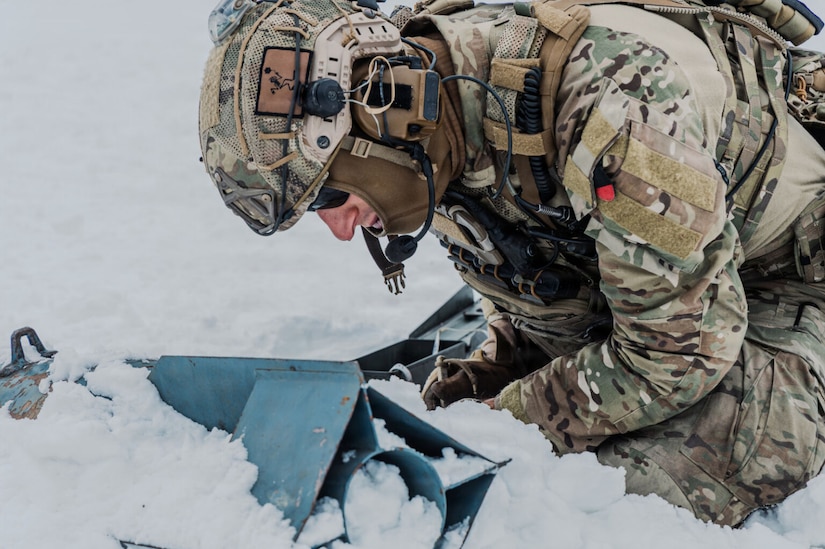
A man in a camouflage cold-weather military uniform crouches down on a snow-covered ground as he works with a piece of military equipment.

Arctic Specialist is an annual Norwegian-hosted multinational exercise focused on expeditionary mine countermeasure operations and land-based explosive ordnance disposal tactics. The strategic location of the exercise provides valuable training in an extreme cold-weather environment, where conditions are dynamic, and the operating environment continues to evolve.  

"The sailors of EODMU-8 have made me immensely proud, demonstrating unparalleled skill and resolve by executing complex operations across the EOD spectrum in the harshest conditions with our allies," said Navy Cmdr. Matthew Guido, the unit's commanding officer. "Their achievement is a testament to the hard work and professionalism they conduct daily in preparation to maintain security and access in the Arctic corridor. Our partnership with the Norwegian Navy EOD is vital to our shared success in the Arctic, and we are grateful for their collaboration and friendship."  

During the 10-day exercise, U.S. Navy EOD technicians conducted a wide range of operations, including underwater demolitions, exploitation of mines, conventional munitions disposal, rapid airfield damage repair, close-quarters combat, rappel operations and trench clearance. These training events collectively contributed to increased lethality and technical expertise in the Arctic domain and emphasized integration among allied forces in preparation for future conflicts.

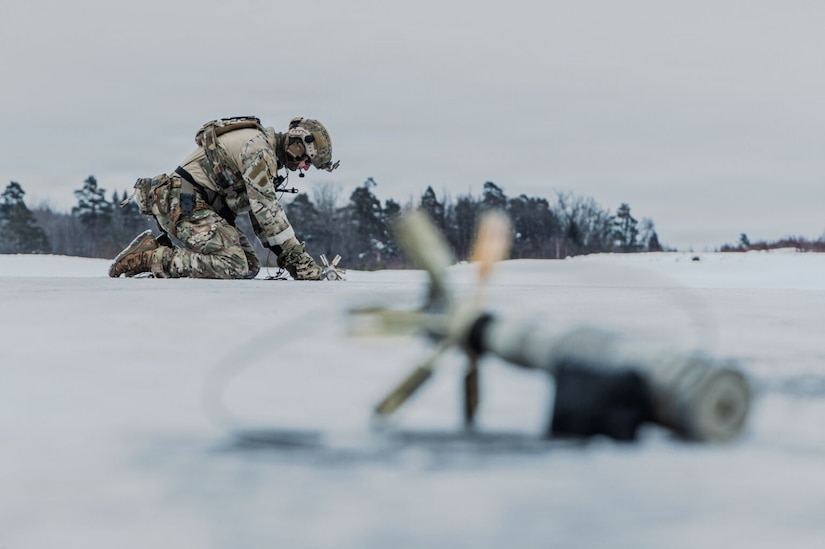
A person in a camouflage cold-weather military uniform crouches down toward a snow-covered ground to place a piece of military equipment on the ground. Another piece of military equipment is in the foreground, and trees are in the distance.

"The Norwegians are excellent hosts and dependable teammates," said Navy Lt. Andrew Lewis, EODMU-8 officer in charge. "We are lucky to have an exercise that brings together EOD operators that are experts at working in the Arctic domain. Each lesson they teach us pays dividends for the EOD force as we work towards bolstering our extreme cold-weather capabilities."  

The exercise provided valuable real-world training opportunities for EOD technicians to refine their professional skills while operating in extreme cold-weather conditions. Arctic Specialist evaluates planning, communications and operational oversight while simultaneously providing warfighters and enablers with valuable operational experience as they test the people, equipment and logistics needed to execute missions in remote and austere locations.  

"In the Arctic, there is no margin for complacency. Our Norwegian partners and Navy EOD operators demonstrate that in freezing environments, the smallest detail can become the biggest threat," said Navy Senior Chief Petty Officer Juan Hernandez, an ordnance disposal technician assigned to EODMU-8. "We look forward to continued U.S participation in Exercise Arctic Specialist for years to come, strengthening our partnerships and advancing our cold-weather capabilities alongside our allies."

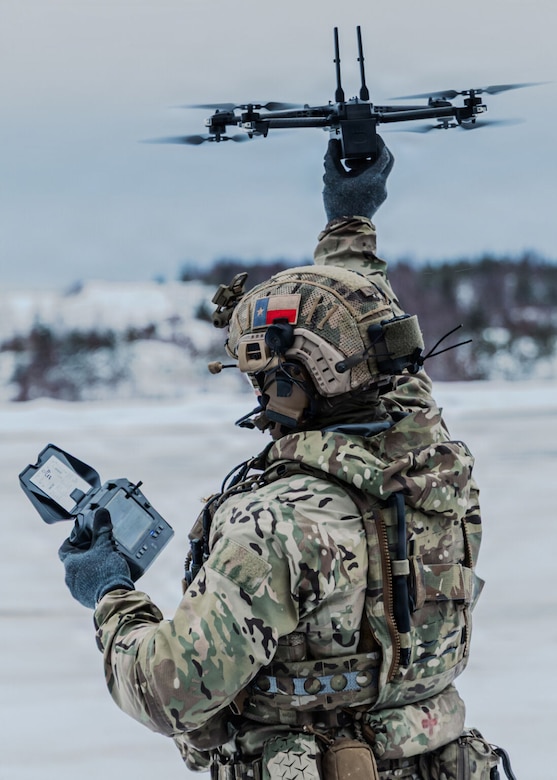
A person in a camouflage cold-weather military uniform holds a drone over his head with one hand and a remote control in the other, outside in a snowy environment with trees in the distance.

The Norwegian-hosted exercise also served as a venue for exchanging tactics, techniques and procedures through the integration of foreign EOD professionals embedded within U.S. Navy EOD platoons.  

"We are very pleased that this exercise has participants from several NATO nations and different branches of defense," said Navy Cmdr. Senior Grade Christian Couillault, executive director and chief of the Norwegian Naval EOD Commando. "This is one of the few exercises where the main training audience is the Navy EOD diver himself and his team. The cooperation we have developed and maintained over the many years with EODMU-8 is strong."  

Arctic presence remains a high-priority mission for forces across the War Department and is central to homeland defense as its strategic importance grows.

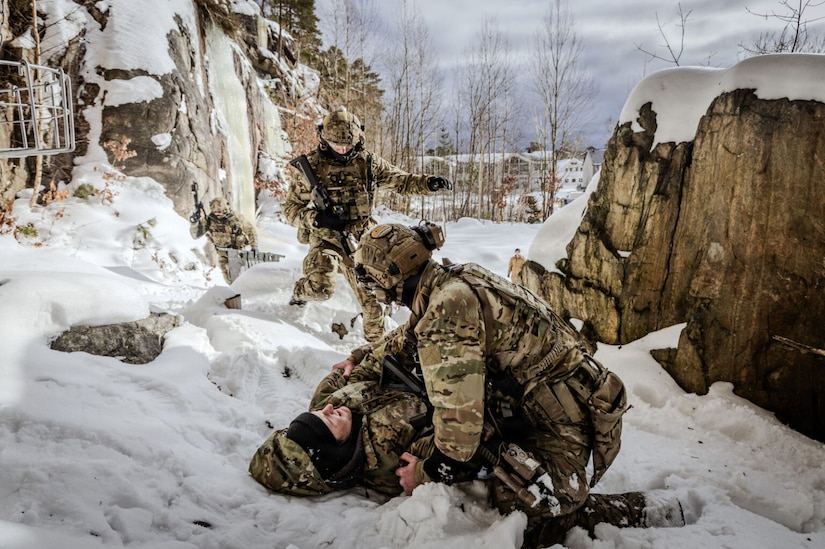
A person in a camouflage military uniform bends down to attend to another person in similar attire next to large rocks on a snow-covered ground, while two people in military uniforms  walk toward them. Trees and buildings are in the distance.

The effects of emerging technologies and increased economic competition continue to shape an evolving security environment, requiring an increased level of regional stability and cooperation. These conditions demand naval forces capable of operating effectively in high-latitude environments.  

"We are grateful that the U.S. Navy sends its best sailors to create realistic training missions," Couillault said. "The technology brought by the U.S. Navy EOD team to test in Norway enriches us all in the development track. The fact that we are able to develop procedures together within several military skills in demanding arctic conditions makes us better equipped for joint operations in the north."