Monday, June 01, 2026

Face of Defense: Damage Controlman Develops Next Generation of Warfighters


Face of Defense: Damage Controlman Develops Next Generation of Warfighters

Meet Navy Petty Officer 2nd Class Crystal Avila, an instructor assigned to Navy Recruit Training Command in Great Lakes, Illinois, the service's only boot camp.
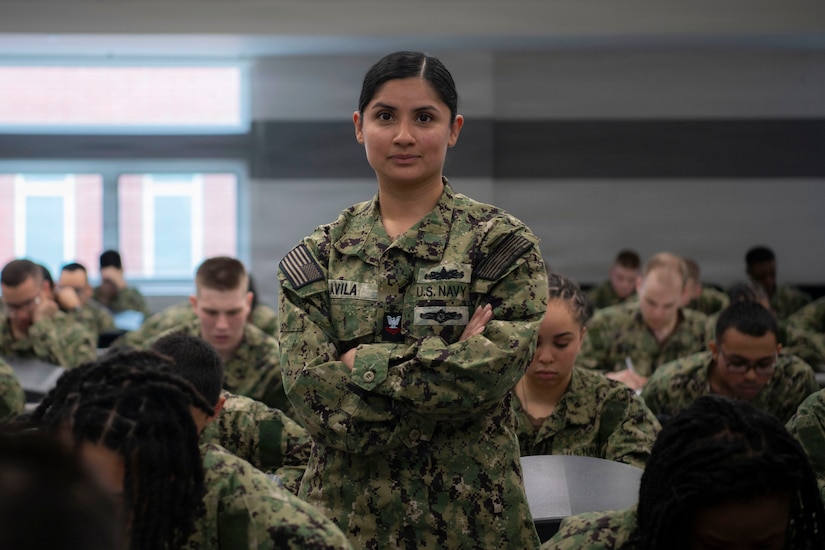
Navy Petty Officer 2nd Class Crystal Avila
A sailor in a camouflage uniform stands with her arms crossed in a classroom setting, as sailors in similar attire sit at desks around her.
Job: Damage Controlman and Instructor
Stationed: Recruit Training Command, Great Lakes, Ill.
Unit: Navy
Hometown: Waukegan, Ill.
A native of Waukegan, Illinois, Avila joined the military 11 years ago looking for opportunity and a way to build a more stable future for her family. 

"I joined the Navy for the educational opportunities and the chance to travel and experience different cultures," Avila said. "It's also given my family financial stability and allowed my children to benefit from the unique experiences that come with military life." 

Building on her desire for learning and growth, Avila gained experience while serving aboard the aircraft carrier USS Dwight D. Eisenhower, the amphibious assault ship USS Essex, the destroyer USS Sampson and at Afloat Training Group Pacific Northwest in Everett, Washington. Across those assignments, she developed technical expertise in damage control and shipboard firefighting — skills that now shape how she trains the Navy's newest sailors. 

Avila said one of her earliest defining moments came during her first underway period aboard a carrier, when she experienced the scale and rhythm of life at sea for the first time. 

"I had been on the ship for a few months, but my first time going underway was completely different," she said. "Watching everyone prepare to be gone for a month made me realize how much there was to learn. I also hadn't realized how many people an aircraft carrier can hold. By the end of that underway, I understood what I needed to prepare and even started to appreciate how peaceful it can be in the middle of the ocean." 

'Every Sailor Is a Firefighter' 
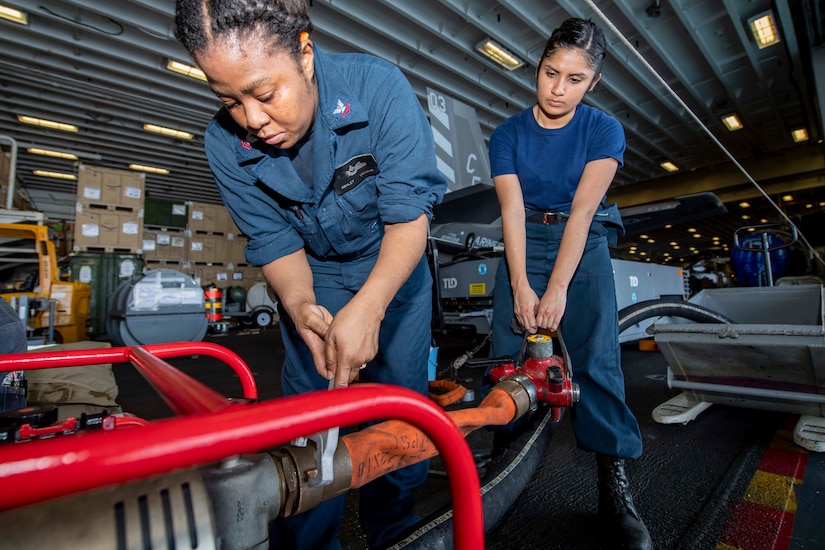
Two sailors, one using a wrench-like device to attach a hose to a pump as the other holds an attached piece of equipment, work in the hangar bay of a vessel.
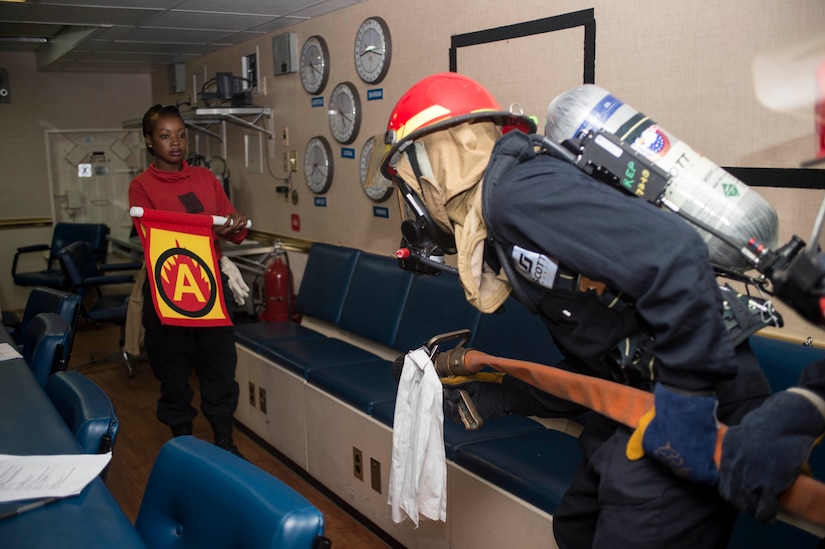
A sailor in firefighting gear holds a large hose and crouches in front of another sailor holding a red and yellow flag with an "A" on it indoors.
Inspired by stories from her recruiter, Avila chose the damage controlman rating — one that quickly revealed its importance to the safety of every sailor at sea. 

"The sea stories my recruiter told me about damage control had a big impact," she said. "Being a damage controlman, you really learn how important our equipment and training are. It also gave me the opportunity to train other sailors to control or mitigate casualties so everyone can make it home to their families. At the end of the day, every sailor is a firefighter." 

At Navy Recruit Training Command, Avila serves as both an instructor and testing proctor, responsible for teaching and evaluating recruits on required academic material and tactical combat casualty care assessments. 

"My job is to make sure recruits understand the material they need to succeed in boot camp," she said. "Whether it's an academic test or a [tactical combat casualty care] assessment, attention to detail is critical. Those habits carry over into everything we do in the Navy." 

Instructor of the Year 
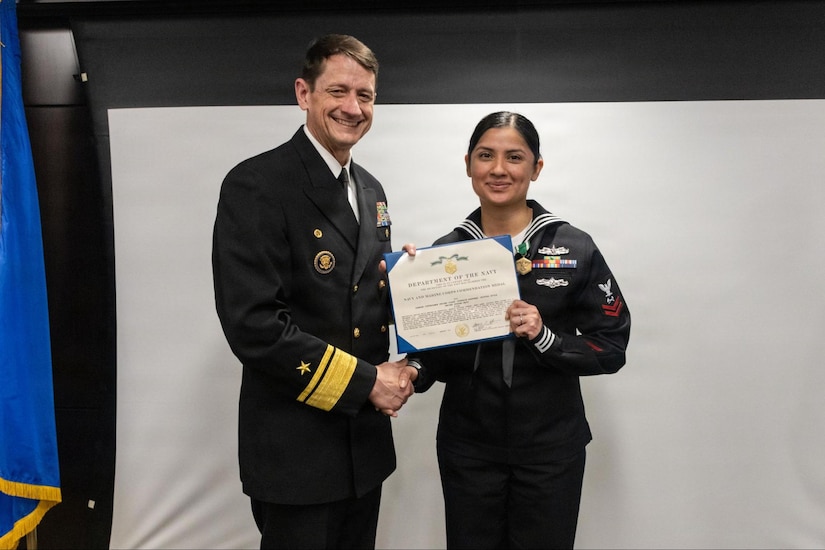
A person in a military dress uniform shakes the hand of a sailor as both of them hold a certificate and smile indoors.

Avila's dedication to instruction recently earned her recognition as the Naval Education and Training Command Junior Instructor of the Year — an honor awarded to instructors who demonstrate exceptional performance, leadership and mentorship in developing the next generation of warfighters. 

"Being named Junior Instructor of the Year didn't change me — it reassured me that the way I teach is making a positive impact," she said. "Teaching isn't just about delivering information. It's about making sure sailors understand it and retain it, because everyone learns differently." 

For Avila, the most rewarding part of her role comes from watching recruits grow in confidence throughout the training process. 

"In the beginning, many recruits are shy or unsure of themselves and don't want to participate," she said. "But as they get closer to graduation, you see their confidence grow and the way they start working together as a team improves. Being a sailor means being part of something bigger than yourself and learning how to work together toward one mission." 

Like many instructors, Avila said balancing time constraints while ensuring recruits fully understand complex material can be challenging. 

"One of the biggest challenges is figuring out how to tailor certain topics so recruits understand them while still staying within the time we're given for each lesson," she said. "It's made me more efficient and adaptable as a result." 

Inspired by Family 

Avila credits her family for instilling the values that have helped her succeed throughout her naval career. 

"My family taught me accountability, discipline and respect," she said. "My mom always emphasized taking responsibility for your actions and giving your best effort. The support from my husband and kids has also helped me stay resilient throughout my career." 

Outside of her professional role, Avila enjoys spending time with her family and pursuing creative hobbies. 

"When I have free time, I enjoy crafting on my [design machine]," she said. 

Looking to the future, Avila is motivated to pursue further growth, both personally and professionally. 

"My goal is to earn my bachelor's degree," she said. "In the next five years, I hope to either commission as an officer or be selected for chief." 

In all, Avila's efforts ensure that the Navy's mission continues through the recruits she prepares, equipping them with the knowledge, discipline and confidence to succeed in the fleet. 

Navy Recruit Training Command boot camp lasts approximately nine weeks, and all enlisted sailors begin their Navy careers at the command. More than 40,000 recruits train there annually.

Maintainers Honor Flying Tiger Heritage With Aircraft Paint Restoration

Among rows of gray A-10C Thunderbolt IIs on the flight line at Moody Air Force Base, Georgia, one Thunderbolt aircraft commands attention before its engines even start.

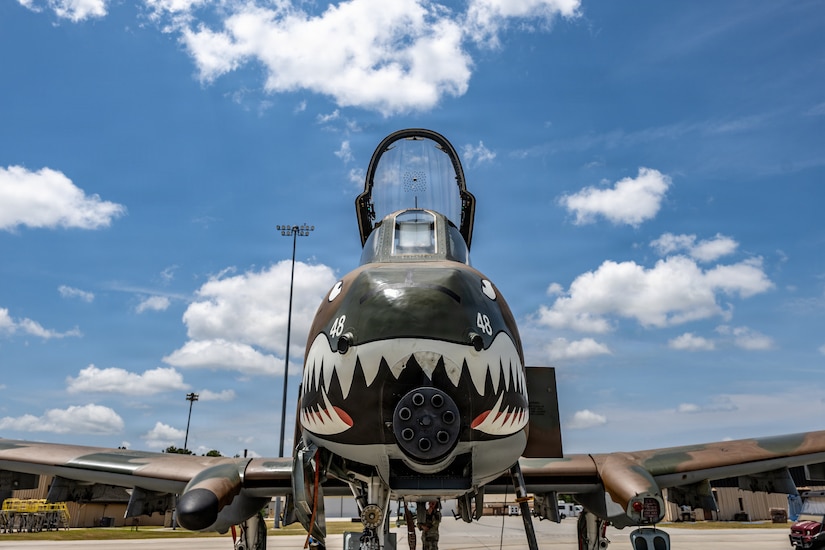
The front of a military jet parked on a tarmac with a paint job resembling a shark's head with a large mouth and jagged teeth.

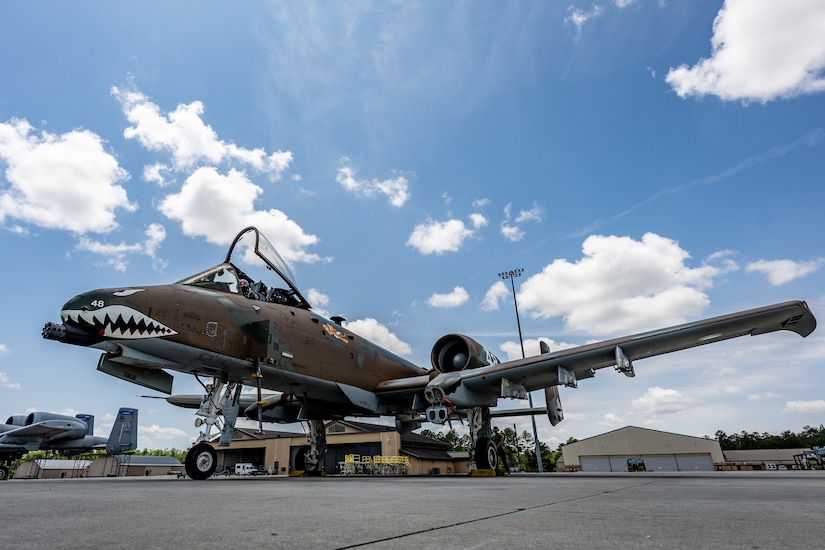
Sweeping camouflage stretches across the aircraft while a bold blue fuselage stripe and the unmistakable Flying Tiger emblem cut through the gray backdrop of modern airpower. More than heritage paint, the aircraft serves as a tribute to Army Air Corps Brig. Gen. David Lee "Tex" Hill, the legendary Flying Tigers and the combat legacy carried on today by the 23rd Fighter Group stationed at Moody. 
 
Hill was a member of Claire Chennault's American Volunteer Group, famously known as the Flying Tigers, said William Godwin, 23rd Wing historian. He flew P-40 Warhawks with the 2nd Pursuit Squadron as a flight leader and was credited with 12 1/4 aerial victories during his time with the World War II group.

On July 4, 1942, the group disbanded, and the 23rd Fighter Group was activated. Hill joined the 23rd FG as a major and was the first commander of the 75 Fighter Squadron; he took command of the 23rd a year later. Hill would go on to fly the P-51 Mustang with the 23rd and raised his total number of aerial victories to 18 1/4. 
 
Aviation history runs deep on base. Hill served as a commander within the American Volunteer Group, whose combat missions in the China-Burma-India theater became legendary during the war. After the group was disbanded, its mission and fighting spirit lived on through the 23rd Fighter Group, with the 75th Fighter Squadron continuing that lineage.

Today, that heritage is reflected not only in the aircraft's design but in the airmen who brought it to life. Behind the scenes, 11 airmen assigned to the 23rd Maintenance Squadron dedicated an extended amount of time to transform the jet. The project demanded technical expertise, coordination and attention to detail, ensuring the finished aircraft honored both the squadron's heritage and the airmen who carried that legacy forward. 
 
"First, it was just another project to us, but once we got into it, we realized it was something different," said Air Force Senior Airman Memphis Waller, maintenance squadron aircraft structural maintainer. "It gave us a chance to learn new techniques and be part of something we knew people would remember. The process itself was a lot of work."

A person in a flight suit sits in the cockpit of an aircraft parked on a tarmac with a paint job resembling a shark's head with a large mouth and jagged teeth.

The team sanded the aircraft and cleaned up the old paint, then wiped everything down to ensure the surface was ready for the legacy design. After that, they had to prepare the plane and track down where every stencil belonged so they could repaint each one correctly.

"The [painting] process was different from what we usually do, so there was definitely a learning curve, but seeing it all come together made it worth it," Waller said. 
 
The aircraft's story began long before the camouflage pattern and Flying Tiger insignia took shape on the Moody flight line. Following an asset transfer from South Korea, maintainers at Moody accepted and processed the A-10 before taking on the extensive restoration project.

What started as a routine transfer quickly became something more, an opportunity to transform the aircraft into a visual reminder of the squadron's enduring history. For the airmen involved, the project carried meaning beyond restoring an aircraft. 
 
"When people see the heritage aircraft alongside the P-40 in the air park, they can immediately connect the history," said Air Force Staff Sgt. Tucker Lee, maintenance squadron noncommissioned officer in charge of corrosion control. "It's a continuation of the Flying Tigers legacy, and that's something this wing takes a lot of pride in. We just hope to keep carrying that tradition forward. 
 
"If the original Flying Tigers hadn't been successful, we wouldn't be here today carrying that name and history," he continued. "The shark teeth that people associate with the A-10 started back with the P-40s, and now they've become part of what makes the Warthog iconic. Keeping that heritage paint scheme and the nose art reminds us [of] where we came from and pushes us to continue that legacy of success." 
 
That pride was reflected in every stage of the project. From carefully matching historical details to working long hours as a team, maintainers ensured the aircraft would stand as a faithful tribute, reinforcing a shared connection between generations of airmen, past and present. 
 
Now complete, the aircraft serves a dual purpose: it remains a fully mission-capable platform while also standing as a visible reminder of the squadron's heritage. Each time it takes to the skies, it carries forward a legacy that began with the Flying Tigers, proving that while technology evolves, the spirit of the mission endures. 
 
"[The] American Volunteer Group and the 23rd Fighter Group set the standard for the Flying Tigers for future generations," Godwin said. "The American Volunteer Group, in 1941, were told they would not last two weeks. Eighty-five years later, the Flying Tigers are still going strong. The men and women of the 23rd Wing are standing on the shoulders of giants and leading the way with close air support and combat search and rescue."

Medal of Honor Monday: Army Pfc. Charles N. DeGlopper

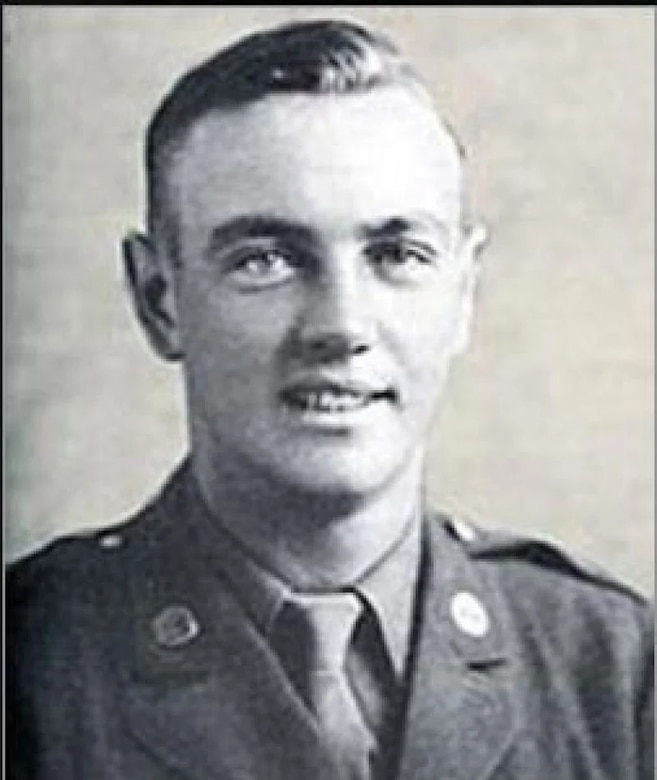
Army Pfc. Charles N. DeGlopper served as a paratrooper during World War II in North Africa and Italy. However, it was for his selfless actions in France, three days after D-Day, that earned him the Medal of Honor posthumously.

A man in a formal military uniform smiles for a portrait.

DeGlopper was born in Grand Island, New York, Nov. 30, 1921, to Charles and Mary DeGlopper. He grew up on a cattle farm and was the youngest of his siblings: John, Robert and Lillias. DeGlopper attended a one-room school until eighth grade, then graduated from Tonawanda High School in 1941.  

He didn't play sports in high school; instead, he joined a bachelors' club for cooking and sewing with his childhood friend Harold Long, according to Long during a 2022 interview with Niagara Frontier Publications.  

"We had a great time. The teacher always said, 'We've got to teach you sewing.' But we wanted to cook. That's how I got to know Charlie," Long recalled. 

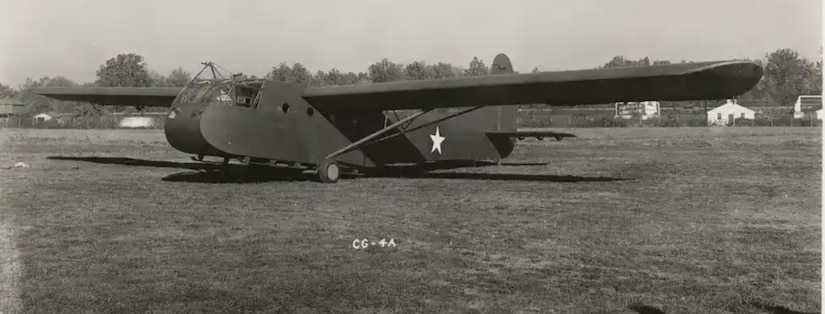
DeGlopper enlisted in the Army in November 1942 when he received his draft notice. It was difficult to fit the 6-foot-7-inch-240-pound private in uniform, since he wore size 15 boots. Following basic training at Camp Croft, South Carolina, he boarded a ship in April 1943, serving with Company C, 325th Glider Infantry Regiment, 82nd Airborne Division.

A black-and-white photo of a World War II-era glider sitting in a grassy field.

On June 9, 1944, after crash-landing his glider near the Normandy town of Sainte-Mère-Église, France, he was advanced with the forward platoon to secure a bridgehead across the Merderet River at La Fière, France. 

"At dawn, the platoon had penetrated an outer line of machine guns and riflemen, but in so doing had become cut off from the rest of the company. Vastly superior forces began a decimation of the stricken unit and put in motion a flanking maneuver, which would have completely exposed the American platoon in a shallow roadside ditch where it had taken cover," his Medal of Honor citation reads. 

Detecting this danger, DeGlopper volunteered to support his comrades by firing his automatic rifle while they attempted a withdrawal through a break in a hedgerow. 

With disregard for his own safety in a concentration of enemy automatic weapons fire, he walked from the ditch onto the road in full view of the Germans. He sprayed the hostile positions with assault fire. 

"He volunteered to cover the movement of his buddies to more advantageous terrain. Standing at 6'7" tall, it was hard for him not to be conspicuous. He certainly knew that he would be an easy target for the Germans, for the Nazis. Yet, with remarkable bravery, he acted above and beyond the call of duty to protect his fellow soldiers and accomplish the mission," said Army Maj. Gen. David Conboy, who served as the guest speaker during a 2024 ceremony to dedicate a park to DeGlopper in his hometown.  

Although wounded twice, DeGlopper continued firing. Kneeling in the roadway, weakened by his wounds, he leveled his weapon against the enemy and fired burst after burst until he was killed.  

He was successful in drawing the enemy action away from his fellow soldiers, who continued the fight from a more advantageous position and established the first bridgehead over the river.  

In the area where he made his intrepid stand, his comrades later found the ground strewn with dead Germans and many machine guns and automatic weapons.  

On March 10, 1946, DeGlopper's father received the Medal of Honor from Army Maj. Gen. Leland S. Hobbs at Trinity Evangelical United Brethren Church in Grand Island. 

Hobbs had commanded the 30th Infantry Division at Normandy. 

"He did all he could. We did all we could. Nothing more could be done. Charles DeGlopper did not fear fear. He admitted it. It should be a lesson to all of us," said Hobbs at the ceremony, according to the March 11, 1946, newspaper "The Buffalo News."

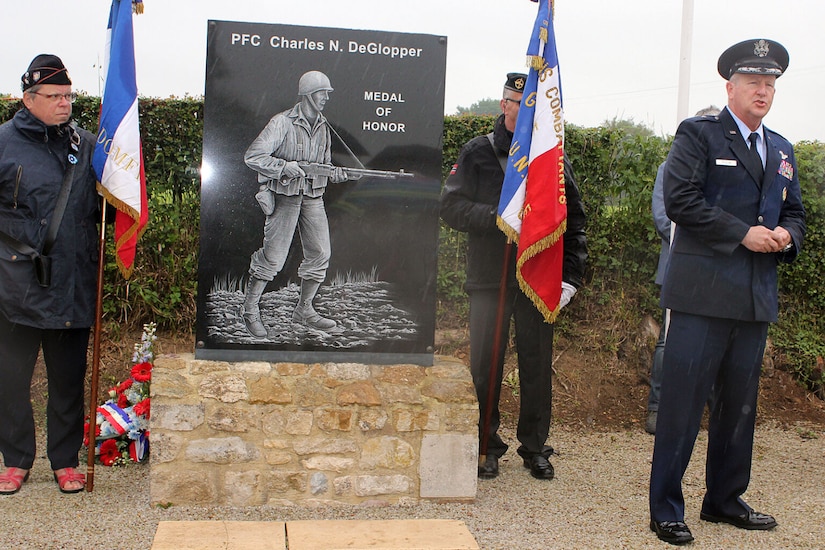
A man in a formal military uniform speaks outdoors in front of a plaque featuring a soldier holding a weapon. Behind him are two men in similar attire, holding flags on each side of the plaque.

His legacy lives on in his hometown and throughout the Army. 

On Dec. 3, 1947, the Army Transport Englin Victory was renamed the Pvt. Charles N. DeGlopper at the Brooklyn Army Base in Brooklyn, New York. A road at Fort Bragg, North Carolina, is named for him, and in January 2015, the Fort Bragg Air Assault School was dedicated and renamed the DeGlopper Air Assault School.  

The Army Reserve Training Center in Tonawanda, New York, is named the Charles DeGlopper Center. On June 9, 2024, 80 years after he paid the ultimate sacrifice, his hometown dedicated the DeGlopper Memorial Park with a rifle salute and a military helicopter flyover. 

DeGlopper is buried in Maple Grove Cemetery in Grand Island.