Monday, August 17, 2026

Competitors Display Resilience, Teamwork at Fort Drum's Mountain Mudder

More than 1,000 Fort Drum, New York, community members answered the "call to dirty" Aug. 14, putting their laundry detergent to the test as they dove into the muck during the base's annual Mountain Mudder.
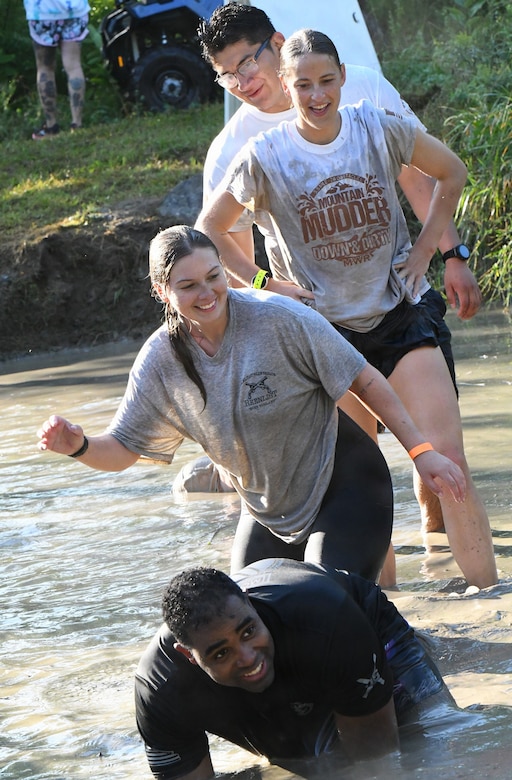
A group of smiling people in athletic gear run in a line into a ditch filled with muddy water.
Hosted by the installation's Directorate of Family and Morale, Welfare and Recreation, the grueling 5.5-mile course was a showcase of resiliency and esprit de corps. Competitors raced through 27 formidable obstacles, ranging from icy water plunges, towering rope climbs and sticky mud pits. 
 
To be sure, running shoes were separated from feet, socks went from white to gray in an instant and it even took a group effort to fish one competitor's eyeglasses out of the mud. 
 
But after completing the final obstacle — the warped wall — and receiving a medal and complimentary power-hose shower, most participants left with a profound sense of accomplishment. 
 
"I feel unbelievable," said Army Sgt. Kristen Kisner. "It was so nice to actually have this experience with some of my battle buddies." 
 
Kisner ran her first Mountain Mudder alongside fellow members of Company C, 548th Division Sustainment Support Battalion, 10th Mountain Division Sustainment Brigade. For her, the most rewarding part was helping each other overcome the course's physical demands to finish as a team. 
 
"Just working together and making sure we were staying together," she said. "Going over the walls was challenging, because some of us are really short, so we had to work as a team to actually accomplish those climbs." 
 
Kisner, who arrived at Fort Drum in the spring, is relatively new to the 10th Mountain Division. She said her job has kept her busy and participating in the event was a welcome break. 
 
"This was absolutely amazing, and I'm glad that our leaders had the time to come out and support us," she said. "Some of them did the challenge with us, so we loved that."

The event was also a first for Army Spc. Tanner Sublett, assigned to the Multipurpose Company, 1st Battalion, 87th Infantry Regiment, 1st Mobile Brigade Combat Team. He ran the course with his platoon and said the final warped wall was the day's toughest test. 
 
"But it was really a lot of fun, and I just like challenging myself," he said. "You know, seeing something that looks tough and then going out and doing it just to prove to myself that I can." 

One of his teammates, Army Pfc. Nathan Simmons, recently returned from supporting cadet training at the U.S. Military Academy at West Point, New York. He said it was the challenge that drew him to the Mountain Mudder. 
 
"Honestly, I heard this was going to be tough — getting through 27 obstacles on a 5-mile course — but this was something I really wanted to do," Simmons said. "The hardest part for me was getting out of the water and running to the next obstacle — that transition when your body is weighed down from all the water. But we got through it."

Department of War and RTX Accelerate Critical Munitions Production Through Navy Tomahawk Award

The Department of War has announced a $22.9 billion contract with Raytheon, an RTX business, awarded by the U.S. Navy, to accelerate production of the Tomahawk missile, a critical long-range strike capability. 

"The Department called upon industry to expand munitions production, and RTX has answered that call," said Under Secretary of War for Acquisition and Sustainment Michael P. Duffey. "This Tomahawk award increases our ability to equip the Joint Force, ensuring our Warfighters never face a fair fight." 

This contract rapidly fields capabilities to meet modern threats while providing industry partners with the stability required to expand their workforce, increase manufacturing throughput, and fortify supply chains. In addition, it advances the Department's Acquisition Transformation Strategy by accelerating critical weapons delivery and reducing procurement lead times. 

"Guaranteeing our naval and joint forces have the lethal firepower they need to deter aggression and protect the homeland is paramount," said Acting Secretary of the Navy, Hung Cao. "This landmark $22.9 billion investment will accelerate Tomahawk missile delivery to our warfighters at unprecedented speed. By working closely with industry to expand our munitions industrial base’s capacity, the Department is utilizing every available tool to meet the demands of our current operations, ensuring they are equipped to fight, win, and come home safe." 

Portfolio Acquisition Executive (PAE) Munitions is a Department of the Navy organization responsible for the development, procurement, and delivery of naval munitions and strike capabilities. By unifying key weapons programs and aligning the weapons industrial base, PAE Munitions provides enterprise-level integration to accelerate production, increase capacity, and ensure the Fleet is equipped with the munitions needed to project power and win.

Department of War Orders Research Security Audits at 30 Academic Institutions

The Department of War has issued formal notifications to 30 domestic academic institutions, directing them to initiate immediate and comprehensive reviews of their academic, financial and research collaborations with foreign entities of concern.

These notifications address active institutional ties and collaborations with foreign entities identified under Section 1286 of the FY19 NDAA, as well as organizations associated with rebranded Confucius Institutes. Executed by the Office of the Under Secretary of War for Research and Engineering, this action is designed to protect American taxpayer-funded research investments from unauthorized technology transfer, intellectual property theft and adversarial exploitation.

"The Department of War has zero tolerance for academic partnerships that compromise our national security," said Emil Michael, Under Secretary of War for Research and Engineering. "Institutions that receive funding from American taxpayers must uphold the highest standards of research security, and these mandated audits will ensure accountability across the board."

To maintain eligibility for future federal research funding, the notified universities must complete a comprehensive audit of all identified foreign collaborations, assess the exposure of sensitive or export-controlled research, and implement strict mitigation plans, including the termination of problematic partnerships. Institutions are required to report their findings and actions directly to the Department no later than August 31, 2026.

"Universities are critical partners in executing a wide range of Department of War research programs, and the Department must therefore ensure that our research investments are well protected from foreign exploitation," said Dr. Joseph Jewell, Assistant Secretary of War for Science and Technology.

Through these audits, the Department of War will better anticipate emerging threats, adapt to evolving adversarial tactics and maintain America's position as a global leader in innovation. The Department is pursuing this effort alongside partners in Congress. Together with the House and Senate Armed Services Committees, the House and Senate Appropriations Committees and the House Select Committee on the Chinese Communist Party, the Department continues to build a robust research ecosystem that protects critical discoveries from exploitation.

Medal of Honor Monday: Army Staff Sgt. Stanley Bender

Army Staff Sgt. Stanley Bender was an infantryman during World War II whose unwavering courage under extreme fire earned him the Medal of Honor. 

Bender was born to Andrew and Eva Bender Oct. 31, 1909, in Carlisle, West Virginia. His parents emigrated from the Lithuanian region of Russia. His father was a World War I Army veteran and a coal miner. 

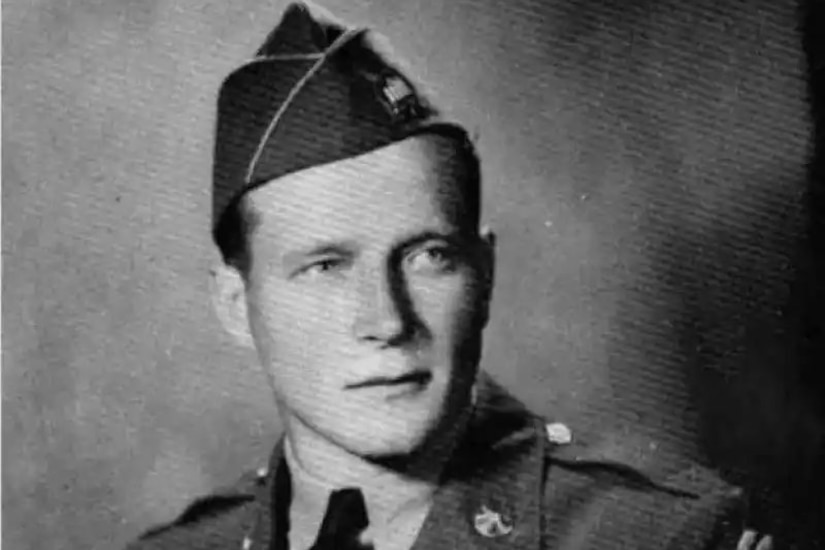
A man wearing a military dress uniform poses for a photo.

His brothers were John, Tony and George and his sisters were Maggie and Eva. 

Bender attended school in Carlisle but dropped out after seventh grade.

The family moved to Chicago at the start of the Great Depression. Bender worked as a truck driver for 10 years before enlisting in the Illinois National Guard in December 1939. He also was a chauffeur for a department store. 

Bender married Esther Marie Tincher, April 9, 1945, and they had two daughters, Shirley Ann and Evelyn Marie. 

His Medal of Honor action took place Aug. 17, 1944, near La Londe-les-Maures, France. At the time, he was assigned to Company E, 2nd Battalion, 7th Infantry Regiment, 3rd Infantry Division. 

That day, Bender climbed on top of an inoperable tank in full sight of the enemy to locate the source of the withering machine-gun fire that had halted the advance of his company. 

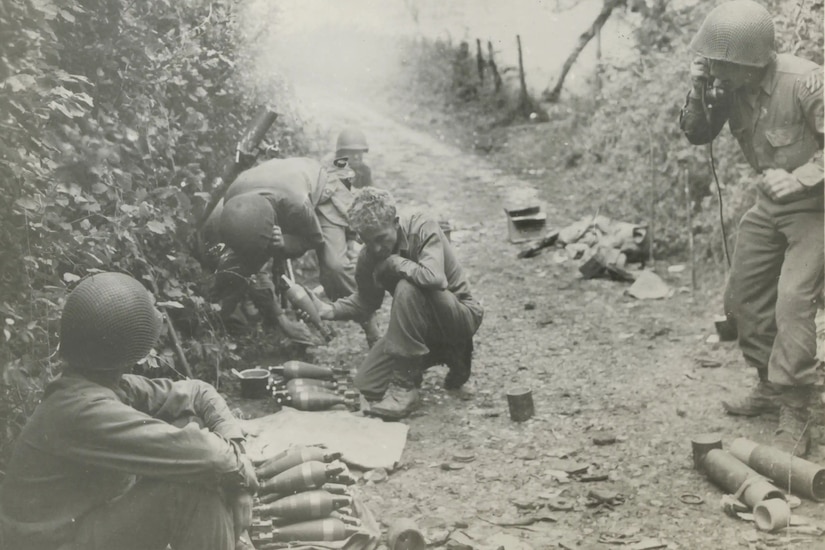
Soldiers on a dirt road operate weapons and a field radio.

Although bullets ricocheted off the turret near his feet, he nevertheless remained standing upright on the tank for more than two minutes. 

Locating the enemy machine guns on a knoll 200 yards away, Bender ordered two squads to cover him and led his men down an irrigation ditch, running a gauntlet of intense machine-gun fire that completely blanketed 50 yards of his advance and wounded four of his men.  

While the Germans hurled hand grenades at the ditch, Bender stood his ground until his squad caught up with him, then advanced alone in a wide flanking approach to the rear of the knoll.  

Bender walked 40 yards, without cover, in full view of the Germans and under a hail of enemy and friendly fire, to the first machine gun and knocked it out with a single short burst. Then he made his way through the strongpoint, despite bursting hand grenades, toward the second machine gun, 25 yards away, whose two-man crew fired two bursts at him. He walked calmly through the fire, reached the edge of the emplacement and dispatched the crew. 

Signaling his men to rush the rifle pits, Bender then walked 35 yards further to kill an enemy rifleman and returned to lead his squad in the destruction of the eight remaining Germans in the strongpoint.  

Bender's audacity so inspired the remainder of the assault company that the men charged out of their positions, shouting and yelling, to overpower the enemy roadblock and sweep into town, knocking out two antitank guns, killing 37 Germans and capturing 26 others.  

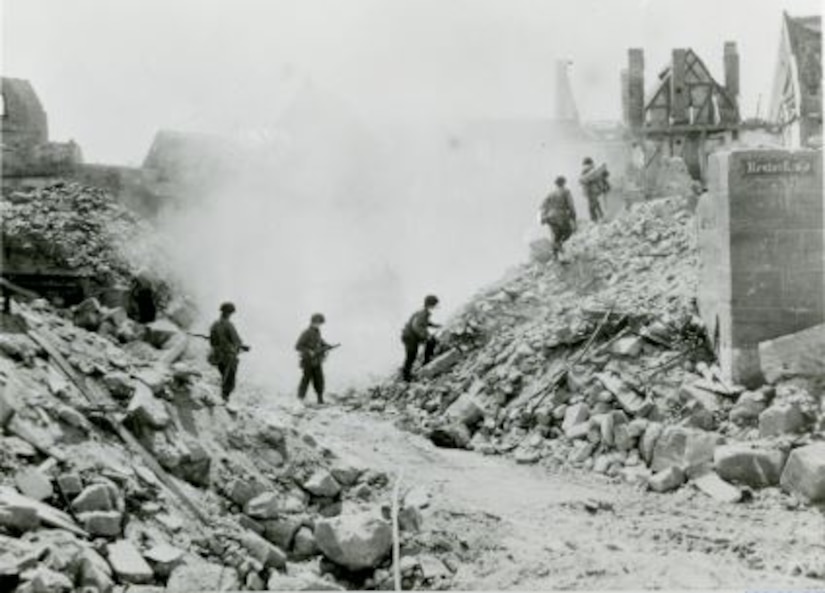
Soldiers wander through the rubble of a destroyed town.

He led the assault company in an attack that overwhelmed the enemy, destroyed a roadblock, took a town, seized three bridges over the Maravenne River and captured commanding terrain dominating the area. 

What makes his feat even more incredible is that he was 35, one of the older soldiers. 

Prior to fighting in France, he participated in Operation Torch in North Africa in 1942, the invasion of Sicily in 1943, and the invasion of Italy and liberation of Rome in 1944. His highest rank was technical sergeant, equivalent to an E-7 in World War II-era rankings. 

After Aug. 17, 1944, he continued with his unit, fighting in France and then in Germany until the war's end in 1945.  

Army Lt. Gen. Alexander M. Patch III, commander of the Seventh Army, presented the Medal of Honor to Bender in France on Jan. 21, 1945. He was honorably discharged on May 19, 1945. 

After the war, Bender worked for the Veterans Administration in Beckley, West Virginia. He was a member of the American Legion and Veterans of Foreign Wars, advocating for veterans' benefits. 

He died June 22, 1994, and is buried in High Lawn Memorial Park in Oak Hill, West Virginia, along with his wife, who died in 2006. 

The Stanley Bender Memorial Bridge on the West Virginia Turnpike was named in his honor Nov. 9, 1954. It was later demolished as part of a highway realignment project. A second bridge on the West Virginia Turnpike was named for him in 1987. 

There is also a Sergeant Stanley Bender Bridge in La Londe-les-Maures, France, close to where his Medal of Honor action occurred. 

Bender, along with legendary Air Force Col. Chuck Yeager, participated in a June 1963 Centennial Day parade in Charleston, West Virginia. 

The Darius-Girėnas American Legion Post dedicated a memorial to Bender in the Brighton Park area of Chicago. He was a member of that post following the war. 

His Medal of Honor is on display at the West Virginia State Museum in Charleston, West Virginia.