Tuesday, June 30, 2026

Exercise Venom Forge Strengthens Partnerships, Boosts Combat Readiness

 June 30, 2026 | By Air Force Staff Sgt. Jake Jacobsen, 432nd Wing

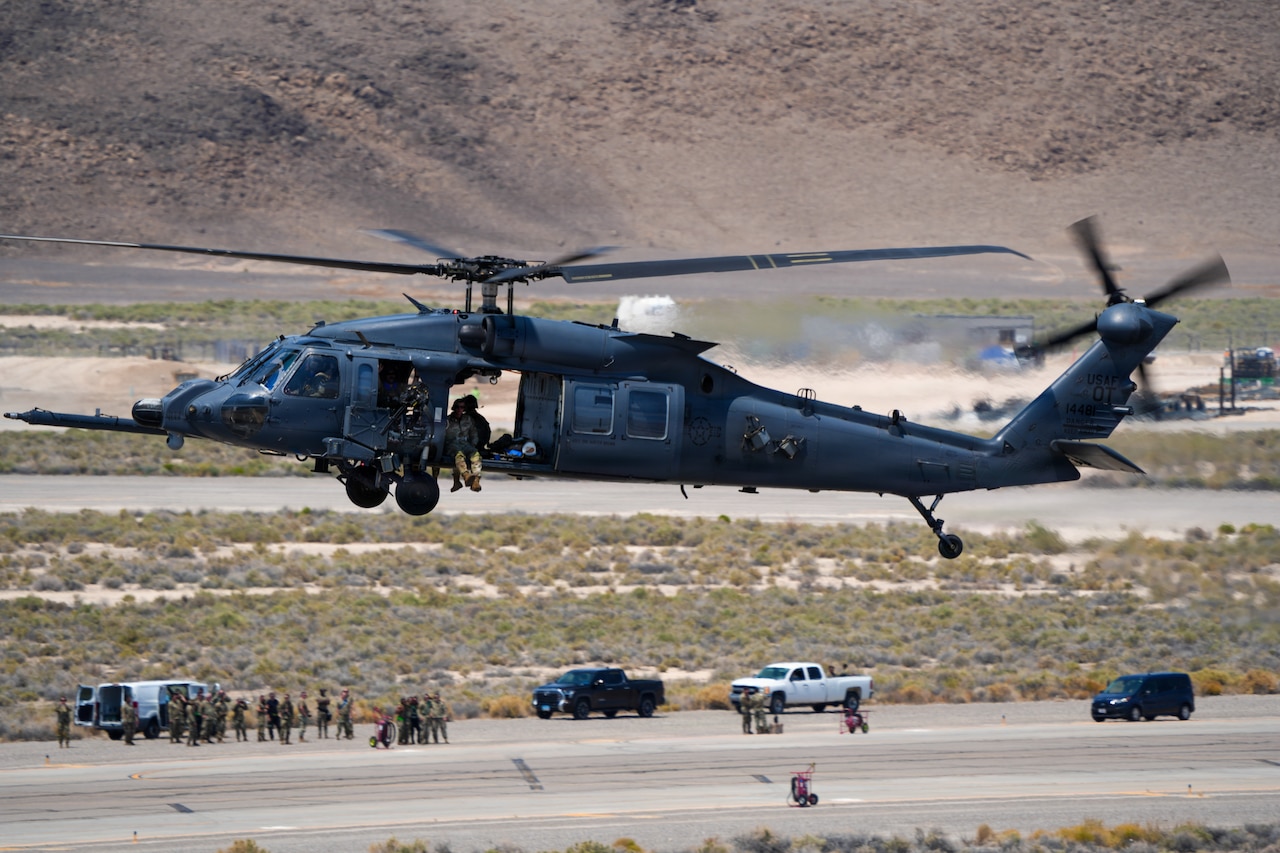
A military helicopter hovers above a flight line as people in military camouflage uniforms stand around on the ground.

An integration exercise designed to develop new tactics, techniques and procedures, combined support from five wings, seven groups and 17 squadrons across a multitude of operations and support at Creech Air Force Base, Nevada, June 17.

Dubbed Venom Forge, this exercise implemented lessons derived from the 57th Maintenance Group's inaugural Agile Maintenance Leadership Course to develop tactical-level maintenance leaders who can build mission-type orders, manage risk, communicate under friction, generate aircraft and create the conditions for combat airpower to happen.

In preparation for the event, mission partners completed a multiplatform hot-pit refueling site certification on base, helping enable contingency hot-pit and integrated combat turn training for multiple fighter platforms. The effort created a foundation for future agile combat employment training iterations.

"Creech [Air Force Base's] support was critical because it gave the capstone an unfamiliar environment and helped turn the course concept into executable training," said Air Force Maj. Yoarmerby Gomez, 57th Maintenance Group maintenance tactics officer. "This exercise required more than ramp space. It required access, support equipment, airfield operations, fuels support, fire emergency services, safety, security, medical response planning, host-base coordination and leadership buy-in."
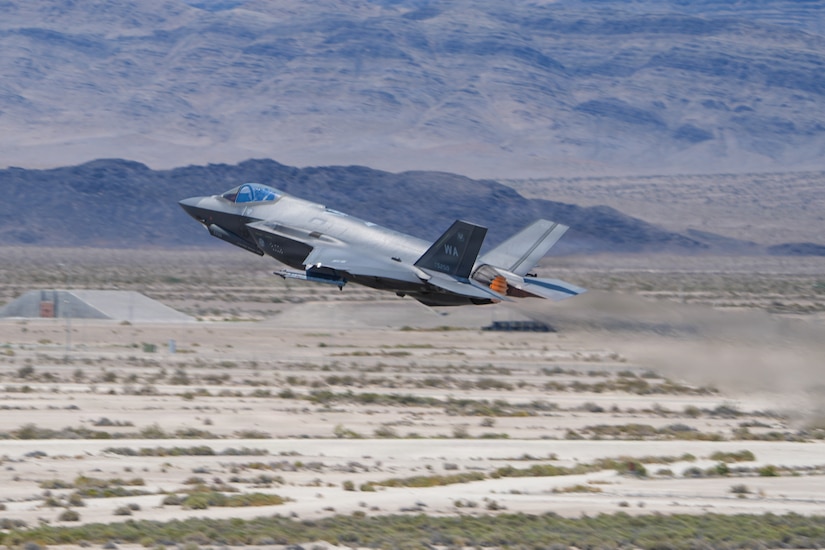
A military jet flies over desert terrain.

To execute the exercise, organizations from the 57th Wing, 99th Air Base Wing, 53rd Wing, 355th Wing and 432nd Wing came together to give students a realistic stage to experience how maintenance decisions affect logistics. The students learned how movement timelines affect aircraft generation, how medical and emergency-response planning affects mission risk, and how base constraints shape execution.

The base provided further support with equipment required for execution, facilitation of access across the installation and aided aircraft integration and operations not part of normal day-to-day mission operations.

"[The base] provided the right balance of proximity, realism and operational value," Gomez said. "It is close enough to Nellis [Air Force Base] to support a controlled hub-to-spoke training model but separate enough to force students to coordinate with a real host base instead of relying on home-station assumptions."

To further test units involved, an inject involving members suffering from simulated heat stroke was enacted, allowing medical teams on HH-60W Jolly Green II helicopters to integrate critical care air transport while aggressor units conducted hot-pit integrated combat turns on F-35A Lightning IIs and F-16C Fighting Falcons.
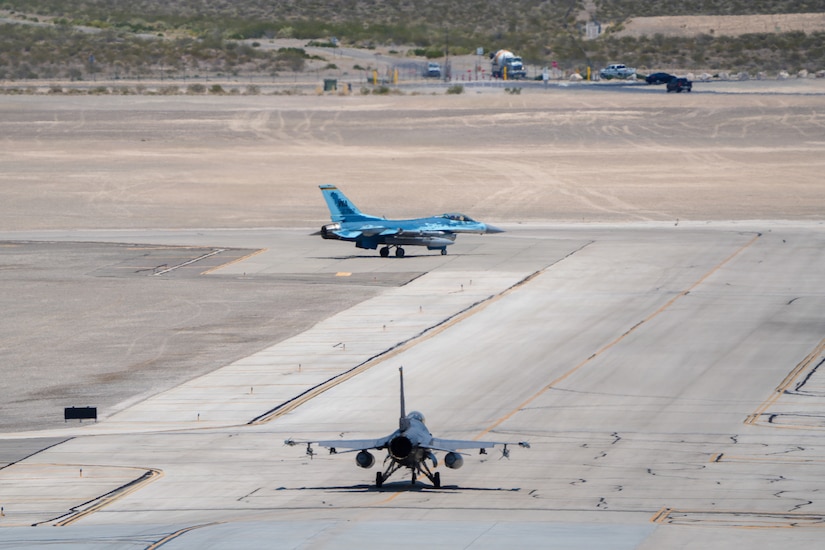
Two military jets taxi on a flight line.

"What made Venom Forge unique was that every organization had its own reason to be there," Gomez said. "One of the clearest examples of the training value was the level of deconfliction required on the airfield. At one point, F-35s and F-16s were being refueled and rearmed while two HH-60s were entering the airspace. These elements of controlled chaos were exactly what we wanted the students to experience. It forced multiple agencies to communicate, deconflict and execute safely in a dynamic environment."

The certification and partnership conducted during the exercise enabled a repeatable foundation for future iterations. These next events could include more students, additional mission partners, different aircraft and more deliberate deconfliction across multiple simultaneous operations.

"For the students, Venom Forge showed that aircraft generation is not just a maintenance action," Gomez said. "Thanks to this exercise, we now have a scalable course model, a stronger relationship with [the base], a multiagency training framework and a better understanding of what it takes to generate combat airpower from a spoke location."

JIATF 401 Leaders Visit Whiteman Air Force Base to Strengthen Counter-Drone Operations

Joint Interagency Task Force 401 leaders recently visited Whiteman Air Force Base, Missouri, to learn about the installation's counter-unmanned aerial systems operations and initiatives in advance of the upcoming directed energy pilot program.  

The visit highlighted how the 509th Bomb Wing and the 131st Bomb Wing have strengthened base defense by combining advanced technologies with physical defenses and operational procedures.  

During the visit, leaders discussed infrastructure upgrades, engagement authorities and how best to overcome integration hurdles, as well as strategies for safely employing counter-UAS engagement options within the homeland. The meeting also highlighted how base leaders are successfully using locally developed concepts of operation in their strategy.  

Security forces personnel demonstrated how they are employing the systems provided by JIATF 401 to further strengthen their capabilities. 

"The tools and training we've received from JIATF 401 allow us to respond faster and more effectively to drone threats," said Air Force Tech. Sgt. Brent Keefler, 509th Bomb Wing section chief for counter-UAS and small UAS. "Having both the technology and training to act gives our team confidence to protect the base and our airmen." 

The visit underscored the War Department's ongoing commitment to partnering with and delivering state-of-the-art counter-drone solutions to warfighters to defend personnel as well as critical facilities and assets. 

"When looking at an installation's counter-drone capabilities, I don't focus solely on the equipment or the array of assets on a map," said Army Brig. Gen. Matt Ross, JIATF 401 director. "I ask who the commanders are that have the mission to defend the base from drones. Whiteman's leadership and airmen are demonstrating exceptional initiative and capability in this mission." 

Sinking Exercise Demonstrates Capabilities of Joint Force

U.S. Pacific Command joint forces, along with allied and partner forces, successfully carried out a live-fire sinking exercise as part of Valiant Shield 2026, targeting the thoroughly cleaned and decommissioned amphibious transport dock USS Juneau more than 200 nautical miles off the coast of Guam. 

The Juneau launched in 1966 and saw action during the Vietnam War and Operation Desert Storm before it was decommissioned in 2008. 

The evolution brought together air, surface and subsurface assets in coordinated strikes, allowing crews to sharpen critical skills in weapons employment and target engagement under realistic conditions that no simulator can fully replicate.

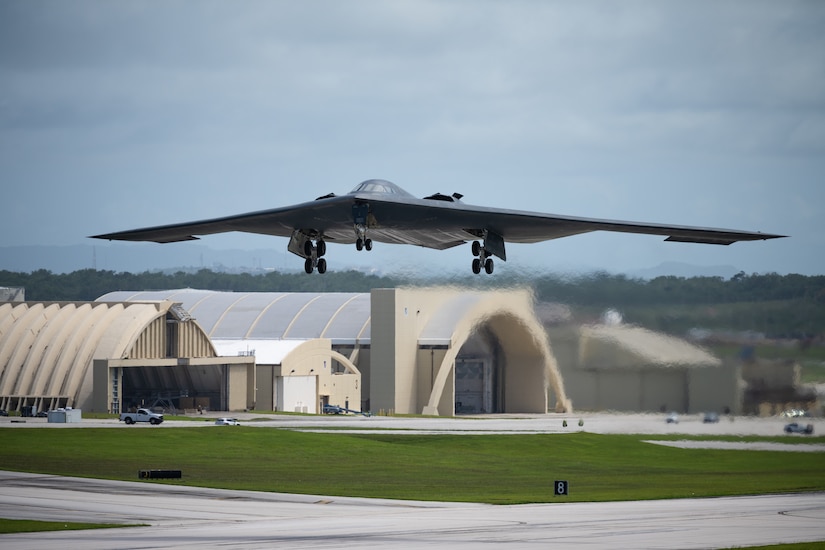
A military bomber aircraft takes off from a runway with aircraft hangars in the background.
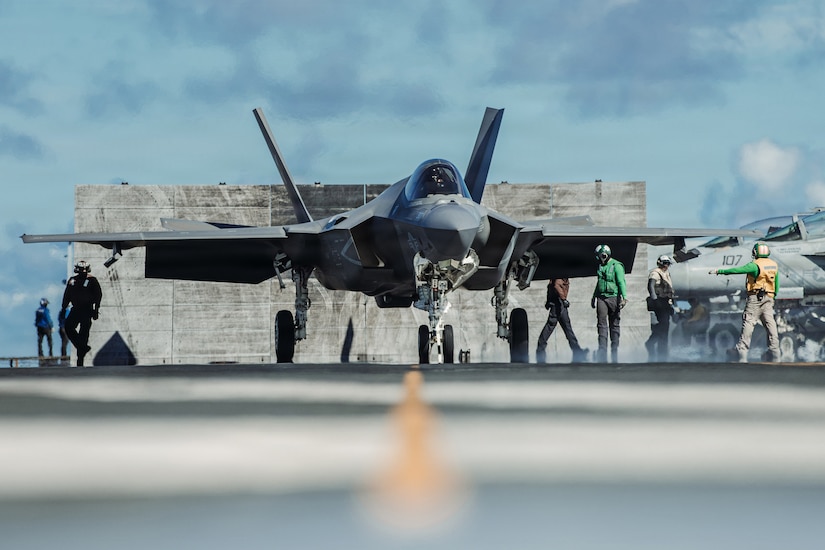
Several people in military uniforms walk around a military aircraft on the flight deck of an aircraft carrier.
"This [exercise] provided an outstanding opportunity for our joint team to integrate capabilities across domains, honing the lethal precision and coordination essential for high-end maritime operations in the Pacific theater," said Navy Rear Adm. Eric Anduze, commander of Carrier Strike Group 5 and Task Force 70. 

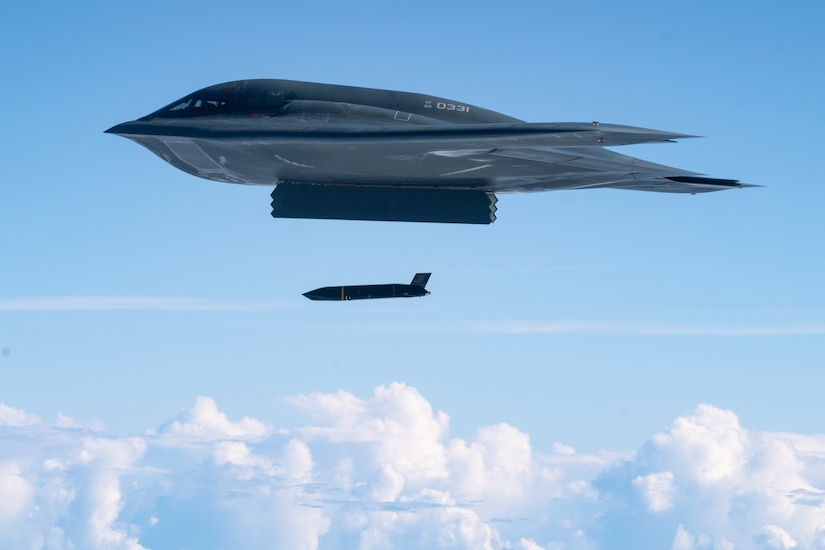
The coordinated strike included a long-range anti-ship missile deployed by an Air Force B-2 Spirit bomber. The LRASM is designed to detect and destroy enemy ships at long ranges. Developed by the U.S., it's a key component in the military's counter-maritime strike operations.   

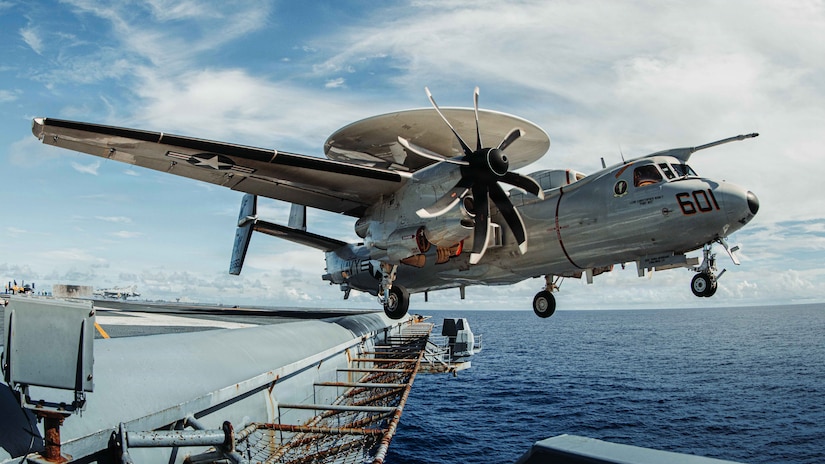
A military aircraft flies off the end of an aircraft carrier sailing in the ocean.

"The B-2's impressive performance underscores the U.S. military's commitment to adaptability and flexibility in the face of emerging security challenges," said Air Force Gen. Kevin B. Schneider, commander of Pacific Air Forces. "By prioritizing counter-maritime strike operations, we can maintain a decisive edge over adversaries, protect our national interests and ensure the free and open Pacific that underpin our global security."  

With the deployment of the LRASM from the B-2 Spirit, the Pacific Air Forces has another tool in countering maritime threats. This milestone showcased high-end innovation reinforcing the War Department's commitment to safeguarding national interests and maintaining global security.

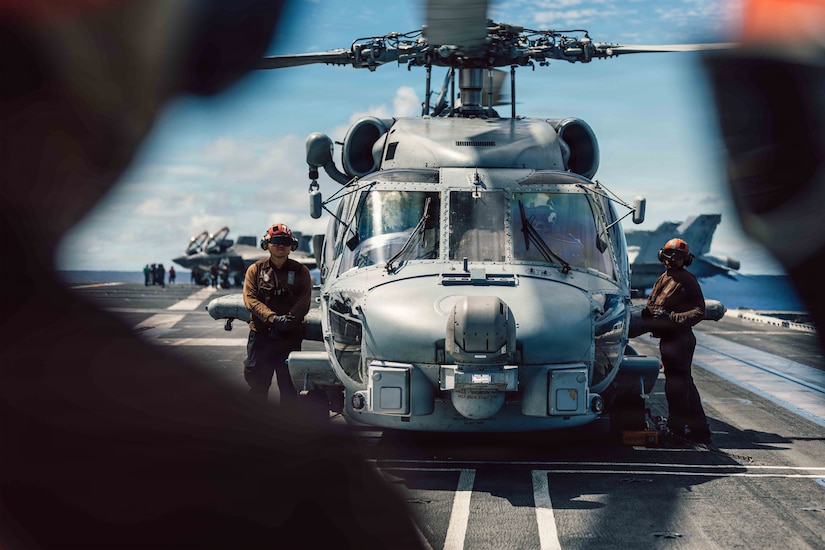
Two people in military uniforms stand next to a military helicopter on the flight deck of an aircraft carrier as a person in the foreground signals them.
A missile launches from a stealth bomber in the air, with clouds below it and a light blue sky in the background.
All operations adhered strictly to federal environmental regulations and international standards. Prior to the exercise, the target vessel underwent extensive preparation, including the complete removal of hazardous materials in line with Environmental Protection Agency guidelines. The selected site was surveyed to ensure the safety of marine life, vessels and personnel, with full compliance to the National Environmental Policy Act, Marine Mammal Protection Act and other key statutes. 

Exercise Valiant Shield is a biennial, multilateral field training exercise conducted by the U.S. and partner nations in the Western Pacific focusing on joint, cross-combatant integration operating across sea, air, land and cyberspace.