Thursday, February 12, 2026

Railhead Operations Drive Strategic Mobility for Exercise in Alaska

Large-scale arctic exercises far into the Alaska tundra require support just as sophisticated and robust as the operations themselves. It takes a coordinated network of planners, inspectors and transportation specialists working behind the scenes to move equipment safely and efficiently.

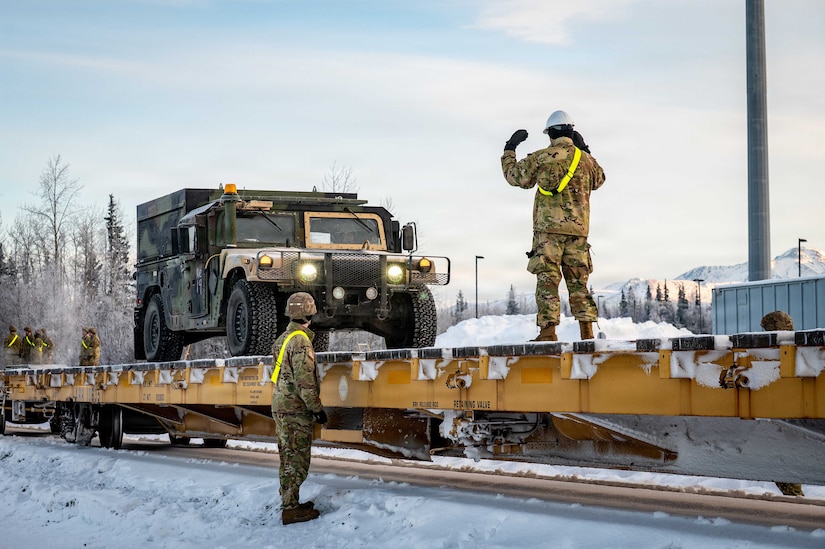
A person wearing a camouflage military uniform and a hard hat stands on a flatcar and gestures with his hands to guide a military vehicle; another person in similar attire stands on the ground and observes.

In support of the Joint Pacific Multinational Readiness Center 26-02 exercise at Fort Wainwright, Alaska, logistics professionals assigned to the 773rd Logistics Readiness Squadron and the 486th Movement Control Team, 17th Combat Sustainment Support Battalion, 11th Airborne Division, transported critical equipment for several Army units across Joint Base Elmendorf-Richardson, Alaska. 

"The entire operation is a coordinated effort between the deploying units, the division transportation office, the movement control center, the installation transportation office, and Alaska Railroad representatives," said William Lower, installation mobilization officer for the squadron. "It's a continuous flow from planning through final execution."

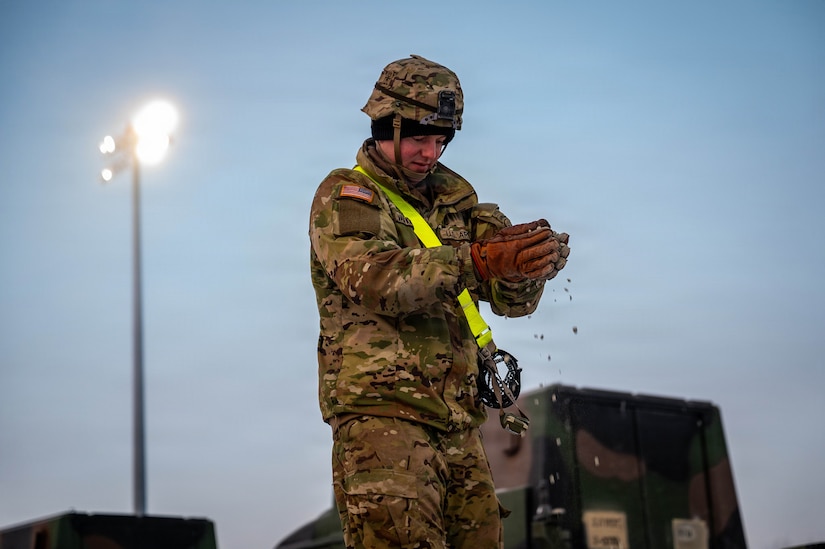
A man wearing a camouflage military uniform and gloves lets gravel fall from his cupped hands outside under a blue sky with a large tower light in the background.

The logistics workflow starts long before equipment enters the rail yard. Personnel working with unit movement officers identify all gear to be shipped, then work with the movement control center and other transportation offices to book the necessary railcars. Training for the loading teams ensures personnel are prepared and proficient when operations begin. 

"By working in tandem with the [movement control center], our team ensures every piece of equipment is not only properly inspected but also loaded onto railcars precisely, according to the approved load plan," said Army Capt. Benjamin Mohn, 486th Movement Control Team commander. "This meticulous oversight is essential for maximizing the use of available space and ensuring equipment meets the Alaska Rail standards, guaranteeing that the train can transport the maximum amount of equipment possible in a single movement." 

A vital phase of the process is the transportation integrity and preparation for shipment inspection. At the designated marshaling area, each vehicle and piece of cargo undergoes a detailed examination for transportability, mechanical soundness, proper documentation and safety compliance before being cleared for movement.

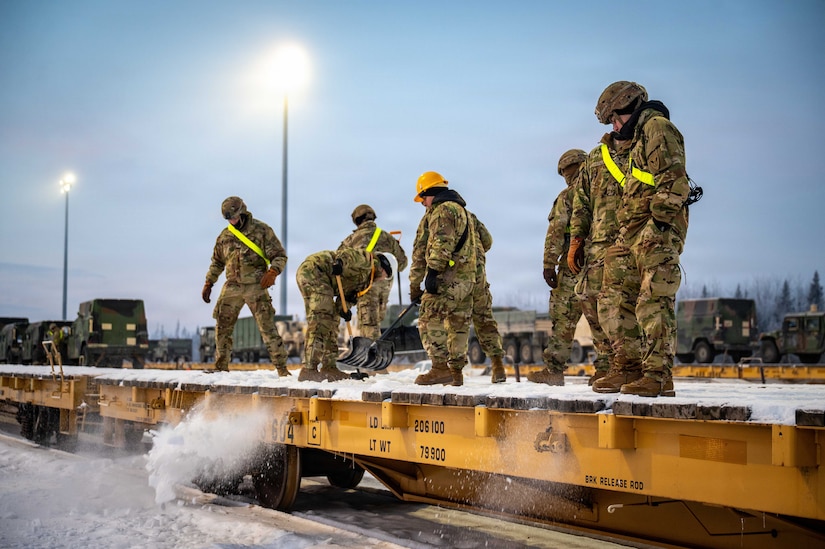
About eight people wearing camouflage military uniforms, safety belts and helmets remove snow from a flatcar at a railhead outside under a blue sky with tower lights and other military vehicles in the distance.

"Every piece of equipment receives a thorough TIPS inspection to ensure it's mechanically sound, properly secured and documented for movement," Lower said. "That step is essential to moving equipment safely and efficiently." 

Central to that effort was the railhead operation, a core logistics process that inspects, documents and loads military vehicles and cargo onto commercial railcars for movement up to the Joint Pacific Multinational Readiness Center. Railhead operations serve as a key node in the broader logistics network, ensuring that vital equipment arrives intact and on schedule. 

By housing both the movement control center and the installation transportation office within the 773rd LRS, the squadron ensures seamless integration of planning and execution, from initial coordination to cargo departure. This integration enabled the 257 TIPS inspections of the 65 railcars carrying vital equipment in support of the Joint Pacific Multinational Readiness Center.

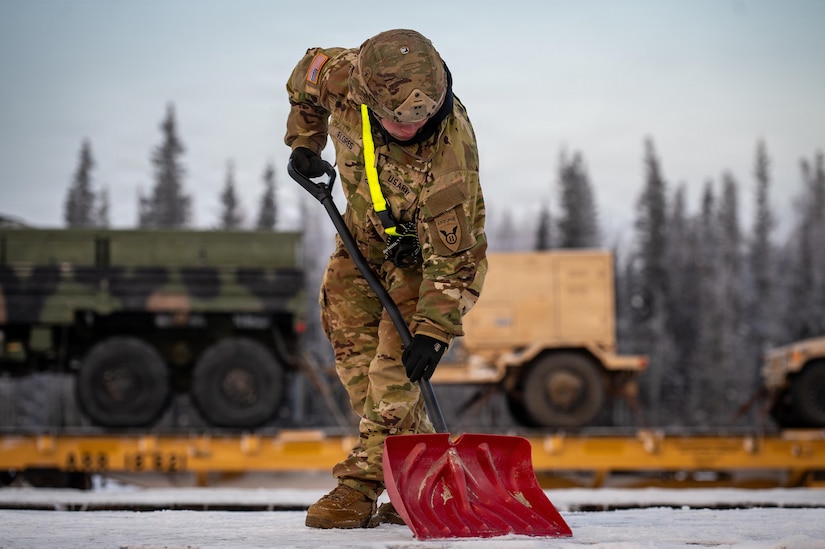
A man wearing a camouflage military uniform, safety belt and helmet shovels snow from the surface of a flatcar at a railhead; Another flatcar loaded with military vehicles is in the background.

"The [movement control center] and [installation transportation office] are integral parts of the 773rd LRS," Lower said. "By bringing those capabilities together, we're able to synchronize the entire process and guarantee assets are deployed safely, securely and on schedule." 

Railhead and movement control operations often go unseen by soldiers whose gear is already en route or in place. Still, these logistics professionals provide the backbone that enables units to meet training and operational objectives. 

"The strong, trusted partnership between the [movement control team], the [movement control center] and all participating units is the bedrock of our success," Mohn said. "This shared understanding allows our team to remain agile and effectively solve the inevitable challenges and friction that arise during complex operations, ensuring the mission is always accomplished."

Hegseth Calls for Military Unity Across Western Hemisphere at Inaugural Defense Chiefs Gathering

Secretary of War Pete Hegseth today called on defense chiefs and other senior military leaders from 34 Western Hemisphere countries to unite in deterrence against bad actors who may already be operating in, or working to encroach upon, the region. 

Convened by Air Force Gen. Dan Caine, chairman of the Joint Chiefs of Staff, and held in downtown Washington, the daylong, first-of-its-kind Western Hemisphere Chiefs of Defense Conference focused on regional security cooperation against narco-terrorism and other criminal enterprises throughout the hemisphere, while also analyzing common security priorities between allies and partner nations.  

While delivering prepared remarks at the meeting's outset, Hegseth said the U.S. — like all countries represented at the conference — desires a hemisphere of peace, which is why all those countries must work together to achieve and preserve it. 

"We, like you, want — and will — achieve a permanent peace in this hemisphere. So, let's work together [with] our militaries: exercising, training, operations, [intelligence], access, basing, overflight, you name it — let's work together," Hegseth told the gathered leaders.  

"To achieve these goals, we have to stand together; there's no other way to do it," he added.  

Hegseth said the War Department, under the leadership of President Donald J. Trump and his administration, is prioritizing protecting the homeland and key territories throughout the hemisphere for the first time in decades. 

"The United States is asserting, reestablishing and enforcing the Trump corollary of the Monroe Doctrine," Hegseth explained. 

Issued in 1823 by President James Monroe, the Monroe Doctrine declared that the Western Hemisphere was off-limits to any new attempts at colonization by European nations, and that any interference by those powers would be viewed as a hostile act against the United States.  

Reciprocally, the U.S. pledged not to interfere with any of Europe's internal affairs and not meddle in any of Europe's colonial affairs. 

"It's common sense: restoring American power and American strength in our hemisphere through shared priorities and common interests and threads with partners against our adversaries," Hegseth said.  

He went on to reiterate a core tenet of the Trump administration's philosophy on homeland security: that, for far too long, the U.S. had focused on securing and defending other nations around the world while neglecting security within the U.S. and throughout the Western Hemisphere. 

"The consequences of this have been dire for our nation and for your nations; fentanyl, cocaine [and] other deadly drugs poured across our border, poisoning and killing millions of Americans. The number of deaths for Americans to those weapons and those threats is far higher than American casualties in any kinetic war," Hegseth said, adding that illegal mass migration and human smuggling had risen exponentially in the years leading up to the U.S. closing its southern border last year.  

Along with the residual benefits of closing the border — which Hegseth said include the biggest drop in illegal border crossings in the past 50 years, as well as a significant reduction in the U.S. murder rate — he also pointed out the successes that the U.S. military and law enforcement are having through the anti-narco-terror mission to the south, specifically with Operation Southern Spear. 

Launched last year by U.S. Southern Command, Southern Spear is a joint U.S. military campaign aimed at disrupting drug trafficking in the Caribbean and Eastern Pacific, particularly by conducting lethal airstrikes against suspected traffickers.  

"Operation Southern Spear has restored deterrence against the narco-terrorist cartels that profit from poisoning Americans and killing our people and your people," Hegseth told the group, adding that the number of narco-terror boats in the region has diminished significantly since the U.S. strikes began in September 2025.  

"Narco-traffickers know that the true cost of flooding our country with deadly drugs is death for themselves — a real deterrent," he said. 

Hegseth also pointed to the success of Operation Absolute Resolve, in which U.S. forces last month captured Venezuelan leader Nicolás Maduro and his wife. 

"Operation Absolute Resolve demonstrated, once again, the bravery and skill and capability of America's best: our warfighters," he said. 

As his remarks drew to a close, Hegseth underscored that Trump and his administration believe that sovereignty and territorial integrity depend upon military power, and not just traditional law enforcement. 

"Yes, policing is important [and] enforcing is important, but military power is [also] important," Hegseth said, adding that the countries represented during the day's conference must work together to combat and dismantle narco-terrorism and drug trafficking cartels in the Western Hemisphere.   

"We need to build those bonds of partnership to defeat the challenges to our security and our sovereignty," he added. "So, as you might say, we can make the Americas great again."  

Senior Enlisted Advisor to Chairman Testifies on Quality of Life

Warfighters are the foundation of War Department lethality, said Senior Enlisted Advisor to the Chairman David L. Isom, who testified before the Senate Armed Services Committee's personnel subcommittee on service member and family quality of life, yesterday.

The love and support from their families make their service possible, he added.

As the joint force works tirelessly to ensure the safety and security of the nation, DOW and the nation must also work tirelessly to ensure service members have full support and that they have what they need to fight and win when called upon, the SEAC said.

"Humans are more important than hardware, because the true strength of our military isn't just in our ships and our tanks or our aircraft. It's the unwavering spirit and the trusted hands of our people, our total joint force," Isom said.

The U.S. Capitol building is flanked by trees in the winter with two flags flying to the left of the dome.

Isom told the subcommittee that he and Air Force Gen. Dan Caine, chairman of the Joint Chiefs of Staff, have three priorities:

  • First, the joint force must be properly armed — the right capabilities and capacity when needed to fight and win.
  • Second, the joint force must be globally integrated across all domains — with interagency, industry and with allies and partners.
  • Third, DOW must build a ready joint force. Being ready is about repetitions, tough training and building muscle memory. This also includes being clear-eyed about the future and being candid with the force and its families.

"Underpinning these priorities is our most important asset, and that's our people," Isom said. "We recruit America's best, and we must retain this talent by taking care of them and taking care of their families."

Senior enlisted leaders from all the service branches also testified.