As America celebrates 250 years of independence, the District of
Columbia National Guard, citizens and other government staff gathered at
the Congressional Cemetery in Washington, Aug. 23, to look back 212
years — to a moment when ordinary citizens answered an extraordinary
call and stood in defense of the young nation's capital during the
Battle of Bladensburg.
The wreath-laying ceremony connected America's Freedom 250
commemoration with the citizen-soldier tradition that helped defend the
nation in its earliest years and continues today with the National
Guard. Held among the gravesites of those who lived that history, the
ceremony honored their courage while examining the lessons their service
left for future generations.
"Whether you're describing acts of bravery or military chaos, the
story [of that battle] cannot be told without recognizing the role of
the citizen-soldier," said Mark Hudson, executive director of the
cemetery. "The local militia joined the desperate fight to defend our
young nation."
Historian Glenn Williams placed their service within the broader
Chesapeake campaign during the War of 1812. With much of the nation's
military strength committed elsewhere, he said the Washington area was
defenseless except for the citizen-soldiers of the militia as British
forces advanced toward the capital.
Williams described how American riflemen initially engaged and
counterattacked the British advance before reinforcements shifted the
balance. Outnumbered three to one and eventually outflanked, the
American defense collapsed, clearing the way for British forces to enter
Washington and burn several prominent public buildings.
Army Brig. Gen. Leland D. Blanchard II, interim commanding general of
the D.C. National Guard, said approximately 1,000 D.C. militia members
assembled to defend the capital in 1814.
"They were ordinary Americans who answered an extraordinary call," he
said. "They stood in defense of a young capital, a young government and
an independence won only a generation earlier."
For Blanchard, remembering the battle also means confronting the
lessons that came from defeat. The militia members who assembled in 1814
possessed courage and commitment, but courage alone could not overcome
their shortcomings in preparation, organization and coordination.
"Bladensburg reminds us that courage is essential, but courage must
be matched by readiness," Blanchard said. "Training matters. Leadership
matters. Command and control matter. And the relationships we build
before a crisis matter when that crisis arrives."
Reflections on the D.C. Militia Legacy
Those lessons, he said, remain relevant more than two centuries later
as the National Guard confronts an increasingly complex mission set
spanning domestic response, homeland defense and support to global
operations.
"Readiness is not something we begin building when the emergency
starts," Blanchard said. "It is built every day — through training,
preparation and trust between the people and organizations who may one
day be called to respond together."
While the Battle of Bladensburg ended in defeat, Blanchard emphasized
that its enduring value lies in what America carried forward from the
experience.
"Winning independence and preserving independence are not the same
thing," he said. "One required a generation to establish a nation. The
other requires every generation to remain prepared to defend it."
That responsibility, he said, has always depended on more than one organization or institution.
A.J. Orlikoff, cemetery director of programming, brought the
commemoration from military history to personal remembrance. Through
research, Orlikoff has positively identified 26 D.C. militia veterans of
the Chesapeake campaign buried at the Congressional Cemetery, while
noting many more may remain unidentified.
"These defenders of the capital came from all walks of life — clerks,
craftsmen, public officials, businessmen — all stepped up to defend the
city," he said, before reading aloud the names of all 26 identified
militiamen, restoring individual identities to men whose graves, in some
cases, are unmarked.
"By reading their names and visiting their graves, we are doing much
more than simply remembering a battle," Orlikoff said. "We're restoring
their identity as people; we're restoring the memory of their service."
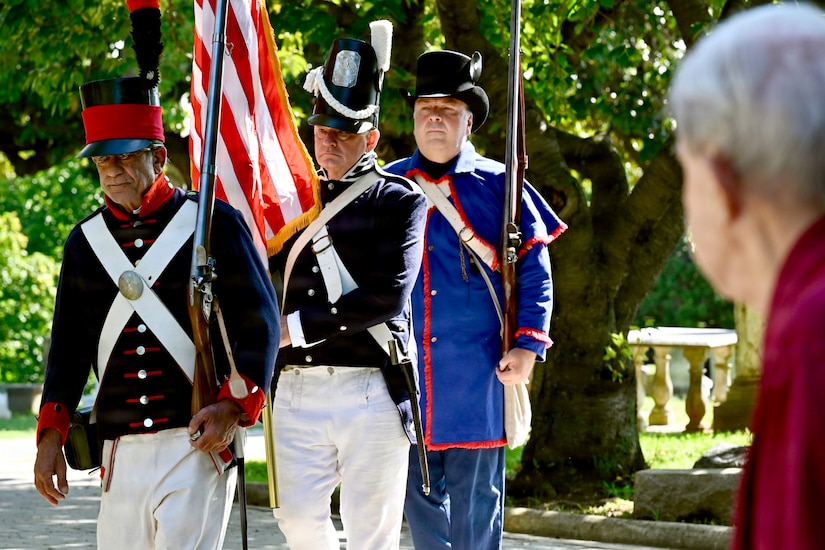
Following the remarks, Hudson and Blanchard laid a wreath at the
grave of one of the fallen militiamen. A color guard then rendered a
ceremonial volley in honor of those who defended the capital.
For Blanchard, the connection between 1814 and 2026 remains clear.
The uniforms, technology, missions and threats have changed, but the
responsibility to remain ready— and the citizen-soldier and airmen
tradition behind it — endures.
"The citizen-soldier is not simply part of our history," Blanchard
said. "It is a living tradition. Today, ordinary men and women continue
to step away from their families, their careers and their communities
when the nation calls."
That continuity carries particular meaning in Washington, where
today's D.C. National Guard traces its heritage to the militia tradition
that helped defend the capital more than two centuries ago.





 Posts
Posts

