Monday, March 16, 2026

Joint Task Force Southern Border Marks One Year of Success, Bolstering Southern Border Security Through Integrated Operations

Joint Task Force Southern Border reached its one-year anniversary, March 14, underscoring a year of agile, full-scale and partner-focused missions supporting the Department of Homeland Security's southern border mission.
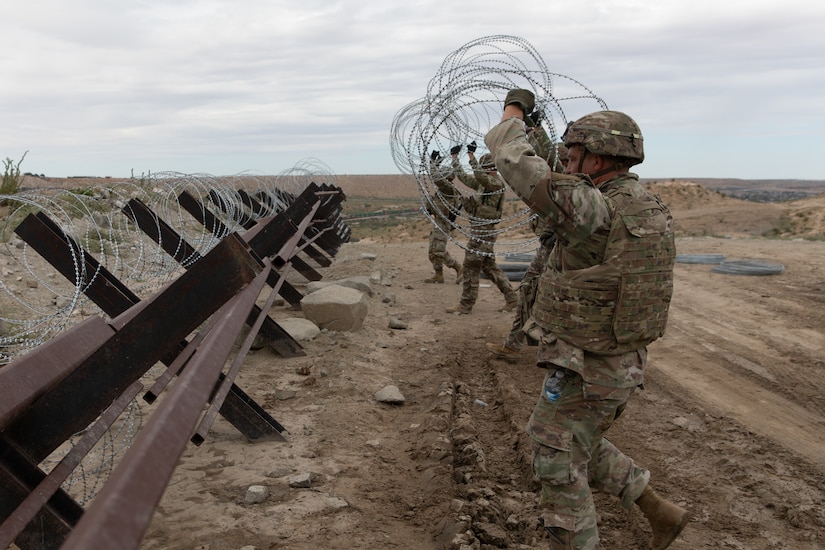
People wearing military camouflage uniforms move concertina wire over a barrier fence in a desert terrain.

Soldiers assigned to the 10th Mountain Division in Fort Drum, New York, deployed to Fort Huachuca, Arizona, to establish the new task force, March 14, 2025, under the authority of U.S. Northern Command. The 101st Airborne Division from Fort Campbell, Kentucky, assumed control of the JTF-SB mission following a transfer of authority from the 10th Mountain Division, Oct. 10, 2025.

JTF-SB's mission is to safeguard U.S. territorial integrity and protect the American people. The task force achieves this by increasing situational awareness along the southern border, accelerating response capabilities and supporting federal law enforcement partners so they can focus on frontline duties.

One Year of Impact: Unified Operations, Measurable Results

Over the past year, JTF-SB service members provided consistent watch across 1,954 miles of the U.S.-Mexico border, conducting remote and mobile detections spanning from river crossings to high-traffic urban corridors. Through synchronized planning, rapid mobility and persistent presence, JTF-SB has enhanced southern border security by expanding detection and monitoring, improving data sharing that enabled U.S. law enforcement partners to increase apprehensions while also improving the warfighting readiness of assigned units.

Key accomplishments and operational highlights from the past year include:

  • JTF-SB has assisted DHS in achieving historically low levels of individuals attempting to illegally cross our southern border and an equally historic effectiveness in arresting or turning back those that do.
  • More than 20,000 service members have honorably served under JTF-SB since its establishment.
  • Approximately 22,000 enhanced detection and monitoring missions were conducted, enabling greater awareness of illegal crossings from Mexico into the United States. Of these, almost 3,000 were joint patrols alongside U.S. Customs and Border Protection agents, and over 800 were mirrored patrols on both sides of the southern border with CBP and the Mexican Secretariat of National Defense.
  • More than 84,000 security site missions were conducted, providing continuous detection and monitoring across key areas of the southern border. These missions leveraged advanced sensor-borne technology, including fixed and mobile ground sensors and long-range systems, to deliver greater situational awareness.
  • Aviation assets have executed nearly 1,600 aerial observation flight missions and 220 unmanned aerial missions, monitoring areas of interest and providing overwatch for personnel on the ground.
  • Nearly 6,000 signs and 2,000 buoys have been installed along 656 miles of the southern border to clearly demarcate the five recently created national defense areas.
  • Over 51,000 rolls of concertina wire were delivered and are actively being emplaced into key areas in conjunction with CBP. This supports barrier reinforcement along the southern border, the largest of its kind in U.S. history, adding a layer of deterrence in areas most needed to deter and deny illegal crossings.
  • Units are conducting real-world testing of new equipment and technology, including the TRV-150C tactical resupply vehicle; the infantry squad vehicle that Marines trained on for the first time in an operational environment; an unmanned surface vessel and solar-powered maritime detection device; and various kinetic and nonkinetic counter-unmanned aerial systems.

These results reflect a year of disciplined execution and unified effort across federal, state and local partners.
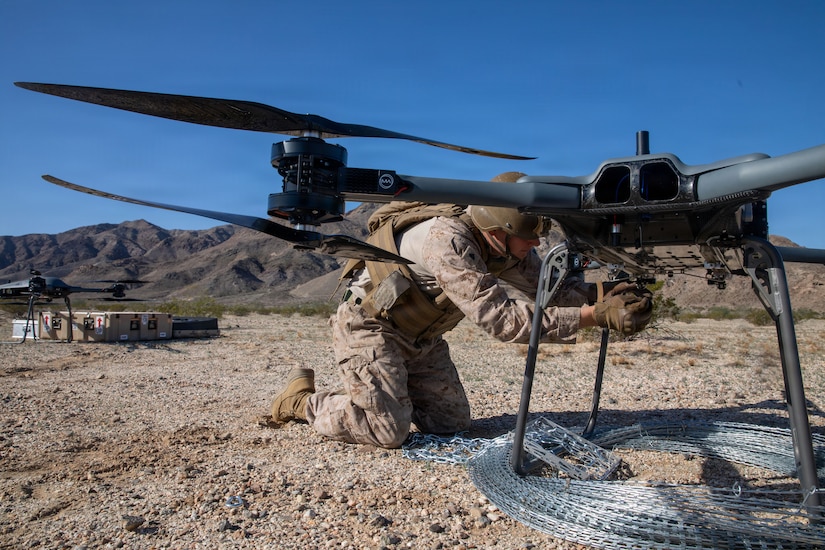
A man wearing a camouflage military uniform works on a drone in mountainous desert terrain.

"During this first year, Joint Task Force-Southern Border and partners have proven what a whole-of-government approach to our nation's southern border can accomplish," said Army Maj. Gen. David Gardner, commanding general of the JTF-SB and 101st Airborne Division. "Our joint teammates and partners have strengthened border security through unity of effort, accelerated decision-making and enhanced detection capability. While the environment is complex, our mission is clear: to secure the homeland with precision, professionalism and respect for the rule of law."

Entering its second year, JTF-SB remains dedicated to its mission, strengthening integration, advancing data-driven operations and supporting CBP and partner agencies with professionalism and adaptability.

"Our mission continues and our commitment is unwavering," Gardner said. "We will keep evolving, supporting our partners and protecting the American people."

Medal of Honor Monday: Navy Petty Officer 1st Class Francis Pierce

As the chaos of World War II's Battle of Iwo Jima unfolded, Navy Petty Officer 1st Class Francis Junior Pierce refused to leave any wounded men behind. The hospital corpsman showed fearlessness throughout the turmoil. That valor led him to receive the Medal of Honor. 

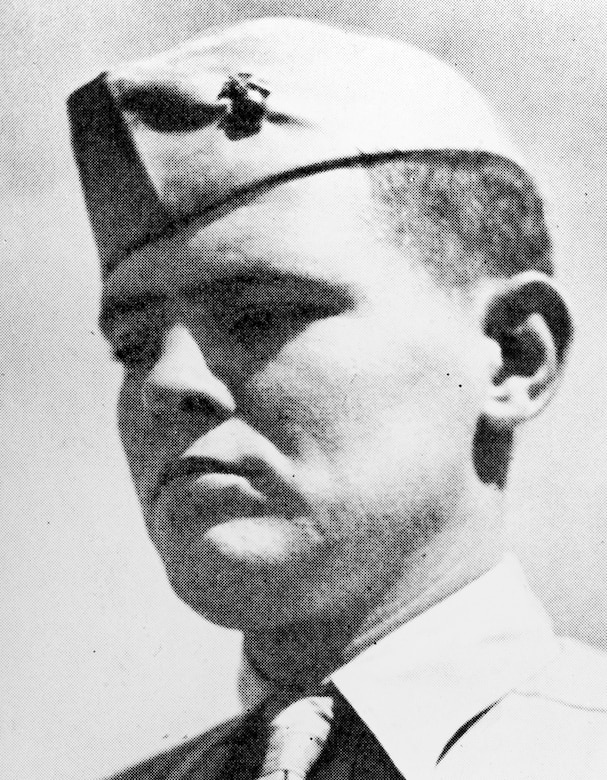
A man in a military cap looks stoic while looking toward the ground.

Pierce was born Dec. 7, 1924, in Earlville, Iowa, to Frank and Rose Pierce. He grew up on a farm and had a younger brother named Donald.

Pierce turned 17 the day Pearl Harbor was attacked by Japan, which thrust the U.S. into World War II. Shortly thereafter, he enlisted in the Navy to do his part for the war effort.

After completing training to be a hospital corpsman, Pierce served the early part of the war at various duty stations in the Carolinas. He rose to the rank of pharmacist's mate before being transferred in January 1944 to the newly activated 4th Marine Division in Camp Pendleton, California. Soon after, the unit was deployed to the Pacific.

Pierce's first time in combat was in February 1944 during the Marshall Islands campaign, when the division landed on Roi-Namur, a small island in the Kwajalein Atoll. During that battle, Pierce saw fighting that made him reject the corpsman's code to remain unarmed. Going forward, he was never without a submachine gun. According to naval historians, he "used it so effectively that the Marines nicknamed him 'the Angel with a Tommy Gun.'"

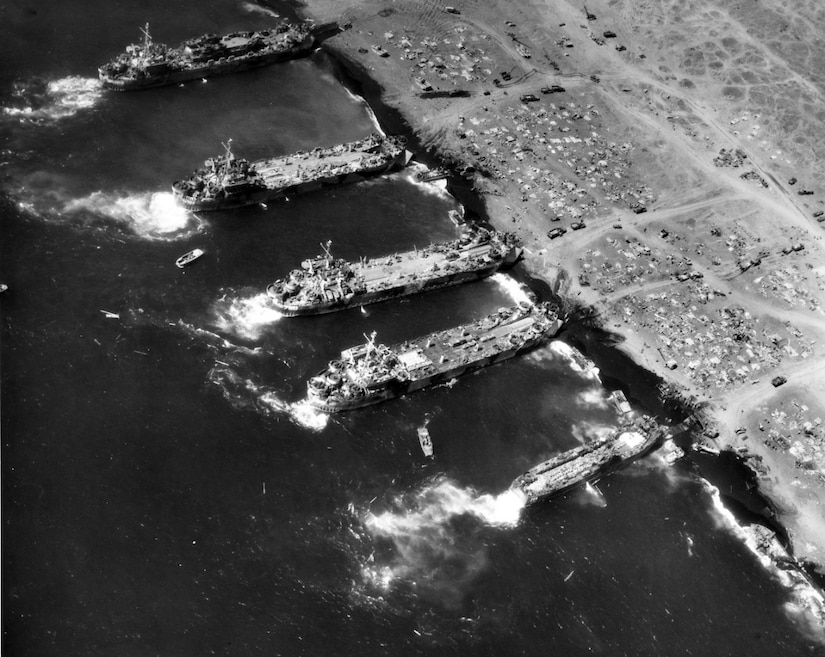
An aerial view of four large ships beached along a shoreline to deliver supplies.

For the rest of the year, Pierce's unit, the 2nd Battalion, 24th Marines, remained almost continuously in combat, fighting on the islands of Saipan and Tinian in the Mariana Islands chain.

Their next stop — Iwo Jima, a tiny volcanic island that, if taken from the enemy, would put Allied aircraft in striking distance of the Japanese mainland. It became the bloodiest campaign of the war for the Marine Corps, a monthlong battle in which 27 men later received Medals of Honor for their heroics, including Pierce.

Throughout the battle, Pierce carried out dangerous volunteer missions that put him under near-continuous enemy fire. He became an expert on the terrain, going back and forth about 25 miles of the landscape to memorize details and draw a map marking enemy forces he'd encountered.

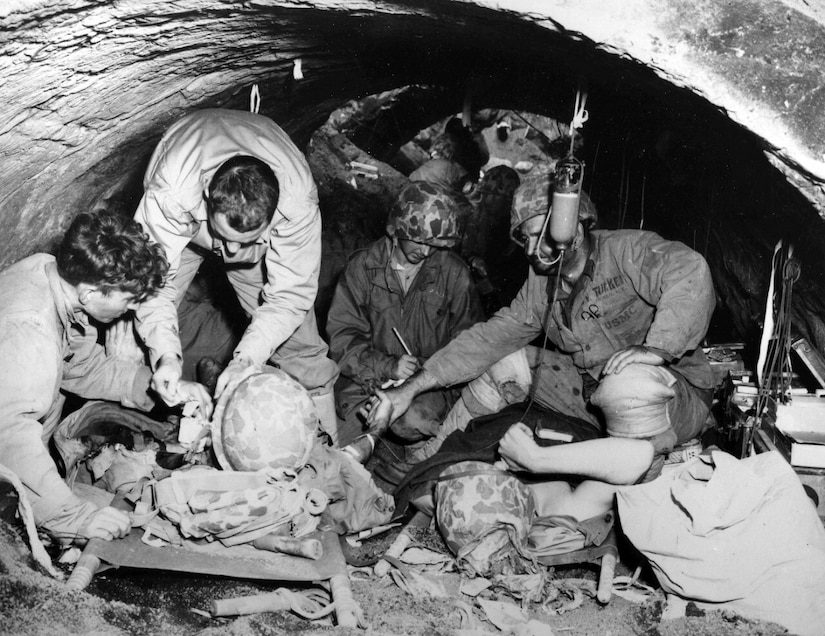
Four men stand or kneel above two men on stretchers, giving them aid. All are in a small concrete shelter not high enough to stand up in.

On March 15, 1945, Pierce was in a group of medics who were carrying two wounded Marines to an aid station when they got caught in heavy enemy fire that injured a corpsman and two stretcher bearers. Pierce quickly took charge and carried the newly wounded men to a shelter, where he gave them first aid and directed them toward an evacuation route.

Pierce then stood out in the open and blasted his weapon toward the enemy to draw their fire, giving six other stretcher bearers a chance to reach cover. From there, he focused on the Marines who'd been injured before the latest chaos erupted.

As Pierce was attending to the profuse bleeding of one of the Marines, the victim was struck again by a bullet from an enemy hiding in a cave about 20 yards away. With no concern for his own safety, Pierce put himself in harm's way to draw out the attacker and kill him using the last of his ammunition.

Now unarmed, Pierce lifted the wounded Marine onto his back before moving across 200 feet of open, bullet-strewn terrain to get him to safety. It was a harrowing trip, but Pierce pushed through his exhaustion — as well as warnings from his peers — to go back across the same fire-swept path to rescue the second Marine. That effort paid off, and they both reached safety.

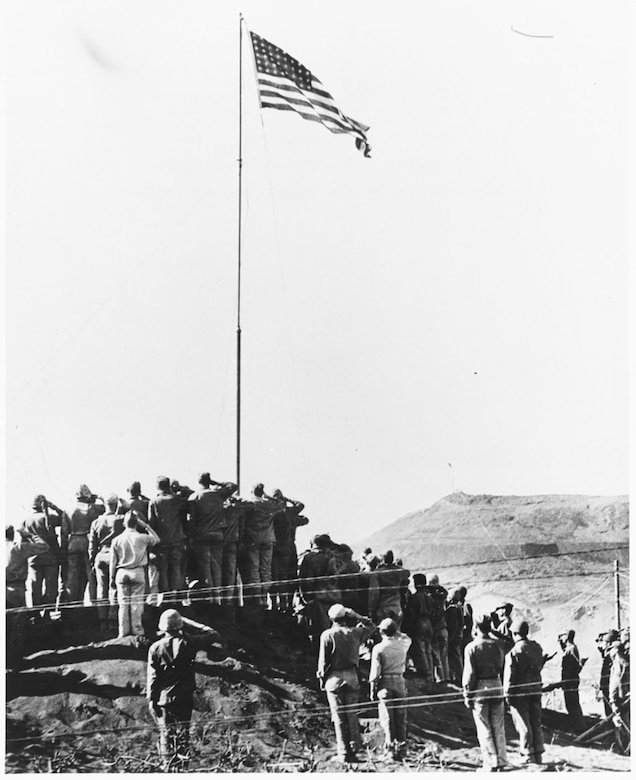
Dozens of men stand on a small, desolate hill to salute an American flag that’s been raised on a tall flagpole.

The next day, Pierce led a combat patrol to a sniper's nest. As he was attending to a stricken Marine, he was shot in the shoulder and suffered shrapnel injuries. Pierce refused aid for himself, though, instead directing others to continue attending to the wounded Marine's treatment while he laid down cover fire for their protection.

Pierce's fearless actions inspired his entire battalion. He was initially awarded a Silver Star and the Navy Cross, but they were later combined and replaced by the Medal of Honor.

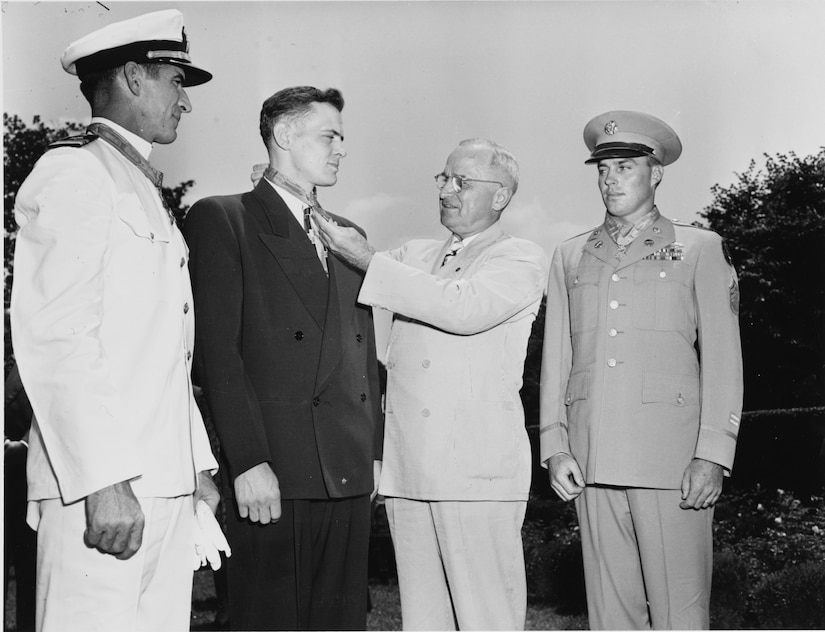
Pierce received the nation's highest honor for valor on June 25, 1948, from President Harry S. Truman during a White House ceremony. The medal was also bestowed upon Army Staff Sgt. John R. Crews and Navy Lt. Cmdr. Jackson Charles Pharris that day.

Aside from Pierce, three other pharmacist's mates were awarded the Medal of Honor for their actions on Iwo Jima: Navy Petty Officer 3rd Class Jack Williams, Navy Petty Officer 2nd Class George Wahlen and Navy Petty Officer 1st Class John Willis. 

Three men in formal military uniforms stand together, with a man in business attire standing in the center, who places a medal around the neck of the man in the middle.

Pierce was discharged from the Navy in 1945 and worked for a short time as a logger back in his home state. Later that year, however, he moved to Grand Rapids, Michigan, to finally meet Lorraine Decker, with whom he'd been corresponding throughout the war, according to the Grand Rapids Press newspaper. The pair married in August 1946 and had two sons.

Pierce went to work as an officer for the Grand Rapids Police Department, working his way up the ranks from beat patrolman to deputy chief by the time he retired in 1982. The Grand Rapids Press said among his many duties, he was the city's bomb disposal expert.

After Lorraine Pierce died in the 1970s, Pierce spent his remaining years with his second wife, Madelyn, before succumbing to lung cancer on Dec. 21, 1986, at age 62.

Pierce is buried in Holy Cross Cemetery in Grand Rapids.

In 2003, toy maker Hasbro released a commemorative G.I. Joe figurine of Pierce. To date, he's the only hospital corpsman to be honored with his own action figure.