Tuesday, August 11, 2026

National Guard Continues Washington Wildfire Support

 Aug. 11, 2026 | By Joseph Siemandel, Washington National Guard

As wildfires burn across the state, the Washington National Guard continues to provide aviation, hand crew and security support to communities and firefighters working to contain them. 

Since the wildfire response began July 19, National Guard aviation crews have flown 225 flight hours, dropping more than 1,400 buckets and nearly 1.2 million gallons of water on fires across eastern and central Washington. 

While weather, winds and smoke conditions play a major part in day-to-day operations, for the aircrews flying those missions, the overall conditions pose unique challenges. 

"These aircrews are performing some of the most tactically and technically challenging flying they will experience in their entire careers," said Army Lt. Col. Kevin Robillard, a pilot assigned to the 96th Aviation Troop Command. 

Robillard said crews are navigating high altitudes, high winds, limited visibility, heavy smoke and extreme heat, while operating around civilian aircraft, firefighters on the ground and areas where radio communications can be limited. 

"I would argue that, in many respects, this flying is every bit as challenging — if not more challenging — than combat flying," he said. 

The mission requires more than skilled aircrews. Fuelers, maintainers, flight operations personnel and military liaisons work behind the scenes to keep aircraft in the air and crews ready to respond. 

"And so far, our crews are doing an absolutely fantastic job," Robillard said. "I'm incredibly proud of our aircrews and our ground support personnel. They are absolutely crushing it while operating in some of the harshest conditions and most demanding flying environments an aircrew will ever experience." 

The National Guard's support also extends to the ground. Since Aug. 1, hand crews have been working alongside firefighting agencies from across the country. Crews are conducting fire line construction, hose lays, mop-up, debris clearing, brushing and chipping operations at a fire near Leavenworth, Washington. The hand crews have provided additional manpower for demanding ground operations. 

"Your [National Guard] team is great," said Craig Covey, incident manager for the fire near Leavenworth. "We have 105 go-getters that come in and say, 'What can we do?' And they work all day until we tell them it's time to stop. We really enjoy having them here."  

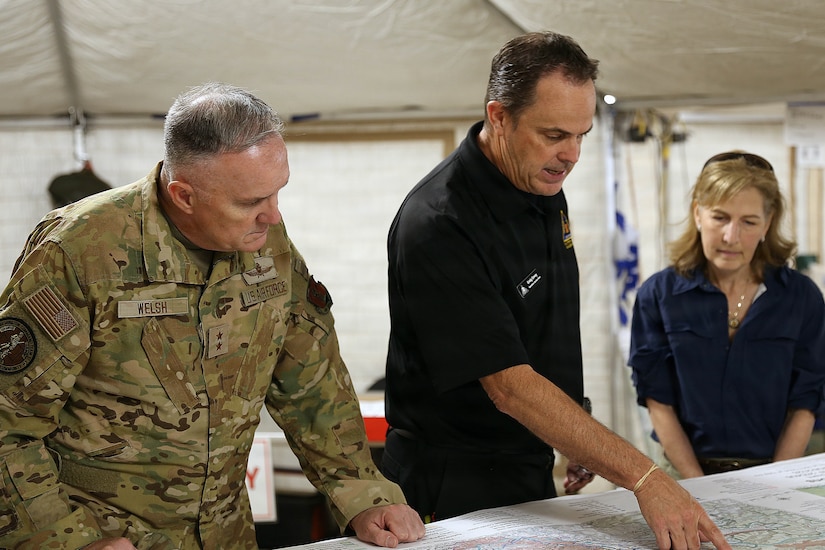
U.S. Rep. Kim Schrier, Washington's 8th Congressional District representative, recently visited guard personnel and firefighters supporting the fire mission near Leavenworth to give thanks. 

"I can't tell you how much I appreciate you and everything that you are doing for Washington," Schrier said. 

In Spokane, Washington, National Guardsmen are supporting local authorities by manning 20 traffic control points for the Spokane Police Department and the Spokane County Sheriff's Office.  

For Army Lt. Col. Dan Wessman, Washington National Guard, the mission has provided a unique opportunity to serve his community. 

"As a Spokane guy myself, I am truly humbled about the community and the outpouring of support for all our soldiers and airmen and the first responders who are here to help," Wessman said.
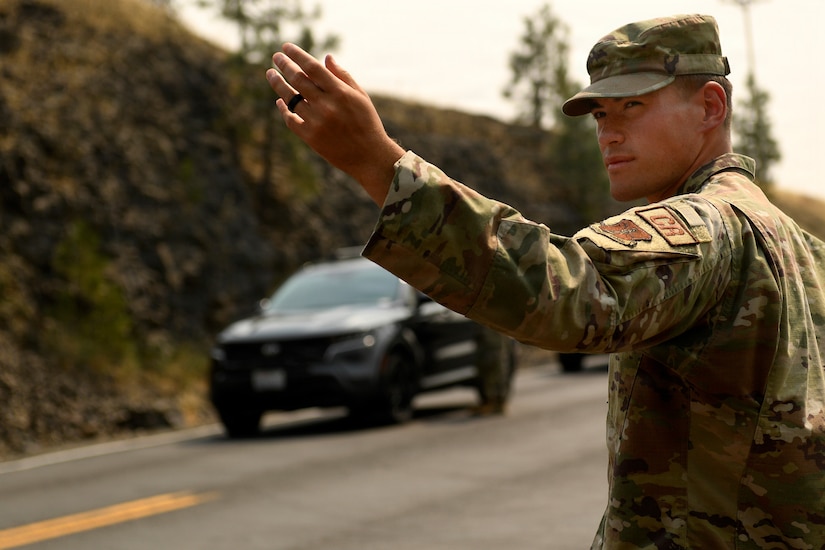
A man wearing a camouflage military uniform guides traffic while standing on the side of a road.
A man wearing business attire points to a map while speaking to a woman in similar attire and a man in a camouflage military uniform; they are all standing inside a large tent.
Currently, 345 Washington National Guardsmen, as well as 20 Washington State Guard members, are activated in support of wildfire missions. Their impact can be felt in the communities they are serving. 

"Our job is to be there when Washington needs us, and that's exactly what our soldiers and airmen are doing," said Air Force Maj. Gen. Gent Welsh, Washington National Guard adjutant general. "We're bringing the capabilities of the National Guard to the table, working alongside the agencies leading these responses and doing whatever we can to help protect Washington communities. Whether it's putting water on a fire, building fire lines, clearing debris or supporting local law enforcement, our people are ready to serve wherever they're needed."

U.S., Moroccan Forces Leverage Africa's Multidomain Experimentation Center

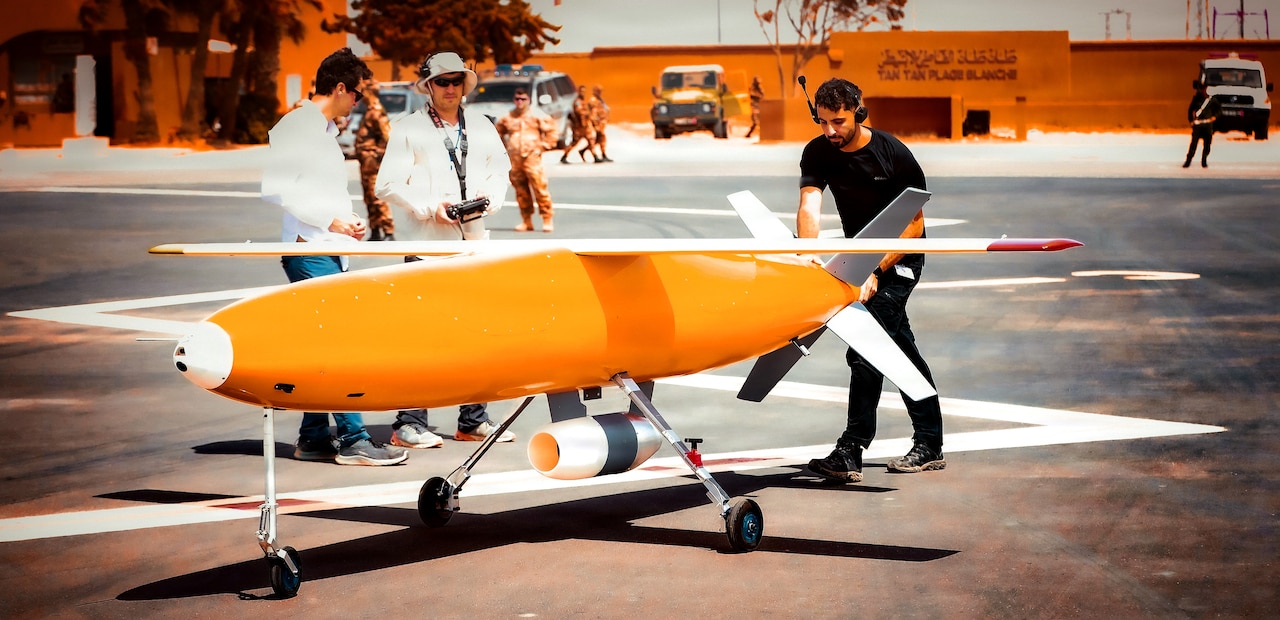
A man in casual attire pushes a large yellow and white missile in a parking lot as two other people observe.

U.S. service members partnered with Morocco's royal armed forces to enable the first-ever live-fire demonstration leveraging the Africa Multidomain Training and Experimentation Center, supporting a U.S. defense industry partner in testing long-range precision-strike capabilities as part of the Army's Test Range Expansion Initiative, Aug. 3-7. 

The demonstration marked a major milestone in U.S.-Morocco defense cooperation, expanding opportunities to evaluate emerging capabilities in realistic conditions while accelerating the delivery of new technologies to the joint force. 

"The vision is to establish [the Africa Multidomain Training and Experimentation Center] as a regional hub for innovation, strategic cooperation and industrial development, as well as a center of excellence dedicated to the experimentation, validation, evaluation and development of advanced technologies," said Moroccan Col. Zouhair El Hamdani, the royal armed forces officer in charge of coordination. "This first live-fire demonstration marks a significant milestone in turning that vision into reality." 

The initiative will also continue to bolster the U.S.-Morocco strategic partnership by offering a dedicated space where military forces and defense industry partners can rapidly test, evaluate and refine new capabilities.

"Morocco's partnership provides a crucial venue that accelerates readiness for the U.S. joint force and our African partners," said Air Force Gen. Dagvin R.M. Anderson, commander of U.S. Africa Command. Anderson added that the Africa Multidomain Training and Experimentation Center not only strengthens security cooperation and drives innovation but also demonstrates that trusted partnerships are how the countries help tackle shared security challenges together. 

U.S. and Moroccan personnel established an expeditionary test site and conducted a single live-fire demonstration, working alongside defense industry engineers and technicians to validate communications systems, assess maneuverability of wings, tires and trolley components, as well as collect critical weather and targeting data. The event generated operational insights to inform future experimentation, capability development and employment. 

"The AMTEC live-fire demonstrates where multinational training is headed, integrating emerging technologies with partner forces in realistic operational environments," said Army Col. Michael M. Gacheru, the regional engagement division chief of Africom's Strategy, Engagement and Programs Directorate. "As AMTEC continues to evolve in Morocco, we're expanding advanced training, strengthening interoperability and accelerating innovation alongside our African and international partners. Together, we're building a more connected, more capable force prepared for tomorrow's security challenges."

The live-fire event employed a low-cost, long-range cruise missile system designed to provide affordable, scalable precision-strike options while collecting operational performance data. By integrating a U.S. defense technology startup into the event, Morocco and Africom demonstrated a model for rapidly connecting operational requirements with industry innovation.

As AMTEC continues to mature, it will provide U.S. and Moroccan forces, as well as allies and defense industry partners with a cost-effective venue to evaluate capabilities across multiple warfighting domains. Future experimentation will expand into long-range fires, autonomous systems, wireless communications and advanced sensing technologies, ensuring innovation translates rapidly into operational capability for the joint force.