Monday, January 26, 2026

U.S., Italy Commemorate 82nd Anniversary of Operation Shingle

Army Master Sgt. Joshua Van Horn walked through the curved rows of white marble crosses at the Sicily-Rome American Cemetery in Nettuno, Italy, his steps slowing as he searched for a familiar unit.
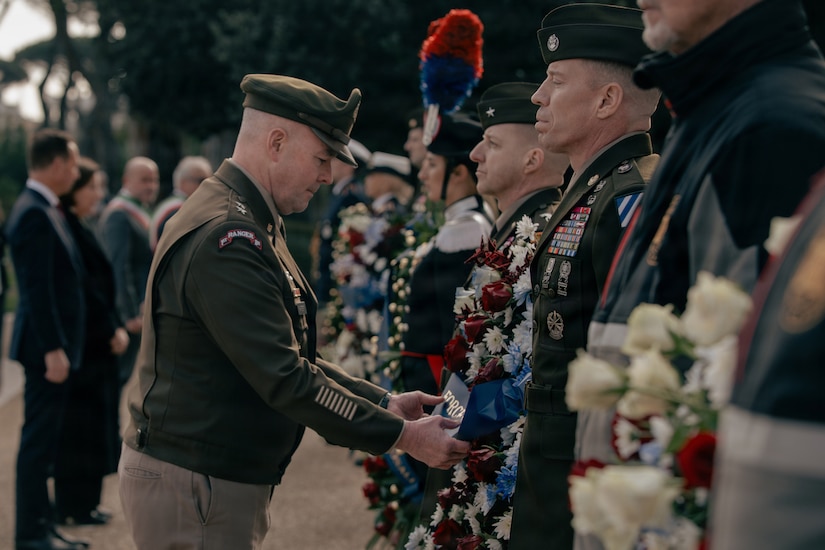
A man in a military dress uniform inspects a wreath during a ceremony at a monument in Italy. There eight people in military dress uniforms standing in a line with wreaths in between them. There are four other people in business attire standing in the background.

His eyes settled on the headstones of soldiers from the 504th Parachute Infantry Regiment, 82nd Airborne Division, also known as the "devils in baggy pants," a name given to them by a German officer during World War II. Van Horn grazed his hand across the smooth marble and paused at the grave of Army Pvt. James Warren, the name etched permanently into the stone. 

Van Horn once served in the 504th PIR, deploying with the unit to Afghanistan. Standing among the graves offered a moment to reflect not only on their sacrifice, but on his own service.
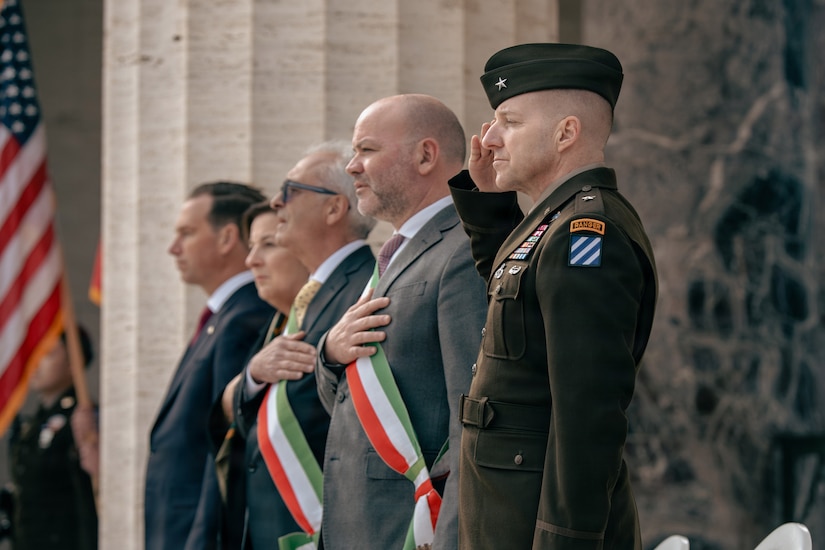
A man wearing a military dress uniform renders a salute while two men in business attire stand with hands over their hearts during an outdoor commemoration ceremony in Italy. Another man and a woman in business attire stand beside them in a row. The American flag is displayed in the background.

"Coming here gives you a sense of purpose," Van Horn said. "It reminds me why we do what we do." 

Van Horn participated in the 82nd anniversary commemoration of Operation Shingle at the cemetery in Nettuno, Jan. 22. He led the 173rd Airborne Brigade honor guard during the ceremony, which honored the service and sacrifice of U.S. and Allied forces who fought during the World War II landings at Anzio, Italy, and Nettuno.
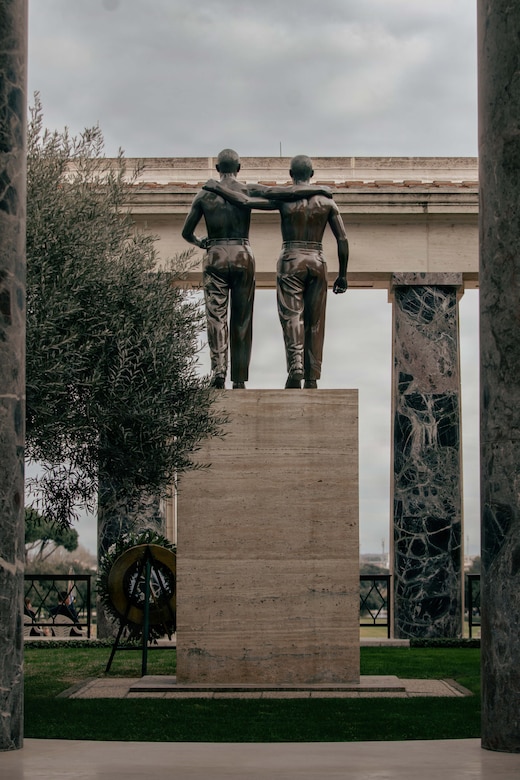
The back of a monument of two men with their arms over each other's shoulders is displayed during a commemoration ceremony in Italy. There is a wreath displayed on a stand in front of the monument.

"This cemetery is a testament to what makes America great," Van Horn continued. "Eighty-two years later, these graves are still cared for. What other country does that? Honoring soldiers who died liberating others."

U.S. and Italian officials delivered remarks throughout the ceremony, including U.S. Ambassador to the Holy See Bryant Burch, Italian Deputy Premier and Foreign Minister Antonio Tajani, and U.S. Army Maj. Gen. John L. Rafferty Jr., U.S. European Command chief of staff. 

Local students from Nettuno schools sang, read poetry and laid roses in remembrance of those buried at the cemetery, followed by a ceremonial wreath-laying. The ceremony also honored the life of Army 1st Lt. Carl Hood, the first service member buried at the cemetery.
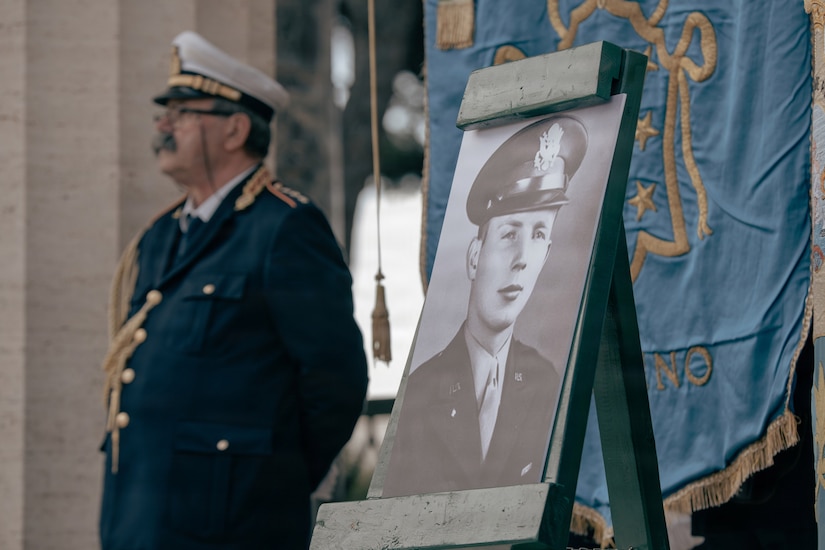
A portrait of a man in a military dress uniform is displayed on an easel during a commemoration ceremony in Italy. An elderly man in a military dress uniform stands in the background.

Speakers echoed the message that the cemetery is not only a resting place for the fallen, but a space meant to guide the living. Burch and Rafferty also reflected on the upcoming 250th anniversary of the Declaration of Independence and its continued relevance. 

"Two hundred and fifty years of dedication to a universal proposition, grounded in human dignity and fundamental rights, that we continue to strive to live up to," Burch said. "Marking this day during such a historic anniversary carries even greater significance."
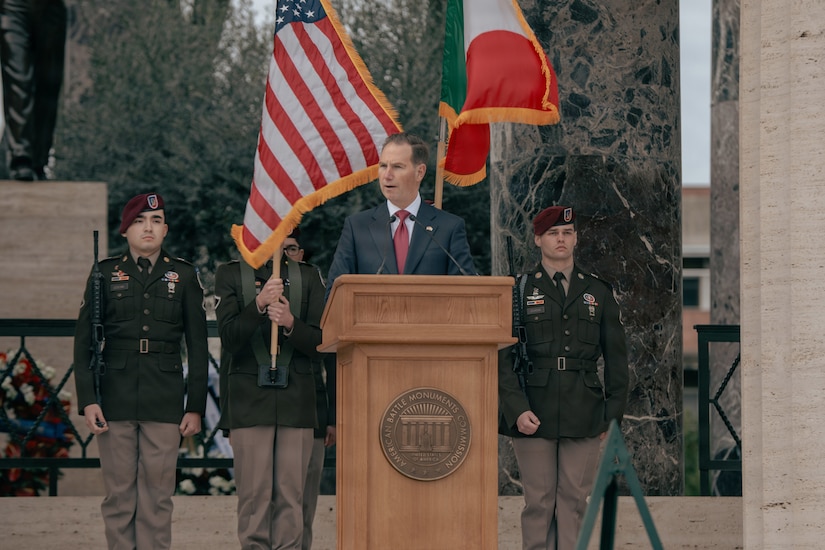
A man in a suit speaks behind a lectern as four people in military dress uniforms stand behind him. One of them in holding the American flag while another holds the Italian flag.

As the ceremony concluded, Van Horn and others moved quietly through the rows of marble crosses and Stars of David, reflecting on the cost of freedom. 

These cemeteries are not only places of mourning, but also places of memory, meant to remind the living what service demands and what liberty costs.

Steady in the Storm: Guardsmen Support D.C. Through Winter Weather

Snow fell steadily as a military Humvee eased through Washington's streets with tires crunching over packed ice and traffic lights reflected off slush-covered pavement. Inside the vehicle, Army Col. Larry Doane, commander of Joint Task Force District of Columbia, scanned a digital map, tracking patrols spread across the city as a winter storm tightened its grip.

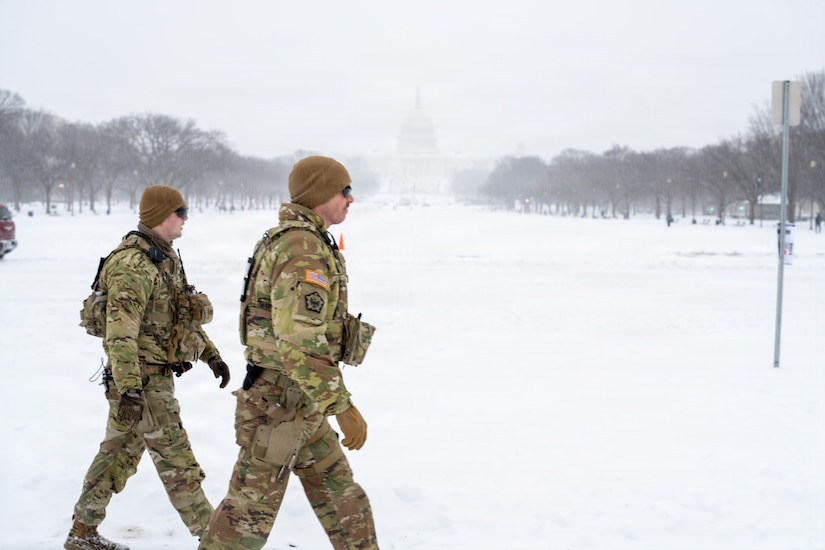
Two people in camouflage military uniforms walk along a snow-covered sidewalk in front of the U.S. Capitol.

"Slow and steady," Doane said, watching a civilian vehicle struggle for traction nearby. "Interesting driving choices out there today." 

The storm transformed the mission almost instantly. What began as routine presence patrols in support of the D.C. Safe and Beautiful mission shifted toward life-safety priorities — mobility, visibility and helping people navigate a city slowed by snow and ice. 

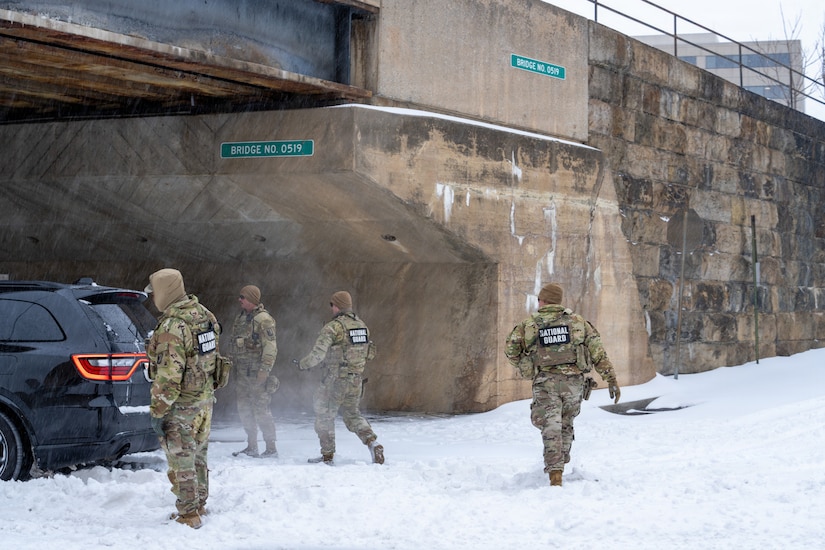
Across the district, National Guard soldiers and airmen moved deliberately through metro stations, neighborhoods and key corridors. Some checked on patrol teams braving long shifts in freezing temperatures. Others used high-mobility vehicles to assist first responders, transport personnel and help stranded motorists clear snowbanks and regain traction. 

Four people in camouflage military uniforms stand outside in the snow, inspecting a black vehicle under a bridge.

"This is where the Guard fits naturally," Doane said, as the Humvee turned toward Union Station. "When conditions get tough, we bring mobility, manpower and discipline to support our partners and the community." 

Throughout the ride-along, Doane stopped repeatedly to speak with guardsmen on post — asking about their gear, their feet, their food and their radios. He reminded leaders to rotate personnel inside warming areas, keep one soldier alert at all times and watch for signs of cold-weather injuries.

"Those basic leadership things still work," he said. "Feet, hands, communication — take care of each other — and the mission takes care of itself." 

Outside, the storm revealed a different side of the mission. Guardsmen pushed vehicles out of snowbanks, guided pedestrians through icy intersections and checked on individuals waiting in the cold. In several cases, teams coordinated with district partners to escort people to warming shelters or help them reach safe transportation. 

"We're providing a lot of mobility today," Doane explained. "That's really what our partners need — getting officers, firefighters and medical personnel where they need to be, and helping civilians move safely through the city." 

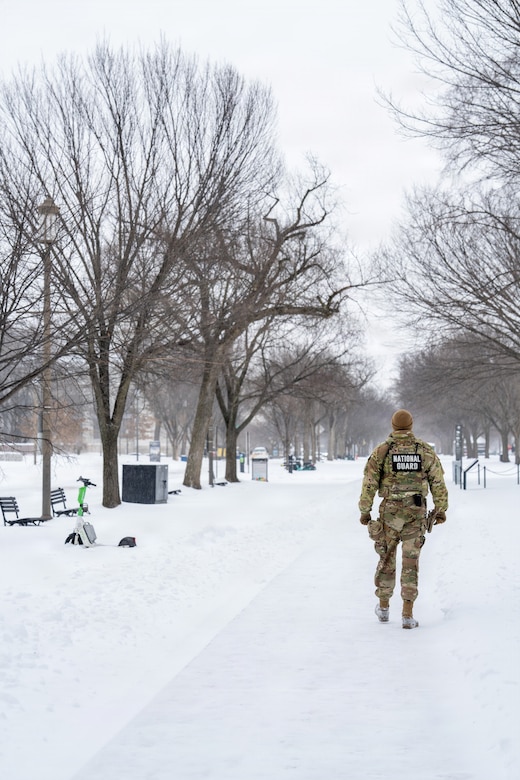
A person in a camouflage military uniform walks along a snow-covered street with rows of trees on either side.

Inside a metro station, Doane paused to observe soldiers standing watch near the turnstiles. Trains continued running despite the weather, and commuters moved through what one passerby called "the safest metro station in America right now." The guardsmen nodded, adjusted their posture and continued scanning the space — visible, calm and unintrusive. 

"That presence matters," Doane said. "Just being here brings the temperature down. People feel reassured." 

The winter storm did more than slow traffic; it tested systems, patience and readiness. Snow and ice complicated response times, narrowed streets and forced constant reassessment of risk. Guardsmen adapted quickly, shifting patrol routes, coordinating with law enforcement partners and prioritizing safety over speed. 

"Safety is No. 1," Doane reminded a team sheltering near a metro entrance. "No reason to stand out here and freeze. We'll get back to normal patrols when conditions allow." 

Despite the conditions, morale remained steady. Guardsmen shared hot drinks, swapped stories and laughed about snowball fights that never materialized. Civilians waved as the Humvee passed, some offering thanks, others simply relieved to see help nearby. 

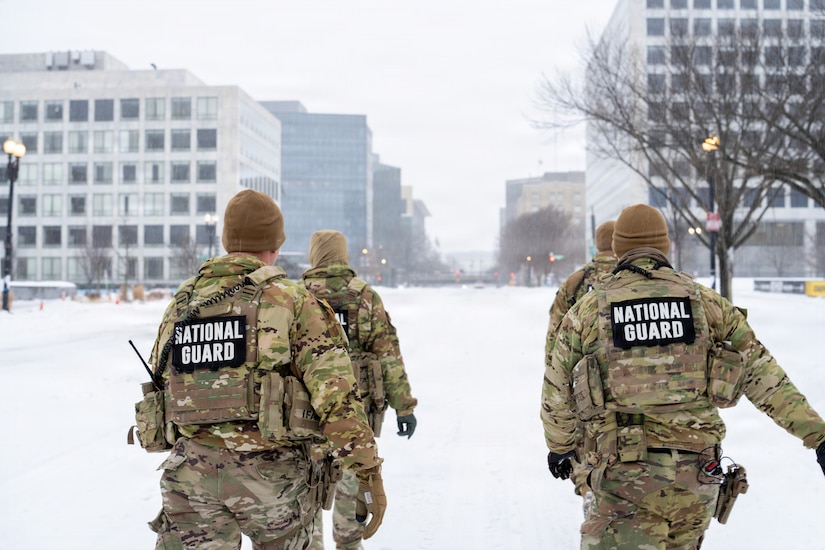
Four people in camouflage military uniforms walk along a snow-covered city street.

"I've gotten more waves today than I have in a long time," Doane said. "People remember what the Guard does during storms like this." 

As the night wore on, the mission continued, quietly, steadily and without ceremony. Patrols remained in place. Vehicles stayed ready. And across the city, guardsmen stood watch while Washington dug itself out. 

"What we do is important," Doane said as the Humvee rolled back into traffic. "But how we do it matters more. The way our soldiers carry themselves, the way they treat people — that's what builds trust." 

In a city shaped by movement and unpredictability, the storm underscored the Guard's enduring role: ready when conditions worsen, visible when reassurance is needed and committed to serving the community — no matter the weather. 

Medal of Honor Monday: Army Tech. 5th Grade Eric Gibson

Army Tech. 5th Grade Eric Gibson served as a cook during World War II, but his desire for more led him to work out a deal with his superiors to fight on the front lines. During one intense battle in Italy, Gibson consistently went ahead of the soldiers he led and took out threats in their path. He didn't survive the ordeal, but his bravery and leadership earned him the Medal of Honor.

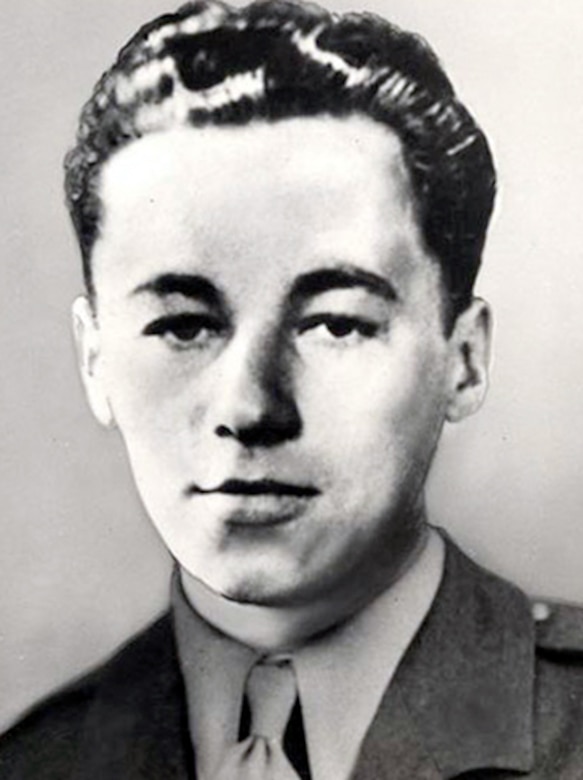
A man in a military dress uniform poses stoically for a photo.

Gibson was born Oct. 3, 1919, in Nysund, Sweden, to Erland and Agda Gibson. In 1924, after his younger brother, Sven, was born, the family moved to Chicago, where Gibson grew up.

Few details of his early life have been published. Still, by February 1941, Gibson had enlisted in the Army as troop numbers soared ahead of America's inevitable involvement in World War II. After basic training, he was assigned as a cook for the 30th Infantry Regiment, 3rd Infantry Division.

In November 1942, the division deployed to North Africa, where Gibson, as part of Company I, took part in that invasion and the subsequent invasion of Sicily.

As the division plowed through enemy territory, Gibson decided he wanted to make a bigger impact than just being a cook. So, he worked out a deal with his commanding officer that allowed him to serve as a rifleman in an infantry squad whenever the company went into battle, according to the U.S. Army Quartermaster Museum.

In the mountainous terrain of Sicily, where motorized Army vehicles weren't useful, Gibson is credited with leading a pack of mules carrying supplies across several miles of rugged landscape. Later, as the company's main scout, he located several enemy positions and even killed and wounded two German soldiers during ensuing firefights.

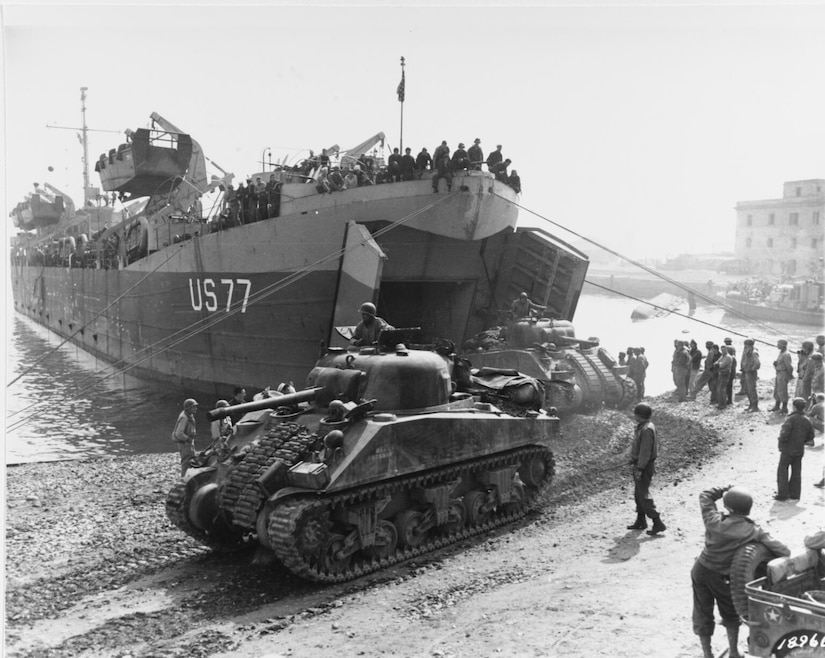
A large ship with ropes coming from its bow and an open front sits on a beach. In front of it sits a large tank as another one rolls off the ship. Dozens of men in military uniforms stand on the ship while several others in similar attire stand on the beach.

In mid-January 1944, the division landed on the Anzio beachhead in Italy. As Gibson's company moved up the coastline, he continued with his dual missions, repeatedly distinguishing himself in combat, according to the museum.

On Jan. 28, 1944, Gibson's company had made it all the way to northern Italy and was near the island of Isola Bella when they came under attack. Gibson quickly mobilized and led a squad of unseasoned soldiers — those sent to the front lines to fill vacancies left by casualties — through a "baptism by fire," his Medal of Honor citation stated. But their efforts bore fruit. They managed to destroy four enemy positions, kill five and capture two German soldiers, all while also securing their company's left flank.

Gibson then continued ahead of his fellow soldiers, moving through a wide stream ditch until he came within 20 yards of a concealed enemy soldier, who opened up on him with automatic fire. Several bullets nearly hit Gibson, but that didn't stop him. He charged, firing his submachine gun every few steps until he got to the enemy position and fired at point-blank range, killing his opponent.

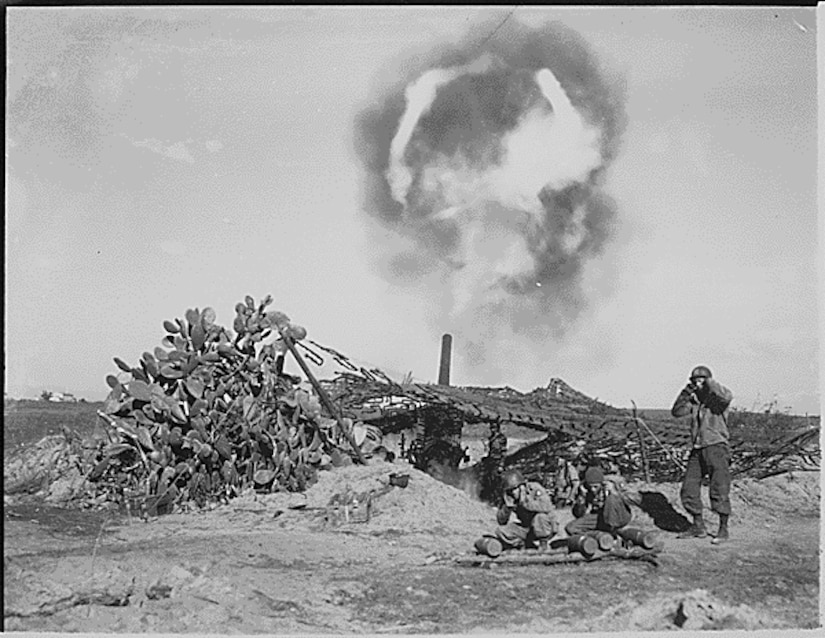
A long gun aimed skyward lets off a plume of flames. Two men in military uniforms kneel as a third man in similar attire stands while covering their ears. Foliage can be seen around them in a barren landscape.

As a smattering of artillery landed in and around the ditch, the impact from one knocked Gibson flat. As soon as he got to his feet, he was fired on by two enemy soldiers who were about 75 yards away. Gibson immediately raced toward them and didn't stop, even when machine gun fire opened up on him about halfway to the position. Gibson killed one foe and captured the other.

Shortly after that, during another spray of heavy machine gun fire coming from about 200 yards further down the ditch, Gibson crawled back to his squad and ordered them to direct as much fire as possible toward the enemy so he could flank that machine gun nest.

Getting to the emplacement required Gibson to crawl 125 yards through an intense artillery barrage that included crossfire from two machine guns, which showered dirt all over him. He made it, however, and once he reached the nest, he threw two hand grenades into it before charging forward with his submachine gun, killing two enemy soldiers and capturing a third.

When his squad got to a bend in the ditch, Gibson moved forward alone to scout out the situation. That's the last time his fellow soldiers saw him alive.

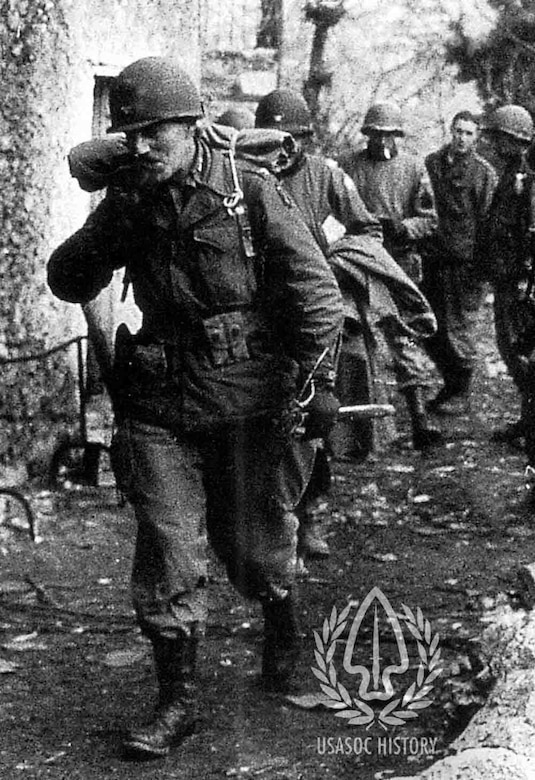
A group of men in military combat gear walk single file along a dirt path.

Gibson's squad later told officials that when they heard an exchange of gunfire, they moved around the bend. About 35 yards toward an enemy outpost, they found Gibson dead. However, before he fell, he managed to kill one more German soldier.

Gibson's fearless actions kept the men in his squad alive, even if it meant his own death. For that, he was posthumously awarded the Medal of Honor. His parents were gifted it on his behalf Sept. 15, 1944, during a ceremony at Camp McCoy, Wisconsin.

When Gibson's body was returned to the U.S. in 1948, he was buried in Nora Cemetery in Rice Lake, Wisconsin, where his parents had moved while he was overseas.

Gibson has not been forgotten. Over the years, an Army Reserve center in Berwyn, Illinois, and a dining facility on Fort Lee, Virginia, were named in his honor. In 1995, a Navy container ship was renamed for the fallen soldier, and in 1999, Gibson was inducted into the Quartermaster Hall of Fame.