Wednesday, September 09, 2026

Exercise Big Rescue Kanagawa 2026 Strengthens Bilateral Disaster Medical Readiness

Sailors assigned to the U.S. Navy Medicine Readiness and Training Command Yokosuka, Japan, joined U.S. and Japanese military, government, medical and emergency response organizations for Exercise Big Rescue Kanagawa 2026, Sept. 1, at the Kanagawa Prefectural Comprehensive Disaster Prevention Center and Fire Academy in Atsugi City, Japan.
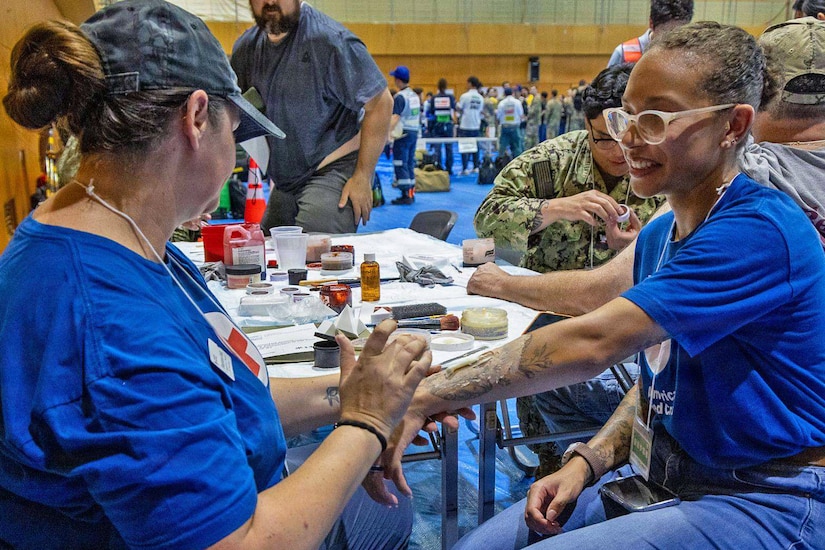
A woman wearing a blue shirt and hat paints on the arm of another woman also wearing a blue shirt.

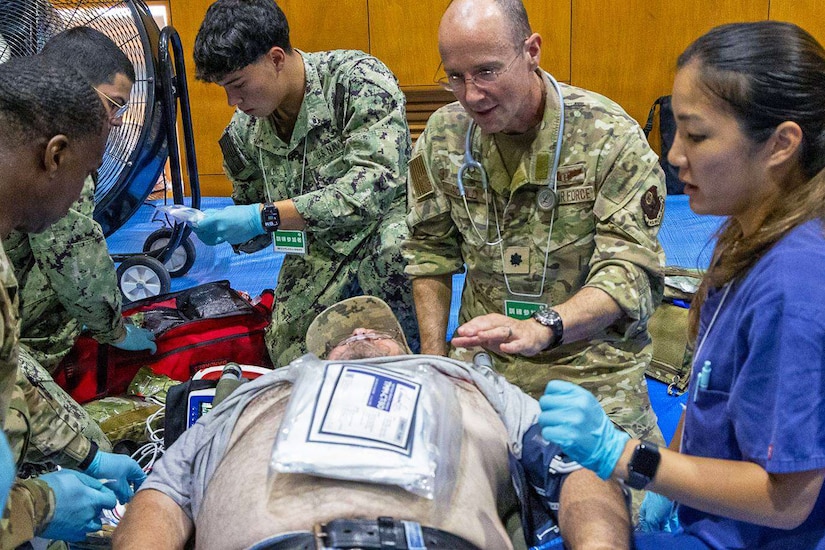
USNMRTC Yokosuka contributed doctors, hospital corpsmen, Japanese fellows and translators to a tri-service U.S. medical team. The team integrated with other War Department emergency responders and Japanese medical partners to rehearse patient reception, bilateral triage and treatment, casualty movement and coordination across military and civilian medical systems.

Big Rescue Kanagawa is a large-scale, multiagency disaster-response exercise jointly organized by Kanagawa Prefecture and Atsugi City. It brings together Japanese and U.S. military, medical and emergency response organizations to practice coordinated rescue and medical operations.

USNMRTC Yokosuka sailors and American Red Cross Yokosuka volunteers applied moulage — makeup and materials used to simulate injuries — to role players before the mass casualty scenario. American Red Cross Yokosuka volunteers also served as role players, creating realistic conditions for medical teams to assess injuries, prioritize treatment and move patients.

Translators and Japanese fellows helped U.S. and Japanese participants communicate throughout the exercise. Their support allowed medical teams to exchange information, coordinate care and work through differences in language, procedures and medical practices before a real emergency occurs.
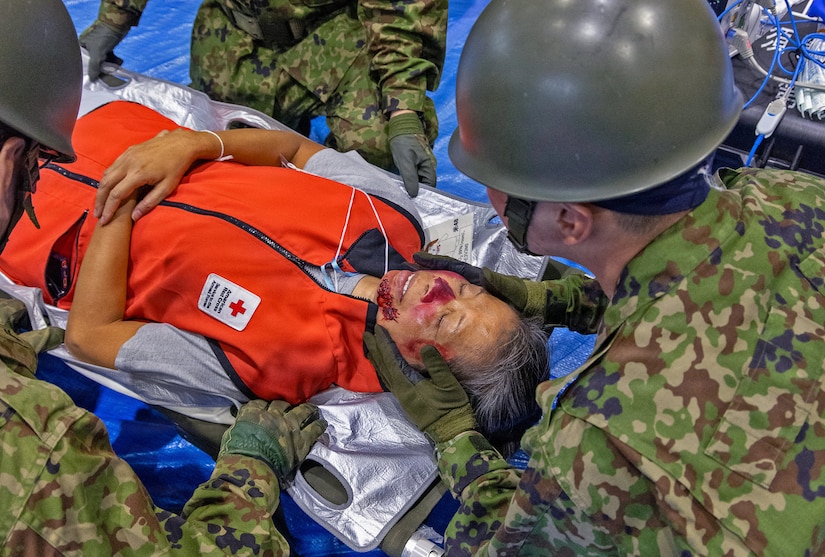
A man wearing a camouflage military uniform cups the face of a woman in an orange vest with simulated bruising on her nose and chin during a mass casualty exercise.
Four people wearing camouflage military uniforms tend to a simulated patient lying on a stretcher during a mass casualty exercise. A woman wearing blue nurse's scrubs assists them.
"Exercises like Big Rescue Kanagawa are about more than validating procedures — they are about building the relationships and trust that make a coordinated response possible," said Nikolai Kerry, emergency manager, USNMRTC Yokosuka. "By training alongside our U.S. joint partners and Japanese allies, we strengthen the communication, teamwork and shared understanding needed to provide timely care when communities need us most."

Japanese Prime Minister Sanae Takaichi attended the exercise with Defense Minister Shinjiro Koizumi, Kanagawa Gov. Yuji Kuroiwa and other local officials. The delegation observed rescue, medical and emergency response demonstrations conducted by participating organizations.
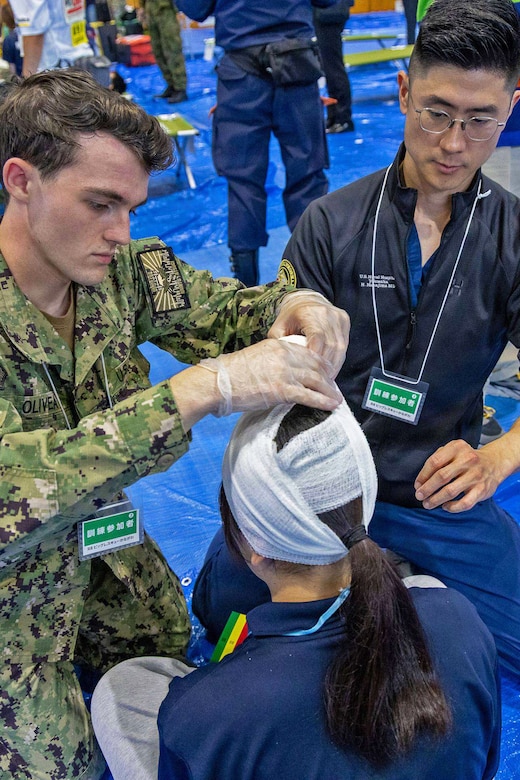
A man wearing a camouflage military uniform wraps a bandage around a simulated patient's head during a mass casualty exercise. Another man is kneeling next to him to help him with applying the bandage.
Army Maj. Gen. James Dooghan, commanding general of U.S. Army Japan, met with the prime minister on behalf of the department teams participating in the exercise. U.S. Army Japan participated alongside the Japan Ground Self-Defense Force, Navy and Air Force, highlighting capabilities U.S. forces in Japan can provide in support of disaster-response operations.

USNMRTC Yokosuka's command triad also attended the drill to observe the command's sailors working with Japanese medical partners and other War Department responders during the medical response scenario.

"Seeing USNMRTC Yokosuka and U.S. Navy Medicine Readiness and Training Unit Atsugi personnel work through a complex scenario reinforced the value of training as one Navy medicine team," said Navy Capt. Joshua A. Miller, commanding officer, USNMRTC Yokosuka and director, U.S. Naval Hospital Yokosuka. "Every rehearsal builds the confidence and habits that allow us to respond with purpose when it matters most. That is what it means to be ready, steady and together."

Department Recognizes Suicide Prevention Programs for Supporting Warfighters

The War Department recognized unique and innovative suicide prevention programs during a ceremony in the Pentagon's Hall of Heroes, Sept. 2.

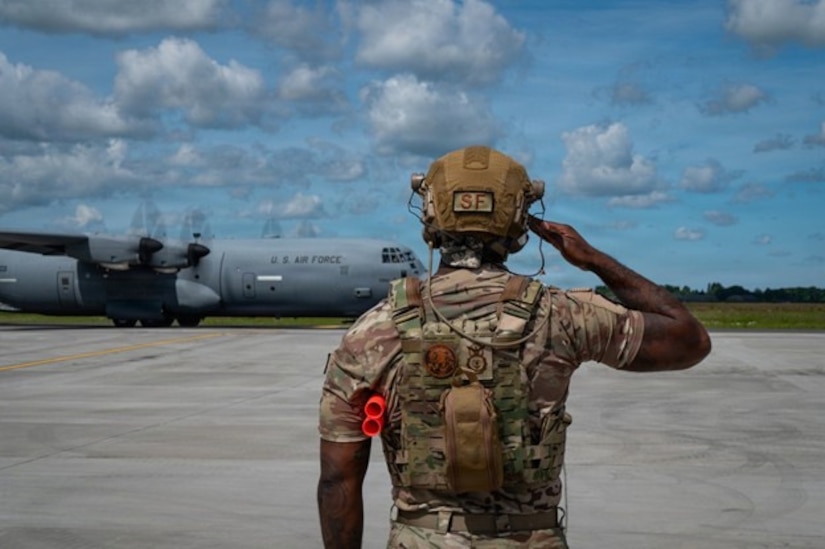
A person wearing a camouflage military uniform and hearing protection salutes while a large aircraft prepares for takeoff.

The 11 department and two Coast Guard programs were recognized for building partnerships, equipping leaders and peers, connecting people with resources, and creating environments in which service members and families could more readily seek support.

"It is not just what they did during the last Suicide Prevention Month," said Alicia Matteson, Defense Suicide Prevention Office acting director. "They represent sustained efforts, informed by data, informed by the needs of their particular communities that they are serving."

Keith Bass, assistant secretary of war for health affairs, praised each of the honorees before handing out the awards.

"Today, we honor outstanding individuals for their efforts. I was just absolutely in awe of the creativity and the passion," Bass said. "Thank you on behalf of the Military Health System."

Joining Bass and Matteson during the annual event were Tim Hoyt, Defense Health Agency chief mental health officer, and Coast Guard Rear Adm. Shane Steiner, Coast Guard deputy assistant commandant for workforce and family services.

September may be Suicide Prevention Month, Hoyt noted, "but the individuals and commands we recognize today did not limit their work to a single month, event or campaign. They invested in suicide prevention throughout the year."

Hoyt added that celebrating these efforts today conveys to the force that the department values a multilayered approach to suicide prevention, which includes:

  • Leaders who know and care for their people.
  • Commands who act before concerns become a crisis.
  • Programs that make support easier to access.
  • Teams that strengthen connection and belonging.

The recognized programs represent a vital part in fostering that sense of support and connection in military communities, the speakers underscored.

Bass said when someone seeks care in a military hospital or clinic, "we will wrap our arms around that individual. We're going to take care of them and we're going to take care of our families. We have to continue to push this awareness. Nobody's alone. We do this as a team to take care of our folks."

A person wearing a camouflage military uniform pulls a person in similar attire over an obstacle.

During the ceremony, leaders emphasized that hope resounded throughout each team's efforts to prevent suicide.

"Hope is a belief that things will get better. But it's more than that," Matteson said. "It is also having the agency to make it so. And sometimes we forget that piece. The agency to make it so needs to exist for individuals to have hope that things will get better."

Each program was recognized for its outstanding prevention efforts and was evaluated by the military services based on criteria provided by the Defense Suicide Prevention Office.

Honorees are:

  • 12th Combat Aviation Brigade, Katterbach Army Airfield, Germany. The brigade enhanced direct support of soldiers working in aircraft hangars with interactive walkabouts and physical resiliency notebooks. The unit also created an anonymous peer support group to help soldiers discuss stress without fear of career impacts.
  • 84th Training Command, Army Reserve, Fort Knox, Kentucky. The command executed a campaign that trained leaders to recognize early deviations in a soldier's normal state of being. To combat isolation among geographically dispersed soldiers, the command implemented sponsorship checklists, virtual touchpoints and chaplain-partnered events. The initiative also integrated holistic health and fitness principles into events.
  • Kentucky Army National Guard. The program created a modern suicide prevention music video that moves past traditional training briefings. This shareable video successfully connected soldiers and families to critical resources across the state.
  • Marine Corps Headquarters Battalion, 1st Marine Division, Camp Pendleton, California. The battalion normalized seeking mental health support by hosting more than 30 interactive events, including a resiliency lunch and learn series. They also provided incoming Marines with secure storage training and physical gun locks.
  • Marine Forces Reserve, Force Headquarters Group, New Orleans. This unit created "Vibes are Off," informal, rank-inclusive forums during which Marines can openly discuss stress. Their efforts drastically increased self-reporting and helped recruit 15 new peer prevention trainers.
  • Navy Medicine Readiness and Training Command, Portsmouth, Virginia. The command combined digital innovation with community outreach, launching a mobile app for mental healthcare and hosting basewide wellness fairs. They also partnered with Operation Homefront to provide support to more than 6,000 military children.
  • Navy Reserve Center Minneapolis. This center trained 400 Navy Reserve service members across 17 units on how to spot early signs of a mental health crisis. They collaborated with fitness leaders and chaplains to build spiritual and mental toughness.
  • Air Force Headquarters, Air Force District of Washington, Joint Base Andrews, Washington. The command trained more than 300 senior leaders in a supportive postcrisis framework and empowered airmen to share their personal resilience stories. They also taught leaders how to have comfortable, nonjudgmental conversations about secure firearm storage.
  • Westover Air Reserve Base, Massachusetts. The 439th Airlift Wing brought mental health support directly to high-risk career fields, doubling demand for coping sessions for firefighters and distributing secure storage tools. They also expanded unit-level help by training 22 resilience training assistants.
  • 172nd Airlift Wing, Air National Guard, Allen Thompson Airfield, Mississippi. Driven by the commander's clear support, the wing launched a gamified "Helping Hands" scavenger hunt in addition to mindfulness events. These activities showed airmen of all ranks how to make self-care a daily practice.
  • Buckley Space Force Base, Colorado. The base reached 25,000 community members through targeted leadership briefings, secure storage education and a veterans' suicide awareness ruck march. Base suicide response teams also support survivors by providing therapeutic art resources.
  • Coast Guard Base Boston/Leadership Development Center, New London, Connecticut. Operating at the local level, the base completed more than 260 outreach initiatives to support 4,000 personnel. The center then integrated these real-world lessons directly into training pipelines for 1,300 future Coast Guard leaders.
  • Coast Guard Station Golden Gate, California. The station used its unique bridge-recovery mission to secure a new physical bridge barrier and overhaul emergency response protocols. They also hosted an awareness walk for 400 first responders and provided daily, low-barrier support to the crew.

President Trump’s Executive Order Aims to Speed Veterans’ Access to VA Healthcare and Benefits

WASHINGTON – President Donald J. Trump signed an executive order today designed to cut weeks from the average time Veterans wait to receive Department of Veterans Affairs benefits.

The executive order, “Accelerating Access to Veterans’ Benefits and Employment Opportunities,” directs VA and the Department of War to work together so that service members’ Military Personnel Files and Service Treatment Records are available to VA beginning on the day they enter military service.

Providing VA with immediate access to these records is intended to help Veterans receive the benefits they have earned more quickly after leaving the military, including healthcare, disability compensation, GI Bill education benefits and VA home loan benefits.

During the second Trump Administration, VA reports that the average processing time for disability benefit claims has fallen 46%, from 141.5 days to 76.1 days. The department estimates that improved sharing of military records between DoW and VA could reduce processing times for recently separated service members by an additional 20 to 30 days on average.

The executive order also directs VA and DoW to modernize related information technology systems to support the sharing of these records. It calls for the use of artificial intelligence to make the benefits process more convenient for Veterans and directs the departments to adjust related technology contracts as necessary to accomplish the order’s goals.

In addition, VA and the Department of Labor are directed to work with DoW as it updates the Transition Assistance Program and other programs intended to help service members find employment more quickly as they transition to Veteran status.

“President Trump understands the importance of putting Veterans First like no other commander in chief, and this executive order will make it faster and more convenient for Veterans to get the benefits they’ve earned,” said VA Secretary Doug Collins. “Giving VA continuous access to warfighters’ military records will eliminate weeks of waiting for Veterans applying for VA healthcare and financial benefits. We want to make the transition from military to Veteran status as seamless as possible, and we look forward to working with President Trump and Department of War Secretary Pete Hegseth to do just that.”

The executive order follows a series of developments the VA highlights from President Trump’s second administration. According to the department, VA has:

United States Department of War and Mongolia's Ministry of Defense Conduct Bilateral Defense Framework

On September 8, 2026, Mr. Alvaro Smith, Deputy Assistant Secretary of War (DASW) for China, Taiwan, and Mongolia, led the annual U.S.-Mongolia Bilateral Defense Framework (BDF) with Major General Gankhuyag Davagdorj of Mongolia's Ministry of Defense (MoD).

DASW Smith and Major General Gankhuyag identified a structured roadmap for increasing Mongolia's defense spending over the next five years, ensuring that U.S. security cooperation assistance aligns with U.S. interests and Mongolia's defense requirements. They also discussed practical ways to enhance the Mongolian Armed Forces' capabilities and readiness, expand combined military exercises, and strengthen Mongolia's defense industrial base.

DASW Smith commended Mongolia for its critical contributions to the Board of Peace and Haiti Gang Suppression Force. He emphasized that Mongolia's Strategic Third Neighbor Partnership with the United States remains vital to the defense relationship.