Showing posts with label nato. Show all posts

Wednesday, August 19, 2026

Learning With Every Launch: Inside Exercise Cold Raptor

After more than 50 micro-high-altitude balloon launches over the past year, a specialized team of soldiers assigned to the Multi-Domain Command – Europe learned no two flights are exactly alike, though every launch provides lessons the team can apply to the next one.
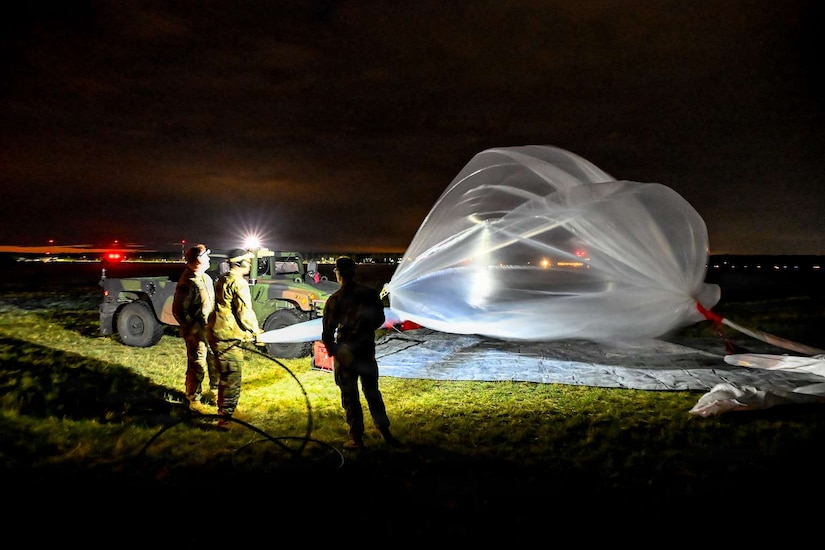
Three men wearing camouflage military uniforms control a large balloon at night in an open field.

The team recently conducted a week of balloon launches in Poland during Exercise Cold Raptor. The training supported NATO's Eastern Flank Deterrence Initiative, a NATO-led regional initiative supported by U.S. Army Europe and Africa that integrates emerging technologies to strengthen deterrence and readiness along NATO's eastern flank.

Cold Raptor gave soldiers hands-on experience launching, tracking and operating tactical balloons in a European environment while refining the procedures they will use during future missions.  

Decentralized Operations and Multidomain Readiness  

Soldiers assigned to the Extended Range Sensing and Effects Company, 2nd Multi-Domain Effects Battalion, conducted the training. Many on the team are qualified satellite communication systems operator-maintainers and are applying their signal expertise to emerging high-altitude systems.  

Army Sgt. Eric Atwater Jr., a signal sergeant, said the exercise tested the team's ability to operate from separate locations.  

"The purpose of Cold Raptor was to see how our launch team and our pilot team can operate from decentralized points," Atwater said. "We wanted to maintain communications while balloons go up in one location, while the flight trajectory is managed and monitored by another team off-site."  

For Army Sgt. Shakir Claxton, a fellow high-altitude balloon operator, improvement comes from repetition.  

"The biggest thing is getting us out in the field, setting everything up, making sure we have a solid timeframe we can work within and doing as many launches as we can," Claxton said. "The more repetitions we get, the better we get at the job."
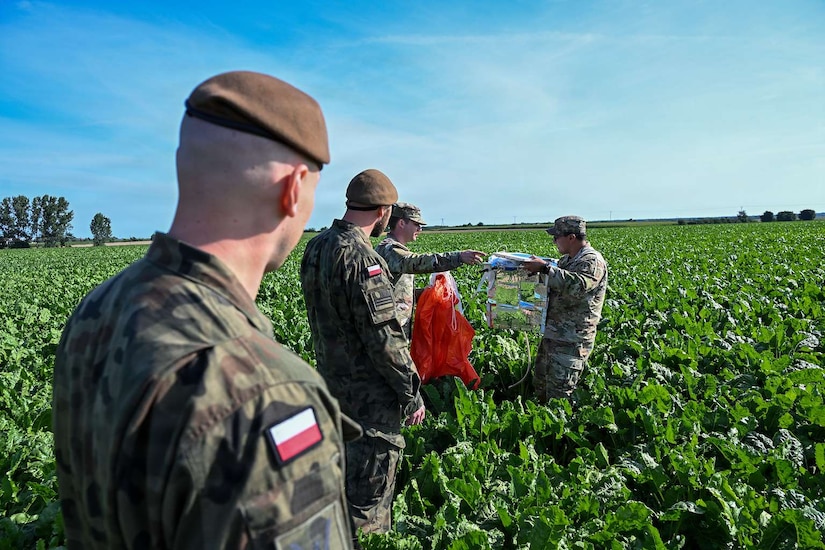
Men wearing camouflage military uniforms retrieve a military balloon from an open field.

The training also supported the company's broader multidomain mission. Claxton compared their capabilities to the three prongs of a trident, each contributing to the sensing mission.  

"We put up the balloons to give a certain kind of view of an area, while other parts of our company, like [unmanned aircraft systems] and [electronic warfare], work hand in hand on the sensing aspect," he said.  

Adapting to Changing Conditions  

During the exercise, the team conducted launches from Powidz, Poland. Some of the balloons ascended into the stratosphere, reaching altitudes between 60,000 and 70,000 feet — approximately 18,300 to 21,400 meters — while carrying experimental payloads designed to extend communications and improve domain awareness.  

Operating in the stratosphere requires precision. Teams must account for changing weather conditions while meeting strict aviation schedules.  

"We have specific windows when these balloons need to go up to meet mission requirements," Atwater said. "Whenever we're contacting airspace control, they're expecting these terminals to be in the air at specific times. If something goes wrong, you have to think quickly on your feet, troubleshoot and find the cause in a timely manner."  

Micro-high-altitude balloon technology continues to evolve and operating the experimental equipment throughout the week presented the team with real-world challenges. By troubleshooting problems as they occurred, soldiers successfully completed flights throughout the exercise and collected data to support continued experimentation.  

The lessons learned during Exercise Cold Raptor also contribute to a broader effort to strengthen deterrence along NATO's eastern flank. The Eastern Flank Deterrence Initiative is not a single unit or location, but a distributed system of capabilities operating across domains and nations. The concept aligns land forces with NATO's regional defense plans and connects mission command systems, networks and data so allied forces can share a common operating picture and make decisions faster. Exercises like this help determine how emerging technologies can contribute to the larger effort.
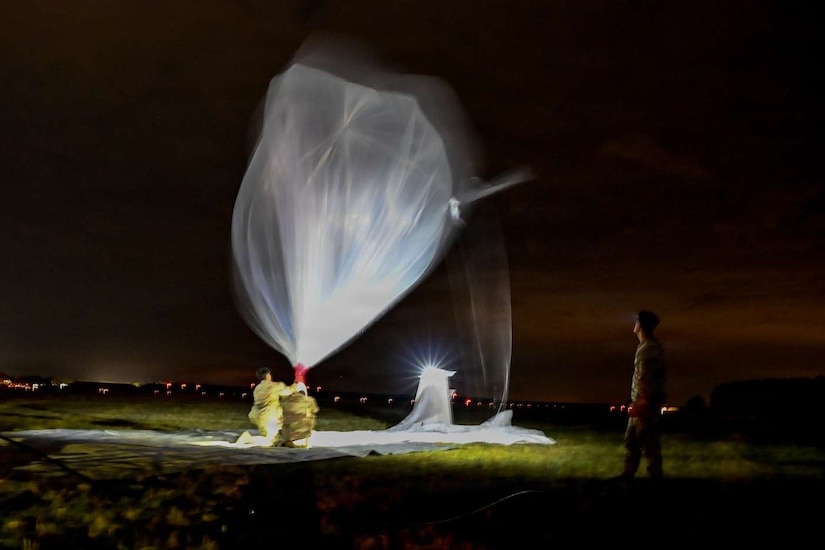
At night in an open field a person wearing a yellow safety suit holds onto a large balloon. Another person in a camouflage military uniform stands by to watch.

"The Eastern Flank Deterrence Initiative operationalizes all-domain deterrence for NATO through a data-enabled posture that harnesses the changes in the character of war," said Army Brig. Gen. Steven P. Carpenter, commanding general of Multi-Domain Command – Europe. "Experimentation with emerging technologies allows us to better understand the operational environment, refine how we integrate capabilities across domains and strengthen our ability to deter aggression alongside our NATO allies."  

Allied Interoperability and Airspace Coordination  

Launching from Poland required more than preparing the balloons and monitoring their flights. The team also coordinated closely with Polish authorities to ensure each launch met host nation airspace requirements.  

"Airspace coordination is a major priority with this kind of mission," Claxton said. "We have an excellent communication pipeline and a strong working relationship with our Polish partners."  

That coordination extended to the flight line, where the launches drew interest from Polish partner forces. Because Polish forces had not previously worked with this type of platform in Poland, U.S. soldiers provided hands-on demonstrations of the equipment and launch process. The demonstrations allowed Polish soldiers to see the technology up close and build a shared understanding of the capability.  

For the soldiers on the ground, helping develop the emerging capability carries responsibility and opportunity.  

"Initially trained as a 25 Sierra [satellite communication systems operator-maintainer], the Army already entrusted me to support established communications equipment," Atwater said. "Being introduced to something new and experimental is an honor. What feels like growing pains for us right now will end up being the foundation that future soldiers rely on."  

For him, the mission also connects to a childhood dream.  

"When I was a kid, I wanted to be an astronaut," Atwater said. "What I would say to my younger self is: you might not be the one going up to the stars, but you'll be the reason everyone looks to the sky and knows you sent something up to the very edge of space. They'll feel safer knowing you put it there."  

Exercise Northern Viking Marks 75 Years of Defense Cooperation

U.S. service members arrived in Keflavik, Iceland, yesterday, joining forces with the Icelandic Coast Guard and other NATO allies for the U.S. 6th Fleet's Exercise Northern Viking 2026.

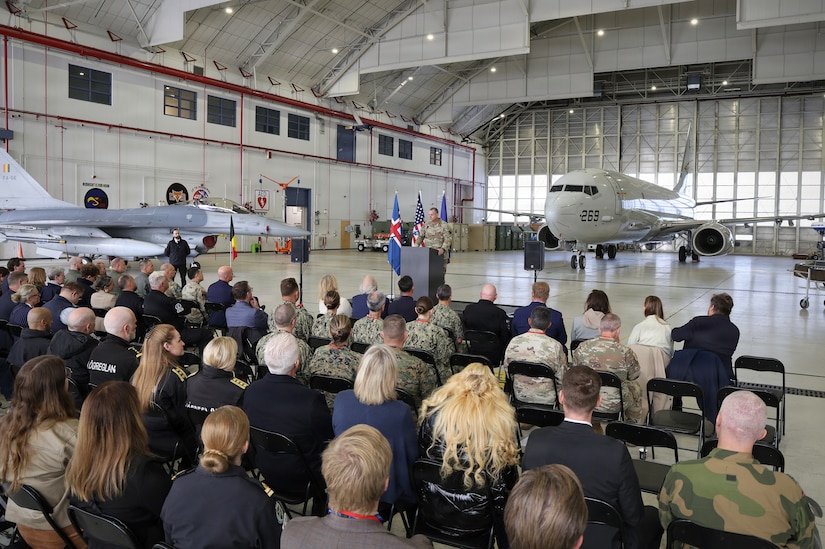
A man in a camouflage military uniform speaks to dozens of people in similar attire and business attire seated in an aircraft hangar; there are two military aircraft in the background.

Participating nations include Belgium, Denmark, France, Iceland, Norway, Poland and the U.S., alongside specialized assets and personnel assigned to the Allied Maritime Command and NATO Joint Force Command Norfolk.

"Our defense cooperation with the United States has thrived for 75 years because it has never stood still; it has developed to meet [the] evolving challenges of our time," said Þorgerður Katrín Gunnarsdóttir, Iceland's minister for foreign affairs, during the exercise's opening ceremony. "The best way to celebrate this anniversary is not merely by commemorating our partnership, but by actually practicing it — together and alongside our allies. Northern Viking is precisely that, a demonstration that the commitments we have made to one another are dynamic, practical and built on trust, underpinned by shared interests."

This year's iteration of the biennial exercise marks the 75th anniversary of the 1951 bilateral defense agreement between Iceland and the U.S. Running from Aug. 22 to Sept. 3, Northern Viking will challenge joint and coalition forces with a series of highly realistic training scenarios.

Key training opportunities will focus on antisubmarine warfare, mine countermeasures, expeditionary construction, search and rescue, humanitarian medical response and disaster response.

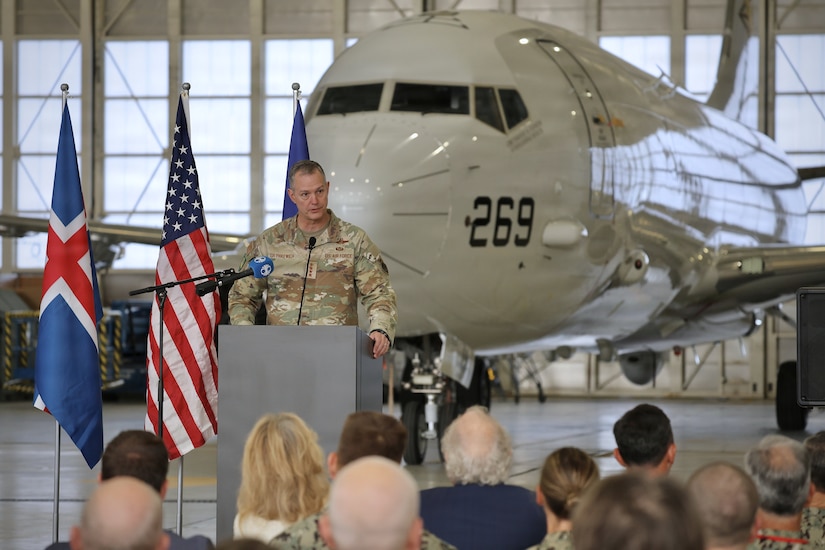
A man in a camouflage military uniform speaks to dozens of people in similar attire and business attire seated in an aircraft hangar; the American, Iceland and NATO flags are displayed behind him, and a large military aircraft is in the background.
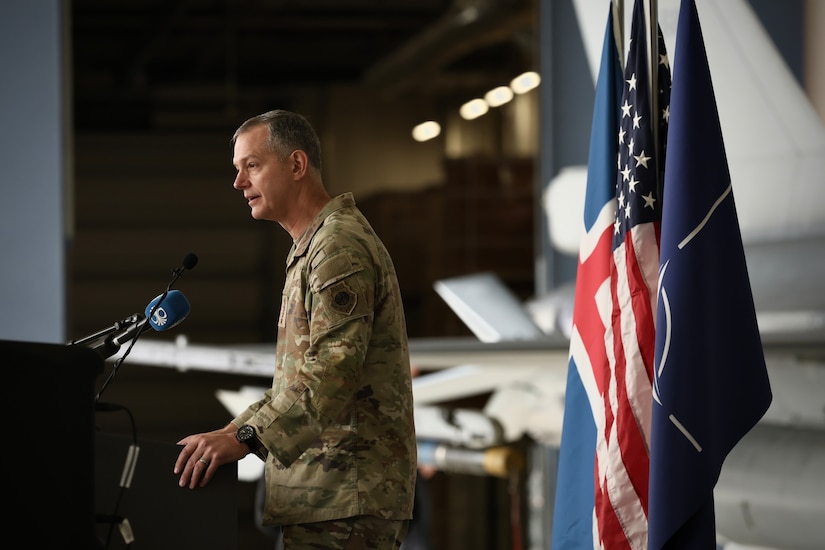
A man in a camouflage uniform speaks into a microphone while standing behind a lectern; the American, Iceland and NATO flags are displayed behind him.
"Seventy-five years of bilateral defense cooperation is a testament to the unbreakable bond between the United States and Iceland," said U.S. Navy Vice Adm. J. T. Anderson, U.S. 6th Fleet commander. "Northern Viking 2026 is a demonstration of our commitment to the collective defense of the North Atlantic. Together with our allies, we continue to create an environment that allows interoperability among NATO maritime forces so that European allies can take over primary responsibility for deterrence and defense in the European theater."

Exercise Northern Viking 2026 is designed to strengthen interoperability and force readiness between the U.S., Iceland and other allied nations. The exercise enables critical multidomain command and control of joint and coalition forces defending Iceland and safeguarding the sea lines of communication within the waterways between Greenland, Iceland and the United Kingdom.

As a vital global shipping corridor, keeping this area secure is an imperative for transatlantic trade, commerce and security between North America and Europe.

"Together, we're honing our warfighting skills and ensuring our ability to secure this critical region and to project decisive combat power wherever and whenever necessary," said Air Force Gen Alexus G. Grynkewich, NATO supreme allied commander Europe and commander of U.S. European Command. "Throughout this exercise, and others, we will leverage the power of data in [artificial intelligence] enabled decision support tools, will integrate data streams in real time and ensure our command and control structures can make decisions at the speed of future conflict."

The 1951 defense agreement was the foundation of a unique security framework designating the U.S. as responsible for Iceland's defense in the absence of its own standing military. This treaty established a highly specialized and enduring defense presence in the region.

Over the last 75 years, this partnership has adapted from Cold War deterrence to modern multidomain defense operations, ensuring that the transatlantic bridge remains open and secure.

Thursday, June 25, 2026

USVDIV-32 Advances Unmanned Operations With NATO During BALTOPS 2026

Sailors assigned to the Unmanned Surface Vessel Division 32 are at the forefront of the Navy's fleet during exercise Baltic Operation 2026, delivering realistic counter-unmanned surface vessel training against unmanned vessels to NATO allies.

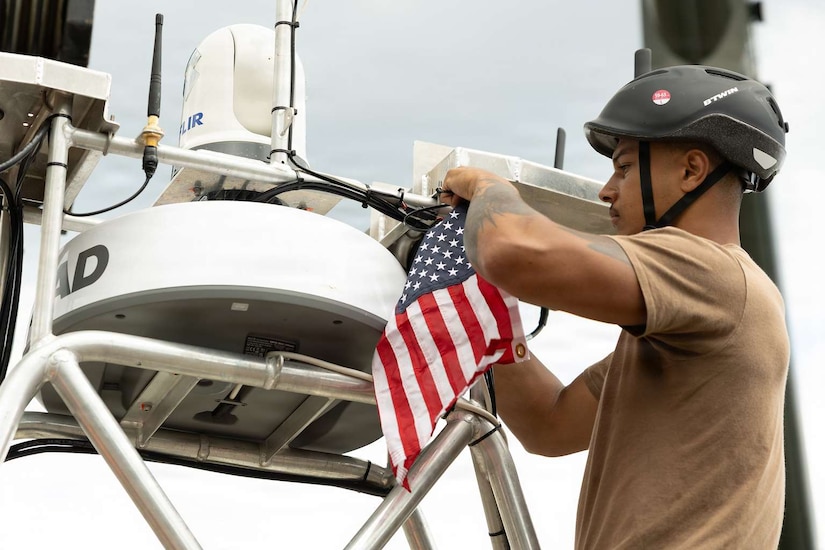
A man wearing a brown T-shirt and helmet, hangs a small American flag onto an unmanned surface vessel.

Established early this year, USVDIV-32 is one of the newest additions to the Navy's unmanned operational units. Tasked with maintaining and implementing unmanned vessels, the division's sailors regularly conduct exercises and training with multiple platforms, with the most common being global autonomous reconnaissance craft, or GARC. 

"GARCs are just one of the several USVs," said Navy Lt. Sarah Weinstein, commanding officer of USVDIV-32. "GARC is just the one that we've had the most experience within the last couple of years, but they're all very similar. " 

A defining feature of USVDIV-32 is the implementation of a new rate, robotics warfare specialist. These specialists are trained to operate and maintain vessels such as GARCs. 

Navy Robotics Warfare Specialist 3rd Class Joshua VanDeCreek expressed excitement about being on the front lines of a new technology that he believes will keep more people safe by sending USVs as opposed to personnel, calling it "a great step in the future."

"I'm proud to be a part of a new unit in the Navy, one that I think is going to be very important," VanDeCreek said.

People wearing camouflage military uniforms work on a small military unmanned surface vessel. Two of them hold up one of its parts at an angle while two others unravel cords attached to the craft.

Chief Robotics Warfare Specialist Christian Butler said the robotics warfare rate will remain vital in the Navy's future. 

"I think most commands, if not all commands, are going to have some component of [robotics warfare specialists], Butler said. "Just because there's no going away from unmanned systems at this point, they're only going to grow in scale, and you're going to need [robotics warfare specialists] to carry that weight." 

During the exercise, USVDIV-32 played a crucial role by deploying GARCs as an opposing force to allied forces. This simultaneously gave allied ships a chance to test their abilities in defending against USVs and provided valuable experience for USDIV-32, allowing them to see their GARCs in action.

"The first difficult part is spotting the USV," Weinstein said. "What does it look like? What are the telltale signs that it might be a USV? How to tell if it's coming inbound and its different behaviors that it's able to display as it gets closer to the ship." 

As the Navy moves toward a hybrid fleet, USVDIV-32 is playing the key role in being among the first to implement this technology. The division's work during BALTOPS 2026 has been invaluable not only to the allied forces but also to the USVDIV-32.

A man wearing a camouflage military uniform points to something in front of him as he speaks. Another person in similar attire watches.

The sailors of USVDIV-32, with the emerging robotics specialist rate, are carving the path for the Navy's future. 

This is only the beginning of this technology, with no end in sight for its importance and potential.   

"I think the technology and the autonomy will continue to grow to give them more options to make USVs more lethal or more effective at executing the mission that they've been tasked with," Weinstein said. 

Monday, September 22, 2025

Hegseth Hosts Canadian Counterpart at Pentagon for Bilateral Discussion

 Sept. 22, 2025 | By C. Todd Lopez, Pentagon News

Secretary of War Pete Hegseth today hosted the Canadian Minister of National Defense David McGuinty for a bilateral discussion at the Pentagon. 

Canada is one of the United States' closest defense partners as both nations share responsibility for defense of North America through the North American Aerospace Defense Command. 

"Our great nations have served together in many wars. ... And today our warfighters continue that, serving together through joint exercises, defending the homeland and really the only binational command of its kind, which is NORAD," Hegseth said. 

The secretary said the work at North American Aerospace Defense Command is important for the defense of North America, but also that there's much that can be done between the U.S. and Canada to modernize its operations. 

"The threats to North America require a strong U.S.-Canada defense relationship — there's no doubt," Hegseth said. "And I know Canada has committed at the [NATO] summit to increasing defense spending to 5% of [gross domestic product] by 2035, which is incredible to see. A very strong step." 

The Canadian Prime Minister Mark Carney announced in June an additional $9.3 billion in defense investments, McGuinty said. These investments bring Canada's commitment to defense to 2% of its GDP "a full five years ahead of schedule." 

McGuinty said the increase in spending is not just about budgets. 

"It's a game changer," he said. "These investments are building combat-ready forces, recruiting and retaining the best, modernizing critical infrastructure on 33 bases, upgrading our cyber [and] our digital defense, [and] sharpening our ability to fight shoulder-to-shoulder with folks like you." 

Canada, like the U.S., is also working to strengthen its defense industrial base, McGuinty said. 

"We're launching a major defense industrial strategy for the country; cutting through red tape to deliver faster, improving resilience, securing access to vital resources, like critical minerals — turns out, we have lots of those," he said. "These hard power capabilities are going to ensure we're ready to strike back and defend whenever and wherever we need." 

While Canada is stepping up its defense involvement in both the Euro-Atlantic and Indo-Pacific regions, McGuinty said homeland defense in North America, in partnership with the U.S., remains the top priority. 

"Defending North America remains our top priority," McGuinty said. "That starts in the Arctic — our shared front line. Canada is locked in to protect the north, its people, its environment and its strategic advantage. It's where our sovereignty, our national security and our partnership with the U.S. comes together strongest. So, from NORAD modernization to Arctic surveillance and infrastructure, we're taking major and fast, bold, decisive action to shore up our collective defense." 

Friday, September 11, 2015

Dempsey: NATO Can Focus on Both ISIL and Russia


By Lisa Ferdinando DoD News, Defense Media Activity

ISTANBUL, September 11, 2015 — NATO has the capacity to focus on two simultaneous problems facing the alliance -- Russia and the Islamic State of Iraq and the Levant, the chairman of the Joint Chiefs of Staff said today.

"Russia has fielded military capabilities that -- were they to have an intent to do harm to the alliance -- they would have the capability to do so," Army Gen. Martin E. Dempsey said.

"NATO is big enough and powerful enough and stable enough to be able to deal with both threats at the same time," the chairman said.

"But what we're seeing is a period of time where we can have the tendency to look at one threat for a while and then we look at the other threat for a while," he said. "Frankly we got to keep our eye on both threats over time."

Dempsey is in the middle of a weeklong trip that began with a stop in Germany to meet with his German counterpart. He then traveled on to Turkey for a NATO Military Committee conference being held Saturday.

The Roots of ISIL

ISIL, he said, is a manifestation of deeper, broader and longer-term issues, including pervasive instability, disenfranchised groups and ethnic and religious conflict in the Middle East and North Africa.

"The underlying issues that allowed ISIL to be created or to create itself are not going to be resolved in the near term," he said.

"NATO has on its southern flank that non-state threat and what that particular threat requires is us to look transregionally," Dempsey said.

NATO will also benefit from hearing the perspective of the conference's host nation, Dempsey said, adding that he hopes to have one-on-one discussions Saturday with Gen. Hulusi Akar, Turkey’s chief of General Staff.

"I do look for the opportunity on the sidelines of conference to get his perspective, find out how he views the issues that are confronting not only his country but NATO, because they are of course the eastern flank of NATO," Dempsey said.

The chairman said he sees Turkey as critical to NATO’s understanding of the issues it faces.

As the only Muslim country in NATO, Turkey is "very important in helping us try to figure out how to resolve the issues that are evolving in the Middle East and North Africa," he said.

Dempsey said he looks forward to discussions on the response of each nation to the multiple, complex issues facing the alliance -- both unilaterally and as a part of NATO.

The day-long NATO session kicks off Saturday morning with opening remarks by Akar, and Czech Gen. Petr Pavel, the chairman of the NATO Military Committee. Sessions are to address topics including the European migrant crisis and NATO's mission in Afghanistan.

Friday, September 21, 2012

U.S. Navy Ships Depart For Joint Warrior Exercise 12-2


By Mass Communication Specialist 2nd Class (SW/AW) Foster Bamford, Navy Public Affairs Support Element West

USS GETTYSBURG, At Sea (NNS) -- Two U.S. Navy ships, led by Commander, Destroyer Squadron (COMDESRON) 26, departed from the U.S. for Scotland, Sept. 17.

The ships will take part in the Joint Warrior 12-2 exercise with allied navies. Joint Warrior is a coalition exercise designed and led by the Joint Tactical Exercise Planning Staff (JTEPS) in the United Kingdom.

Sailors from guided-missile destroyer USS Mitscher (DDG 57), guided-missile cruiser USS Gettysburg (CG 64), Helicopter Maritime Strike (HSM) 46 Detachment 2 and U.S. maritime support reconnaissance patrol aircraft from Experimental Evaluation Test Squadron (VX) 1, Patrol Squadron (VP) 9 and VP 10 and fleet replenishment oiler USNS Leroy Grumman (TAO 195) will play a role in the exercise, which is intended to improve interoperability between allied navies and prepare them for possible joint exercises in the real world.

"Allied and coalition operations are the standard when units deploy," said Capt. Nelson Castro, commander of COMDESRON 26. "This exercise provides a venue for our Sailors to practice and learn NATO operating procedures."

Joint Warrior is the United Kingdom's advanced naval certification course and is on par with a U.S. Joint Task Force Exercise. The exercise is a multi-national training event for allies in a maritime environment. It aims to improve interoperability and prepare forces for combined exercises. There are 12 countries participating in Joint Warrior including the U.S. and the United Kingdom. Those countries are Denmark, Netherlands, Estonia, France, Spain, Norway, Brazil, Germany, Canada, Sweden, and Belgium.

"Many of the allied units involved in Joint Warrior exercises will be the same units our ships will see on deployment," said Castro. "This familiarity allows for the development of trust. All nations benefit from open commerce in the maritime common. Our Navy deployed forward supports the movement of goods worldwide, which affects everyone."

Joint Warrior is a two-week exercise that begins in early October. It involves sea, ground and air assets from participating allied and NATO forces and aims to foster a spirit of teamwork between allied nations.

Wednesday, September 19, 2012

Jackal Stone Promotes Special Operations Partnerships


By Donna Miles
American Forces Press Service

WASHINGTON – The scenario for the Jackal Stone 2012 special operations exercise taking place in Croatia reads like a Hollywood thriller.

A criminal gang infiltrated an industrial plant in the fictional nation of Freedonia, stealing nuclear, biological and chemical material to pass to a terrorist organization. Commandos from U.S. Special Operations Command Europe teamed up with special police from Croatia’s Interior Ministry to track down the perpetrators and recover the material.

The recovery – following an action-packed mission – wasn’t the end of the story. An analysis revealed that the insurgents behind the plot had tentacles extending deep into Freedonia. They had to be stopped.

Freedonia turned for help to the United Nations, which in turn, called on NATO to intervene with military forces. NATO declined, citing force commitments in Afghanistan and elsewhere, but urged individual member nations to form a coalition.

Eleven nations stepped forward, with the United States taking the lead. U.S. and Romanian company commanders command two ground task forces, and a Norwegian is leading the maritime component.

“We formed this coalition, and now we are going to take on the Freedonian insurgency problem,” Army Maj. Gen. Michael S. Repass, commander of Special Operations Command Europe, told American Forces Press Service by phone from Croatia.

That sets the stage for Jackal Stone, an annual multinational exercise designed to build special operations capabilities and improve interoperability among European partner nations.

The two-part exercise began earlier this month with a bilateral U.S.-Croatian counterterrorism exercise and expanded into a multinational, multi-echelon counterinsurgency scenario that continues into next week.

About 700 U.S. participants are on the ground, working alongside special operators and enabling forces from 10 partner nations as they apply capabilities many have honed together in Afghanistan.

“To the extent possible, Afghanistan has informed everything that we are doing during this exercise,” said Repass, who serves as Jackal Stone’s coalition commander.

About 60 role-players, many portraying insurgents, add realism to the scenario.

“This is a live exercise, full up,” Repass said. “We have role players, people who have taken on the personas of insurgents and are living those personas. And we have multiple sources of intelligence collecting on these personas in the operating environment.”

That includes many of the intelligence sources in use in Afghanistan, including human intelligence and imagery from intelligence, surveillance and reconnaissance aircraft flying overhead, he said. Participants also conduct post-mission analyses, applying biometrics from a database created especially for the exercise, and exploiting intelligence from seized cell phones and computers.

“So we have a very sophisticated operation at the tactical level that will feed intelligence upward, creating a much more robust intelligence picture,” Repass said. “At the same time, we are getting national-level Freedonian and international intelligence feeding into us, and we are pushing that down to the tactical units.”

While exercising as they would operate in a real-world scenario, the participants are improving their ability to work together as they apply what NATO calls “smart defense,” Repass said.

The basic premise is to leverage each other’s capabilities to build stronger teams to serve in a coalition or NATO operation, he explained. “You provide tactical units up to your level of ability and your nation’s willingness to do so, and you team up with another capable partner,” he said.

Repass pointed to the International Security Assistance Force special operations structure in Afghanistan as a tangible demonstration of that concept. Stood up about four years ago, it has grown to an estimated 2,000 operators from about 18 countries.

Jackal Stone is building on this capability, Repass said, strengthening participants’ collective ability to plan and execute combined and joint multinational operations with host-nation support from civil and governmental agencies.

That’s fundamental to realizing the vision of Navy Adm. William H. McRaven, the Special Operations Command commander, of a special operations force network, postured for global challenges.

While ensuring special operations have the equipment and technical ability to operate together, Repass said the exercise helps strengthen the relationships that underpin their operations.

“One of the fundamental truths of this whole endeavor is that you can’t build trust in a crisis. You have to have long relationships, and this is strictly done in the human domain,” he said.

“The more we develop these relationships, the better we will work together in the future,” Repass said. “The more capable and interoperable our militaries are, the better we will be as a community to achieve common goals of security, stability and peace.”