Showing posts with label operation dragoon. Show all posts

Monday, September 14, 2026

Medal of Honor Monday: Army Capt. Daniel W. Lee Sr.

Army Capt. Daniel W. Lee Sr. was a platoon leader during World War II. He earned the Medal of Honor for valorous action in southeast France in 1944, during Operation Dragoon. 

Lee was born June 23, 1919, in Alma, Georgia. His parents, Daniel M. Lee and Ida Hyres, were farmers. Lee and his six siblings grew up working on the family farm.
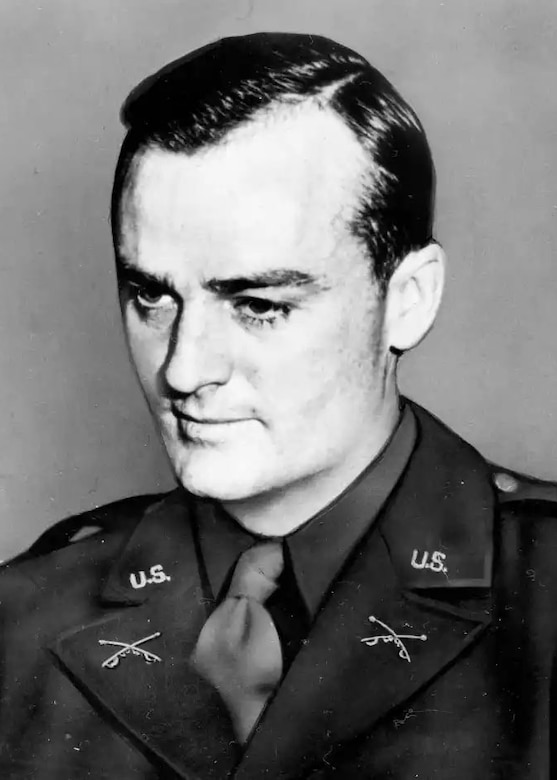
A man wearing a formal military uniform poses for a portrait.

After graduating from Alma High School in 1937, Lee attended the University of Georgia, paying his way by working odd jobs; he worked for a professor, typed papers for fellow students and surveyed crops. He graduated in 1941 with a bachelor's degree in agriculture and began his career in soil management. 

In December 1942, Lee married Sallie Davis, and they had three children after his service ended in World War II: Daniel W. Lee Jr., James and Elizabeth. 

Shortly after being denied entry into the Air Force because he was colorblind, Lee was drafted into the Army in March 1942. He was commissioned a second lieutenant later that year, and his unit, the 117th Cavalry Reconnaissance Squadron, shipped to England for training. They arrived in northern Algeria in 1943, but by then, the enemy had already surrendered. His unit then engaged in combat during the Italian Campaign, from May to August 1944. 

On Sept. 2, 1944, Lee was the leader of Headquarters Platoon, Troop A, 117th Cavalry Reconnaissance Squadron, 7th Army in Montrevel, France, when his Medal of Honor valor occurred. 

According to the medal citation, the Germans had mounted an hourslong attack against the outnumbered Americans when Lee organized a patrol to knock out their mortars.  

He led his men to the edge of town, neutralizing enemy riflemen on a ridge. Atop the ridge, he observed seven Germans manning two large mortars near an armored half-track about 100 yards down the slope.  

Armed with a rifle and grenades, Lee left his men on the high ground and crawled to within 30 yards of the mortars, where the enemy discovered him and unleashed machine-gun fire — shattering his right thigh.
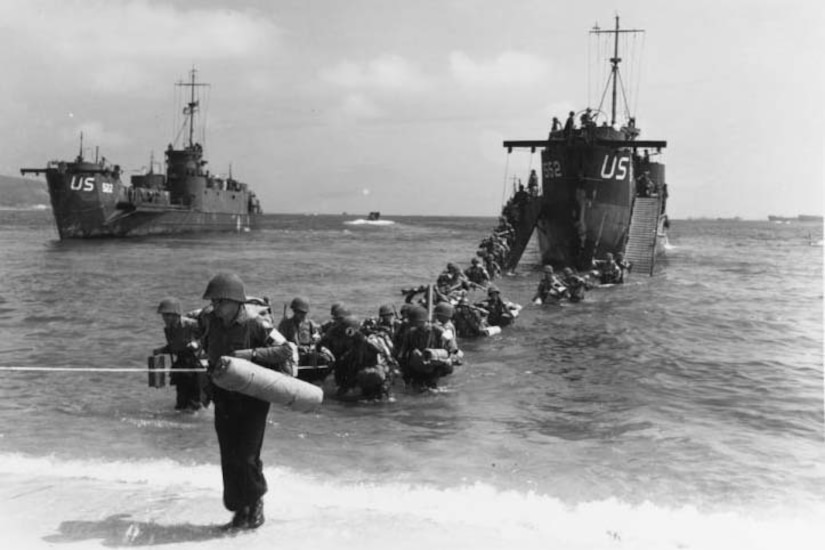
Soldiers wade from ship to beach.

"Scorning retreat, bleeding and suffering intense pain, he dragged himself relentlessly forward," the citation reads. 

Lee killed five Germans with rifle fire, and the others fled before he reached their position. While being fired on by an armored car, he took cover behind the German military vehicle and used a discarded German antitank weapon to neutralize the threat.  

"Despite his wounds, he inched his way toward the car through withering machine-gun fire, maneuvered into range and blasted the vehicle with a round from the rocket launcher, forcing it to withdraw," the citation reads.  

Lee struggled back to his men, where he collapsed from pain and loss of blood.  

During a 2022 interview, Lee's daughter provided further details. Outnumbered, Lee's platoon surrendered, and the Germans took many of the American soldiers but left Lee because of his injuries. 

"Dad told my brother that a German soldier made the decision to leave him there rather than kill him or take him, as he would not have made it. Dad was forever grateful," Beth Lee von Mersveldt said. 

Lee was promoted to first lieutenant, and despite his severe wounds, chose to remain in the military. He transitioned to the Army Reserve, then known as the Organized Reserve Corps. 
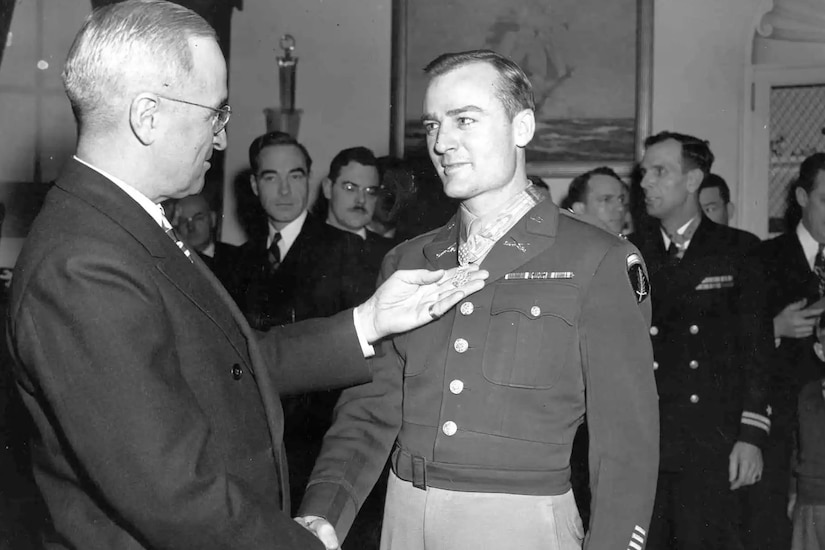
A man wearing business attire shakes hands with a man in a formal military uniform.
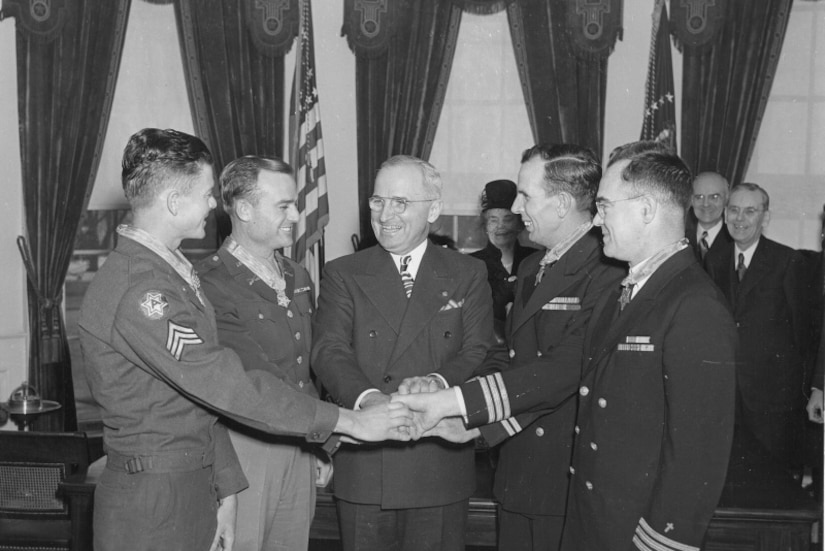
Four men wearing formal military uniforms and wearing medals around their necks, form a circle and join hands with a man in business attire.
President Harry S. Truman presented the Medal of Honor to Lee in a White House ceremony, Jan. 23, 1946. During the ceremony, Truman reportedly told Lee and three others receiving the same award, "I would rather have that medal — the Congressional Medal of Honor — than to be president of the United States." 

After his recovery, Lee worked for the Veterans Administration in Valdosta, Georgia, assisting returning veterans with accessing healthcare, education and other benefits. 

He was recalled to service at the start of the Korean War in June 1950. He was promoted to captain and served as a combat training officer at Fort Knox, Kentucky, until 1952. Lee returned to civilian life, rising to the position of senior vice president of the Southwest Region of Military Service Company, the oldest division of EBSCO Industries. 

Lee died Jan. 22, 1985, at the age of 65, and is buried in Rose Hill Cemetery in Alma. His wife, Sallie, eventually remarried; she died Oct. 1, 2016. 

In April 1996, a bridge near his hometown was dedicated as the Daniel Warnell Lee Memorial Bridge. 

Sunday, July 22, 2012

World War II Veterans Honored for Their Part in Operation Dragoon


By Army Sgt. 1st Class Tyrone C. Marshall Jr.
American Forces Press Service

WASHINGTON, July 22, 2012 – A group of World War II veterans received recognized yesterday in a ceremony held here for their gallantry during a 1944 combat operation in southern France.

Operation Dragoon lasted from Aug. 15 until Sept. 14, 1944. It was the second largest amphibious invasion of World War II, with over 1,000 ships delivering three divisions of troops to the beaches of France. Additionally, an airborne division parachuted into the country to help secure beach heads along with Greek, Polish and Dutch forces, according to retired U.S. Army Lt. Col. Timothy Stoy, historian for the Society of the 3rd Infantry Division.

The Society of the 3rd Infantry Division hosted the ceremony honoring veterans who fought during the operation. French Army Col. Brice Houdet, military attaché from the French Embassy, presented the French Legion of Honor during the ceremony to retired U.S. soldiers John Singlaub, Paul Donlon, Darryl Egner, Elias Hernandez, Michael Halik and the son of Stanley Siemrzuch.

Before presenting the French awards, Houdet thanked the group of veterans on behalf of the people of France.

“I would like to salute all of the American allied veterans who took part in that momentous operation 68 years ago,” he said. “We are deeply honored to have some of you with us today.”

“I will have the distinct honor to present six of these highly deserving former service members with the Legion of Honor, France’s highest national honor and distinction, for their outstanding services during World War II,” Houdet said.

The six award recipients were all accompanied by members of the Military District of Washington’s Sgt. Audie L. Murphy Club, representing the connection to Murphy and the 3rd Infantry Division in which he served.

During the ceremony, U.S. Army Command Sgt. Maj. Edd Watson, currently the command sergeant major of the 3rd Infantry Division, narrated a Missing in Action presentation, and explained the items on a table displayed to honor fallen soldiers.

U.S. Army Maj. Gen. Randy E. Manner, Joint Staff director for the chief of the National Guard Bureau, said Operation Dragoon may not be as well known as some other World War II operations, but it should be remembered for its strategic importance.

“Sometimes, the voice of history does not speak as loudly about some events such as Operation Dragoon,” Manner said.

“So that’s our job today … to be that voice and to speak loudly about those great successes all those many years ago,” he said. “Those gathered here … know the strategic value of Operation Dragoon.”

Manner, whose father served under Singlaub, a retired Army major general, noted Operation Dragoon was critical because it opened a much-needed supply line into France for the allies to “continue to smash the Nazis.”

“History records that over 90,000 soldiers and over 11,000 vehicles were on the beach, on the ground, within days,” he said. “The bottom line is the operation significantly contributed to the shortening of the war in Europe, which meant, of course, the shortening and the lessening of the number of lives that were lost and the number of the families that were affected.”

U.S. Army Maj. Gen. Thomas S. Vandal, director of operations, readiness and mobilization for the Department of the Army, thanked all of the veterans present for their sacrifice and “tremendous” service to the country.

“Although not as well known as Operation Overlord, Operation Dragoon was a highlight of the second World War for many in our military,” he said. “[It was] one of the most successful combined joint operations in the European theater.

“Today, we take fighting as a joint team, alongside our sister services, for granted, just as we’ve come to count on our multi-national allies to be there in operations around the world today,” Vandal said. “But on Aug. 15, 1944, in the early days of the liberation of Europe, such a level of cooperation was far from commonplace.”

Vandal called the allied forces a “vanguard” of history who forged a path “for all of us to follow.”

“Some historians have mistakenly called Operation Dragoon the ‘forgotten D-Day,’ particularly in comparison to the larger and more famous invasions of Normandy,” he said. “In fact, some have even gone so far as to imply that the operation was easy – merely a cakewalk.

“Sgt. Audie Murphy, from the 3rd Infantry Division, might disagree with this characterization,” Vandal said. “Given that he earned a Distinguished Service Cross during Operation Dragoon, I think it speaks for itself [and what troops] did.”

Vandal noted allied forces of Operation Dragoon advanced more than 500 miles in less than a month and took more than 100,000 Germans prisoner.

“Overlooked by history or not, Operation Dragoon was a pivotal moment in the history of France, a fact well understood by all of you veterans sitting here today,” he said.

Vandal, a former member of 3rd Infantry Division himself, expressed his appreciate for all World War II veterans.

“All of our veterans are a national treasure, and we are all fortunate to be in their presence,” he said. “They have left a legacy for our Army and our nation to follow.”