Saturday, July 25, 2026

Mission Marge Brings Legacy of America's 'Ace of Aces' to Guam Airmen

A recovered wingtip from "Marge," the legacy Lockheed P-38 Lightning fighter aircraft flown by Army Air Forces Maj. Richard Bong, America's World War II "Ace of Aces" and Medal of Honor recipient, touched down on U.S. soil for the first time in over 80 years at Andersen Air Force Base, Guam, July 13.  

The Wisconsin Air National Guard transported the historic artifact as part of Mission Marge, an effort to preserve a piece of World War II aviation history.

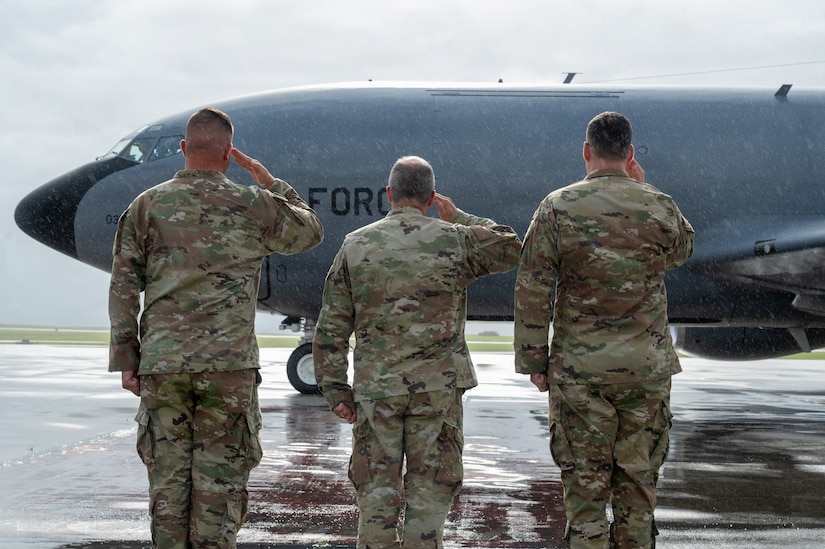
Three men wearing camouflage military uniforms salute a military aircraft.

"The leading World War II ace, Richard Bong, was born and raised in Poplar, Wisconsin," said Air Force Brig. Gen. Adria Zuccaro, the Wisconsin Air National Guard chief of staff-air. "The Wisconsin Air National Guard, who's a state partner, joined in on this really exciting historical moment."  

Zuccaro and the aircrew participated in the wingtip's recovery, transporting it aboard an existing mission returning from Papua New Guinea through the War Department National Guard Bureau State Partnership Program.  

The arrival marks a major milestone in Mission Marge, a collaborative preservation endeavor between the Richard I. Bong Veterans Historical Center and Pacific Wrecks.

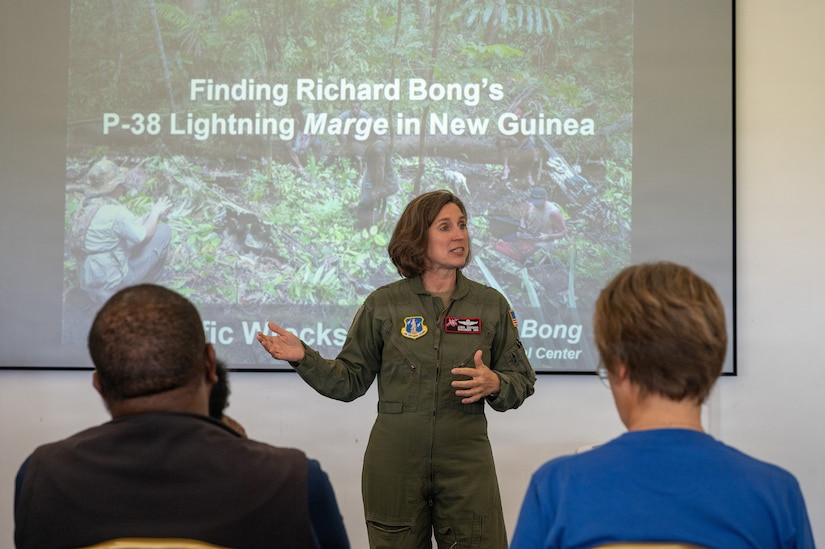
A woman dressed in an Air Force flight suit stands in front of a projector screen to address a group of seated people.

The plane, named after Bong's girlfriend and future wife — Marjorie Ann "Marge" Vattendahl — crashed in the jungles of Papua New Guinea in 1944 and remained undisturbed for decades. The return of this surviving segment bridges the legacy of America's "Ace of Aces" with the modern Air Force.  

The recovery effort brought together Bong's family, the Wisconsin Air National Guard, Pacific Wrecks, the Richard I. Bong Veterans Historical Center, the Papua New Guinea National Museum and Art Gallery and local communities, whose respective representatives made up the Mission Marge delegation that stopped by Andersen.  

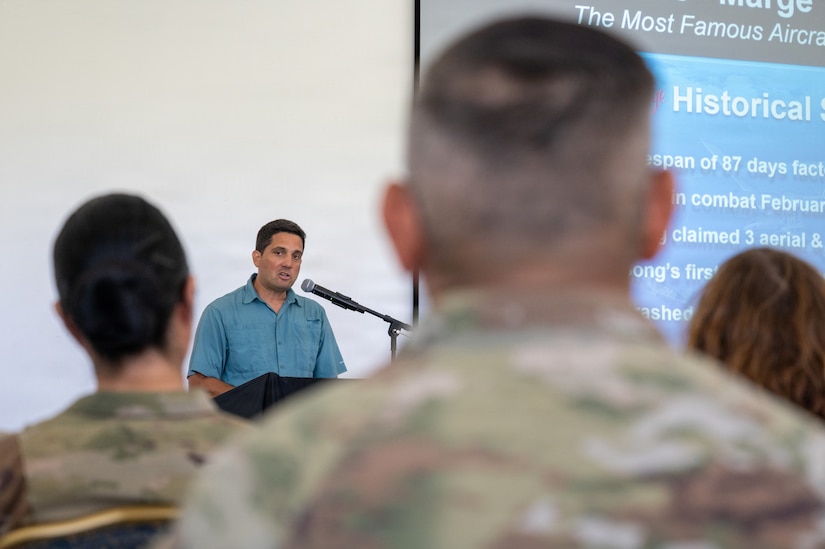
Airmen gathered at the base's Sunrise Conference Center for a briefing led by Justin Taylan, founder of Pacific Wrecks, chronicling Bong's military legacy and the expedition that uncovered his aircraft.

A man wearing a blue shirt stands at a lectern and addresses a crowd.

Taylan explained how historical records, archival research and an expedition to Papua New Guinea led investigators to the crash site in May 2024. The team documented thousands of images of the wreckage before identifying distinctive P-38 Lightning fighter aircraft components, which ultimately confirmed its identity.  

"Where the red paint had faded away, below it, was a black stenciled '993,'" he said. "Finding the serial number on that wreckage was the sign that we had waited for, that this is Richard Bong's plane."  

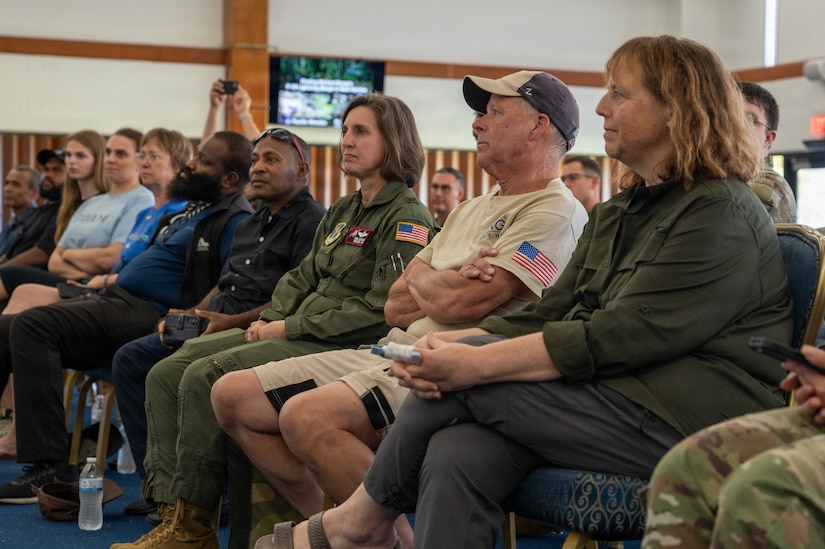
Mitchell Erickson, Bong's nephew, answered questions from attendees at the end of the brief, detailing the significance of the recovery to his family and Air Force history.

A group of people are seated in rows in a large room.

"Seeing a piece of your history come through, especially the aircraft of the 'Ace of Aces,' is significant for airmen today," Erickson said. 

Andersen Air Force Base served as the first stop for the historic wingtip after departing from Papua New Guinea, and it continued its journey to Hawaii before arriving at its final destination in Wisconsin.  

The wingtip was unveiled during the Experimental Aircraft Association AirVenture Oshkosh 2026 at Wittman Regional Airport in Oshkosh, Wisconsin, before becoming part of the Richard I. Bong Veterans Historical Center's collection in Superior, Wisconsin, where it will preserve Bong's legacy and educate future generations about one of the nation's most celebrated pilots.  

"For us [who] are currently serving, I hope what you take from this is that people do remember that our service is important, and it's not only important for those who serve, but it's important to your families," Zuccaro said. "You can take this as a demonstration that 82 years later, there is still family that this is incredibly important to."

Historic Multinational Medical Team Integrates Aboard the USS Essex

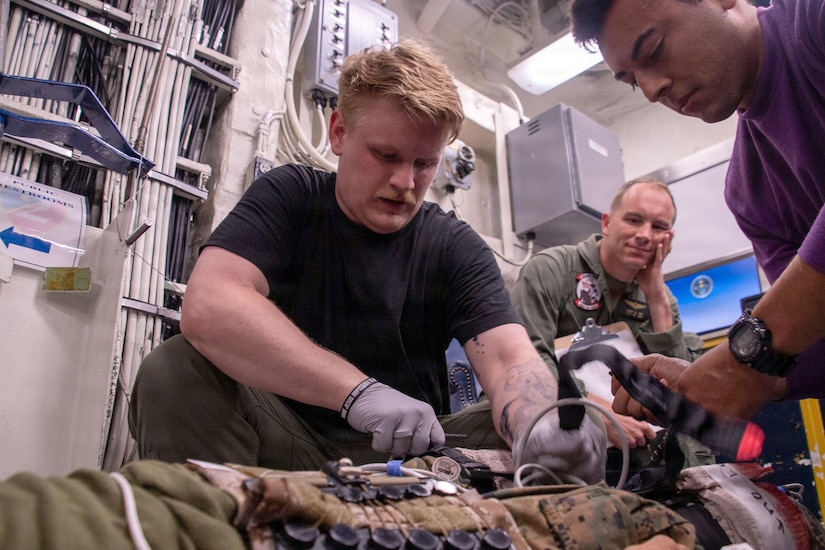
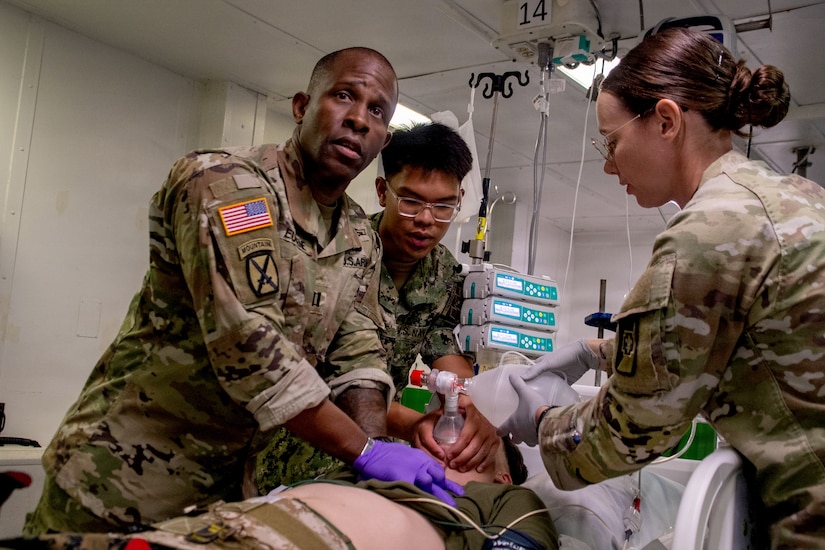
Two men tend to a simulated casualty while another man observes during a mass casualty exercise.

In a historic medical first, a multiservice, multinational team of American and Canadian military medical professionals successfully delivered seamless, life-saving trauma care afloat. 

Operating aboard the amphibious assault ship USS Essex during Exercise Rim of the Pacific 2026, this newly forged coalition of doctors, nurses, medics and combined operating room technicians proved they could run a fully functioning shipboard trauma center under the most intense combat and disaster conditions.

Traditionally, while multiservice and multinational hospitals have successfully operated on land during past conflicts, afloat environments have remained strictly isolated. The administrative intricacies of differing licensing, credentialing and clinical privileges across nations and branches have historically posed an insurmountable barrier. For this iteration of Exercise Rimpac, planners spent more than six months pushing paperwork up the chain of command to grant active clinical practice authority to Canadian and U.S. Army personnel aboard a Navy vessel, allowing them to physically treat patients for the first time.

"The medicine is pretty straightforward, and we all practice good, evidence-based medicine," said Navy Capt. David Foster, the USS Essex senior medical officer. "We didn't have to teach each other how to do medicine. What we did have to learn how to do was integrate and communicate as a team."

This unique integration allowed the Essex to fully flex its hospital capabilities, running all four of its onboard operating rooms simultaneously to manage a massive, simulated influx of critically injured casualties.

The combined force fused the organic crew of the Essex and the Navy's Fleet Surgical Team 5 with the Army's 147th Field Hospital and 105th Surgical Augmentation Detachment, alongside Canada's 1 Canadian Field Hospital and the Canadian Medical Emergency Response Team.

The joint team's capabilities were put to the ultimate test during a massive, two-phase casualty drill simulating the aftermath of a natural disaster. During the exercise, the integrated medical department managed a total of 17 simulated patients presenting with severe, life-threatening trauma — a fourfold increase from a smaller, four-patient trial run conducted days prior.

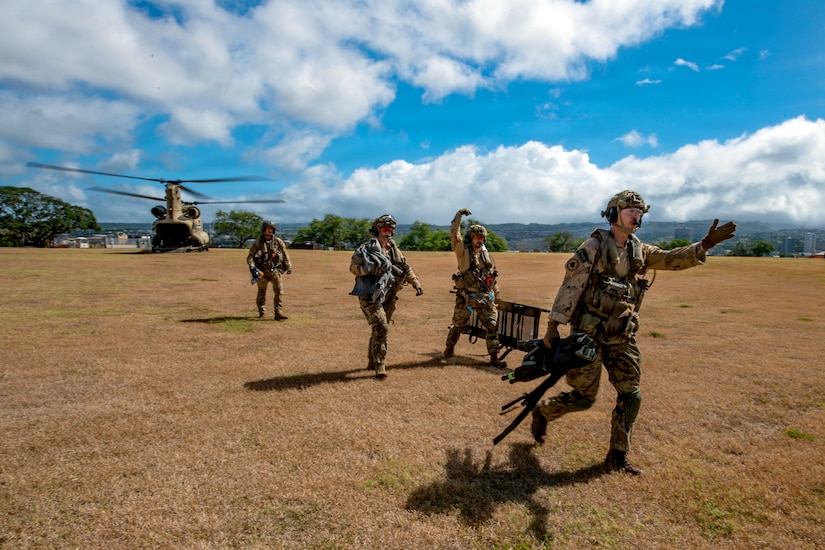
Casualties were transported from the point of injury by a diverse fleet of partner-nation aircraft and Army helicopters.

Three people dressed in camouflage military uniforms tend to a simulated casualty during a mass casualty exercise.

Significantly, the Canadian Medical Emergency Response Team acted as the en route care asset, picking up casualties from the point of injury and treating them in the air aboard a U.S. Army CH-47 Chinook. The Canadian team inside the cabin included emergency physician Capt. Richard Lee, flight nurse Maj. Nadine Verwey and paramedic Sgt. Nickolas Petuhoff performed aggressive, mid-flight resuscitations.

"The one that I was most involved in the care of was a patient who sustained facial trauma where they had a compromised airway," Petuhoff said. "They required some aggressive airway management ... so they had a surgical airway."

The team also had to contend with aircraft variations that disrupted their standard operating procedures. Verwey noted that the U.S. Army Chinook had a large internal fuel tank, which reduced cabin space compared to Canadian aircraft.

"We weren't able to just do what we normally do," she said. "We had to adjust our plan, which helps to build flexibility and resilience in the team."

Once the casualties crossed the threshold into the ship's medical bay, they were met by a unified trauma team that spent the preceding days actively ironing out communication and process bottlenecks.

"Somebody might call a piece of equipment a widget and somebody else might call it a thingamabob," Foster said. "As soon as we got underway together, we got the team leaders together, and we paired up and grouped up the folks of the same skill types together to clarify and level-set all of those communications."

The team also implemented a radical, bottom-up process improvement suggested by a junior crew member to reverse the physical flow of patients through the triage spaces. By replacing standard hand-carried stretchers with rolling gurneys and establishing a strict, one-way directional flow, the team drastically reduced transit time between the flight deck, triage area and operating rooms.

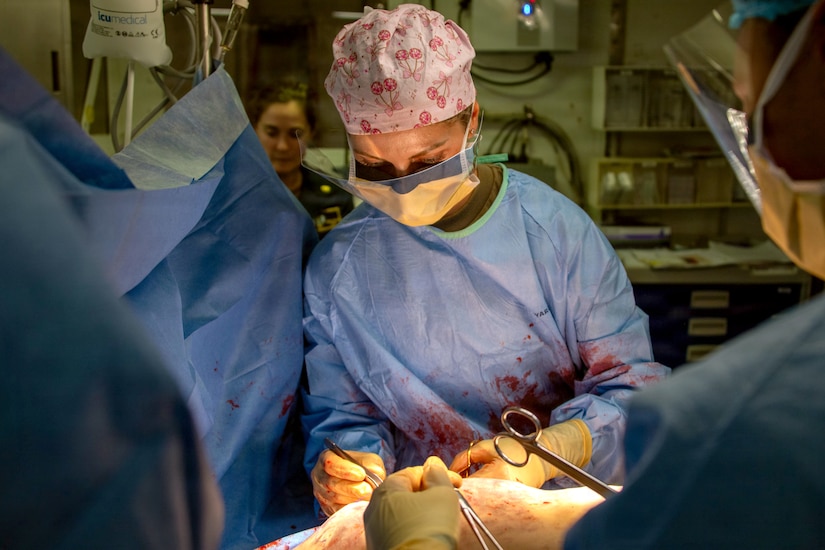
A woman dressed in a surgical gown, mask and cap operates on a simulated casualty during a mass casualty exercise.

"As small a difference as that might seem on the outside, it is actually a really significant change that really improves patient flow," said Lt. Cmdr. Sebastian Vuong, a Canadian anesthesiologist and transfusion medicine specialist.

Inside the operating suites, the realism of the training was elevated by hyper-realistic cut suits.

"The surgeon can actually cut through with a real scalpel. There [are] actual organs inside that actually bleed," said Navy Cmdr. Jesse Bandle, FST 5 officer in charge and commander of the Amphibious Task Force-Surgeon, Amphibious Squadron 5. "It really increases the level of fidelity of this surgical simulation."

Vuong, alongside an Army general surgeon, performed an emergency thoracotomy on a cut suit to open a patient's chest, control massive lung bleeding and administer blood transfusions. To manage resources efficiently, Vuong also provided intensive care unit sedation for a bilateral leg fasciotomy on an electrical burn patient to save the limb, freeing up the operating rooms for other critical cases.

"It's really not about the medical clinical care; it's about how to streamline the processes," she said. "Medicine really has no uniform."

The drill also forced the medical staff to navigate the grim realities of mass casualty triage and resource limitations. Facing a patient with an unsalvageable head injury and exposed brain matter, providers pivoted to expectant care, administering pain medications for comfort while bringing in the ship's chaplain to ensure a dignified death.

For veteran land-based providers like Army Col. Dennis Turner, a nurse anesthetist with 25 years of service, practicing medicine afloat introduced unique, eye-opening challenges. 

"I learned that I can do resuscitative immersion care pretty much in any environment now, even aboard ship," Turner said. 

He noted that, unlike a land-based Army field hospital, where supply replenishment is constant, shipboard medicine is far more isolated. 

"It seems like it's more resource-constrained here out in the middle of the ocean than we are on land," Turner said. "We don't have to worry about whether we're close enough to land to be able to receive more supplies and send away casualties."

Four people wearing camouflage military uniforms run from a helicopter during a mass casualty exercise.

While surgeons operated, the ship's dental crew activated a "walking blood bank," drawing fresh whole blood from the crew to sustain the trauma bay. Other teams managed complex abdominal laparotomies, packed open wounds and stabilized severe pelvic fractures.

"I learned how to be a bit more fluent, control the chaos, both outside and on the inside, a little bit better," said Navy Petty Officer 3rd Class Cole Krablin, search and rescue medical technician. "Stay ready, be ready."

Beyond the clinical success, the exercise highlighted the strategic advantages of using an amphibious assault ship like the USS Essex for humanitarian aid and disaster relief missions. While dedicated hospital ships like the USNS Mercy offer extensive clinical space, they are slower to transit and rely heavily on civilian hospital staffing. The Essex offers a highly mobile, tactically flexible alternative, combining robust Role 2 surgical suites with the organic heavy-lift capabilities of the Marine Corps.

"The Essex provides a unique ability to really incorporate the extra assets from the Marine Corps as far as airlift, transport and being able to put the Marines ashore to clear obstacles, restore operations at airfields, purify water and transport food," Bandle said.

By the end of the exercise, the multiservice, multinational team successfully rewritten the playbook for shipboard trauma care. At the patient's bedside, the boundaries between the U.S. Navy, U.S. Army and Canadian Armed Forces dissolved entirely, leaving behind a highly capable, unified force ready to face the world's next crisis.

"Medicine is a language that all of us speak with the same goal of providing excellent patient care," Verwey said.

Thirty nations, 30 surface ships, 5 submarines, 15 national land forces, more than 190 aircraft and more than 30,000 personnel participated in Exercise Rimpac 2026 in and around the Hawaiian Islands, June 24-31. The world's largest international maritime exercise provides a unique training opportunity while fostering and sustaining cooperative relationships among participants critical to ensuring the safety of sea lanes and security on the world's oceans. The exercise is the 30th in the series that began in 1971.
Boys Nation Delegates Visit Pentagon, Lay Wreath at 9/11 Memorial

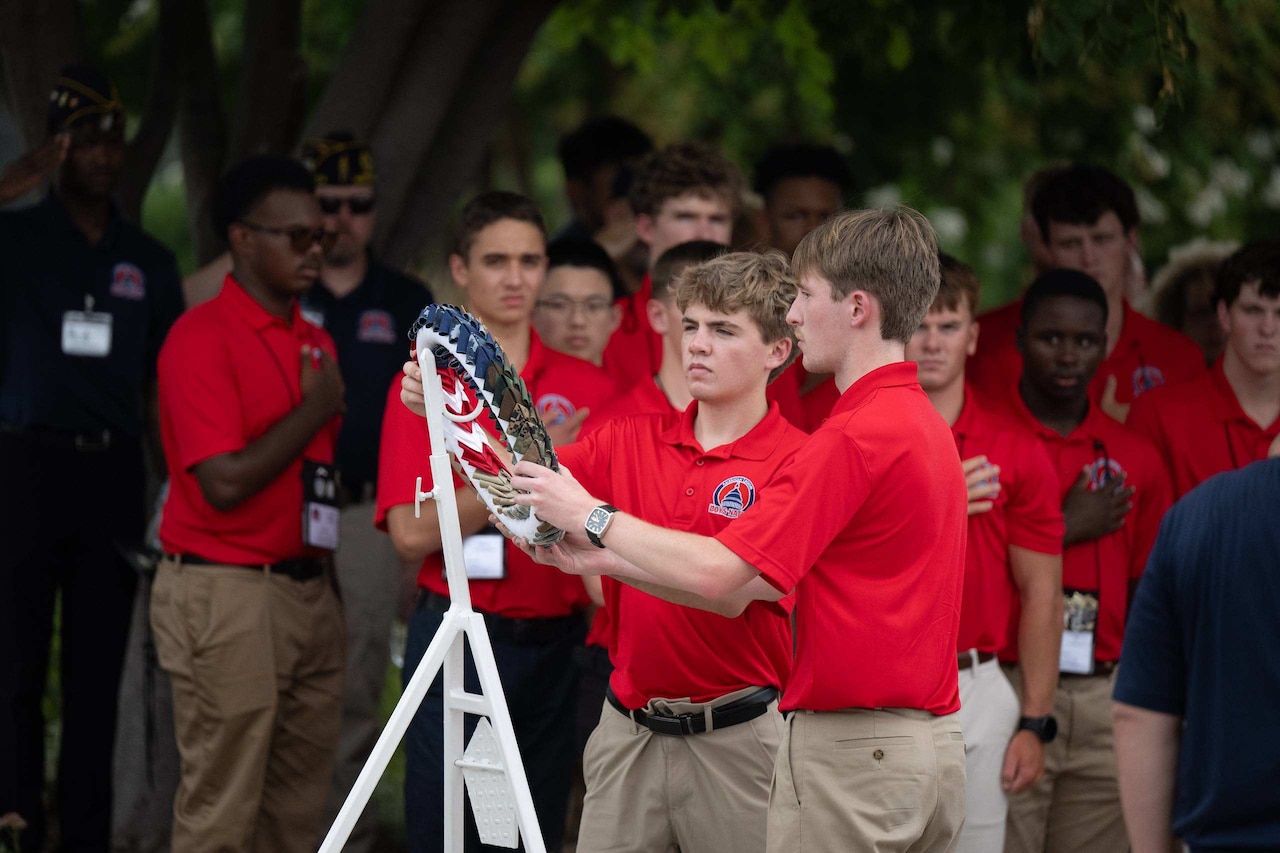
Two boys wearing casual attire place a wreath on a stand outside as more than a dozen other boys in similar attire observe.

Just months ahead of the 25th anniversary of the Sept. 11 attacks, about 100 high school students from the American Legion Boys Nation program visited the Pentagon July 21. 

The trip included laying a wreath at the National 9/11 Pentagon Memorial before touring the building and hearing remarks on service, character and the responsibilities of leaders. 

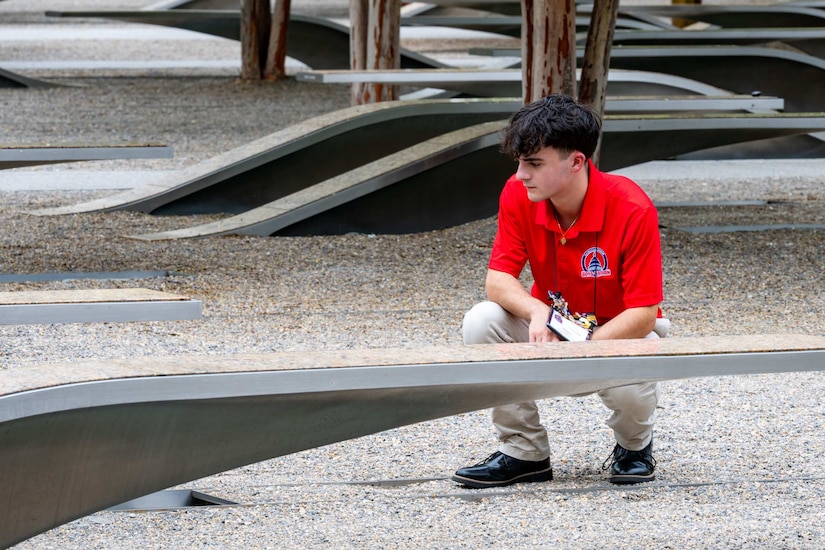
Joined by about 30 Legionnaires, counselors and staff, the delegates began at the memorial to see the 184 benches honoring those killed aboard American Airlines Flight 77 and inside the Pentagon on Sept. 11, 2001. 

Jared Harrison, a Boys Nation counselor who was a White House intern on the day of the attacks, described the uncertainty in Washington that morning and the unity that followed. He told the delegates that the country needs their leadership now. 

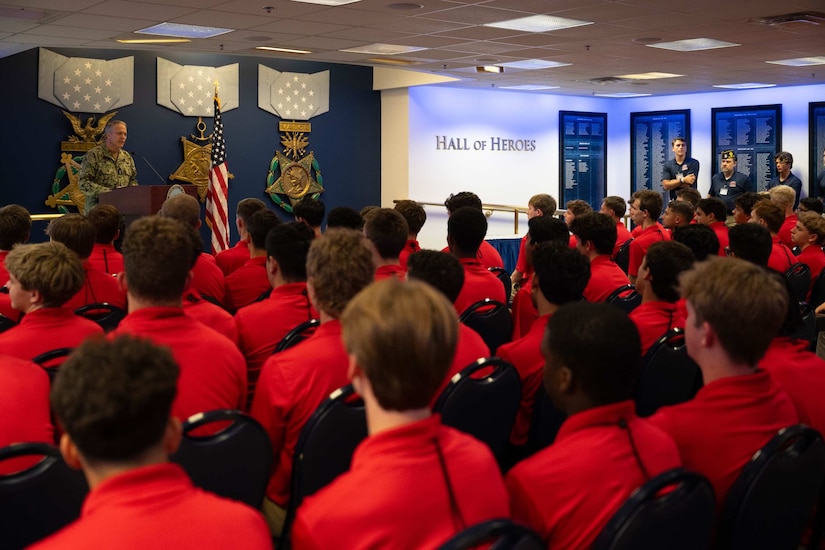
A man wearing a camouflage military uniform stands at a lectern and speaks into a microphone to an audience of boys in casual attire.

"You have been told several times this week that you're the leaders of tomorrow," Harrison said. "I want to impress upon you: you're the leaders of now; we need you today." 

Brady Pace, Boys Nation's president pro tempore, connected the ceremony to the oath each delegate took as a senator. 

"When we as senators took our oaths of office, we swore to support and defend the Constitution of the United States," Pace said. "These souls made the ultimate sacrifice in both support and defense of our Constitution." 

John Alley, the program's senate secretary, spoke about the resolve Americans displayed after the attack. 

A boy wearing casual attire crouches near a bench to read a plaque outside at a memorial.

"In the face of unspeakable tragedy, we did not fracture as our enemies intended," Alley said. "Rather, we came together in a way the world never imagined that we could." 

After two delegates placed the wreath, the group toured the Pentagon and gathered in the Hall of Heroes, where the names of Medal of Honor recipients line the walls. 

"It was a powerful experience," said Thomas Farrell, a delegate from Huntington, West Virginia. "The military has always seemed so abstract to me, and the Pentagon seemed like an unreachable place, but actually going and seeing where our freedoms are defended was incredibly informative." 

Before the formal briefing, delegates discussed their own ambitions — service academies, ROTC, aviation, intelligence, explosive ordnance disposal and other fields — and learned there is no single route into military service. They were encouraged to keep their options open and, once entrusted to lead, to listen to the noncommissioned officers and enlisted experts who have mastered their crafts. 

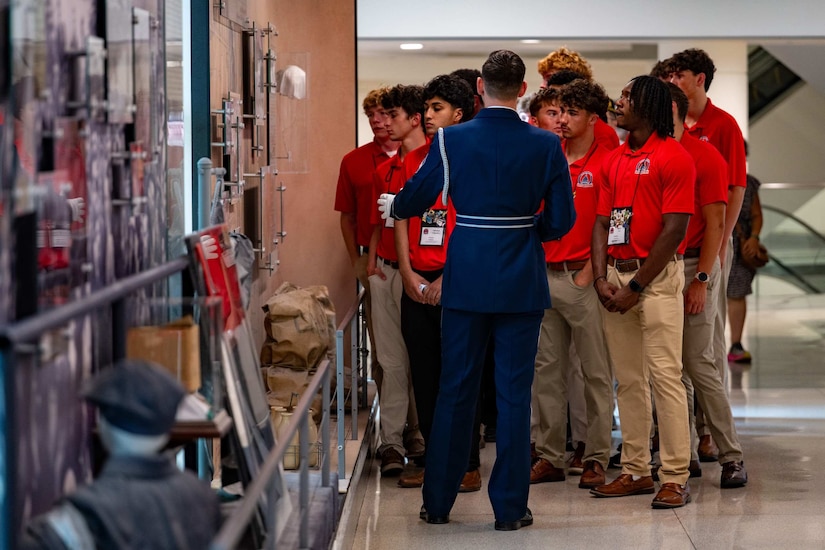
A rear-facing man wearing a formal military uniform gives a tour to a group of boys in a hallway.

Navy Vice Adm. Paul Spedero Jr., director of the Joint Staff, told the delegates that the republic prospers because of leadership and service. Speaking during the 250th anniversary year of the Declaration of Independence, Spedero focused on four attributes he said effective leaders share: integrity, resilience, decisiveness and humility. 

"Your integrity is a currency," Spedero said. "Every time you tell the truth, even when it's inconvenient, every time you take responsibility for a failure instead of passing the blame, you make a deposit into that account. When you lie, cheat or deflect, you bankrupt it. Without integrity, you cannot build trust. And without trust, you cannot lead." 

The questions ranged from combat decisions and command to servant leadership, drone warfare and artificial intelligence. Asked how leaders develop, Spedero said experience matters most. 

"But the best contributor to your leadership development is experience," he said. "So, every opportunity that you have to be out there leading, don't miss it." 

The annual Pentagon visit is part of Boys Nation's weeklong program in Washington, during which delegates study representative government and public service. 

When asked about servant leadership, Spedero explained motive matters more than rank or status. 

"If you're here for rank, if you're here for stature, if you're here for money, you're in the wrong place," he said. "If you're here because you want to make a difference, and you want to make a difference with other people that want to make a difference, then servant leadership is easy."

DOW Identifies Army Casualty

The Department of War has confirmed the identity of an active‑duty Soldier who was killed in action supporting overseas operations in Jordan, following positive identification by the Armed Forces Medical Examiner System.

Staff Sgt. Angel S. Rampersad, 28, of Ozone Park, N.Y., died on July 17, 2026, during an enemy attack at Muwaffaq Salti Air Base, Jordan. The incident remains under investigation.

Staff Sgt. Rampersad was assigned to 1st Battalion, 57th Air Defense Artillery Regiment, 52nd Air Defense Artillery Brigade, 10th Army Air & Missile Defense Command, Ansbach, Germany.

For more information regarding Staff Sgt. Angel S. Rampersad, members of the media may contact U.S. Army Europe and Africa at media@army.mil.