Showing posts with label special forces solder. Show all posts

Sunday, August 26, 2012

McRaven Warns Special Ops Community about Disclosing Classified Information


By Donna Miles
American Forces Press Service

WASHINGTON – The commander of U.S. Special Operations is expressing concern about former members of the community who he said “are using their ‘celebrity status’ to advance their personal or professional agendas,” and warned those who divulge classified information will be held accountable.

Navy Adm. William McRaven raised the issue in an email sent to the entire special operations community following several recent incidents involving former special operators. The latest was the announcement that a former Navy SEAL who participated in the raid that killed Osama bin Laden will publish a first-person account of the operation without first getting the book reviewed by the Defense Department for clearance.

“While as retired or former service members, they are well within their rights to advocate for certain causes or write books about their adventures, it is disappointing when these actions either try to represent the broader S.O.F. community, or expose sensitive information that could threaten the lives of their fellow warriors,” McRaven wrote.

At the Pentagon Friday, Spokesman George Little told reporters defense officials have not read the book, but do expect to “assess it for the potential that it contains classified information.” Any possible prosecution over leaked material would be up to the Justice Department, he said.

Adm. McRaven acknowledged the benefit of reading other special operators’ stories. He noted that his thesis while attending the Naval Postgraduate School was based on “a rigorous examination of available literature” and provided background for his own book, “the Theory of Special Operations.”

“Most of these books were wonderful accounts of courage, leadership, tough decision making, and martial skill, all of which benefited me as I tried to understand our past and how it could affect missions in the future,” he said in his email.

McRaven also recognized the value of movies that provide insight into the lives of special operations professionals, noting that seeing John Wayne’s appearance in “The Green Berets” influenced his own decision to become a special operator. “Countless stories have been told through the medium of film that needed to be told and I am thankful that they were,” he wrote.

But he drew a distinct line between what he called “recounting a story for the purposes of education or entertainment and telling a story that exposes sensitive activities just to garner greater readership and personal profit.” It’s a line he said must be respected – even after leaving the military.

“Every member of the special operations community with a security clearance signed a nondisclosure agreement that was binding during and after service in the military,” he said in his email. “If the U.S. Special Operations Command finds that an active duty, retired or former service member violated that agreement and that exposure of information was detrimental to the safety of U.S. forces, then we will pursue every option available to hold members accountable, including criminal prosecution where appropriate.”

Current and former special operators have both a moral obligation and legal duty to submit their works for pre-publication security review. “We are fully prepared to work with any author who is looking to tell his story and wants a straightforward assessment of the potential security impacts of their work,” he wrote.

Addressing a related issue, McRaven expressed concern over “the growing trend of using the special operations ‘brand,’ our seal, symbols and unit names, as part of any political or special interest campaign.”

“Let me be completely clear on this issue: U.S.S.O.C.O.M. does not endorse any political viewpoint, opinion or special interest,” he wrote.

McRaven said he strongly encourages active-duty special operators to participate in the political process, as appropriate under ethics rules, and for retired members to do the same. “However, when a group brands itself as special operations for the purpose of pushing a specific agenda, then they have misrepresented the entire nature of S.O.F. and life in the military,” he said.

“Our promise to the American people is that we, the military, are nonpartisan, apolitical and will serve the president of the United States regardless of his political party,” McRaven emphasized. “By attaching a special operation’s moniker or a unit or service name to a political agenda, those individuals have now violated the most basic of our military principles.”

McRaven encouraged former special operators to “voice their concerns from the highest hilltop” when acting as private citizens. However, by claiming to represent a broader SOF constituency as they do so, “they do a disservice to all of their S.O.F. teammates who serve quietly and respectfully in support of this great nation,” he wrote.

“Our reputation with the American people is as high as it has ever been,” McRaventold the special operations community. “The sacrifices of our men and women downrange have earned us that respect. Let us not diminish that respect by using our service in special operations to benefit a few at the expense of the many.”

Wednesday, June 06, 2012

Veterans, Contemporary Warriors Salute D-Day Landings


By Army Staff Sgt. Rick Scavetta
U.S. European Command

SAINTE-MÈRE-EGLISE, France, June 6, 2012 – When Eugene Cook jumped into Normandy during the predawn hours of June 6, 1944, he landed several miles from his intended drop zone.

Alone in the dark French countryside, the young 101st Airborne Division paratrooper from Georgia assembled his rifle, got his bearings and began looking for other Americans among Normandy’s hedgerows. In the days and weeks that followed, Cook took part in the now-famous battles that began the liberation of France and led to Allied victory over Nazi Germany.

Cook, 87, was among the handful of World War II veterans who attended the 68th anniversary of the D-Day landings here this week. U.S. service members from all the military branches took part in honoring the veterans, something Cook said he was glad to see.

“We have to commemorate the lives of the guys we left here,” Cook said. “They gave their lives for us, and we should show them thanks.”

Known as Operation Overlord, the D-Day landings of June 6, 1944, combined U.S. and Allied air drops with beach landings along Normandy’s coast. U.S. paratroopers from the 82nd and 101st Infantry Divisions dropped onto the Cotenin peninsula to secure bridges, roads and towns vital to allowing the troops landing at nearby Utah Beach to move inland.

“That day, 68 years ago, as American blood mixed with French soil, it cemented even further the strong bonds between our two nations,” said U.S. Army Secretary John McHugh said as visited the La Fiere drop zone.

For the returning veterans there was a mix of feelings -- glad to be alive and sharing good times and sorrowful memories of those who’d died.

Yesterday -- a cold and overcast day -- John Perrozi walked between rows of white marble gravestones at the Normandy American Cemetery, overlooking Omaha Beach. He stopped at one cross and then another, paying his respects to several buddies who died fighting in Normandy. As an 82nd Airborne Division paratrooper, Perozzi fought on D-Day with the 505th Parachute Infantry Regiment. It was his first trip back since the war.

During a June 3 ceremony at the La Fière drop zone, a battlefield where Perozzi fought, he received France’s highest military medal, the Légion d'Honneur. Before the ceremony, thousands of spectators watched as U.S. and international paratroopers recreate D-Day’s airborne operations -- jumping from U.S. Air Force planes onto the “Iron Mike” drop zone near the La Fière bridge -- at the Mederet River just west of Sainte-Mère-Eglise.

Soldiers from the Fort Bragg, N.C.,-based U.S. Army Civil Affairs & Psychological Operations Command and the Kaiserslautern, Germany-based 5th Quartermaster Detachment were among the hundreds of paratroopers who took part.

The Liberty Jump Team, which includes veterans from other conflicts and civilian parachutists, also jumped. Dave De Soucy, a retired officer from California who served in combat with the 101st Airborne Division during Vietnam, was one of the first to land in La Fiere’s marshy drop zone -- an area that was flooded on D-Day where several 82nd paratroopers drowned on D-Day, stuck in their chutes and harnesses. Packing up his chute, De Soucy said commemorative jumps honor World War II paratroopers, but also remind people about our current military operations.

“It’s an almost overwhelming experience,” said De Soucy, pausing as emotions welled inside him. “We’ve got to remember the folks who did it and those who still do it -- the one percent who go into harm’s way for the benefit of the [other] 99 percent.”

Afterward, Charles Rivkin, U.S. Ambassador to France, jumped with the Golden Knights, the U.S. Army’s parachute demonstration team. Then spectators, dignitaries, soldiers and veterans gathered on the grassy slope nearby for a series of commemorative speeches and wreath presentations.

John Roman, 87, who came ashore with the 4th Infantry Division, was surprised to hear a German military band at the ceremony, playing “Glory, Glory Hallelujah.” Seeing German troops didn’t bother him, he said.

“You’ve got to forget, some time,” Roman said. “It’s good that they are here. Maybe, the world will be better off.”

Toward the end of the war, Roman met a young French woman, Jacqueline, at a café. They’ve been married 66 years and had six children, she said. Each year, they come back, as Roman wants to remember buddies he lost, she said.

When wind gusts caught the beret of a German soldier, Jacqueline Roman watched in amazement as Lt. Gen. Mark Hertling, commander of U.S. Army Europe, walked over and knelt down to pick up the beret off the dirt, then handed it back to the German.

“That’s the American way,” she said. “That was wonderful.”
After World War II, there were 16 million living American veterans. Now, many are reaching their final years. U.S. troops cherished the opportunity to speak with them, to shake their hands and hear their stories.

“You can learn firsthand about history from these veterans,” Hertling said. “Not a lot has changed. They had the same fears and anxiety as they went into combat and the trauma from the things they faced. They teach our soldiers a lot about what that means.”

One older paratrooper hugged Army Staff Sgt. Rachel Medley, 34, of Eureka, Calif., who serves with the Golden Knights. Meeting soldiers from World War II is humbling, she said.

“They paved the path for the way the world is today,” Medley said. “The time is rapidly approaching when it won’t be living history anymore. It will be just something we read about in books because there will be no one who witnessed this. For us to be here and say thank you, it’s a huge honor to be in their presence.”

U.S. troops and veterans marched through Sainte-Mère-Eglise, where they were honored with a banquet in the town square. Similar events were held throughout the area during the days leading up to this year’s D-Day commemoration.

Earlier in the week, on June 2, U.S. Special Operations Forces demonstrated a high altitude, low opening jump near the historic Norman town of Mont Saint Michel. Army Capt. Stephen Cargill, an officer from the Stuttgart, Germany-based 1st Battalion, 10th Special Forces Group, said free falling above Normandy meant a lot to him.

“It’s just amazing to get the opportunity to see something so incredible,” Cargill said. “It hits that much closer to home, to land on hallowed ground.”

One evening, Cargill and fellow Special Forces soldiers relaxed outdoors near the Stop Café, a famous gathering spot in Sainte-Mère-Eglise. Troops mingled with French people wearing old-fashioned uniforms. One Dutch teen, Rob Van Meel, 13, cautiously approached the Green Berets in his authentic World War II uniform of a 101st Airborne Division soldier.

While many French children ask U.S. troops for a souvenir, Van Meel just asked about their patches. Impressed with Van Meel’s detailed uniform, Army Master Sgt. Damon Storey got down and presented Van Meel with a set of combat jump wings -- a treasured possession. Van Meel attended D-Day anniversaries in Normandy every year of his life, he said. In fact, his first costume was as a World War II ammunition box at just 3 months old. He thanked Storey, but said he wouldn’t wear the jump wings on the Screaming Eagles uniform, as it wouldn’t have been historically correct.

A handful of aging U.S. and Allied veterans attended several ceremonies over the course of week. Ellan Levitsky Orkin, 92, and her sister Dorothy, 95, who served together in Normandy as U.S. Army nurses, were offered honorary French citizenship during a June 4 ceremony in Bolleville. They helped unveil a new memorial to World War II medics, near where they served with the 164th Field Hospital. They come back every year, but they don’t quite understand all the excitement, Orkin said.

“We came and had a job to do and we went home,” she said. “When we went home, nobody asked us questions then and we didn’t talk about it. It was too painful.”

Still, some veterans are willing to share their tales. And they don’t mind using newer technology if it means bridging the gap of miles. Milt Staley, 93, of Redding, Calif., waded through chest-deep surf onto Utah Beach on D-Day with the 4th Infantry Division. He first returned in 2011 and has since kept in touch with his French friends on Facebook.

When Staley visits the church at Sainte-Mère-Eglise, he remembers occupying foxholes dug earlier by 82nd Airborne Division paratroopers. Afterward, Staley fought with the 90th Infantry Division and was wounded in combat. Coming back to France is not about reliving the horrors of war, he said. It’s about sharing time with people in France.

“I was never hugged and kissed and thanked so much for what we did,” Staley said. “It amazed and overwhelmed me and I think I’ll never forget it.”

Cook, on the other hand, has returned many times. He also looks forward to seeing people he’s met before, plus reflecting on some of his wartime thoughts, he said.

“This brings back the memories of the guys we were with here,” Cook said. “It’s important that we rededicate ourselves to their sacrifice and D-Day helps us do that.”

Sunday, October 16, 2011

The OSS Society Unveils Design for National Museum of American Intelligence & Special Operations

Museum will tell one of America’s greatest untold stories

WASHINGTON D.C. –  Created practically overnight, in the depths of World War II, men and women from all parts of American society created the most dynamic and unique organization in United States history: the Office of Strategic Services, predecessor to the Central Intelligence Agency, U.S. Special Operations Forces, and the U.S. intelligence community.

Today, nearly seventy years later, The OSS Society has embarked on its latest mission, though not nearly so clandestine as those of its youth: to tell the great, largely unknown story of the OSS and its lasting effect on U.S. national security through the creation of a National OSS Museum of American Intelligence & Special Operations™.

On October 15, The OSS Society unveiled plans for this new museum, designed by Fentress Architects, which will tell the story of the men and women who served in the OSS between June 13, 1942 and October 1, 1945. The landmark building and its three-quarter acre of exhibits will jointly remind the world of their efforts, achievements and sacrifice. The architectural design expresses the spirit of resistance, and eventual triumph against the forces of oppression and terror, in stone, glass and steel.

 “It is a great honor to roll out plans for the National OSS Museum of American Intelligence & Special Operations. It will tell a monumental story, made up of over 70 years of history about the country’s very first strategic missions to preserve our freedoms during times of war. This is the story of the OSS, a story that has not been heard before,” said Curtis Fentress, Founder & Chief Designer at Fentress Architects. “This museum will be a national tribute to all former members of the OSS, their families, and the American people.”

The design of the National OSS Museum™ was inspired by emblems symbolic to the organization: the wingspan of the American Bald Eagle, represented by the twisting gesture of the dramatic roof line, and the spearhead of the official OSS seal, which inspired the museum’s site plan. These symbols connect the past to the present-day Central Intelligence Agency and U.S. Special Operations Forces, which were born from the OSS and carry on its legacy today.

 “The concepts pioneered by General Donovan and the OSS continue to guide those in the contemporary intelligence and special operations fields.”  --David Petraeus, Director of the CIA.

Visitors arriving by vehicle will see a breathtaking structure rise above the tree line. The museum’s 11 angular forms will create a powerful gesture of the OSS’s rise to prominence amidst global conflict and unrest. Enlivened by light entering through glass walls and clerestories, the lyrical composition speaks to how the 11 divisions of the OSS worked together on daring missions to preserve the country’s freedoms. Day and night, the museum will be a beacon on the horizon.

Upon entering, visitors experience a soaring space with a 500-foot-long by 80-foot-tall curved Remembrance Wall engraved with the names of the OSS members killed in action during World War II, poignantly recalling each life. Epic scenes from OSS training and operations films are projected on this wall, and immerse the visitor in history. Audio of direct voices and sounds will add to the immersive experience.

The facing Reflection Walls create interactive multi-media zones that provide private areas for personal contemplation. Visitors from throughout the world can access wartime stories of these clandestine heroes, share their thoughts, or further immerse themselves in the experience through these touch-screen walls. The use of monumental digital media allows these walls to function as additional exhibit spaces and to position the museum in the 21st century. The complex will also serve as a center of research. To reduce operations and maintenance costs, the museum will be sustainable, designed to meet LEED Gold certification standards.

“Today, our Central Intelligence Agency, U.S. Special Operations Forces, and the entire intelligence community are as critical to protecting the United States as they have ever been in our nation’s history,” said Charles Pinck, President of the OSS Society. “I am very excited about and proud of this museum design honoring the OSS, as it will give us the chance to tell America’s greatest untold story.”

The National OSS Museum of American Intelligence and Special Operations™ will celebrate the historic accomplishments of the OSS, America’s first strategic intelligence agency. It will be a monument to those who served in the OSS and those today who are inspired by its legacy.

The Office of Strategic Services (OSS) Society celebrates the historic accomplishments of the OSS during World War II—the first organized effort by the United States to implement a centralized system of strategic intelligence and the predecessor to the Central Intelligence Agency and U.S. Special Operations Forces—and educates the American public regarding the continuing importance of strategic intelligence and special operations to the preservation of freedom in this country and around the world. Its Board of Directors includes two former commanders of the U.S. Special Operations Command, President George H. W. Bush, five former Directors of Central Intelligence, former Secretary of Defense Robert Gates, and Ross Perot. The OSS Society is comprised of OSS veterans, their descendants, and members of the U.S. intelligence community and U.S. Special Operations Forces. It traces its beginnings to 1947 when its predecessor, the Veterans OSS, was founded. The OSS Society is a 501(c)3 nonprofit organization.

 For more information on The OSS Society, please visit www.osssociety.org or email oss@osssociety.org

For more information on the National OSS Museum of American Intelligence & Special Operations™, please visit www.nationalossmuseum.org.

Fentress Architects is a nationally-known design firm that passionately pursues the creation of sustainable and iconic architecture. Together with their clients, Fentress creates inspired design to improve the human environment. Founded by Curtis Fentress in 1980, the firm has designed US$26 billion of architectural projects worldwide, visited by over 300 million people each year. Fentress is a dynamic learning organization, driven to grow its ability to design, innovate and exceed client expectations. The firm has been honored with more than 360 distinctions for design excellence and innovation, and in 2010, Curtis Fentress was recognized by the American Institute of Architects with the most prestigious award for public architecture, the Thomas Jefferson Award. Fentress has studios in Denver, Colorado; Los Angeles, California; San Jose, California; Washington, D.C.; and London, U.K. www.fentressarchitects.com

Please contact Angela Potrykus at 303.282.6192 or potrykus@fentressarchitects.com for more information or images.

Tuesday, August 30, 2011

Special Ops Forces Will Remain Essential, Official Says

By Karen Parrish
American Forces Press Service

BLOOMINGTON, Ind., Aug. 30, 2011 – The nation’s special operations forces are experiencing heady but somewhat perilous times, the Pentagon official tasked with overseeing them said here today.

“The skills and capabilities of America’s elite special operators have never been more recognized by the nation – sometimes, frankly, more than I like,” Michael D. Lumpkin, acting assistant secretary of defense for special operations and low intensity conflict, told hundreds of people attending the National Defense Industrial Association’s Joint Missions Conference here.

Operations since 9/11, culminating in the May strike that killed Osama bin Laden, mean special operations forces are more active and more integrated across the military than ever before, Lumpkin said, with Defense Department and other agencies’ senior leader ranks now peppered for the first time with generals and flag officers raised in the special operations community.

Public awareness of special operators may fade over time, Lumpkin said, but the demand for their skills likely will remain.

As the nation faces severe budget constraints, he noted, it remains critical to train and equip a special operations force that has more than doubled in size over the past decade. Across-the-board defense spending cuts could mean the military loses capabilities it would then have to rebuild at greater expense later, he said, adding that the key challenge is to identify capabilities that must be sustained and institutionalized to prepare the force for the kinds of conflicts the nation is going to face in the future.

Trends shaping the national security environment include the growth in power of nonstate actors, increasing instability in fragile states, and ever more readily available advanced technologies, Lumpkin said.
These threats mean the intensity of operations over the last 10 years likely will be sustained for the next 10, or even 20 years for special operations forces, he said.

“We need to be cognizant of the future and current fiscal climate while ensuring special operations forces retain their edge,” he said.

In Afghanistan and other regions, he noted, criminals and insurgents are nearly indistinguishable.

“Arguably one of the most important lessons we’ve taken from … Iraq and Afghanistan is that success in counterinsurgency, counterterrorism and post-conflict stability, he said, depends upon the integrated efforts of both civilian and military organizations in all phases of the operation, from planning through execution.

The complexity of likely future operations, Lumpkin added, will require special operators to work “fluently” with agency representatives across the defense, development and diplomacy aspects of government.

Narcotics trafficking, transnational organized crime and terrorist networks form a nexus that increasingly requires an interagency and coalition approach to combat effectively, Lumpkin said.

“These networks are challenging the character of the battle space, and thus forcing us to adjust our approaches in combat,” he added.

Lumpkin said new, multi-use tools and technologies linking U.S. forces, allies and police organizations are needed to counter such hybrid threats. “Picture a … digital, coalition joint task force sharing information, including forensic and biometric data, properly controlled, but without current obstacles to sharing,” he said.

Interagency and international approaches to acquisition are inherently beneficial to special operations forces, Lumpkin said, noting that his office oversees the Combating Terrorism Technical Support Office, commonly known as CTTSO.

CTTSO staff members work closely with representatives of more than 100 other state and national government, law enforcement and first-responder agencies “to gather front-line requirements and leverage the resources of multiple users for … rapid prototyping,” Lumpkin said.

As special operations forces and even regular forces face future missions likely to require small teams operating in remote locations around the world, Lumpkin said, new technologies to enhance communications, mobility and surveillance capabilities top the list of needs.

“Picture the great distances of Africa,” he told the audience. “And then consider what new technologies might be needed … to rapidly move and tactically maneuver.”

Light and rugged ground vehicles and aircraft that can be used with existing systems are critical, Lumpkin said. “Integrating new technologies with aviation support is a necessity to maintain our effectiveness in the current war and the small wars of tomorrow,” he added.

Small wars create shortfalls for the nation’s high-end defense aviation capabilities, he noted. “Mobile, rugged, high-endurance, quiet-loitering, persistent systems that can be embedded with and operated in close proximity to the user are necessary to meet warfighter needs,” he said.

Future operations will require mobility systems that can transport sensors, cargo and medical equipment to remote locations, he said, and surveillance capabilities will remain increasingly important.

“Acoustically quiet, long-dwell surveillance aircraft are critical to prosecuting high-value targets and sustaining eyes-on for extended periods of time,” he said.

A close air support aircraft that can arrive quickly with the proper ordnance and remain on station for at least four hours to support ground troops also is “operationally necessary in the irregular wars that we will fight,” he said.

“Such low-cost, highly agile aviation systems can be applied not just to special operations overseas, but to protect our borders as well,” he noted.

Innovations in aircraft design can revolutionize how aircraft are used on the battlefield, Lumpkin said.

Other key near-term needs requiring investment include fixed- and rotary-wing systems and vertical-lift capability, he said, as well as “long-range, high-speed infiltration, extraction and resupply to special operations teams in hostile, denied, politically sensitive areas, in the air, on land and on and under the sea.”

The department has established summits to bring together representatives from the military services, research labs and U.S. Special Operations Command to synchronize technology development efforts and speed and streamline new equipment acquisition for special operations forces, Lumpkin said.

“Closing these kinds of seams between Socom and the services’ acquisition processes will likely be increasingly important in the resource-constrained environment of the future,” the assistant secretary said.

Improving synchronization between Socom and the laboratories also will help to identify opportunities to work together, improve speed of transition to the field and ensure appropriate interaction with industry, Lumpkin added.

The key challenge DOD faces today is consistent for every component, Lumpkin said: balancing budget reductions with the need to preserve the “muscle and bone” of core capabilities. Defense industries must therefore be forward thinking and nimble, he said.

“Despite this fiscal climate,” he told the audience, “we need to really think big about the future of our military, and the future of special operations forces.”

Tuesday, August 09, 2011

U.S. Special Ops Forces Unmatched in World, McRaven Says

By Jim Garamone
American Forces Press Service

WASHINGTON, Aug. 8, 2011 – U.S. special operations forces are unmatched by any country in the world, said Navy Adm. William H. McRaven, who assumed command of the Tampa, Fla.,-based U.S. Special Operations Command today.

McRaven took the reins from Navy Adm. Eric T. Olson during a ceremony presided over by Defense Secretary Leon E. Panetta. The video of the ceremony streamed to special operations teams around the world.

McRaven had been the commander of Joint Special Operations Command and worked with then-CIA Director Panetta to find and kill Osama bin Laden. The admiral told Panetta he looks forward to working with him in his new position.

“Today’s [U.S.] special operations forces are the finest the world has ever seen,” McRaven said. “As demonstrated time and again, their courage, their experience, their dedication to the mission and their sense of patriotism is unparalleled in the annals of history.”

McRaven, who was promoted to four-star rank earlier, also praised families of special operations personnel. “Behind every SOF warrior stands a family of equal strength and commitment,” he said. “As a nation, we are blessed to have such magnificent patriots.”

McRaven spoke directly to special operations personnel during his short statement upon taking command. “I look forward to serving with you,” he said. “The world today is as unpredictable as ever. As such, the American people will expect us to … answer every call to arms, to venture where other forces cannot and to win every fight no matter how tough or how long. They will expect it because we are the nation’s special operations force, and I guarantee you we will not let them down.”

McRaven, a Navy SEAL, has commanded at every level from SEAL platoon leader to his current position. He served during Desert Storm and was commander of Special Operations Command Europe where he also served as the first director of the NATO Special Operations Coordination Center.

Wednesday, July 27, 2011

National Guard, active duty Green Berets receive high honor from French Ambassador

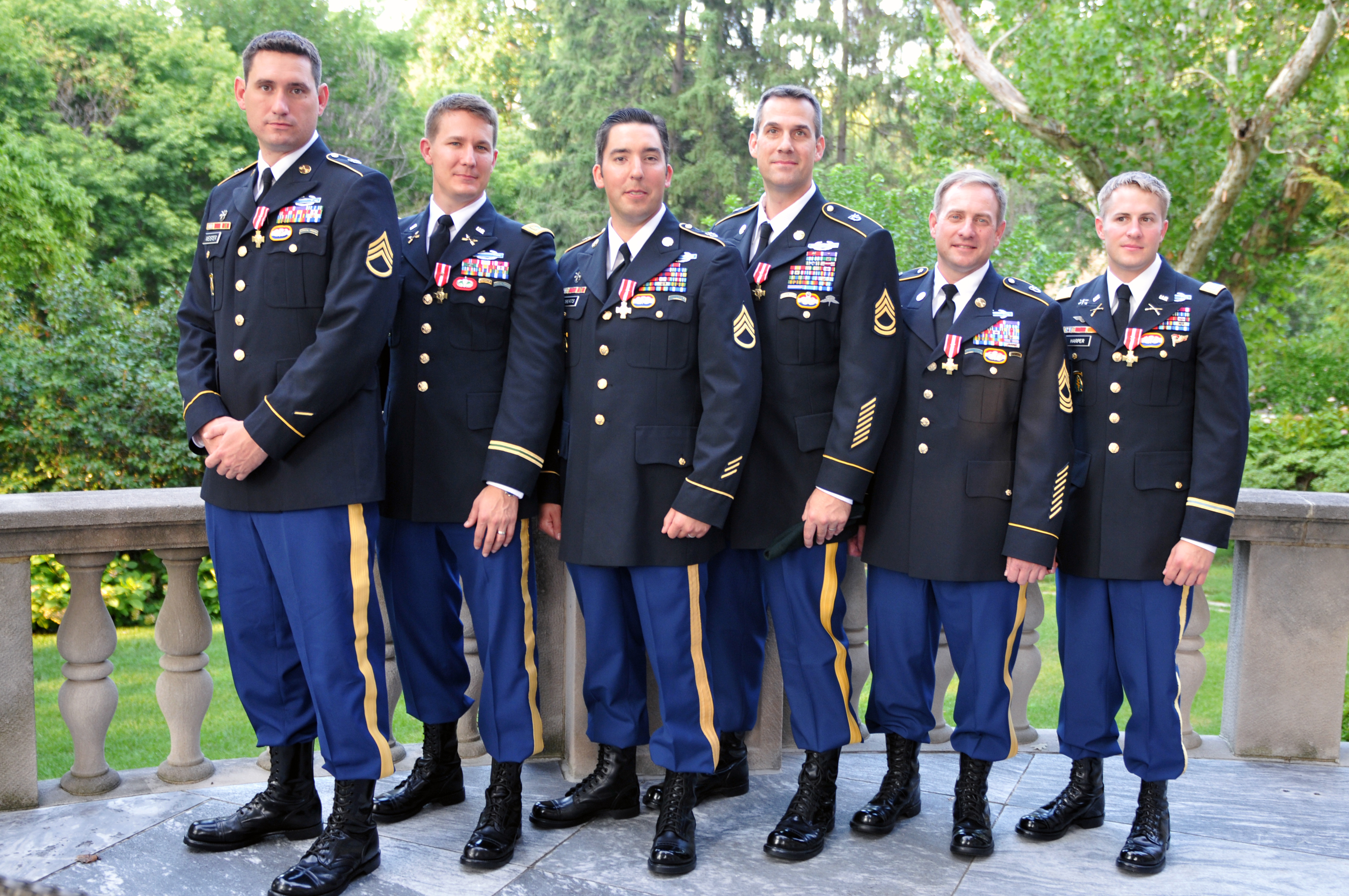
Special Forces Soldiers from the 10th Special Forces Group and the 20th Special Forces Group are seen after they received the French Croix de la Valeur Militaire, roughly analagous to the Silver Star, during a private ceremony at the French Ambassador's Residence in Washington, D.C., on July 25, 2011, awarding the honor to five National Guard and one active duty Special Forces Soldiers. (U.S. Army photo by Staff Sgt. Jim Greenhill)

Thursday, June 23, 2011

Fuerzas Comando Promotes Special Ops Skills

By Donna Miles
American Forces Press Service

WASHINGTON, June 21, 2011 – Elite commandos from 19 countries are participating this week in Fuerzas Comando 2011, a demanding counterterrorism and special operations skills competition sponsored by U.S. Southern Command to promote military-to-military relationships, increased interoperability and improved regional security.

The competitors, from throughout Central and South America and the Caribbean, are taking part in the eighth annual competition that kicked off June 15 and continues through June 23 in Ilopango, El Salvador, said Air Force Maj. Brett Phillips, the lead Fuerzas Comando planner for U.S. Special Operations Command South.

The El Salvadoran military is hosting this year’s exercise, with participants from Bahamas, Belize, Brazil, Chile, Colombia, Costa Rica, Dominican Republic, Ecuador, El Salvador, Guatemala, Honduras, Nicaragua, Paraguay, Panama, Peru, Trinidad and Tobago, Uruguay and the United States.

The competition consists of sniper, assault, physical fitness, strength and endurance events that challenge commandos psychologically as well as physically, Phillips said.

Among this year’s events is a timed 18.8-kilometer forced march, with six-man teams from each country carrying 30-pound rucksacks and rifles, and a series of sniper competitions that include target acquisition, range estimation and night shooting events.

The competitive events wrap up today, to be followed with a combined airborne operation tomorrow and exchange of wings before the closing ceremony.

While special operators test out their tactical skills, a concurrent senior-leader seminar is providing a strategic-level focus to security challenges and possible solutions. Twenty-four nations have sent a senior special operations officer, typically the brigade-level commander of the country’s commando team, and a ministerial-level policymaker associated with the country’s counterterrorism policies, procedures and strategies, to participate in the two-day distinguished visitor program, Phillips said.

“That’s when they talk about the regional counterterrorism projects and programs that are in place, they talk about trans-national threats, they talk about illicit trafficking and how to combat that,” he said. “That is where you are addressing those strategic-level thought processes and objectives.”

Phillips called this two-part approach key to fostering relationships throughout the ranks that pay off in closer regional cooperation, enhanced mutual trust and increased military interoperability as it advances the counter-terrorism training and readiness of participating special operations forces.

“It’s the strategic level, with the commanders and strategic thinkers from that country, all the way down to the tactical level, where the teams that go and break down the doors and go save people, or, depending upon their requirement, they eliminate a threat,” he said.

There’s another dimension to Fuerzas Comando as well. As commandos compete and their leaders convene, staff members from each participating country are operating as a combined staff, providing administrative, logistical, medical, communications and other support.

This, Phillips explained, gives the staffs experience they would need to work together during a real-world contingency.

While Fuerzas Comando has sparked some healthy competition among participants, “the camaraderie and the fraternity between these teams from all these different countries has been just exceptional,” he said.

When the commandos aren’t competing, they share their operational experiences and ideas with other teams and compare different tactics, techniques and procedures. This promotes cooperation and learning, along with a better understanding of how different countries’ militaries operate, Phillips said.

It also lays a foundation for relationships, he said, that could have a big payoff in the future as commandos advance to increasingly responsible positions within their respective militaries.

“Now, if there is a conflict,” he added, “it is a lot more likely that the conflict will be resolved between two chiefs of staff who know each other, who have had a relationship on a personal side as well as professional, and they can resolve their problems in a more practical manner than resorting to armed conflict.”

Phillips said he’s seen past competitors who’d risen through the ranks return to Fuerzas Comando as senior military commanders or government officials to participate in the strategic-level distinguished visitor forum.

“That’s our dream that we are seeing realized,” Phillips said. “These younger team leads from years ago are now growing in rank and position and soon will be able to pick up the phone and talk to Juan or Jose or Jorge or whoever that they competed against 10, 15 years ago as a team member,” and bring the benefit of shared operational expertise to strategic-level conversations.

Phillips said he’s also encouraged by the growth of the Fuerzas Comando, which began in 2004 with 13 countries.

“It just grows and gets better every year,” he said.

U.S. Navy Rear Adm. Thomas L. Brown II, commander of Special Operations Command South, thanked participants during the opening ceremonies at El Salvador’s Special Counterterrorism Command special operations center for the dedication they have brought to the competition and to regional security.

“You represent the world’s finest warriors, sacrificing daily to defend and protect the freedom and security of the citizens of the Western Hemisphere,” the admiral told the participants.