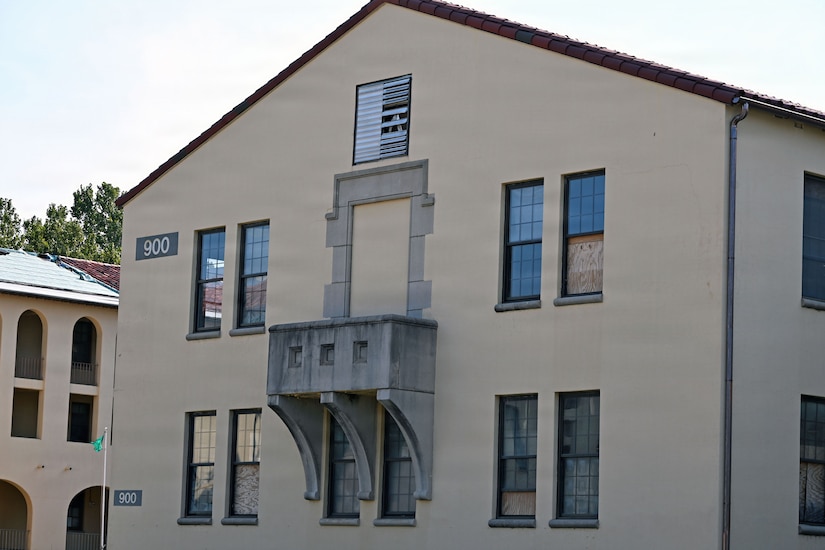
Built in 1939, ahead of World War II, Building 900 at
U.S. Army Garrison, Fort Sill, Oklahoma, looks much the same on the
outside as it did over eight decades ago.
The building features the same historic architecture as neighboring
buildings. But behind the historic facade, the U.S. Army Corps of
Engineers, Tulsa District, is overseeing and executing a high-tech
modernization project that will make this one of the most structurally
reinforced buildings on the installation.
As part of the military construction mission, USACE provides
engineering, construction and project management support for military
installations, helping deliver facilities that support readiness and
quality of life for soldiers. This construction project is transforming
the 43,000-square-foot building to meet current unaccompanied enlisted
personnel housing standards.
"This building has housed enlisted personnel and Marines for
decades," said Joe Krachinsky, quality assurance representative, USACE,
Tulsa District. "This project will completely change the layout of the
building to support today's needs."
The historic shell of the building will remain intact, but the
interior is being completely renovated and updated for modern living.
When the renovation is complete, the barracks will house 72 soldiers.
Each will have a private bedroom and bathroom, with two soldiers
sharing each kitchen. Each floor will also have new day rooms, common
areas and enhanced laundry facilities.
The building will have entirely new heating, ventilation and air
conditioning systems, lighting, fire alarms and sprinkler systems.
Aligning with the USACE mission to build faster, smarter and
together, engineers on the project are using innovative construction
methods to reinforce the aging structure.
"Because Fort Sill is located in a region known for severe weather,
the building is being designed to withstand tornadoes as well as seismic
activity," said Jessica Goodin, construction manager, USACE, Tulsa
District. "The reinforcement goes from the basement to the roof and
works as one interlocking lattice."
Engineers are retrofitting the existing building with a progressive
collapse design, a structural engineering approach that ensures
localized damage won't cause the entire building to collapse. The method
reinforces the existing structure, so losing a column does not cause a
significant portion of the building to collapse. Instead, the load is
redistributed to surrounding structural columns, allowing the building
to remain stable long enough for occupants to evacuate.
Shotcrete, a concrete mixture sprayed onto a surface at high
velocity, will be applied to the existing concrete structural system to
reinforce and strengthen it to meet the progressive collapse design
requirements.
"Building 900 marks the first use of progressive collapse design in
the district," Krachinsky said. "This project will also be the first use
of shotcrete on Fort Sill as a final protective coating."
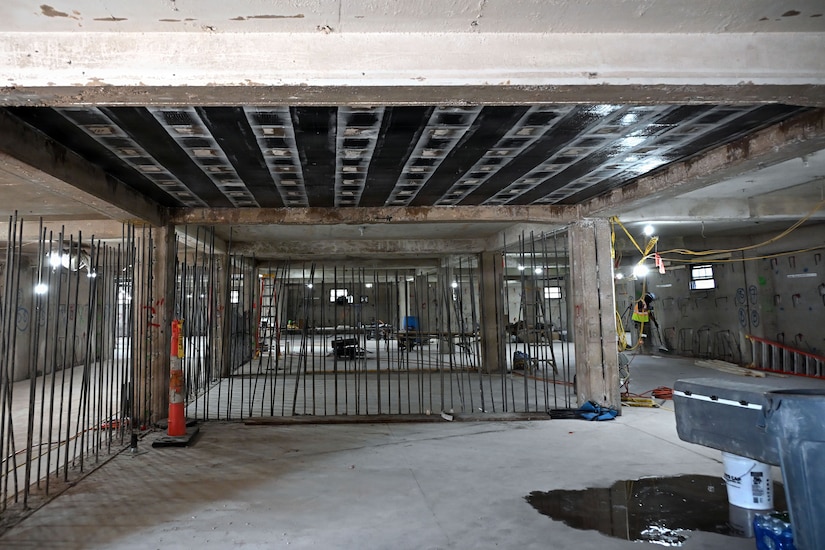
Concrete footings, steel and dowels establish a secure foundation.
Rebar is installed on each level, starting in the basement and fished
through holes drilled into the concrete, locking the floors to the
beams. Even the windows, a naturally weak point, are fortified with
steel plate headers, mounted studs and carbon fiber wraps so the rebar
can lock the walls and headers together.
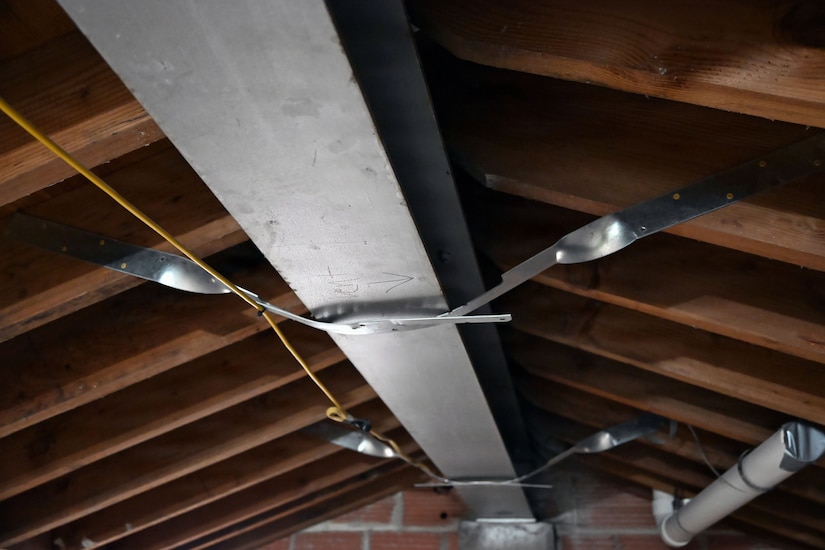
At the top of the structure, the team wrapped the roof trusses in
steel, reblocked them and reinforced them with three-quarter-inch
plywood and metal strapping to lock the roof to the beams.
To ensure structural integrity the team conducts rigorous pull tests
on the footings and the carbon fiber anchored to the walls and concrete.
Engineers use a hydraulic pump attached to floor rings or anchors to
test the load capacity of the wrapped beams and other structural
reinforcements, ensuring the building meets safety specifications.
By using technology and applying modern science and engineering to a
historic building's footprint, USACE is delivering a facility that
honors the history of Fort Sill and the Army while providing a safe,
modern home for the soldiers of today and tomorrow.





 Posts
Posts

