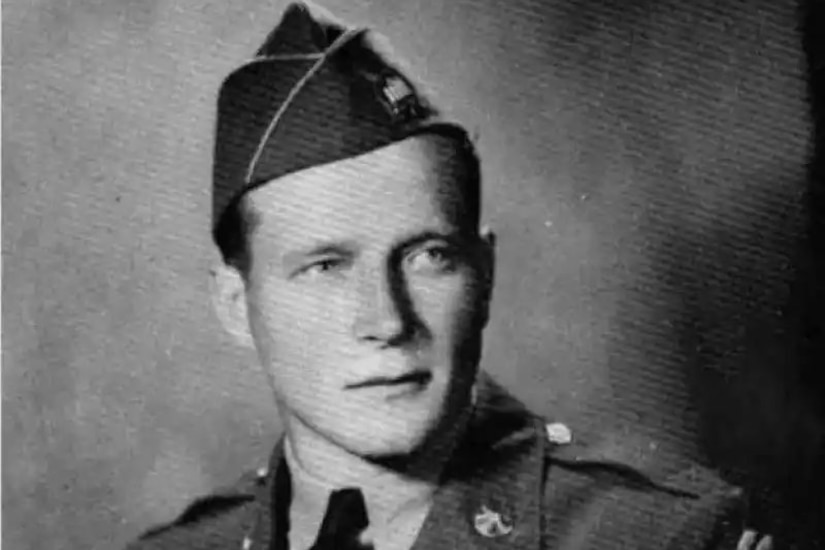
Army Staff Sgt. Stanley Bender was an infantryman
during World War II whose unwavering courage under extreme fire earned
him the Medal of Honor.
Bender was born to Andrew and Eva Bender Oct. 31,
1909, in Carlisle, West Virginia. His parents emigrated from the
Lithuanian region of Russia. His father was a World War I Army veteran
and a coal miner.
His brothers were John, Tony and George and his sisters were Maggie and Eva.
Bender attended school in Carlisle but dropped out after seventh grade.
The family moved to Chicago at the start of the Great Depression.
Bender worked as a truck driver for 10 years before enlisting in the
Illinois National Guard in December 1939. He also was a chauffeur for a
department store.
Bender married Esther Marie Tincher, April 9, 1945, and they had two daughters, Shirley Ann and Evelyn Marie.
His Medal of Honor action took place Aug. 17, 1944, near La
Londe-les-Maures, France. At the time, he was assigned to Company E, 2nd
Battalion, 7th Infantry Regiment, 3rd Infantry Division.
That day, Bender climbed on top of an inoperable tank in full sight
of the enemy to locate the source of the withering machine-gun fire that
had halted the advance of his company.
Although bullets ricocheted off the turret near his feet, he
nevertheless remained standing upright on the tank for more than two
minutes.
Locating the enemy machine guns on a knoll 200 yards away, Bender
ordered two squads to cover him and led his men down an irrigation
ditch, running a gauntlet of intense machine-gun fire that completely
blanketed 50 yards of his advance and wounded four of his men.
While the Germans hurled hand grenades at the ditch, Bender stood his
ground until his squad caught up with him, then advanced alone in a
wide flanking approach to the rear of the knoll.
Bender walked 40 yards, without cover, in full view of the Germans
and under a hail of enemy and friendly fire, to the first machine gun
and knocked it out with a single short burst. Then he made his way
through the strongpoint, despite bursting hand grenades, toward the
second machine gun, 25 yards away, whose two-man crew fired two bursts
at him. He walked calmly through the fire, reached the edge of the
emplacement and dispatched the crew.
Signaling his men to rush the rifle pits, Bender then walked 35 yards
further to kill an enemy rifleman and returned to lead his squad in the
destruction of the eight remaining Germans in the strongpoint.
Bender's audacity so inspired the remainder of the assault company
that the men charged out of their positions, shouting and yelling, to
overpower the enemy roadblock and sweep into town, knocking out two
antitank guns, killing 37 Germans and capturing 26 others.
He led the assault company in an attack that overwhelmed the enemy,
destroyed a roadblock, took a town, seized three bridges over the
Maravenne River and captured commanding terrain dominating the area.
What makes his feat even more incredible is that he was 35, one of the older soldiers.
Prior to fighting in France, he participated in Operation Torch in
North Africa in 1942, the invasion of Sicily in 1943, and the invasion
of Italy and liberation of Rome in 1944. His highest rank was technical
sergeant, equivalent to an E-7 in World War II-era rankings.
After Aug. 17, 1944, he continued with his unit, fighting in France and then in Germany until the war's end in 1945.
Army Lt. Gen. Alexander M. Patch III, commander of the Seventh Army,
presented the Medal of Honor to Bender in France on Jan. 21, 1945. He
was honorably discharged on May 19, 1945.
After the war, Bender worked for the Veterans Administration in
Beckley, West Virginia. He was a member of the American Legion and
Veterans of Foreign Wars, advocating for veterans' benefits.
He died June 22, 1994, and is buried in High Lawn Memorial Park in
Oak Hill, West Virginia, along with his wife, who died in 2006.
The Stanley Bender Memorial Bridge on the West Virginia Turnpike was
named in his honor Nov. 9, 1954. It was later demolished as part of a
highway realignment project. A second bridge on the West Virginia
Turnpike was named for him in 1987.
There is also a Sergeant Stanley Bender Bridge in La
Londe-les-Maures, France, close to where his Medal of Honor action
occurred.
Bender, along with legendary Air Force Col. Chuck Yeager,
participated in a June 1963 Centennial Day parade in Charleston, West
Virginia.
The Darius-Girėnas American Legion Post dedicated a memorial to
Bender in the Brighton Park area of Chicago. He was a member of that
post following the war.
His Medal of Honor is on display at the West Virginia State Museum in Charleston, West Virginia.




 Posts
Posts

