Wednesday, November 04, 2026

Centcom Benefits From Project Agincourt, Drone Dominance Efforts

So far this year, frontline troops in the U.S. Central Command area of responsibility have received more than 25,000 unmanned aerial systems and counter-UAS  to help them better execute their mission.  

The Direct Reporting Portfolio Manager for Unmanned Systems, responsible for delivering those one-way attack vehicles — air, surface and subsurface waterborne vessels — was created in response to President Donald J. Trump's and Secretary of War Pete Hegseth's focus on drone dominance.   

The DRPM-UxS stood up in July, bringing together the existing Joint Interagency Task Force 401, the War Department Innovation Unit and the Defense Autonomous Warfare Group. Its ongoing goal is to rapidly accelerate the development, procurement and fielding at scale of autonomous capabilities essential to maintaining a decisive military advantage.

A five-sided building sits amid highways, waterways and parking lots.

"Under Secretary Hegseth's direction, we are moving at the speed of modern combat to equip our forces with decisive, affordable mass," said Owen West, DRPM-UxS director. "DRPM-UxS was established to cut through red tape and put lethal technology directly into the hands of our frontline troops. The thousands of systems operating across Centcom this year are just the beginning. We will out-innovate, outbuild and out-adapt any adversary on the battlefield. The goal is to scale these capabilities across the joint force." 

This year, with an investment of approximately $782 million, DRPM-UxS has fielded over 1,300 one-way attack UAVs and more than 100 unmanned surface and underwater vessels to Centcom. 

Additionally, through its Joint Interagency Task Force 401, DRPM-UxS has fielded more than 24,000 counter-UAS to establish a multilayered defensive shield that protects deployed forces against adversary drone attacks. 

Just four months in, DRPM-UxS has demonstrated its success by providing Centcom with inexpensive, attritable unmanned systems it can use to fight and win on the battlefield.  

But in September, Hegseth broadened DRPM-UxS' mission with an additional task: Project Agincourt, an initiative to stand up the Autonomous Warfare Command. Led by West and Navy SEAL Senior Chief Max Strasiser, DRPM-UxS chief operating officer, the project creates a pathway to establishing a new four-star functional combatant command that will lead the joint force in unmanned autonomous warfare. 

Last month, West and Strasiser sent an open letter to industry partners laying out the vision for Autowarcom, expected to stand up by Oct. 1, 2027. 

"We are on the clock," the letter said. "In service of Autowarcom, Agincourt must quickly remove the barriers that constrain the initiative of our service members by fusing operations and development. ... If we get this right, we will do more than establish a new command. Autowarcom will institutionalize a mission-based system whose main product is adaptation, building a next-generation development model for sustained American military advantage." 

Over the past year, the department has invested more than $6 billion in unmanned systems to accelerate capabilities across air, land and maritime domains. 

The department also embarked on an effort to entice industry partners to manufacture about 300,000 low-cost drones through a series of four "gauntlets." In the first of four gauntlets, which ended in July, 12 vendors were asked to collectively produce 30,000 drones at $5,000 per unit, totaling $150 million.  

The department is currently executing the second gauntlet, which is scheduled to end in January. Ten vendors are participating, and the government will purchase about 60,000 units at $5,000 each. By the end of the fourth gauntlet, which ends in January 2028, the number of drones ordered will increase from 30,000 to 150,000, and the price per drone will drop from $5,000 to $2,300. 

By establishing a stable demand signal for unmanned systems, the War Department hopes to entice American manufacturers to invest in and increase their unmanned systems manufacturing capacity.

DRPM-UxS Deliver Over 25,000 Autonomous and Counter-Unmanned Systems to CENTCOM AOR

The Department of War announced today that this year, the Direct Reporting Portfolio Manager for Unmanned Systems (DRPM-UxS) has delivered a massive surge of combat-ready, mass-producible unmanned systems and counter-drone capabilities to U.S. Central Command (CENTCOM), providing operational commanders with immediate, cost-effective tactical lethality across the theater.

Through an investment of approximately $782 million this year, DRPM-UxS has fielded:

  • Over 1,300 One-Way Attack (OWA) Unmanned Aerial Vehicles (UAVs), providing precision deep-strike mass.
  • Over 100 Unmanned Surface Vessels (USVs) and Unmanned Underwater Vessels (UUVs), expanding maritime reconnaissance and strike lethality; and
  • More than 24,000 Counter-Unmanned Aerial Systems (C-UAS), establishing a dense, multi-layered defensive shield to protect forward-deployed forces against adversary drone attacks through its counter unit, Joint Interagency Task Force 401 (JIATF-401).

These deliveries demonstrate the Department's rapid shift from multi-year developmental pipelines to an agile "Warfighting Acquisition" model. In the hands of American warfighters, these low-cost, attritable systems serve as high-volume alternatives to legacy, multi-million-dollar exquisite munitions—flipping the battlefield cost-exchange ratio firmly in favor of the United States.

"Under Secretary Hegseth's direction, we are moving at the speed of modern combat to equip our forces with decisive, affordable mass," said Owen West, CEO of Project Agincourt and DRPM-UxS. "DRPM-UxS was established to cut through red tape and put lethal technology directly into the hands of our frontline troops. The thousands of systems operating across CENTCOM this year are just the beginning. We will out-innovate, out-build, and out-adapt any adversary on the battlefield. The goal is to scale these capabilities across the Joint Force."

By scaling commercial production lines and deploying modular software baselines, DRPM-UxS is driving a fundamental restructuring of defense procurement. This effort serves as the operational foundation for the Autonomous Warfare Command (AUTOWARCOM), a planned four-star functional combatant command scheduled to stand up by October 1, 2027.

At Secretary Hegseth's direction, DRPM-UxS will sustain continuous deliveries of low-cost, mass-producible unmanned and autonomous systems to CENTCOM while rapidly expanding fielding pipelines to Pacific Command, European Command, and the broader Joint Force.

Readout of November 2026 U.S.-China Crisis Communications and Prevention Working Group

Nov. 3, 2026

On November 2-3, Ms. Cynthia "Xanthi" Carras, Principal Director for China, Taiwan, and Mongolia in the Office of the Under Secretary of War for Policy, met with Senior Colonel Wang Wei, Deputy Director of the People's Liberation Army (PLA) Office of International Military Cooperation's Americas and Oceania Affairs Bureau, in Washington, D.C., for the annual Crisis Communications and Prevention Working Group. 

Principal Director Carras and Senior Colonel Wang agreed on the importance of advancing practical communication measures to reduce the risks between the United States and China. The working group also discussed additional channels to promote effective crisis management and ways to expediently and effectively communicate.

The Department of War will continue to advance discussions with the PLA on key defense issues in the coming months.

U.S., Colombia Launch Joint Exercise to Strengthen Readiness, Regional Security

A military helicopter transports a large bucket of water over a wildfire in the jungle; smoke rises from the jungle below.

The U.S. and Colombian armies officially launched Exercise Southern Vanguard 2027 during a ceremony in Tolemaida, Colombia, Nov. 2, bringing together approximately 800 military personnel to strengthen interoperability, readiness and bilateral security cooperation. 

The 41st iteration of the annual exercise is hosted by the Colombian National Army, sponsored by U.S. Southern Command and led by U.S. Army Western Hemisphere Command. 

The exercise, which is scheduled to run until mid-November, aims to strengthen soldiers' skills, improve their ability to operate together in challenging environments and enhance mutual readiness. Colombia's role as host underscores the importance of the U.S.-Colombia security partnership and regional military cooperation. 

"Our partnership extends far beyond the formations assembled on this field here. It is institutional [and] professional, and it is enduring," said Army Brig. Gen. Peter L. Gilbert, U.S. Army Western Hemisphere Command deputy chief of staff. "This is how we turn cooperation into readiness." 

Following the opening ceremony, U.S. and Colombian soldiers conducted combined training focused on jungle exercises and counter-improvised explosive device tactics. 

The exercise also included a command post and field training exercise, with broader training objectives spanning maritime interdiction, ground security, cyber defense and interagency cooperation. These activities promote knowledge-sharing, strengthen interoperability and improve combined readiness. 

"I extend a warm and fraternal greeting to all officers, noncommissioned officers, soldiers and international partners participating in the Southern Vanguard 2027 exercise," said Colombian National Army Brig. Gen. Edilberto Cortés, chief of the force generation staff. "This presence demonstrates the shared commitment of our nations to strengthen collective readiness and consolidate the ties of cooperation that support our strategic and historical relationship." 

Building on more than 200 years of diplomatic relations, the United States and Colombia continue to strengthen their military partnership through combined training and professional knowledge-sharing. Exercise Southern Vanguard aims to improve readiness, reinforce interoperability, and support peace, stability and security across the Western Hemisphere. 

Pentagon Official Discusses Forthcoming Review of Military Legal System

A special review panel will assess and recommend improvements to the War Department's military legal system while also honing the judge advocate general corps' warfighting skills, according to a Pentagon official with knowledge of the matter. 

In a May 8 memorandum to senior Pentagon leaders titled "Departmental Review of the Military Legal System and its Impact on Service Members," Secretary of War Pete Hegseth directed the War Department's general counsel to convene a special  panel to "conduct an ongoing, long-term, departmentwide review of all aspects of the military legal system, particularly as it affects service members." 

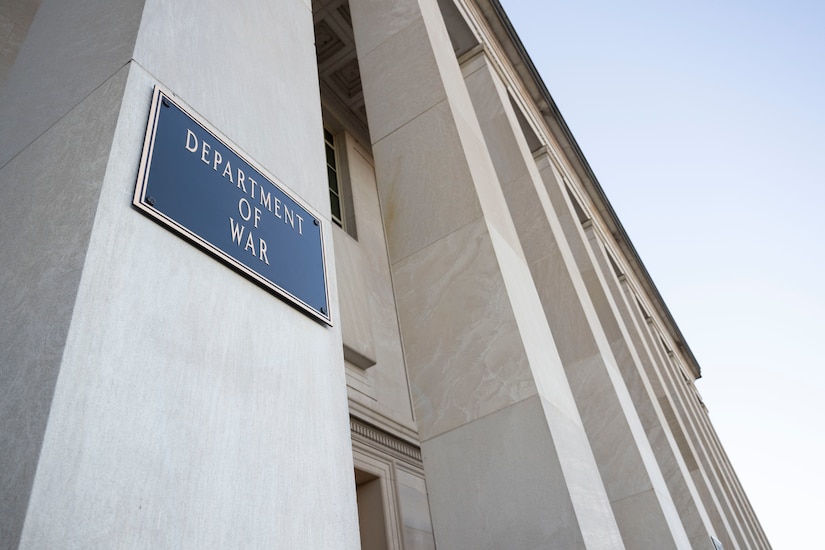
A rectangular metal plaque that reads "Department of War" is mounted on a large stone column at the entrance of a large building. Other, identical stone columns are lined up at regular intervals next to the column with the plaque.

Hegseth charged the panel with identifying innovative ways to cut unnecessary bureaucracy, strengthen judge advocate training and organizations, and refine the judge advocate culture to be more effective and trusted throughout the services.  

The goal ultimately is to develop the highest standards of professionalism in military legal practice, the delivery of command advice and the delivery of legal services throughout the uniformed communities. 

"I do not recall any other time the department has done this kind of comprehensive review internally, where we're looking across all services, comparing and contrasting operations, with the goal to implement best practices from each of the respective services," the official said. 

"Our service members deserve the best legal services available, and part of this process is to assess all aspects of the military legal system to see what we can do better," the official continued. 

The panel will assess how each service's judge advocate general corps operates and identify areas for improvement from an organizational perspective, across the department. Unlike past legal review panels, the memo says this panel will "operate on a sustained basis rather than producing a single, end-of-review report." 

The official explained that the review will be ongoing; as the lines of effort begin, the panel will build based on the data received.  

"As soon as the panel comes up with recommendations, those will be forwarded to the general counsel, then onto [Hegseth] for potential implementation," the official said, adding that all recommendations the secretary signs will be implemented as soon as possible. The panel will comprise highly qualified legal professionals competitively selected from each service's judge advocate general corps. 

Once selected, the panel members will "perform a comprehensive evaluation of all service programs and practices, rigorously compare them across the services, benchmark them against other outside organizations like the various federal and state prosecution and defense organizations, and develop concrete recommendations to improve training, organization, culture and overall performance," according to the memo. 

"This is a holistic assessment of these organizations. … And hopefully, a holistic approach will get us to long-term solutions to improve the military legal system for long-term success," the official said. "We are seeking to drive innovation and improvements in our military legal system to help meet [Hegseth's] ultimate goals of reviving the warrior ethos, restoring trust in our military, rebuilding the military and reestablishing deterrence."

The duration of the review will be determined by how the lines of effort progress, not only in the review phase but also in the implementation of approved changes.

From Vietnam to Afghanistan: A Vermont Guard Member's Lifetime of Service

A man in casual attire smiles and poses for a photo as he pretends to board a military helicopter on a flight line.

"At midnight, it was time to move," said retired Army Sgt. 1st Class Pete Ferrell, recalling a night in Afghanistan.

He gripped the handle of one of the four corners of a field stretcher carrying a wounded soldier. A tray of medical equipment on the soldier's chest chirped as it monitored vital signs and sustained him. The team of four soldiers locked step, carrying the patient onto a plane bound for a higher level of care.

As the plane transporting the wounded soldier took off, Ferrell found himself on the same runway at Bagram Airfield where the deployment began months earlier. There, at the feet of the towering Hindu Kush mountain range, four decades and nearly 3,000 miles stood between him and the jungles he hovered over in a UH-1 Huey helicopter in Vietnam during his first combat tour.

In 2010, at age 62, Ferrell secured an age waiver and volunteered for the deployment to Afghanistan with the Vermont Army National Guard's 86th Infantry Brigade Combat Team.

A man in a camouflage military uniform carries a weapon strapped across his body and smiles for a photo.

"He always seeks something bigger than himself to be part of; that's just who Pete is," said Army Maj. Beth Carrier, a physician assistant assigned to the New Hampshire Army National Guard, who deployed to Bosnia with Ferrell in 2002, when she was a flight medic. "I can only hope that somewhere in my life that I am a fraction as good of a human as he is."

For many, it's hard to imagine that the Vietnam veteran, who flew over 250 combat hours as a Huey crew chief and survived being shot down in Laos, felt he owed more.

"I never got wounded or had PTSD; I was still capable, and I felt I still had to do more," Ferrell said.

When he arrived in Da Nang, Vietnam, in 1970 as a helicopter mechanic, he was assigned to the night maintenance shift in a hangar. It was far from the excitement of flying he had imagined as a child growing up in Braintree, Massachusetts, watching planes take off and land at the airport and flying his own model aircraft. So, he went to his platoon sergeant and asked for a flight platoon assignment.

A few days later, the platoon sergeant told him to shadow another soldier who showed him how to do daily maintenance on a Huey.

"Then he says, 'OK, that one's yours,'" Ferrell recalled. From then on, the 22-year-old specialist was now in charge of his own helicopter.  

"We learned a lot about maintenance in training, but overseeing a whole aircraft was a lot of responsibility," he said.

But along with the added responsibility, he also got his childhood wish.

"When the aircraft flew, you went with it," he said. 

Ferrell said he mostly flew "ash and trash missions" — lift missions that could include transporting anything from troops to supplies to mail.

However, about three months before his tour ended, his unit was selected for Operation Lam 719, a highly contested two-month offensive where they flew South Vietnamese troops into southeastern Laos. The objective was to disrupt North Vietnam's military supply network on the Ho Chi Minh Trail.

Ferrell said he knew this mission was not routine; the danger felt so imminent that he prayed.

"I started out saying [Psalm 23] when we took off on the first three sorties, and by the fourth one, I must have gotten too comfortable," he said. "One pilot said to the other, 'Stay tight to this hill,' and he no sooner said that, and the windshield for the aircraft was blown out."

The aircraft crashed, but Ferrell and the rest of the crew survived.

"Somebody started yelling, 'Come on, come on!'" he said, adding that another aircraft had landed nearby, and they all started running to it. "I grabbed my M16 and started tromping through the jungle, and we all got on the other aircraft and flew out."

An older photo depicting a young man in a flight suit leaning on a military helicopter

It wasn't until Ferrell was on the plane flying home from Vietnam with a ream of military records that he realized he had received 10 Air Medals for his combat flight hours; he received an Air Medal with Valor for the mission on which he was shot down.

Ferrell finished his active-duty service in 1973 and settled into civilian life. He married Deb, the woman he exchanged letters with throughout the war, and they moved to Vermont, where they had their first son.

Then, in 1981, he heard a familiar sound and looked up in the Vermont sky, where he saw Hueys overhead. Ferrell said he knew he had to track them down. He found them at a Vermont Army Guard aviation unit hangar in Burlington.

"I walked in, and there were 12 Hueys there, and it was like a homecoming. I was home again," he said.

Ferrell met with a flight platoon sergeant who eased his fears that joining the National Guard might mean sweeping floors instead of maintaining and flying aircraft.

With that, Ferrell reenlisted and was back to working on Hueys.

In 1998, his unit transitioned to the UH-60 Black Hawk helicopter and assumed a medevac mission. Ferrell was hesitant about learning a new aircraft and mission until he teamed up with Carrier, a 20-year-old specialist so passionate about her role as a flight medic that she inspired him.

"She taught me that it was all about saving lives, and there's no better mission than that," he said.

Ferrell didn't come around right away, though, Carrier said, adding that he refused to do medical training, insisting his job as the crew chief didn't require it. However, he changed his tune after they transported a soldier with severe appendicitis — their first real-world patient in Bosnia.

After the mission, Ferrell told Carrier that her ability to help the soldier had captivated him, but he admitted he felt helpless to assist.

"He completely did a 180 on the entire idea of not touching a patient. It was a 100% adjustment of his thought process," she said. "From then on, he wanted to do all he could, asking, 'What can I do? What can I learn? What can you teach me so I can help you?'"

In turn, Ferrell used his aircraft knowledge to help Carrier better set up her medical gear to deliver care more expediently. She took these lessons with her when their careers parted ways. Carrier deployed to Iraq, was commissioned as an officer and went on to study medicine.

The two remained close. Ferrell was the "man of honor" at her wedding, which required him to wear a raspberry-pink shirt for the occasion.

"I always knew, with him, I was well protected. On the hoist, he could drop me on a dime. I always knew that the aircraft that we were on was the safest that it could possibly be. That was because of Pete's work ethic," Carrier said.

When Ferrell returned from the Bosnia deployment, changes in the aviation unit led him to move on from aviation. Eventually, he was assigned to the Vermont Army National Guard's 86th Infantry Brigade Combat Team headquarters, which led to his 2010 Afghanistan deployment.

When Ferrell told his wife and sons about volunteering for the deployment, he said they were the only people in his family who didn't think he was crazy.

"It's just a part of who he is, and it's how they [his sons] always knew their father," his wife said. "So, it was just, he's going to be gone for a while, but he'll be back, and we will, as we say, improvise, adapt, and overcome."

When Ferrell arrived in Afghanistan, his daily duties at the headquarters company kept him mostly at Bagram, but as he had throughout his career, he felt he still had more to give.

A man in casual attire smiles for a portrait outside; a military helicopter is in the distance.

One night he stumbled upon it while sitting in the base's operations center. A major from another section told him he had a mission at the airfield. Ferrell's interest was piqued. It turned out that the officer had inadvertently found Ferrell another medevac mission: transferring wounded patients from the field hospital to facilities with higher levels of care.

"You know, like Beth [Carrier] had taught me, saving lives is the greatest mission there is, and that is what it was," he said. 

He began stopping at the hospital every day after his shift to ask if volunteers were needed that night, but he never mentioned his side quests to anyone in his unit until years later. Ferrell continued the late-night missions until he returned home from Afghanistan just before Christmas 2010.

By then, he was 63 years old, three years past the standard mandatory retirement age.

Ferrell finally retired from the military in 2011, with 33 years of service.

"You get home from Vietnam, you realize how many men were lost and how many were wounded, and you think, 'Why me? Why did I survive?'" he said. "You figure out that there is a plan here, so you have to go with it. You take it as the blessing that you were saved for a reason. I can look back now and say that this is where God was pointing me."