President Donald J. Trump today announced the Navy's intent to develop a new class of American-designed, 30,000 to 40,000-ton large surface combatants, or battleships, that will be employed to meet the realities of modern maritime conflict.
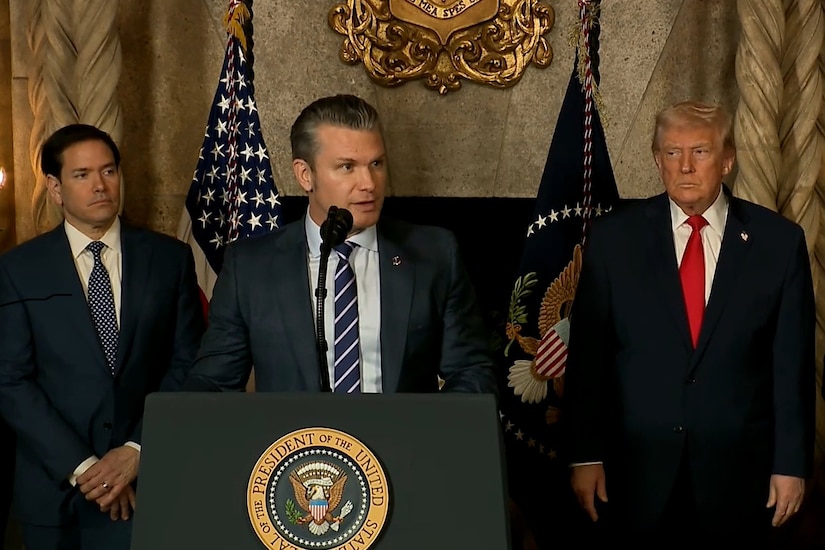
"As commander in chief, it's my great honor to announce that I have approved a plan for the Navy to begin the construction of two brand-new, very large — largest we've ever built — battleships," Trump announced from his Mar-a-Lago residence in Palm Beach, Florida. He was joined by Secretary of State Marco Rubio, Secretary of War Pete Hegseth and Navy Secretary John Phelan.
The new Trump-class of ships — which the president said will contribute to a new "golden fleet" of advanced warships — are currently in the design phase, with construction of the first battleship, the USS Defiant, targeted for the early 2030s.
Phelan said that the new class of battleship is something the Navy "desperately needs." The president noted that the Navy aims to have a fleet of 20 to 25 ships eventually.
"The future Trump-class battleship, the USS Defiant, will be the largest, deadliest and most versatile and best-looking warship anywhere on the world's oceans," Phelan said, adding that he wanted to thank the president for his vision to make the future battleship a game-changing capability for the U.S. Navy.
Phelan also compared the future Trump-class battleships to the former Iowa-class battleships, which were a cornerstone of the Navy's warship fleet for much of the 20th century.
"The Iowa was designed to go on the attack with the biggest guns, and that's exactly what will define the Trump-class battleships: offensive firepower from the biggest guns of our era," Phelan said.
"This ship isn't just to swat the arrows; it is going to reach out and kill the archers," he added.
During his remarks, Hegseth said that strengthening the Navy's fleet ties directly to the War Department's key goals of restoring the warrior ethos, rebuilding the military and reestablishing deterrence.
"American strength is back on the world stage, and the announcement of the golden fleet anchored by new battleships — the biggest and most lethal ever — accomplishes all three of those things and marks a generational commitment to American sea power across the entire department," Hegseth said.
During the announcement, Trump made clear that the new battleships are intended to be constructed entirely in the U.S. by American citizens.
"The construction will create thousands of American jobs. We're going to have the jobs be created," he said.
Along with standard guns and missiles, Trump said the new battleships will be equipped with hypersonic weapons, electronic rail guns and high-powered laser-based weaponry.
He added that the Navy will take the lead in the ships' design, while partnering with the U.S. defense industrial base.
"We're going to make battle groups great again, and this is just one piece of the president's golden fleet that we're going to build with the investments," Phelan said.
The new Trump-class battleships will replace the Navy's previous plans to develop a new class of destroyer, the DDG(X). However, the sea service intends to incorporate the capabilities it had planned to employ on that platform into the new Trump-class ships.
The last time the Navy used battleships in combat was in 1991 during the first Gulf War, when the now-decommissioned Iowa-class battleships USS Missouri and USS Wisconsin provided naval gunfire support against Iraqi targets along the coast of Kuwait.
Today's announcement of the Trump-class battleships comes on the heels of the Navy's Dec. 19 announcement of the FF(X), a new class of frigates intended to replace the Navy's recently cancelled Constellation-class frigate program.









 Posts
Posts

