Monday, June 15, 2026

Army Marksmanship Unit Marks 70 Years of Precision, Innovation, Service

The U.S. Army Marksmanship Unit was officially established Feb. 16, 1956 — an event that would shape the trajectory of American marksmanship for generations. 

Seventy years later, the unit stands as the Army's premier authority on marksmanship training, small-arms expertise and competitive excellence. Its legacy is defined not only by medals and records, but also by its enduring impact on Army readiness, research, doctrine and lethality. 
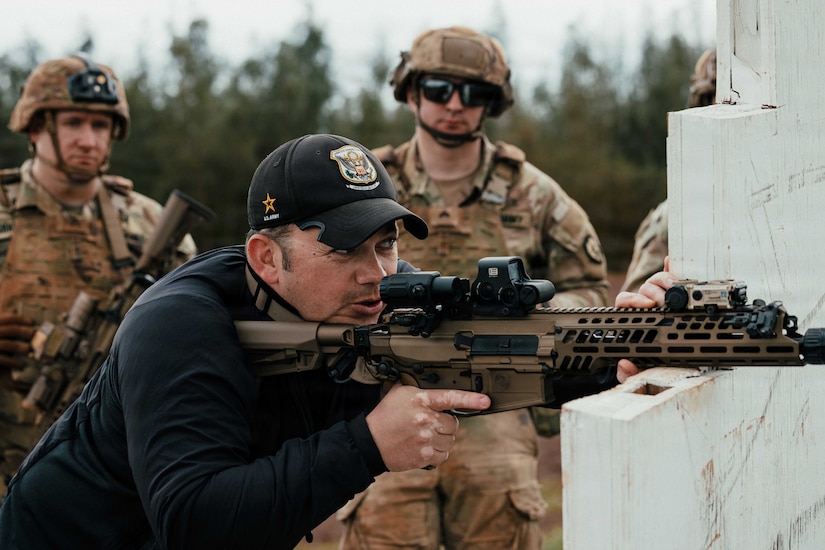
A man wearing casual attire and a baseball cap aims a rifle while propping it on top of a wooden post; there are three men dressed in camouflage military uniforms observing in the background.

The unit's founding purpose was clear from the beginning. In a Nov. 17, 1955, letter to Army Chief of Staff Gen. Maxwell D. Taylor, Army Gen. John E. Dahlquist, commander of the Continental Army Command, set the foundation for the unit's creation. 

"In proportion to its resources, Army leadership in the field of competitive marksmanship on national and international scales should be absolute and unquestioned," Dahlquist wrote, adding that, at the time, there was a perception the Russian army could shoot as well as their Olympic team and could outshoot all other armies. 

Dahlquist wrote that impression needed to be eliminated by the U.S. Army winning international rifle and pistol competitions.  

As the unit developed, its mission expanded. In a Sept. 23, 1991, letter, Army Vice Chief of Staff Gen. Edwin H. Burba Jr. emphasized the importance of marksmanship. 

"The proficient use of individual service weapons is the most important skill of the soldier," Burba wrote. "The U.S. Army Marksmanship Unit is the [U.S. Army Forces Command] standard bearer for effective marksmanship training."  

That vision has guided the unit for seven decades, shaping it into the only organization of its kind within the Army. That founding vision quickly evolved into a broader mission that continues to define the unit today. 
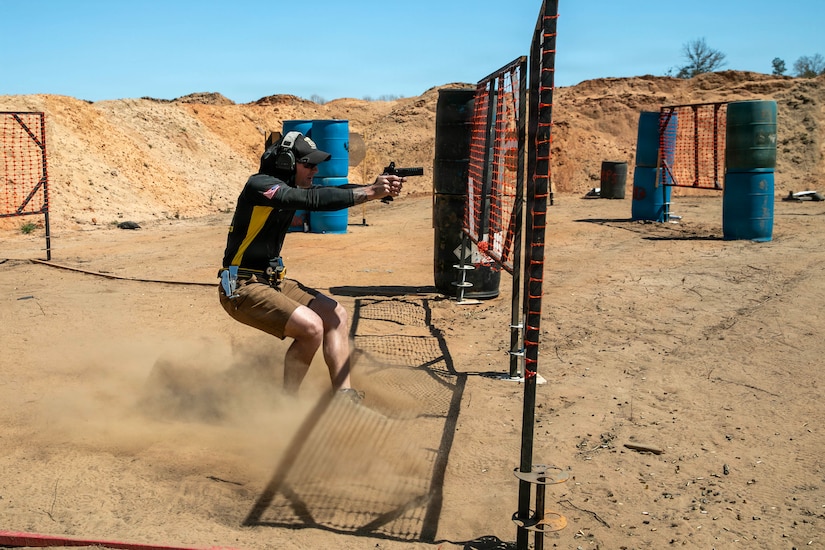
A man wearing casual attire fires a pistol on a training range as dust is kicked up around his feet; there are mounds of dirt and obstacles in the background.

The unit's competitive, training and research missions make it a singular asset. Its competitive teams serve as a real-world test bed, validating training techniques and materiel solutions that shape Army doctrine, small-arms development and lethality initiatives. Since the 1950s, the unit has supported major small-arms programs across the War Department, Justice Department and Department of Homeland Security, often providing technical expertise, hand-loaded ammunition and rapid development capability. 

Supporting Research Across the Army  

For more than 30 years, the unit has partnered with key Army research centers to produce several notable advancements, including: 

  • 6.8 mm reduced-range ammunition — cutting surface danger zones by 40–50%. 
  • Sniper propellant testing — identifying reliable American-made alternatives during supply chain disruptions. 
  • Shock-absorbing concrete testing — supporting shoot-house material evaluation. 

These efforts, along with the unit's contributions to the next-generation squad weapon, reinforce the unit's role as a technical enabler for Army modernization. Beginning in 2012, unit engineers helped shape future small-arms requirements and delivered developmental cartridge concepts that informed the Army's ballistic direction.  
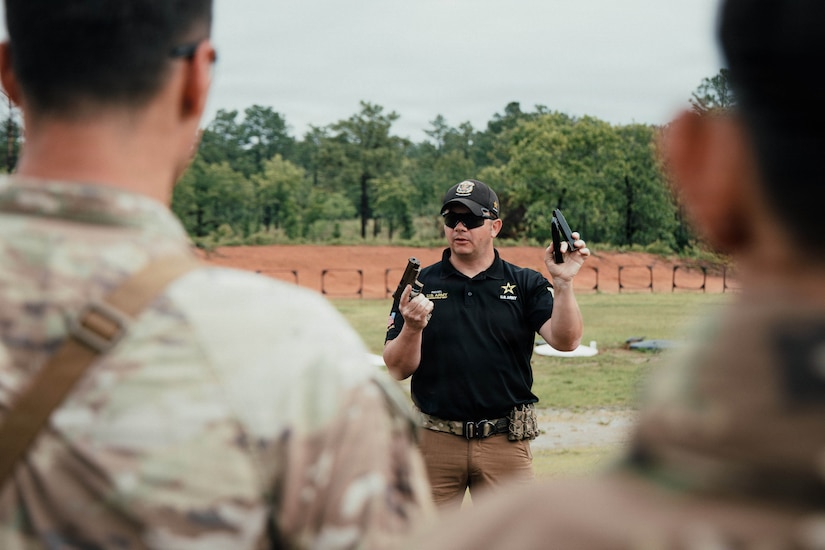
A man wearing casual attire and a baseball cap holds up a pistol and two ammunition magazines as he talks to people dressed in camouflage military uniforms in the foreground.

Between 2019-2021, unit soldiers and civilians supported multiple phases of the next-generation squad weapon evaluation, including sampling, training support, mobility assessments, user feedback and fire-control system input. Today, the unit continues to support fielding and user training across the force. 

Driving Innovation Through Competition  

Competition has always been central to the unit's identity. Beyond medals, these events serve as a proving ground for new ideas. Innovations first tested by unit soldiers have later appeared in the special operations community, including: 

  •  .277 USA and .264 USA cartridges — influencing the Army's adoption of the 6.8 mm combat caliber. 
  • Lightweight intermediate caliber cartridge rifle development — early versions produced by the unit. 
  • .375 EnABELR sniper system — increasing first-round hit probability at extreme distances. 

Another part of the unit's mission is marketing, which involves conducting marksmanship clinics, supervising interservice shooting competitions, maintaining excellence in competition records, representing the Army in national and international events and supporting public engagements. 

Training the Force  

The unit's most enduring contribution is training soldiers. Each year, the unit conducts about 80 training missions, providing hands-on instruction to more than 4,000 soldiers and influencing tens of thousands more. The training has led to 40% increases in lethal hit rates and 50% improvements in marksmanship fluency, delivered at a cost of about $200 per soldier. 
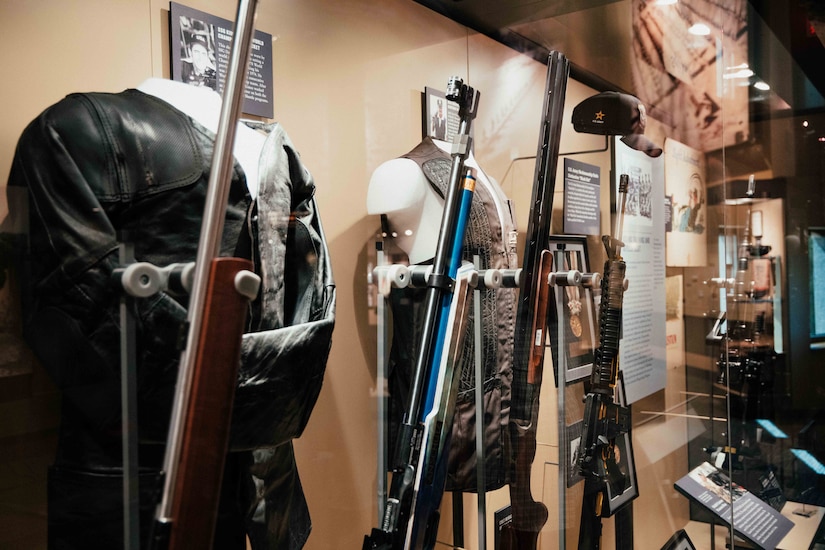
Old uniforms and rifles are on display inside a glass case.

In 2024, Marine Corps Col. James Rose, Marine Raider Regiment commanding officer, praised the unit's support, noting its unmatched instruction and direct impact on sniper lethality. 

Over the past three years, the team has worked with the Department of Tactics, Training and Doctrine to refine small-arms doctrine. The unit also authored the "Small Arms Gold Book," a companion reference supporting the Integrated Weapons Training Strategy. 

Advancing Soldier Lethality Through Science  

Unit soldiers frequently serve as test subjects in biomechanical and physiological studies comparing novice and expert shooters. Recent findings showed expert shooters were 18% more accurate, 50% more stable and 35% slower in rotational movement. 

These insights help shape training techniques across the Army. 
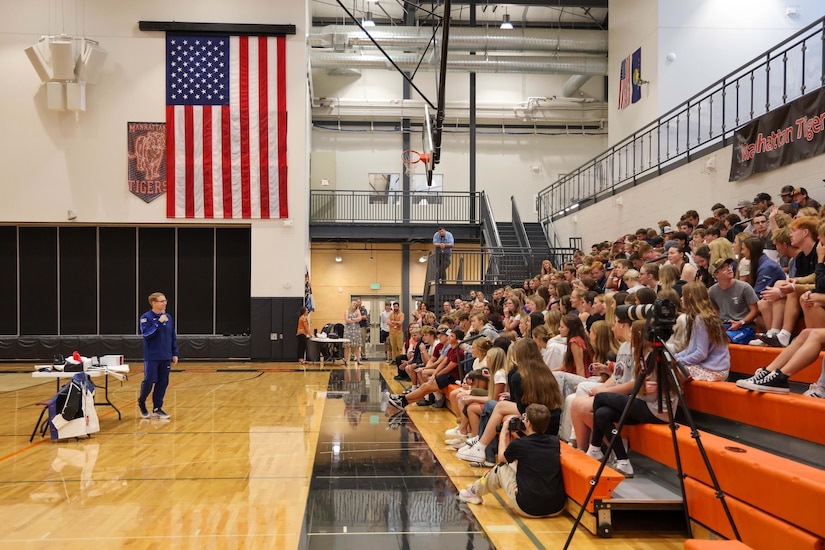
A man wearing athletic attire speaks to dozens of kids seated on the bleachers inside a gym; there is a large American flag hanging from a wall in the background.

From its founding in 1956 to its 70th anniversary, the unit has remained the Army's premier authority on marksmanship. Its influence spans competitive shooting, soldier training, small-arms development, doctrinal refinement and cutting-edge research.  

As the unit enters its eighth decade, its mission remains unchanged and more vital than ever: advancing marksmanship, empowering the warfighter and ensuring the Army maintains its competitive edge.

Warrior Games Week Marks New Chapter for Army Veteran

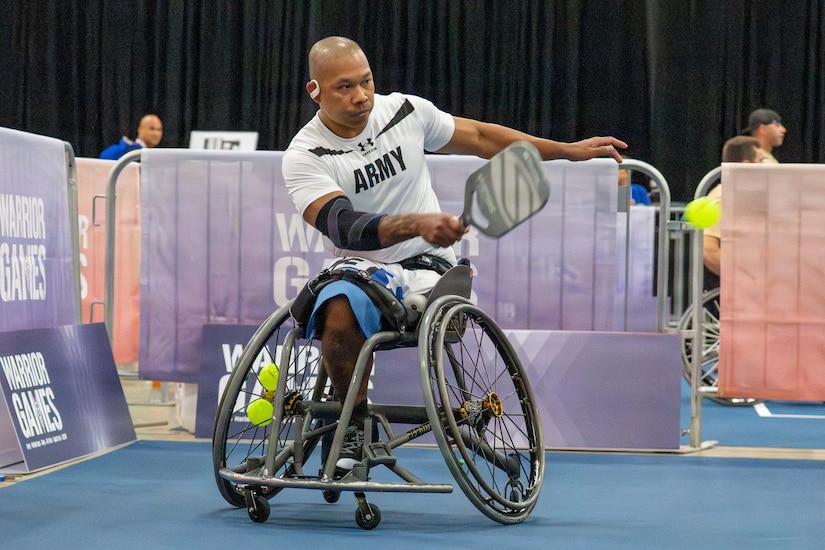
When retired Army Staff Sgt. Gene Calantoc lost his leg in 2020, he was introduced to adaptive sports and competed in the 2024 Warrior Games. Now, two years later, he's back as a stronger competitor. 

During his first games, Calantoc said he was still learning how to move through adaptive sports with speed, skill and confidence. This year, competing with Team Army at the 2026 Warrior Games, he returned with experience, a stronger voice on the basketball court and a deeper understanding of what recovery can become when family, teammates and purpose move with him.  

A man in athletic attire sits in a wheelchair and swings a pickleball racket.

Calantoc served 10 years in the Army, and in 2020, his life changed following a motorcycle accident that resulted in the loss of his left leg. His recovery began during the height of the COVID-19 pandemic, making an already difficult journey more challenging for him and his family.  

In 2024, Calantoc was assigned to a Soldier Recovery Unit at Brooke Army Medical Center in San Antonio, which is where he was introduced to adaptive sports. 

"I was quick and fast with my wheelchair, but I didn't know the game," he said. 

Since then, Calantoc has continued to play wheelchair basketball with the San Antonio Spurs and has attended adaptive sports camps to sharpen his skills. The added experience helped him become more vocal, confident and intentional during competition.  

"Now, I know what to do on the court," he said. "It's a lot of communication and knowing your role."  

His wife, Miho Calantoc, said the difference between 2024 and 2026 is visible. 

"He's less nervous than he was when he first competed," she said. "He's more verbal and communicates more with the team. He takes initiative in making sure the team is together."  

For Calantoc, adaptive sports have become more than competition. They help him stay active, connected and focused. His motto — "Stay true. When life knocks you down, rise stronger and keep moving forward" — reflects the mindset he continues to carry through recovery.  

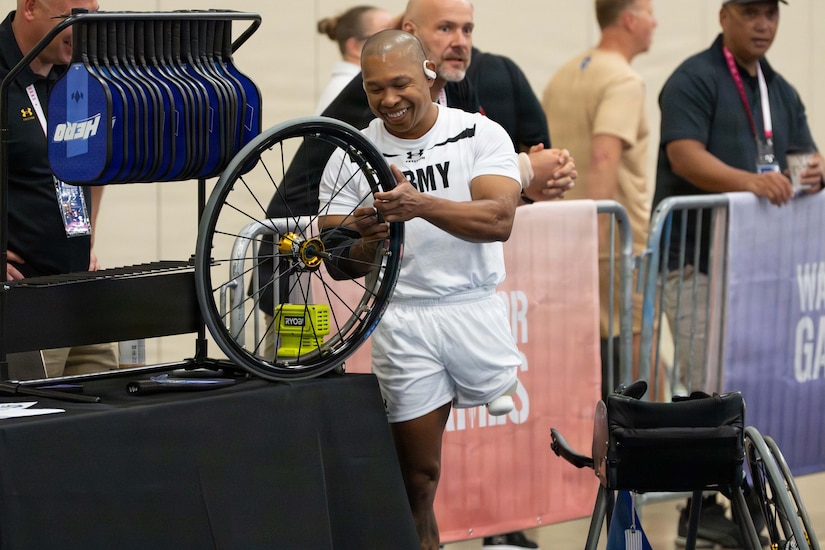
A man in athletic attire stands on one leg next to a table and holds a wheelchair wheel.

"That motto is big for me," he said. "There's a day where I'll get depressed, but that's only one day. Every day is a new day."  

Following the 2026 Warrior Games, Calantoc plans to compete in the National Veterans Wheelchair Games in Detroit next month. He said adaptive sports help him remain connected to others.  

"I've got adaptive sports, and it keeps me busy," he said. "It keeps me smiling and enjoying life."  

Miho Calantoc said she has watched the way adaptive sports have changed her husband and their family.  

"It's amazing," she said. "We've been in a dark space, and adaptive sports brings him so much light. It's such a blessing to see the difference when he is competing and how brightly he shines."  

The week leading up to the Warrior Games also brought another milestone for the Calantoc family. They received an Americans with Disabilities Act-accessible home, a moment both Calantoc and his wife described as life-changing.  

"Thinking about it still makes me cry," Calantoc said. "I really wasn't expecting it."  

For the family, the home represents more than a new address. It represents safety, independence and relief after years of navigating a house that was not built for Calantoc's needs.  

"A lot of times, I'll take a shower [and] I'll slip and fall," Calantoc said. "This house our family received is really going to change my life; it's going to make it easier for me."  

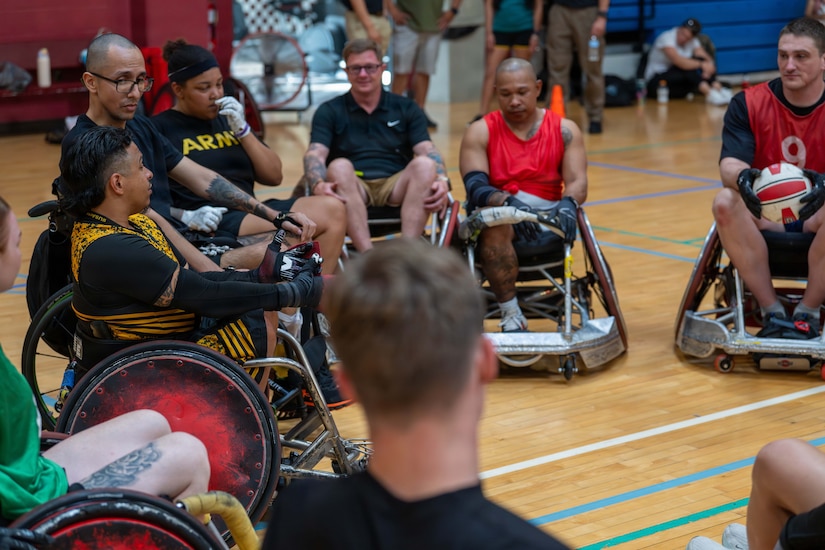
Nearly a dozen people in athletic attire sit in wheelchairs while gathering in a circle inside a gym.

Miho Calantoc said the home is an answered prayer from her side of the recovery journey as his spouse.  

"As a caregiver, there was a lot of worry from my end, especially in the restroom or bathtub," she said. "I know he's a very independent person. Just him being able to get back that independence is so heartwarming for him and for myself."  

For Calantoc, having his wife and children with him during the Warrior Games adds meaning to every event.  

"When my family is here, that's big support," he said. "I want to say 'thank you' to my wife and my kids [for] being here, supporting me. It's huge."  

Miho Calantoc said watching their father compete has become a lesson in resilience for their children.   

"They know Dad's got it, so we got it, too," she said. "He shows them that you can do anything when you put your mind to it."  

Calantoc said he tries to pass that same lesson on to others in the adaptive sports community.

He tells them, "Try all these adaptive sports. You don't know what you can do until you try it."

Warrior Games week represents more than competition for the Calantoc family. It's another step forward in a recovery journey that has touched their lives, a competitor returning with confidence and a family beginning a new chapter in a home built to support the independence he continues to reclaim.

Medal of Honor Monday: Army Pvt. Joe Gandara

 June 15, 2026 | By David Vergun, Pentagon News

Army Pvt. Joe Gandara was a paratrooper who fought in France during World War II. Little is known about him other than that he was the son of Mexican immigrants. However, his bravery and selflessness earned him a posthumous Medal of Honor — nearly 70 years after he sacrificed himself to save his battle buddies.

A man in a formal military uniform smiles for a portrait.

Gandara was born to Jose Melendez and Ramona Orrantia Gandara, April 25, 1924, in Santa Monica, California. He had two brothers, Edward and Rudolph. 

After graduating from Santa Monica High School, Gandara enlisted in the Army two months before his 19th birthday, Feb. 20, 1943. Following paratrooper training at Fort Benning, Georgia, he boarded a troopship to England. 

Gandara was assigned to the legendary 82nd Airborne Division. His unit, Company D, 2nd Battalion, 507th Parachute Infantry Regiment, trained for the upcoming invasion of France near Nottingham, England. He parachuted into Normandy, France, during the D-Day invasion, June 6, 1944. 

Three days later, near the village of Amfreville, his unit came under heavy enemy fire, pinning the men down for a period of four hours.  

Gandara voluntarily advanced alone toward the enemy position. Firing his machine gun from his hip as he moved forward, he destroyed three hostile machine guns before he was killed, according to his Medal of Honor citation. 

Gandara was initially awarded the Distinguished Service Cross. However, nearly 70 years later, he posthumously received the Medal of Honor as part of the 2002 National Defense Authorization Act, which called for a review of Jewish and Hispanic American veterans from World War II, the Korean and Vietnam wars to ensure that no prejudice was shown to those deserving the Medal of Honor.

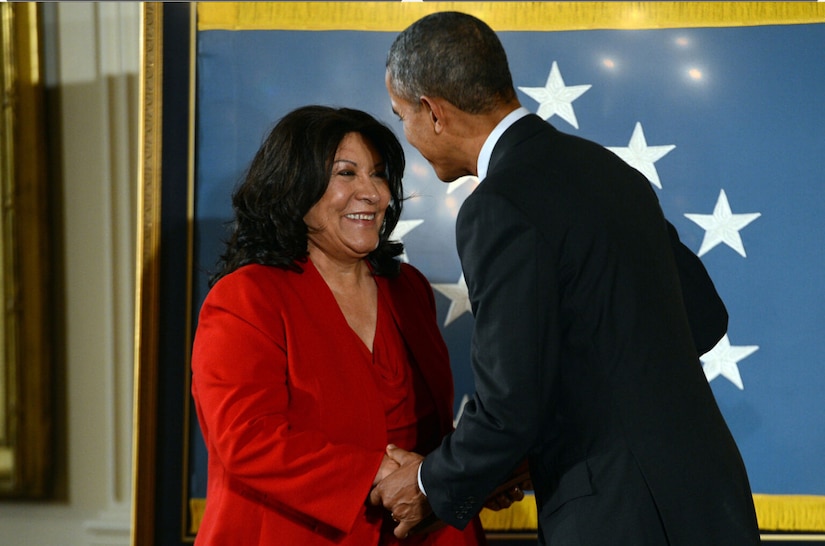
A man and a woman in business attire shake hands and smile in front of a blue square with stars.

President Barack Obama presented the Medal of Honor to Gandara's niece, Miriam Adams, during a ceremony at the White House, March 18, 2014.

"This ceremony reminds us of one of the enduring qualities that makes America great — that makes us exceptional. No nation is perfect, but here in America, we confront our imperfections and face a sometimes-painful past — including the truth that some of these soldiers fought and died for a country that did not always see them as equal," Obama said. 

Following the end of World War II, Gandara was buried in Woodlawn Cemetery in Santa Monica, California. However, his legacy lives on in his hometown and throughout the Army. 

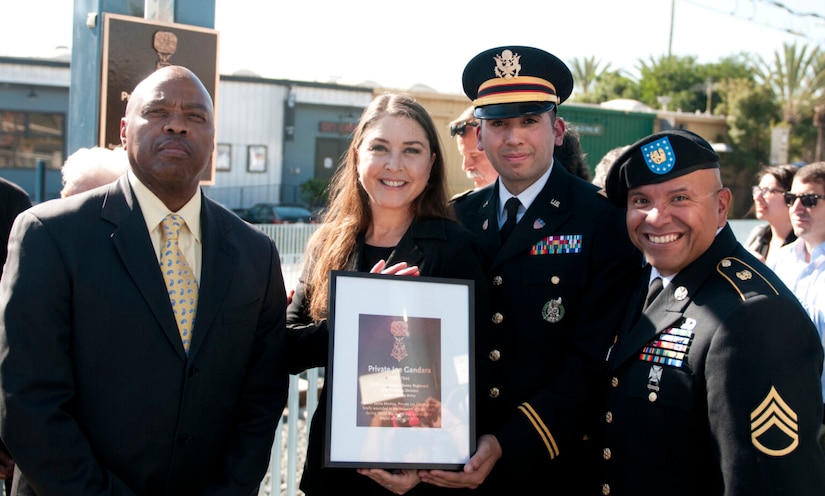
In 2016, Los Angeles named a Metro Rail station after him near the neighborhood where Gandara grew up, and a year later, Santa Monica dedicated a park in his memory.

A woman in business attire holds a framed photo and poses outside with three men, two in formal military uniforms and one in business attire.

In May 2016, a statue of Gandara was included in a memorial to the 507th Parachute Infantry Regiment in Normandy. 

The 82nd Airborne Division selected Gandara as one of the 20 soldiers in its 2018 inaugural class of the All American Hall of Fame, and in 2023, Fort Bragg, North Carolina, named a street after him.