Friday, March 13, 2026

Navy Explosive Ordnance Techs Strengthen Homeland Defense During Arctic Edge 2026

Navy explosive ordnance disposal technicians assigned to Explosive Ordnance Disposal Mobile Unit 11 participated in Arctic Edge 2026, Feb. 23 to March 5. 
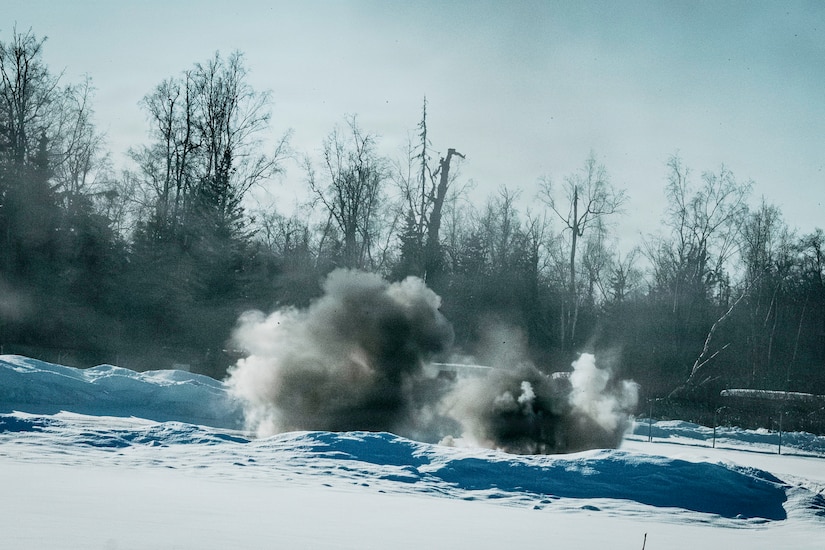
Two clouds of smoke rise from a snow-covered ground.

Arctic Edge 2026, led by the North American Aerospace Defense Command and U.S. Northern Command, is a homeland defense exercise focused on improving readiness, demonstrating capabilities and strengthening joint and allied forces interoperability in the Arctic. 

"This year, our primary objective was to integrate with other EOD entities in new environments," said Navy Chief Petty Officer Quinn Gaubatz, chief explosive ordnance disposal technician. "Subject matter expert exchanges help us better our tactics, techniques and procedures through collaboration of our strengths, especially in the challenging conditions that [Arctic Edge] provided." 

Throughout the exercise, EODMU-11 operated alongside joint EOD forces and other military units on Kodiak Island, Alaska, and at Joint Base Elmendorf-Richardson in Anchorage, Alaska. 

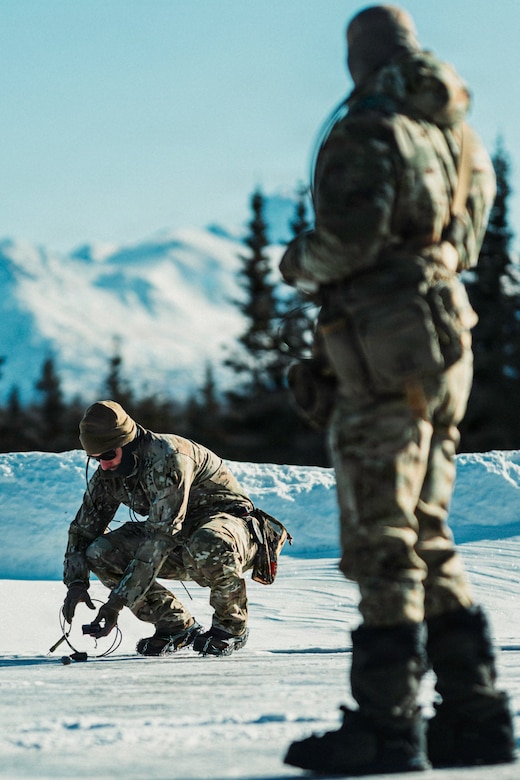
A man wearing a camouflage winter military uniform lays wire onto a snow-covered ground.

On Kodiak Island, EODMU-11 technicians conducted remote operated vehicle operations during a force protection drill, partnering with 1st EOD Company, 7th Engineer Support Battalion, 1st Marine Logistics Group, Unmanned Undersea Vehicles Squadron 1, Naval Information Warfare Center personnel, and U.S. Coast Guard elements assigned to the island to assess, neutralize and recover simulated underwater threats. 

"Demanding environments such as Kodiak create great opportunities to stress test our gear," said Navy Petty Officer 2nd Class Luke Rebeor, an EOD technician. "Operating our ROV systems in training alongside joint counterparts helped us accomplish homeland defense objectives together." 

During the drill, ROV operations expanded and supported joint EOD capabilities by providing an essential standoff area in underwater environments in a potentially high-risk reconnaissance and ordnance disposal mission. 

At JBER, EODMU-11 conducted joint airfield clearance and unexploded ordnance disposal drills with Air Force EOD technicians assigned to the 673rd Expeditionary Civil Engineer Squadron, simulating threats to critical infrastructure under extreme cold weather conditions. 

A military warhead sits on a snow-covered ground next to a block of a military explosive.
A man wearing a winter camouflage military uniform lays wire onto a snow-covered ground. Another man in similar attire stands and watches.
  

"Operating in the Arctic requires some adaptation," Gaubatz said. "Standard explosives and techniques work differently in colder climates, so practicing our skills and techniques in Alaska provided an extremely valuable training opportunity." 

Defending the U.S. is inherently linked to the joint force's ability to operate effectively across the entire Northcom area of responsibility — including the Arctic. Navy EOD's presence in Alaska during Arctic Edge ensured expeditionary competence in support of homeland defense as the strategic importance of the Arctic domain expands.

Soldiers Assist Air Force Squadron With Drone Warfare Training

More than 200 airmen training with the Air Force's 368th Training Squadron spent Feb. 27 at Fort Leonard Wood, Missouri, learning about unmanned aerial systems during an exercise designed to cultivate Air Force airmindedness and the warrior ethos. 
 
The training squadron, based at Fort Leonard Wood, provides initial skills and advanced level training in the areas of ground transportation, engineering, emergency management and pavements and construction equipment. 

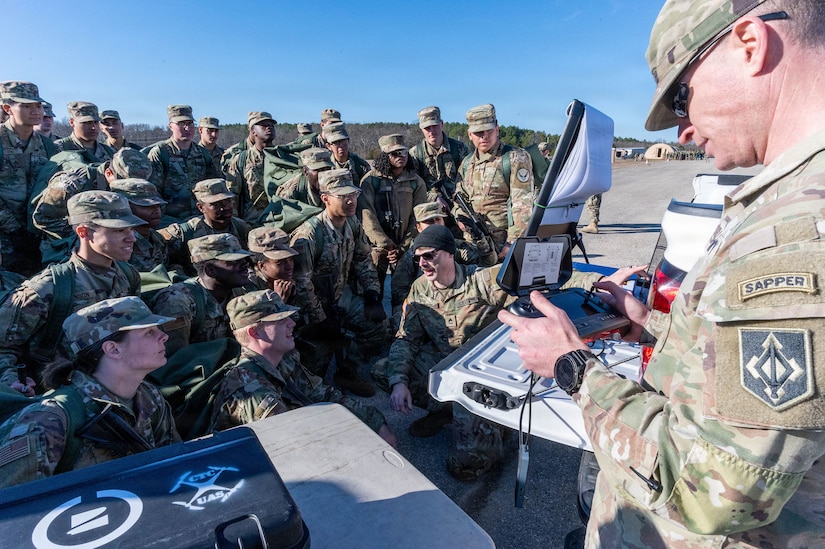
A man in a camouflage military uniform uses a remote control to pilot a drone while another man in similar attire crouches as he speaks to a group of people in camouflage military uniforms gathered outside.

 
According to Air Force Tech. Sgt. Christopher Moss, a specialty code instructor assigned to the training squadron, airmen at various specialty schools on base usually train separately, but this day was unique because it brought them all together. 
 
"It allows them to integrate with our other schoolhouses, bringing them together as one force instead of each person learning just their craft," Moss said. "Producing more well-rounded airmen for the force." 
 
Air Force Capt. Nathan Elking, 368th Training Squadron director of operations, said the unique training event is called Bracer Forge and is an operational readiness exercise. 
 
"It is a continuation of the training airmen receive at basic training," Elking said. "Both exercise initiatives are designed to instill airmindedness and warrior ethos in our airmen." 
 
The squadron's exercise topics vary, but the current unmanned aerial system focus was driven by the unit's specialty codes, which according to Elking play a key role in airfield damage assessment and rapid airfield damage recovery. 
 
"Before each iteration of Bracer Forge, we provide the participating airmen with an operation order for the day and reporting instructions with a training scenario to recover a damaged airfield," he said. 
 
Squadron instructors prepared four stations for the airmen to rotate through. 

A man in a camouflage military uniform speaks to a group of people in similar attire holding rifles while they stand in a tent.

 
At the airfield damage assessment challenge, Elking said teams conducted an assessment on a simulated airfield and relayed the information to their teammates in an emergency operations center. 
 
"The airmen in the EOC were tasked with creating a map of the airfield using the details their counterparts called in over the radio," he said. 
 
While at the UAS reporting challenge, teams established defensive fighting positions and reported UAS activity to their teammates in the EOC by consolidating the information into a report to send up. 

The other two stations were a high intensity physical fitness event and a UAS capabilities overview. Soldiers assigned to the Maneuver Support Center of Excellence Combat Training Company gave the UAS portion of the training. 
 
"We are not subject matter experts on counter-UAS and UAS employment. Being able to leverage our Army partners at [center of excellence] played a significant role in the exercise's success," Elking said. 
 
According to Army Sgt. 1st Class Austin Priebe, Combat Training Company UAS chief, his mission was to introduce small UAS threats, and teach the basics of identifying, reacting to and reporting small UAS threats. 

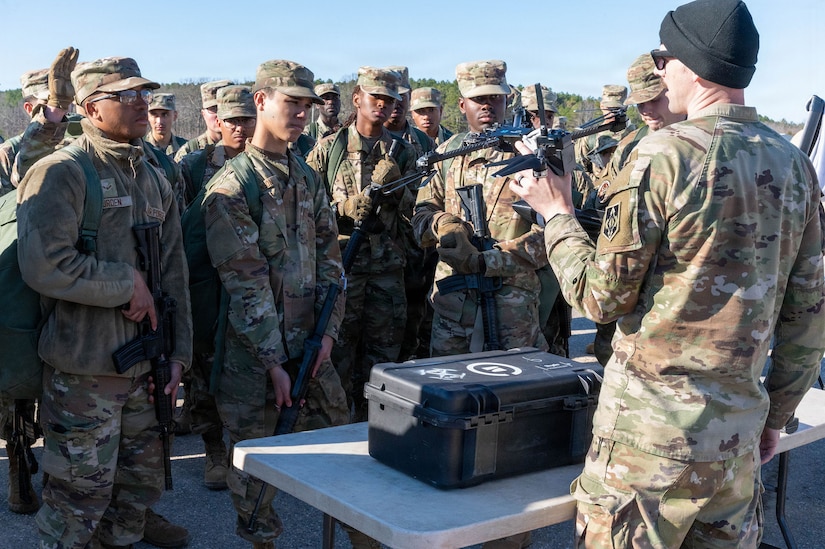
A man in a camouflage military uniform holds a drone while speaking to a group of people in similar attire gathered outside. In front of the man is a black case sitting on a table.

 
Priebe said most trainees he instructs have watched or controlled a simulated UAS in video games, but being able to experience a UAS in person, see and hear a drone up close, is "essential to prepare service members for what they will see in current and future conflicts." 
 
"We conducted practical exercises on scanning for [small] UAS, completing a report and showed the airmen what they look like from an elevated viewpoint," Priebe said. 
 
This was the training company's first time facilitating interservice UAS training. 
 
"I've largely been focused on enabling training and instruction to the Army units here on Fort Leonard Wood since the inception of our UAS program this past fall," Priebe said. 
 
As the battlefield changes rapidly, so does our training requirements. If our organization can provide more realistic and in-depth training to our brothers and sisters in other branches, we only stand to benefit as a military." 

Priebe said his team is looking forward to conducting more interservice training events in the future. 
 
At the end of the day, the exercise was a catalyst for innovation, Elking said. 
 
"By exposing airmen to the dual nature of UASs — both as a threat to counter and a tool to master — we challenge them to rethink their mission sets and pioneer new solutions for the modern battlefield," he said.

George Washington Announces His Farewell to Arms

The general's resignation was not a conclusion but a defining moment in our nation's history. Many regard it as a foundational act of statesmanship, setting a powerful precedent for civilian control over the military. Gen. George Washington, commander of the Continental Army, formally resigned his commission, Dec. 23, 1783, in Annapolis, Maryland, where he delivered his farewell address to the Continental Congress.

Depicted in a painting is a crowd gathered behind a man in uniform reading a document to men seated and standing, while women watch from a balcony.

Washington led the Americans to victory over the British from June 15, 1775, until the war ended Sept. 3, 1783, with the Treaty of Paris. The treaty formally recognized the independence of the U.S., set its boundaries, provided provisions on fishing rights, property restitution for loyalists and the return of prisoners of war. 

"Having now finished the work assigned me, I retire from the great theatre of action, and bidding an affectionate farewell to this august body, under whose orders I have so long acted, I here offer my commission and take my leave of all the employments of public life," he said at the conclusion of his address.

Britain's King George III reportedly said that if Washington resigned, he would be the greatest man in the world. 

Historically, a triumphant general would seize power. Examples abound. For instance, in 44 B.C., Julius Caesar was named dictator for life after defeating his rivals in battle. In 1804, after winning a series of battles, Napoleon Bonaparte proclaimed himself emperor of France. 

Later, Washington attended the Constitutional Convention in 1787, where he was unanimously elected as its president. The other delegates found Washington's mere presence to be crucial to the success of the endeavor. He was held in high esteem.

A $5,000 bill in green color features a man reading to a crowd of people from a document.

Following the ratification of the Constitution, Washington was unanimously elected to be the first U.S. president. Sworn in April 30, 1789, he served two terms before voluntarily giving up power for the last time. 

Department of War Awards Independent School District No 57 of Garfield County (Enid Public Schools) a $22M grant for Eisenhower Elementary School at Vance Air Force Base, Oklahoma

The Department of War, Office of Local Defense Community Cooperation, today awarded Independent School District No 57 of Garfield County (Enid Public Schools) a $22 million grant as the federal share of a larger $28.2 million project to construct a new Eisenhower Elementary School at Vance Air Force Base, Oklahoma.

This project will address facility capacity and condition deficiencies that placed Eisenhower Elementary School as #65 on the 2019 Deputy Secretary of Defense "Public Schools on Military Installations Priority List" (Priority List). Upon completion, 350 students in kindergarten through fifth grade will be supported annually through this project.

Funding for this grant is provided under the Department's Public Schools on Military Installations Program. In making these funds available, the Office of Local Defense Community Cooperation must give priority consideration to military installations that have schools with the most serious facility capacity and condition deficiencies, as determined by the Priority List.

A multi-disciplined Federal Evaluation Team, with representatives from the Assistant Secretaries of the Air Force, Army, Navy, and the Office of Local Defense Community Cooperation reviewed the school project to ensure the award appropriately addresses the noted facility capacity and condition deficiencies.

In correcting the identified facility condition and capacity issues at the Eisenhower Elementary School, this grant keeps faith with service members, improves the quality of education for defense-connected students, aids in the recruitment and retention of vital skills at Vance Air Force Base, and enhances partnerships between the community and the installation.

Blue Angels Mark 80 Years, Certified for 2026 Airshow Season

The U.S. Navy flight demonstration squadron, the Blue Angels, successfully completed its annual certification for the 2026 airshow season Feb. 23, marking the squadron's 80th anniversary. The "airshow-ready" designation was granted after the team completed its demanding winter training, ensuring it meets the highest safety and performance standards before embarking on the 2026 season.

Since its founding in 1946, the Blue Angels have served as ambassadors of naval aviation. Navy Rear Adm. Max McCoy, chief of naval air training, gave final approval for the team's 80th season after observing its last practice demonstration in El Centro, California.

A man in a military flight suit looks to his right, as two military aircraft are seen in the distance above.

"Earning this certification is always an honor, but it carries special weight this year as we prepare to celebrate the squadron's 80th anniversary," said Navy Capt. Adam Bryan, Blue Angels commanding officer. "This team has worked incredibly hard to be ready to honor that legacy and represent the men and women of the U.S. Navy and Marine Corps. We are eager to get the season started."

This year's certification was overseen with a unique understanding of the squadron's mission, as McCoy is the first former Blue Angel to oversee the flight demonstration squadron as the chief of naval air training. McCoy was assigned to the squadron in 2001 and 2005.

"For 80 years, the Blue Angels have represented the absolute pinnacle of naval aviation, and this anniversary is a testament to a legacy of excellence that few organizations ever achieve," McCoy said. "Certification for this historic season was exceptionally rigorous because the standard must be met. This squadron demonstrated unwavering precision and commitment, proving they are not only ready to fly, but ready to continue the Blue Angel legacy with the honor it deserves."

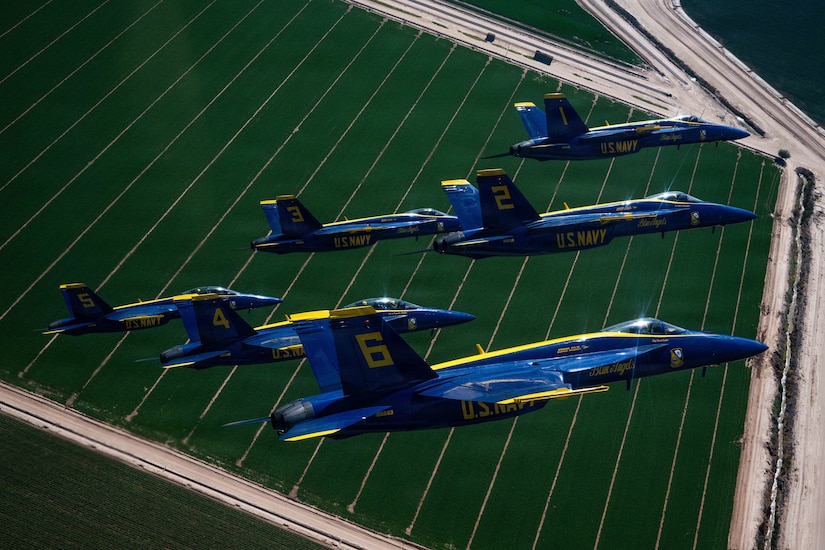
Six blue and yellow military jets fly in formation over a green field.

With its certification complete, the Blue Angels will now begin its season tour across the United States. The Blue Angels team consists of 158 active-duty sailors and Marines, including pilots, aircrew, maintainers and support personnel.

The Blue Angels will host the last show of the season, the Blue Angels Homecoming Air Show at its home base, Naval Air Station Pensacola, Florida, Nov. 6.