Tuesday, February 17, 2026

DOW's New Chief Information Officer Seeks to Put the Warfighter First

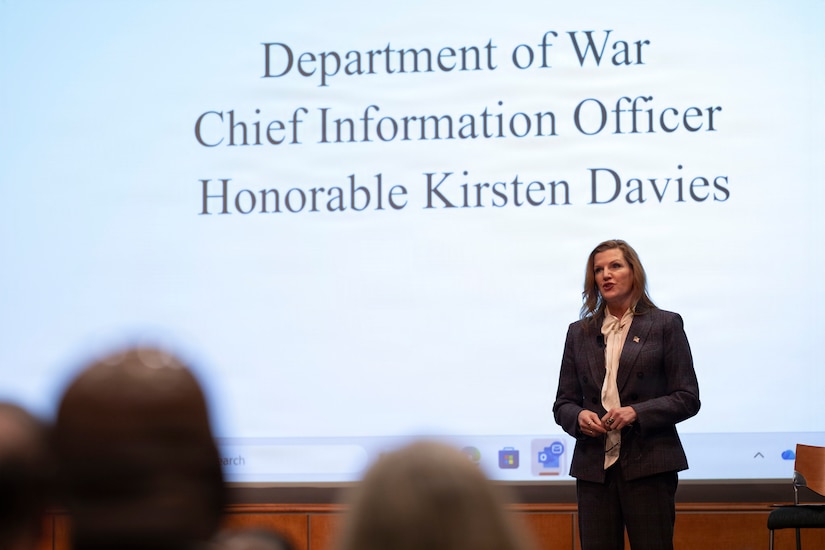
The Pentagon's newest chief information officer, Kirsten Davies, gathered her department's senior leaders and staff together at the War Department's Mark Center in Alexandria, Virginia, Feb. 10, where she laid out a vision for her office that focuses strongly on supporting America's warfighters.

A woman in business attire stands on a stage speaking to an audience that is mostly off-screen. Behind her is a slide projected on the wall that reads, “Department of War Chief Information Officer Honorable Kirsten Davies.”

"Our mission is to support the National Defense Strategy … and the warfighters," Davies told those assembled in the Mark Center's auditorium. "Everything we do should be supporting the warfighter community and their mission."  

Just six weeks into the job, Davies is responsible for serving as the principal staff assistant and senior advisor to the secretary of war and deputy secretary of war for information technology — including national security systems and defense business systems — information resources management and efficiencies. 

This means that Davies is responsible for all matters related to the War Department's information enterprise, including cybersecurity, communications, information systems and more. 

With all those responsibilities under her purview, Davies expanded on the Office of the Chief Information Officer's vision statement, "[building] an information enterprise that is resilient, modern, secure and agile; one that is worthy of the warfighter."

A large crowd of people in business attire seated in an auditorium observing someone speaking to them from off-screen.

"We need ruthless prioritization of all of our initiatives. There are some things we're just simply not going to do because [they don't] serve the warfighter mission," Davies said, adding that she will be seeking her team's help in identifying those initiatives and prioritizing items to pursue immediately, versus what can be pushed further downstream. 

Next, she spoke about OCIO visibility and the need to share it across the entire War Department, including the department's military and civilian-manned field activities. 

"We can't defend what we can't see, [and] we can't optimize something if we don't know what's there," Davies said. "So, [visibility] becomes a real priority."  

Visibility can help OCIO determine if the office's money is being spent appropriately throughout the department and serving the warfighter most effectively, especially as it relates to tactical agility, she added.  

Davies also spoke about additional topics not listed in OCIO's vision statement, including accountability.  

"If you want to own something, own it. There's accountability that's attached to that," she told the group of leaders.   

"We will measure outcomes, not activity," Davies added.

Additionally, she spoke about transforming OCIO's technology landscape in a rapidly evolving information environment.

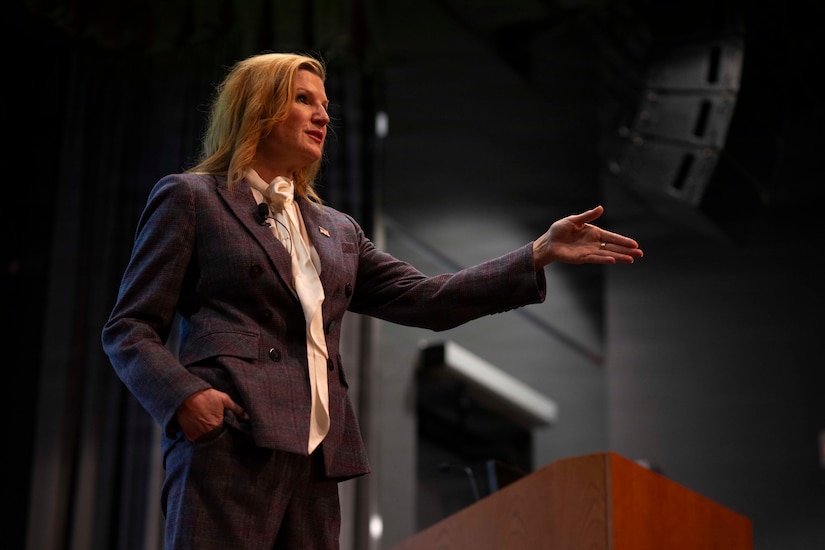
A woman in business attire stands on a stage, gesturing with her left hand while speaking to an audience off-screen.

"We need to execute on data analytics and AI. … We need to secure our advantage in the spectrum … This is a long-term play for us, for national security and for our partners and allies," Davies said. 

Two topics she would like to prioritize for all OCIO leaders immediately are getting up to speed on the recently published National Defense Strategy and becoming familiar with Secretary of War Pete Hegseth's ongoing Arsenal of Freedom tour.  

The tour represents Hegseth's initiative to transform the department's acquisition system and processes to accelerate delivery of capabilities to the warfighter and revitalize America's manufacturing might. 

"Our mission is to support the warfighter," Davies reiterated.  

"You've heard [the secretary] talk about us being on a war footing [and] again, we are not a technology company — we are part and parcel of the warfighter's mission," Davies said, adding that it is essential OCIO align with the warfighter in the realm of cybersecurity and cyber defense. 

As her remarks wound down, Davies encouraged those in attendance to be bold while participating in OCIO's journey from that point forward. 

"Change requires boldness; it requires courage," she said. "We have a window of opportunity to do some really interesting, exciting, transformative work. I want you to embrace the opportunity and also know that I've got your back."

Secretary of War Pete Hegseth Travels to Missouri for Arsenal of Freedom Tour

Secretary of War Pete Hegseth will depart tomorrow for St. Louis, Missouri, to visit Boeing and administer the oath of enlistment to new recruits at the Naval Reserve Officer Recruiting Station.

Secretary of War Pete Hegseth is continuing on the nationwide "Arsenal of Freedom" tour, a call to action to revitalize America's manufacturing might and re-energize the nation's workforce. The tour's message will emphasize that our national security and the peace of the world move at the speed of our Defense Industrial Base (DIB) and rely on the hard work of our American workforce.

The tour will highlight the urgent need to rebuild our DIB to ensure that we continue President Trump and Secretary Hegseth’s peace through strength agenda.

American manufacturing is the bedrock of American strength. The men and women fueling this work are on the frontlines, alongside our warfighters, furthering the nation’s efforts every day they show up to work.

The tour will champion a new approach to defense acquisition, one that prioritizes and awards speed, innovation, and a "commercial-first" mindset.

This includes cutting bureaucratic red tape, empowering program leaders, and providing the stable, long-term contracts necessary for industry to invest and expand.

The goal is to create a defense ecosystem that is more agile and accountable, capable of delivering the tools our warfighters need, when they need them.

The "Arsenal of Freedom" tour is more than a series of speeches; it is a movement to restore our nation's industrial prowess and secure our freedom for generations to come. It is a reminder that the strength of our nation is not just in our military, but in the ingenuity and spirit of the American people.

Riding High: Meet the Military's Last Remaining Mounted Color Guard

For the individuals who serve in the Marine Corps Mounted Color Guard, every day is a test of composure, discipline and adaptability — essential skills they demonstrate alongside wild palominos that were specifically domesticated for the job.

These Marines are unique in that they're the last mounted color guard remaining in the military.

"The unit perseveres because it consistently demonstrates value: connecting the American public to the Corps' legacy while constantly reinforcing Marine professionalism and core values," explained Marine Corps Capt. Elizabeth Kemp, the unit's officer in charge.

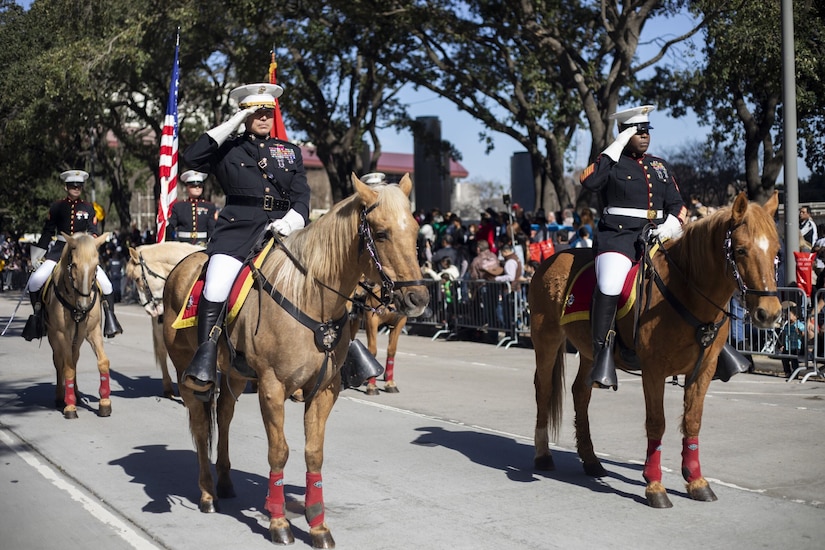
Two men in military dress uniforms salute as they sit stoically on horses while on a parade route. Three other people in similar attire on horses are behind them carrying flags.

Based at Marine Corps Logistics Base Barstow in California's Mojave Desert, the Marine Corps Mounted Color Guard allows a few dedicated Marines the rare but honorable opportunity to present the service's colors and U.S. flag on horseback at military-related parades, ceremonies, commemorations, civic events, and other activities.

Their work is a show of dignity and respect for those who have served the nation, but being selected for the role itself is also considered an honor.

"Marines are entrusted with representing the Corps' history, traditions and standards in front of national and international audiences," Kemp said. "The level of trust and confidence embedded in the unit's core, coupled with the [increased] visibility, makes this a prestigious assignment for all Marines who serve here."

Dedication, Reliability Required

The mounted unit consists of a senior Marine who carries the U.S. flag, known as the color sergeant; a Marine who carries the Marine Corps colors; and two rifle bearers.

Any mid-level enlisted Marine from any career field can be selected for the role. They must possess an outstanding professional reputation and a high level of physical fitness, discipline and reliability. Candidates are screened for maturity, attention to detail and their ability to represent the Corps at the highest level.

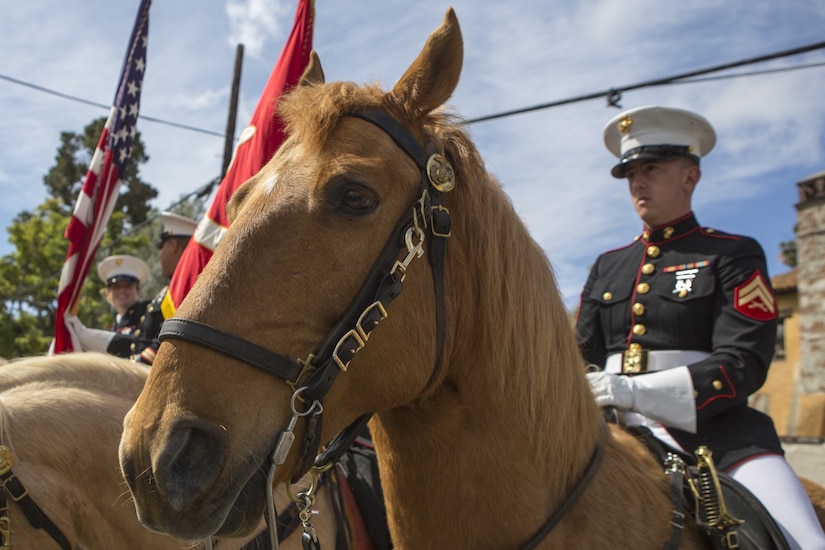
A close-up shot of a horse wearing a bridal. A man in a military dress uniform is seated on the horse’s back.

And if you're a Marine who doesn't know much about horses, that's not a problem. Kemp said many qualified Marines come to the stables with little to no experience in horsemanship or ranch operations.

"What matters most is character, work ethic and the ability to learn quickly while operating as part of a team," she said. "Prior experience is beneficial, but is far less important than discipline, patience, humility and commitment."

Marines selected for the prestigious role spend hours working with the base's civilian horse trainer to learn maintenance and how to ride, as well as all the duties required to work on a ranch.

High-Level Performances

The mounted unit is invited to all sorts of events, including the famed New Year's Day Rose Parade in Pasadena, California. The unit has appeared in every iteration of the parade since 1990, and it's had the honor of leading it several times as the first military unit.

The unit also takes part in rodeos, which can help with recruiting efforts.

"Rodeos combine high energy, unpredictable environments and large crowds. Performing in this setting highlights the Marines' ability to stay composed, disciplined and professional under pressure — skills that translate well beyond ceremonial contexts," Kemp said.

The Mounted Color Guard is currently on tour at various rodeos throughout Texas until March 7.

The team mostly performs in the western U.S. However, in 2024, it made its first trek to the East Coast in about a decade. They presented the colors at the Preakness Stakes, participated in the National Memorial Day Parade and visited various historical sites, including the Marine Corps War Memorial in Arlington, Virginia.

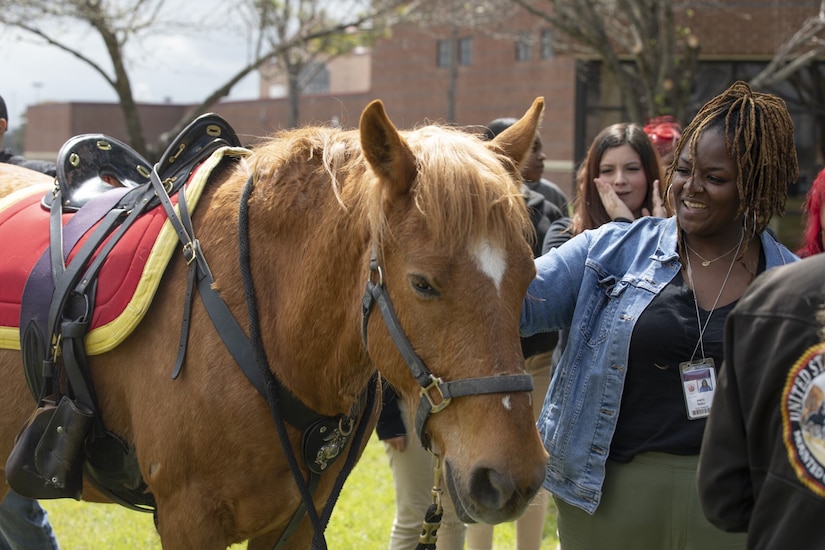
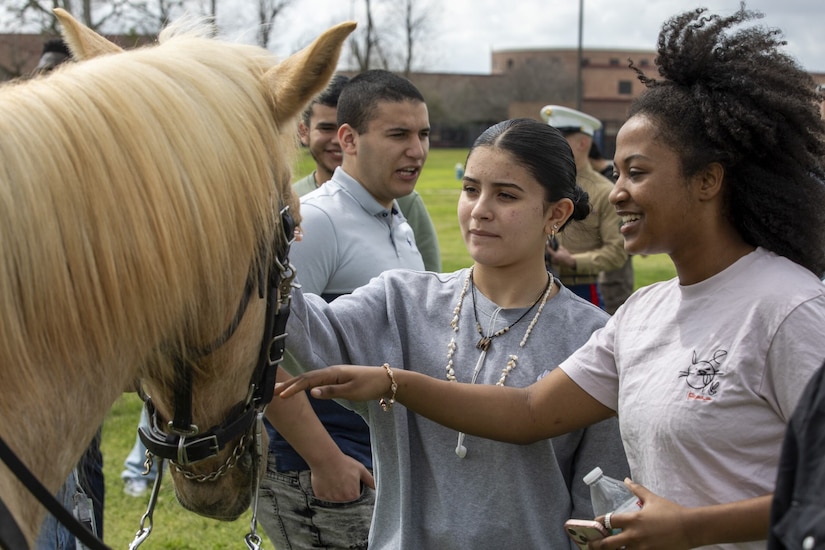
A woman in casual attire smiles while petting a horse. Another woman in similar attire in the background looks excited, placing her hands on her face.
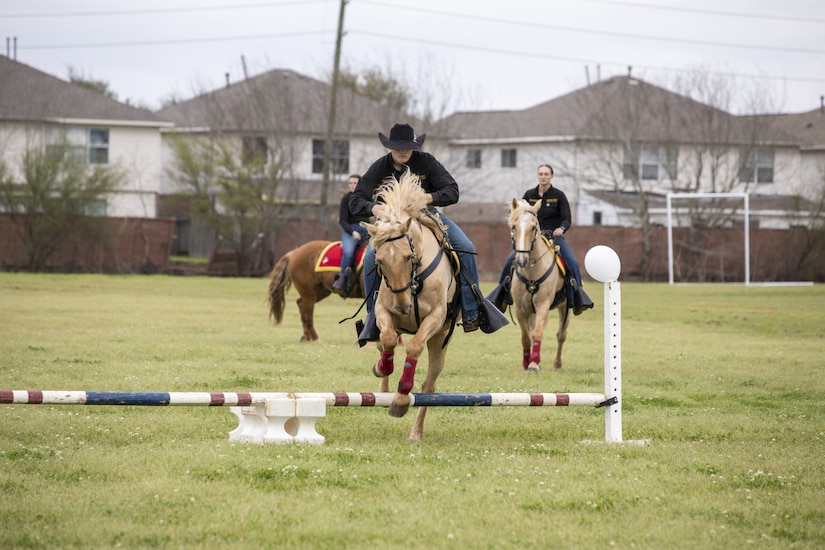
A man on horseback jumps a foot-high obstacle in a grassy area. Two other people on horseback ride behind him.
Two women in casual attire pet the head of a horse. Men in casual attire mingle in the background.
The unit also works with public schools, including through the Junior ROTC and the Young Marines Program. The team used to participate in competitions in the 1980s and 1990s, where they received several national awards; however, they no longer do so because of military regulations.

From Wild and Free to Tame and Disciplined 

Another unique aspect of the job is that these active-duty Marines ride wild palominos adopted from the Bureau of Land Management's Wild Horse and Burro Adoption Program, which protects wild equines on public lands. When there are too many animals to manage, the bureau finds qualified private care for them through adoption or sales. 

According to the color guard's website, stablemen initially found the wild horses on their own and trained them. But a chapter of the 1st Marine Division Association eventually got involved and started the process of adopting the horses through the bureau. That eventually became the official process.

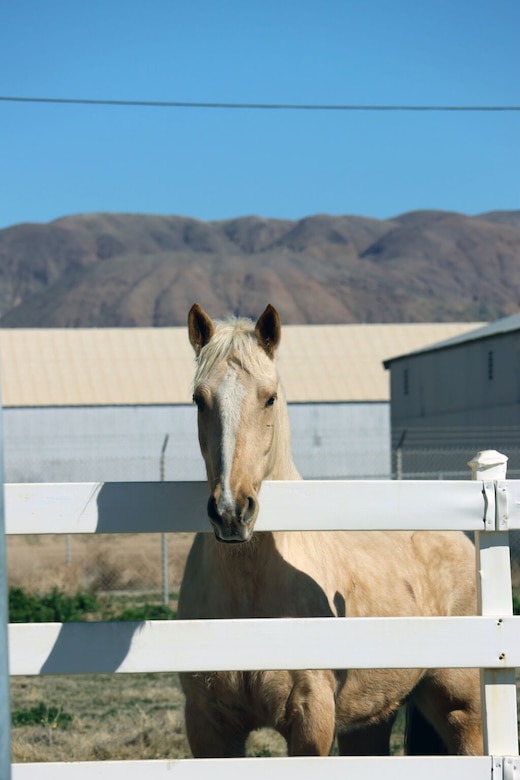
A horse rests its head over a fence. Mountains and a large barn are shown in the background.
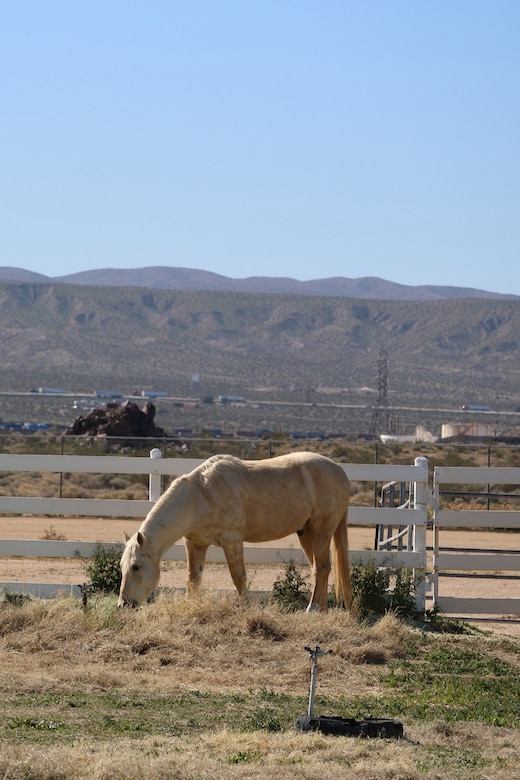
A horse grazes in a pasture. Desert mountains rise in the background.
Adopted horses are tamed and progressively trained to meet the unit's performance standards. They're then slowly integrated into ceremonial presentations. Kemp said the horses are handled with a strong emphasis on safety and welfare by trainers and experienced stablemen.

Developing Ready, Lethal Marines

Kemp said the unit directly supports Secretary of War Pete Hegseth's focus on readiness and lethality by developing Marines who are disciplined, adaptable and can represent the force with credibility.

"It strengthens recruiting, public trust and institutional pride, all of which directly support the Marine Corps' ability to attract and retain high-quality warfighters," she said.

The Marine Corps Mounted Color Guard received its official designation in November 1968. The Army, the only other branch with dedicated mounted color guards, deactivated its last unit in 2023.