Friday, July 10, 2026

U.S. Navy to Christen Future USS George M. Neal

PASCAGOULA, Miss.—The U.S. Navy will christen the future USS George M. Neal (DDG 131) during a ceremony at Huntington Ingalls Industries Inc. (HII) Shipbuilding on Saturday, July 11, at 9 a.m. CDT.

The principal address will be delivered by William Toti, performing the duties of the Undersecretary of the Navy.

"The future USS George M. Neal honors a legacy of extraordinary courage and sacrifice," said Toti. "As we christen this ship, we mark another step toward building the Navy our nation needs. Flight III destroyers are critical to our nation's security, and we are proud to accept each one built by the skilled workforce at Ingalls."

Additional speakers include the Honorable Mike Ezell, U.S. Representative, Mississippi's 4th District; Vice Adm. Doug Williams, Director of Portfolio Acquisition Executive Strategic Systems Programs; and Christopher Kastner, President and Chief Executive Officer, HII.

In a time-honored tradition, the ship's sponsor, Kelley Neal Gray, daughter of the namesake, will christen the ship by breaking a bottle of sparkling wine across the bow.

The ship is named in honor of Korean War veteran Aviation Machinist's Mate 3rd Class George M. Neal, who was awarded the Navy Cross for his heroism during a search-and-rescue mission over North Korea. While serving with Helicopter Utility Squadron ONE (HU-1) in 1951, Neal volunteered for a perilous mission deep in enemy territory to rescue a downed aviator. After their helicopter crashed under heavy enemy fire, he aided his fellow crew members in evading capture for nine days, enduring subsequent imprisonment as a POW before his release.

Arleigh Burke-class destroyers are the backbone of the U.S. Navy's surface fleet, providing protection to America around the globe. These highly capable, multi-mission ships conduct various operations from peacetime presence to national security and provide a wide range of warfighting capabilities in multi-threat air, surface, and subsurface domains. These elements of sea power enable the Navy to defend American prosperity and prevent future conflict abroad.

The christening of DDG 131 underscores the Navy's commitment to building America's Fleet of the Future. For 250 years, American naval power has projected strength globally, operating forward 24/7, 365 days a year. This operational tempo demands continuous capability, and the Fleet of the Future is our answer. The ceremony will be livestreamed at: https://www.hii.com/events/DDG131

Media may direct queries to the Navy Office of Information at (703) 697-5342.

For more information on Arleigh-Burke Class Destroyers, visit:
https://www.navy.mil/Resources/Fact-Files/Display-FactFiles/Article/2169871/destroyers-ddg-51/

Dobbins Airmen Sustain Force During Exercise Patriot Medic 2026 One Meal at a Time

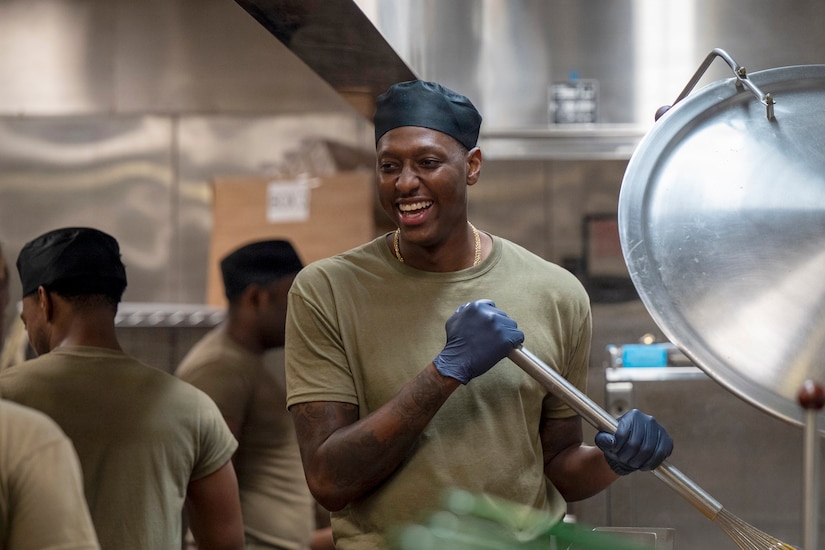
A man wearing a brown shirt and chef’s hat smiles as he holds a kitchen tool.

Before the day's medical training begins and long before the first patient is treated, another mission is already underway. Inside the dining facility at Gulfport Combat Readiness Training Center, Mississippi, the sounds of ovens, serving pans and hurried footsteps fill the kitchen as airmen work against the clock, preparing hundreds of meals that sustain one of the Air Force Reserve's premier medical readiness exercises.

Exercise Patriot Medic 2026, which took place May 25-June 22 at various sites throughout lower Mississippi brought together Air Force Reserve and Army medical personnel to strengthen deployment readiness through realistic field training focused on trauma care, patient evacuation and expeditionary medicine.

While medical professionals sharpen lifesaving skills in austere environments, Reserve airmen assigned to the 94th Force Support Squadron out of Dobbins Air Reserve Base in Marietta, Georgia, ensure those training on the front lines remain fueled and ready to perform.

"It's really tiring and it's very hectic here," said Air Force Airman 1st Class Angela Romero, 94th Force Support Squadron food services technician. "It's always chaotic. You're always running around, but at the end of the day, I feel like it's been a great learning experience. We are with a large variety of people; there are technical sergeants, staff sergeants, senior airmen and all the above, but everybody really comes together to help one another out. We've been working day in and day out, and I feel like we've been feeding 600 people very, very smoothly."

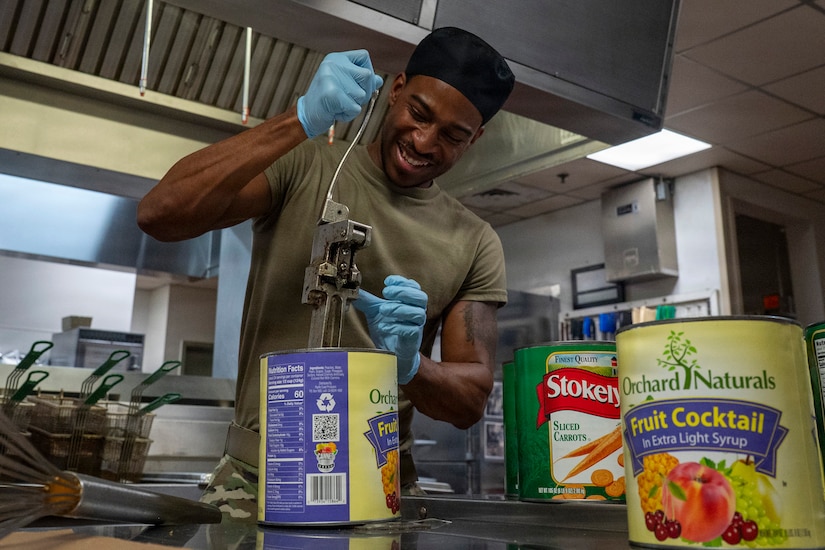
A man wearing a camouflage military uniform uses a large can opener to open two large cans of fruit cocktail and a large can of carrots.

Throughout the exercise, force support airmen assigned to the 94th Airlift Wing served hundreds of meals daily to airmen and soldiers participating in Exercise Patriot Medic. The Air Force team also backfilled the dining facility mission during the opening days of the exercise until Army personnel arrived, requiring early morning and late evening hours to keep meals moving without interruption.

"It's a little crazy because it's such a larger number than what we're used to," said Air Force Airman Gustavo Barroso, 94th Force Support Squadron food services technician. "In the kitchen, you're running back and forth, and the atmosphere is really like, 'OK, we really need to get these meals out.' There's a lot of urgency in here to get everything out because we have a lot of mouths to feed and a lot of people to serve."

For many 94th Force Support Squadron airmen, large-scale food service operations are not part of their routine duties. Supporting Exercise Patriot Medic required them to quickly adapt, practice unfamiliar tasks and rely on one another to accomplish the mission while maintaining the pace needed to support hundreds of personnel.

"To freshen up, I would ask questions on my downtime," Barroso said. "I would try to do some research on certain things that would help me in the kitchen. I would just ask questions and try to get as much information as possible to complete the mission."

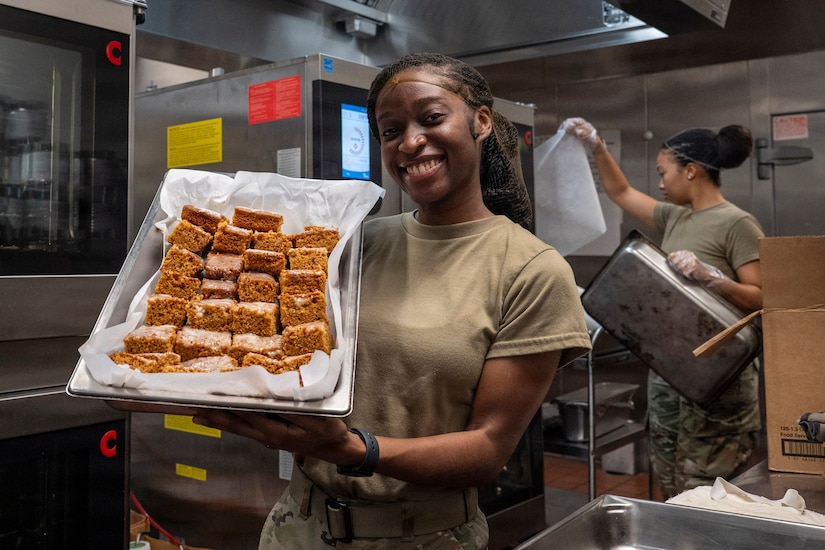
A woman wearing a camouflage military uniform smiles as she holds up a pan of muffins.

While their work often takes place behind the scenes, every meal directly contributes to the readiness of those participating in the exercise. Proper nutrition enables medics, support personnel and joint partners to continue training in demanding environments, with the goal of preparing for future deployments.

"Serving makes me feel good about myself," Romero said. "Realistically, everyone would be eating [Meals, Ready-to-Eat] day in and day out if we weren't back here from 3 a.m. until 10 p.m. making all these meals for everyone. It makes me really feel good about myself. I'm proud of the people in the back because we are all tired and exhausted, but every shift we get it done and we feel good about it."

That commitment extended beyond simply preparing food. Long hours, unfamiliar responsibilities and the physical demands of working in a busy kitchen became another opportunity to strengthen resilience.

"What I've learned while I've been out here is to push through adversity and have real resilience," Barroso said. "It gets tough and you get tired, but in the same way our soldiers, our personnel and our airmen are out there fighting and can't falter, we in the kitchen can't falter because we contribute a lot to the mission. If we don't feed our service members and give them the proper nutrition, they won't be able to complete the mission. Our mission is to help them complete the mission."

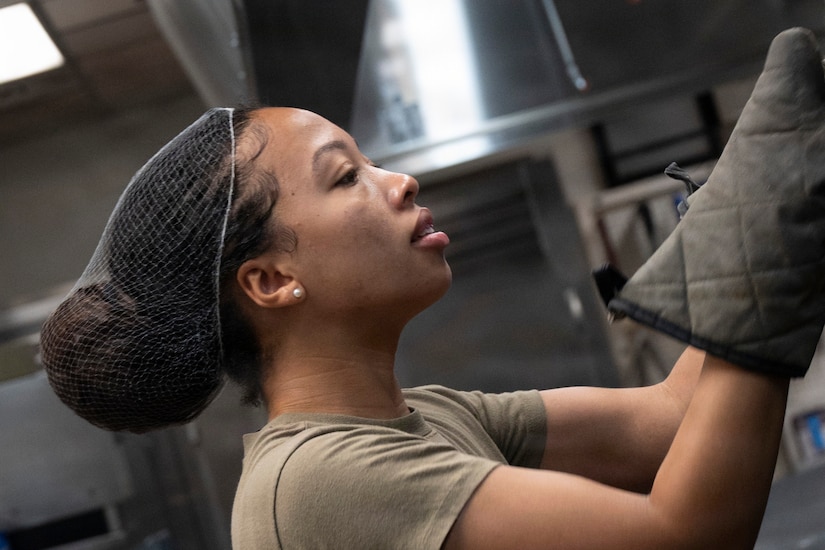
A woman in a camouflage military uniform wears oven mitts as she looks into an oven.

The exercise also reinforced lessons airmen plan to bring back to Dobbins Air Reserve Base from improving communication and teamwork to learning new skills outside their comfort zones. More importantly, it highlighted the shared responsibility every airman has in ensuring mission success, regardless of career field.

"I want to bring back resilience," Romero said. "I'm so tired, but we still wake up and we still come to work. They put me in baking here and I'd never baked a day in my life, and I feel like that's something I'll take back. I'll also take back new communication skills because we obviously have to talk, meet new people and get [accustomed] to certain things."

Despite the demanding schedule, both airmen said the experience strengthened the bonds within the team, where everyone stepped in to help one another and no one was left to carry the workload alone.

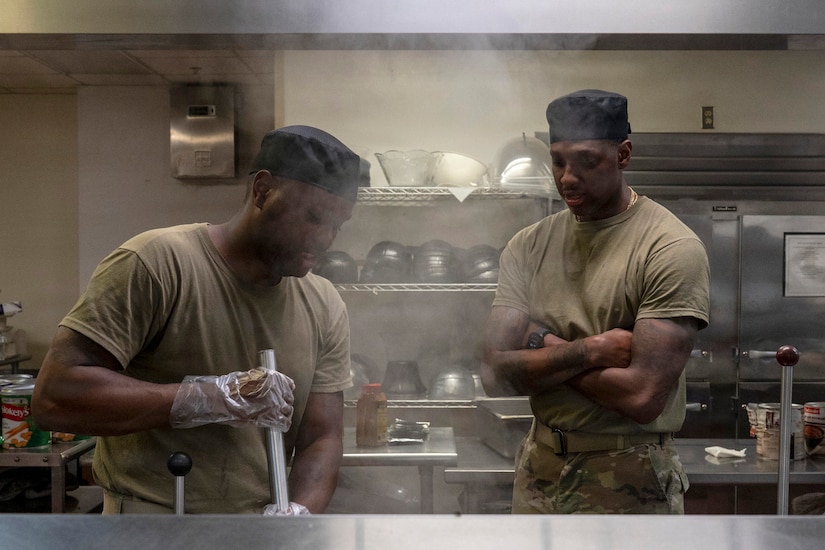
A man wearing a camouflage military uniform stirs soup in a large pot as another man in similar attire looks on.

"I wish they knew how hard we worked," said Barroso, who noted that many diners don't realize the struggle behind the scenes. "It's hot, super hot, and you're getting cuts and burns here and there, you know, and the people walking in, they just see the food. They don't realize how much effort was put into that food to then be served. I wish they knew how much effort we put into the food that they see and eat."

While Exercise Patriot Medic 2026 prepares Reserve medical professionals to deliver lifesaving care in deployed environments, it also demonstrates that readiness depends on far more than the personnel providing treatment. From before sunrise until late into the night, 94th Force Support Squadron airmen sustained the exercise one meal at a time, proving that deployment readiness is built not only through training, but through the airmen whose work behind the scenes makes that training possible.

Alaska National Guard Rescues 4 People in 2 Days

Soldiers and airmen assigned to the Alaska National Guard executed four missions to save four people in the Alaska wilderness before the July Fourth holiday weekend. 

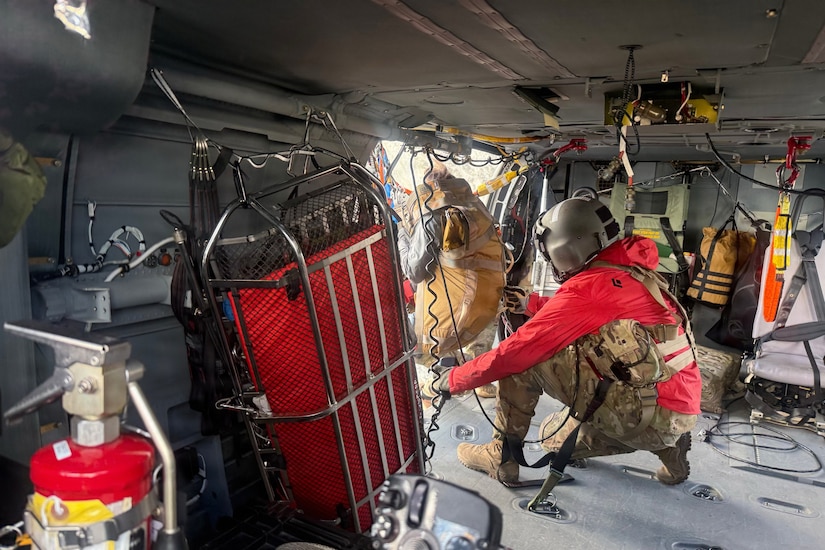
A person wearing a camouflage military uniform is strapped into a helicopter while pressing a controller to lift an attached harness as another person in similar attire guides a person inside the harness into the helicopter.

 
Air Force Maj. Kody Schmidt, Alaska Rescue Coordination Center senior controller, said the first mission started following a request July 2 from the Alaska State Troopers for a hoist-capable helicopter to rescue a critically ill patient from a remote residence on the Kantishna River west of Cantwell, Alaska. 
 
The 176th Wing, Alaska Air National Guard, sent an HH-60W Jolly Green II helicopter and a HC-130J Combat King II aircraft, each carrying pararescuers. 
 
The helicopter special missions aviator hoisted the guardsmen to a spot near the residence, where they made contact with the patient before hoisting everyone into the helicopter for transport to Fairbanks Memorial Hospital in Fairbanks, Alaska. 
 
Later that same day, another mission came in with a request from the National Park Service to medically evacuate a critically ill patient from a remote cabin north of Mount McKinley. 
 
In a similar fashion to the first mission, the helicopter hoisted the airmen near the cabin and then hoisted out the patient for evacuation to Providence Alaska Medical Center in Anchorage, Alaska. 
 
During both missions, the HC-130J provided air-to-air refueling to extend the helicopter's range to reach deep into the interior of Alaska. 

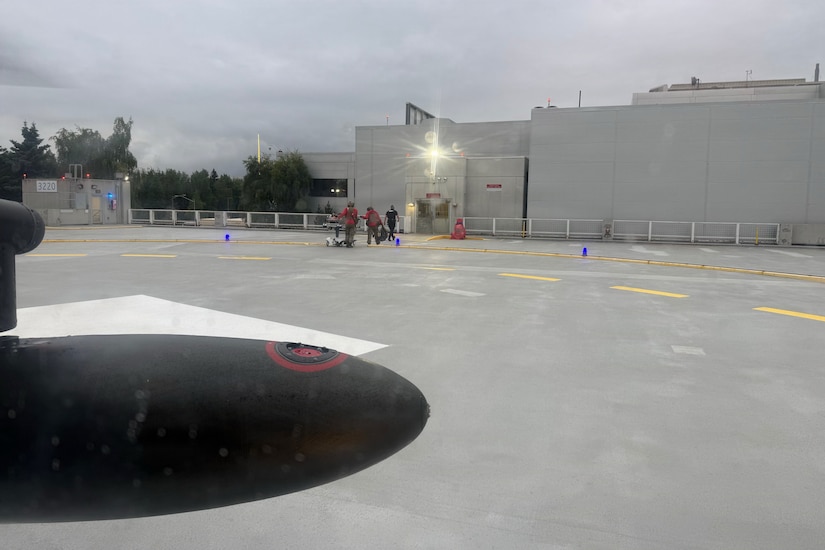
Two people wearing camouflage military uniforms push a person on a stretcher across a helicopter landing pad and into a hospital.

 
Also July 2, a request from the state troopers was received to rescue a stranded hiker who had sent an emergency signal on a satellite communication device on Matanuska Peak in Alaska's Chugach Mountains. 
 
Air Force Capt. Cody McKinney, 207th Aviation Troop Company operations officer, said the Alaska Army National Guard dispatched an HH-60M Black Hawk medical evacuation helicopter. 
 
The Black Hawk crew chief performed a dynamic hoist of the flight medic to contact the hiker, then hoisted both of them into the helicopter for transport to the Palmer Municipal Airport in Palmer, Alaska. During a dynamic hoist, the crew chief lowers the flight medic as the helicopter approaches the patient, preventing spinning and oscillation while decreasing the time required for extraction. 
 
The final mission began July 3 when the National Guard received a request from state troopers to rescue a hiker near Gulkana, Alaska, who was experiencing chest pain. 
 
A Black Hawk crew located the hiker, treated the hiker on site, and hoisted them into the helicopter for transport to Providence Alaska Medical Center. 
 
Schmidt underlined the importance of carrying a satellite communication device when going into the Alaskan wilderness, where cellphone coverage is often unavailable. 
 
The rescue missions involved six aircraft and totaled nearly 21 hours of flying time in less than two days.