Wednesday, July 29, 2026

Fort Rucker's Unmanned Advanced Lethality Course Ramps Up Tactical Drone Training

The Unmanned Advanced Lethality Course at Fort Rucker, Alabama, is pushing forward with a series of updates aimed at strengthening tactical proficiency and meeting student expectations, said Army Staff Sgt. Mario Rostran, the course's noncommissioned officer in charge, and Army Chief Warrant Officer 3 Robert Gatta, the course manager.
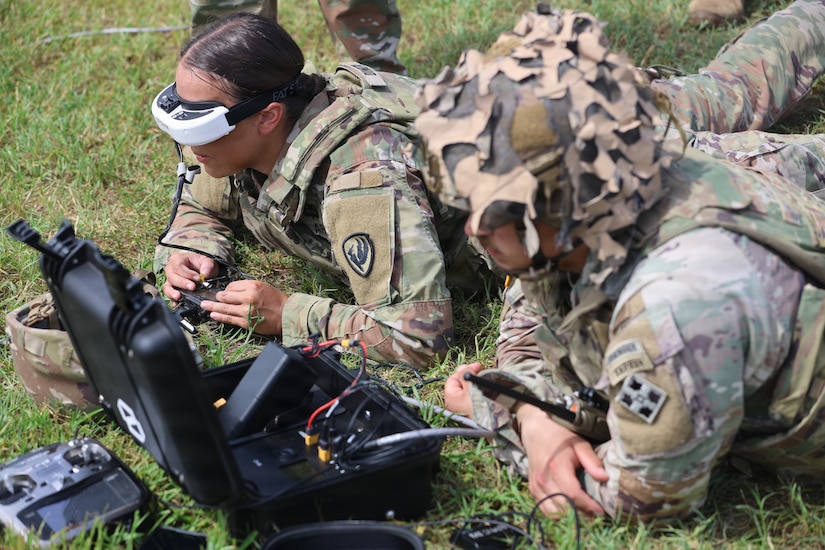
A woman wearing a camouflage military uniform and a tactical headset is lying in the grass in the prone position while a man in similar attire and a helmet looks at a computer screen.

Rostran said the leadership team is focused on refining instruction in response to student feedback to ensure the course delivers the advanced-level rigor it promises.

"We're continuing to improve the course," he said. "We're taking comments as we go and making sure [that] we're meeting the standards students expect. The goal is to make this the advanced course it claims to be."

Working alongside the team, Gatta is helping expand hands-on training and strengthen tactical application throughout the program.

"The most significant update is increasing the amount of physical, kinetic engagements from five to 12," he said. "We have been working to refine the overall course to run smoother and provide the most up-to-date data."

To meet the demand for advanced instruction, the course is shifting to a more tactical framework. Gatta noted the class will complete a culminating exercise this week at the drone training facility in Daleville, Alabama, marking a new experience for the students.

"This exercise will demonstrate a more real-world tactical environment and incorporate a close-quarters battle level of training, whereas previous emphasis has been heavily placed on outdoor live flights," he said. "Our current goal is to make the training more tactical in nature. I believe we have several solid plans to build on moving forward."

During this iteration of the course, students conducted live-engagement training using a purpose-built attributable system, the Shank 1.0, and C-4, a versatile plastic explosive. The event allowed students to apply lessons learned by flying the system, coordinating altitude and executing tactical employment against a designated target.

Army Sgt. 1st Class Riley Watts, assigned to Company A, 1st Battalion, 14th Aviation Regiment, spent months trying to enroll in the course. He said attending has given him a clearer view of how unmanned aircraft systems fit into the future of Army aviation.

"This is a great course to keep you relevant in today's force," Watts said. "Seeing how UAS is being implemented and utilized in today's Army is eye-opening, and it shows you how important it is to understand these systems."
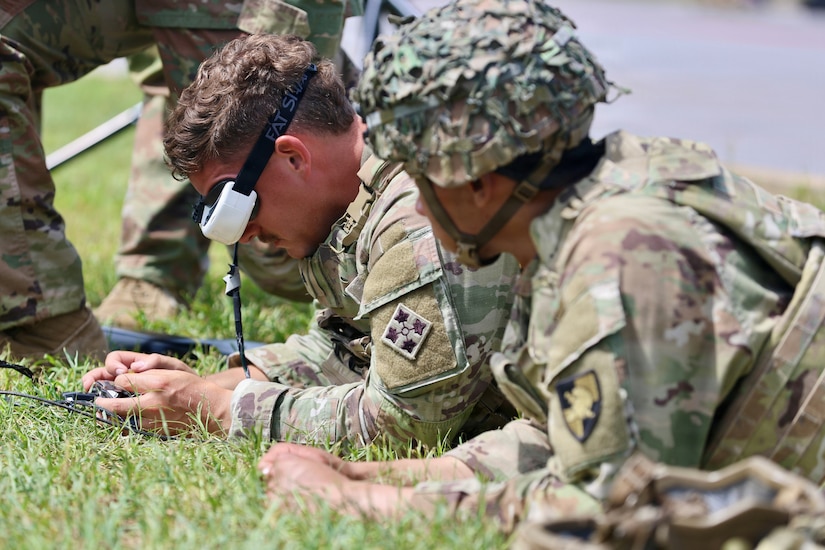
A man wearing a camouflage military uniform and a tactical headset operates a controller while lying in the grass alongside another man in similar attire who is watching.

Matthew Baldwin, a civil engineering major at the U.S. Military Academy, is attending to take tactical drone employment strategies back to the academy's future applied systems and tactics team. His leaders pushed to send two cadets to the course to expand their understanding of drone employment and to share that knowledge when they return.

Baldwin, who hopes to commission into the air defense artillery branch, said the course offers a perspective that will be important to future Army operations.

"One of the big questions is how to counter drones effectively," he said. "You're talking about sending a very expensive rocket to take out a cheap drone. Understanding drones from the operator's side, how they fly, what they look for, helps you understand how to counter them."

Although he arrived with limited tactical flying experience, he said the hands-on instruction has significantly boosted his confidence.

"I didn't know how to tactically fly. It's a completely different flying style," Baldwin said. "I feel better flying them, and now we're trying to develop a training program to help build other pilots on our team."

Beyond flying, Baldwin highlighted the value of the course's mission-planning segments.

"I've really appreciated the planning side, [the military decision-making process], troop-leading procedures, what goes into reconnaissance," he said. "I hadn't learned a lot of that yet. Going into my [fundamentals of small-unit operations] class and eventually into the Army, my knowledge base is definitely better now."

The Unmanned Advanced Lethality Course runs six times per fiscal year, providing recurring opportunities for soldiers seeking advanced UAS training. Upcoming course dates are Sept. 14-Oct. 2, and Nov. 2-20.

Navy to Decommission Littoral Combat Ship Fort Worth

The U.S. Navy will decommission Freedom-variant littoral combat ship, USS Fort Worth (LCS 3) during a ceremony held July 29 at 10 a.m. PDT at Naval Base San Diego.

As an operational unit and test platform, Fort Worth and its crew played an important role in the defense of our nation and maritime freedom. Fort Worth and its Sailors were key to determining the operational configuration and deployment capabilities of today's LCS platform.

The honorable Gordon England, former Secretary of the Navy, will deliver the decommissioning ceremony's principal address. Remarks will also be provided by U.S. Navy Rear Adm. Matthew Kawas, the ship's sponsor's proxy, Ms. Jill J.R. Labbe, and U.S. Navy Capt. (ret.) Warren Cupps.

The ceremony will honor the service and legacy of Fort Worth, as well as the professionalism and dedication of its Sailors and their families.

LCS' are fast, optimally manned, mission-tailored surface combatants that operate in near-shore and open-ocean environments, winning against 21st-century coastal threats. LCS integrates with joint, combined, manned, and unmanned teams to support forward presence, maritime security, sea control, and deterrence missions around the globe.

The LCS class consists of two variants, Freedom and Independence, designed and built by two industry teams. USS Fort Worth is a Freedom-class LCS, built in Marinette, Wisconsin. Austal USA leads the Independence-variant team in Mobile, Alabama, for LCS 6 and the subsequent even-numbered hulls.

By retiring early-hull test platforms like Fort Worth, the Navy redirects investments toward upgrading the remaining LCS inventory with enhanced capabilities. This strategy sustains the LCS program and underscores the Navy's commitment to building America's Fleet of the Future, ensuring the active ships remain relevant, combat-credible, and reliable throughout their service lives.

For 250 years, American naval power has projected strength globally, operating forward 24/7, 365 days a year. This operational tempo demands continuous capability, and the Fleet of the Future is our answer.

Join the ceremony live stream. https://youtube.com/live/-a-bWFo-Re8?feature=share

Media may direct queries to the Navy Office of Information at (703) 697-5342.

DIA Headquarters Auditorium Renamed for Intelligence Pioneer

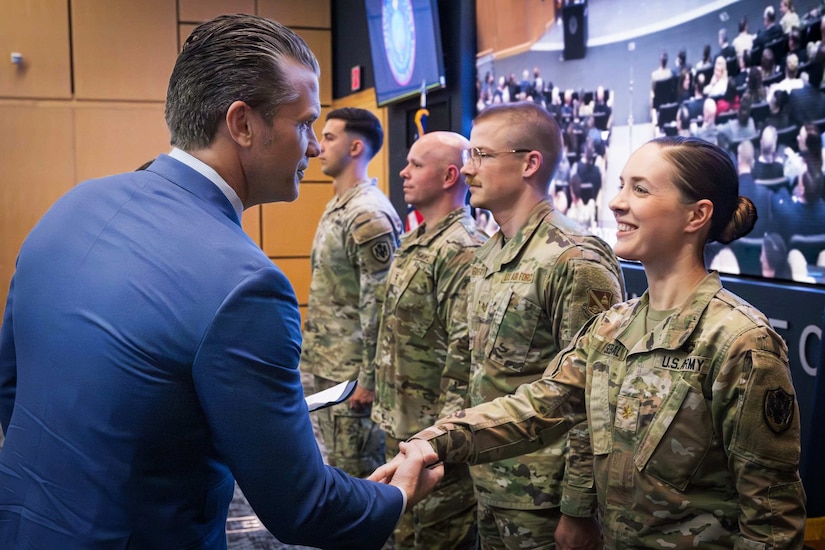
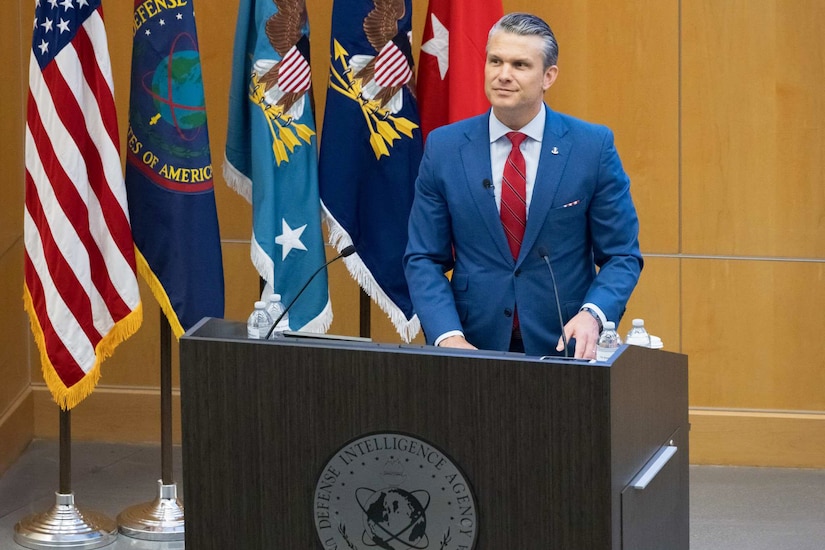
Secretary of War Pete Hegseth met recently with intelligence community professionals at Defense Intelligence Agency headquarters at Joint Base Anacostia-Bolling in Washington, to thank them for their work and to honor one of the earliest members of the intelligence community, Army Lt. Col. Thomas Knowlton.

A man in business attire shakes hands with a woman in a camouflage military uniform while three people stand alongside her in similar attire.

Within the headquarters, the agency renamed Clapper Leadership Hall to Thomas Knowlton Leadership Hall. 

"Thomas Knowlton was a warrior in the Continental Army and the father of American intelligence," Hegseth said. "It was Gen. George Washington, our first commander in chief and the nation's first true spymaster, who commissioned Knowlton in 1776 to form our military's first dedicated intelligence gathering unit. Washington understood that victory is won not just by steel and shot, but by secrecy, by deception and by foresight. He knew that accuracy and timely intelligence are the bedrock of strategic dominance." 

It was after a spree of debilitating defeats as a result of intelligence failures in early battles of the Revolutionary War that Washington recognized the Continental Army's need for an elite group whose sole objective was intelligence and reconnaissance.

A man in business attire stands behind a lectern and speaks into a microphone in an auditorium; the American flag and three other flags are behind him.

With that realization, Washington selected Knowlton as commander of the Continental Army's first intelligence unit, which would come to be known as Knowlton's Rangers.

Washington chose Knowlton as the unit's commander because of his experience as a scout in the French and Indian Wars and his leadership at the battles of Breed's Hill and Long Island. 

Consisting of 130 men and 20 officers, the unit was charged with conducting reconnaissance, carrying out raids against British facilities and other dangerous covert missions. 

Knowlton was killed in September 1776, while leading his men at the Battle of Harlem Heights. His contributions, and the creation of Knowlton's Rangers, are regarded as the birth of military intelligence.

Hegseth told the leaders that in the same way that Knowlton provided Washington with the intelligence needed to defeat the British during the American Revolution, today's intelligence community ensures that America's military has the intelligence it needs to make decisions every day. 

"I cannot do my job without the immense, tireless and often unheralded efforts that you put in every single day," he said. "The work done in these halls and behind these walls, across the globe by the defense intelligence community is the cornerstone ... of our national defense." 

During his visit, the secretary also provided coins to several military personnel and discussed with leaders how departmentwide transformation efforts, including restoring the warrior ethos, rebuilding the military and reestablishing deterrence, affect the defense intelligence community.