Friday, September 26, 2025

Maritime Medical Response: 129th Rescue Wing Stabilizes Mariner 700 Nautical Miles Offshore

Sept. 25, 2025 | By Air Force Master Sgt. Joseph Prouse, 129th Rescue Wing

A Guardian Angel pararescue team assigned to the 129th Rescue Wing, California Air National Guard, stabilized a Filipino mariner aboard the Panamanian-flagged cargo ship Grand Vega after reports of stroke-like symptoms during a two-day search and rescue operation approximately 700 nautical miles off the California coast. 
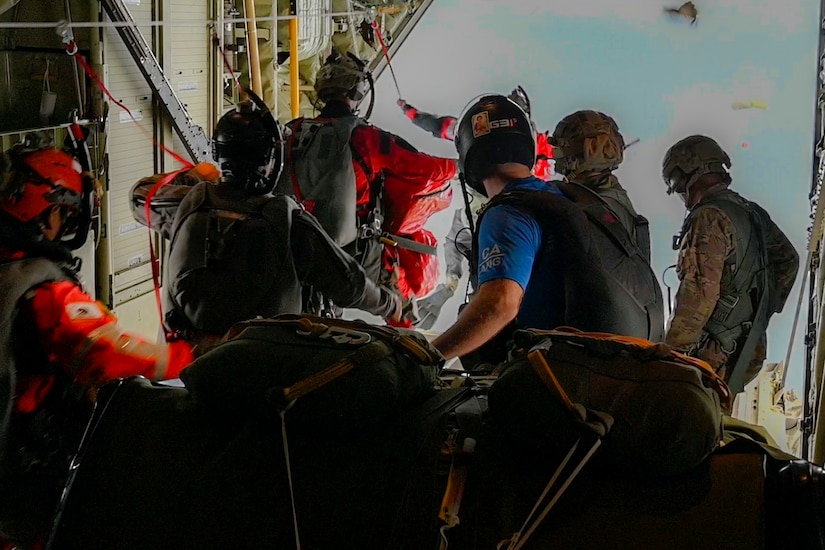
Four people stand at the door of an open aircraft and prepare to jump.

U.S. Coast Guard District 11 relayed the alert in coordination with the Air Force Rescue Coordination Center. The Grand Vega was crewed primarily by Filipino mariners. 

The wing launched an HC-130J Combat King II on Sept. 18, carrying five Guardian Angel team members — pararescuemen and a combat rescue officer — to plan for various sea state contingencies and ensure the team could access the ship upon arrival. Pre-mission planning emphasized multiple insertion options for varying sea states to ensure patient care would not be delayed by conditions. 

Four pararescuemen conducted a maritime parachute insertion with a boat package, accessed the vessel, and moved below deck to assess and stabilize the patient for transfer. A follow-on recovery package launched from Moffett Air National Guard Base the next morning. The package included one HH-60G Pave Hawk and one HH-60W Jolly Green II, while an additional HC-130J provided command-and-control and air-to-air refueling support. 
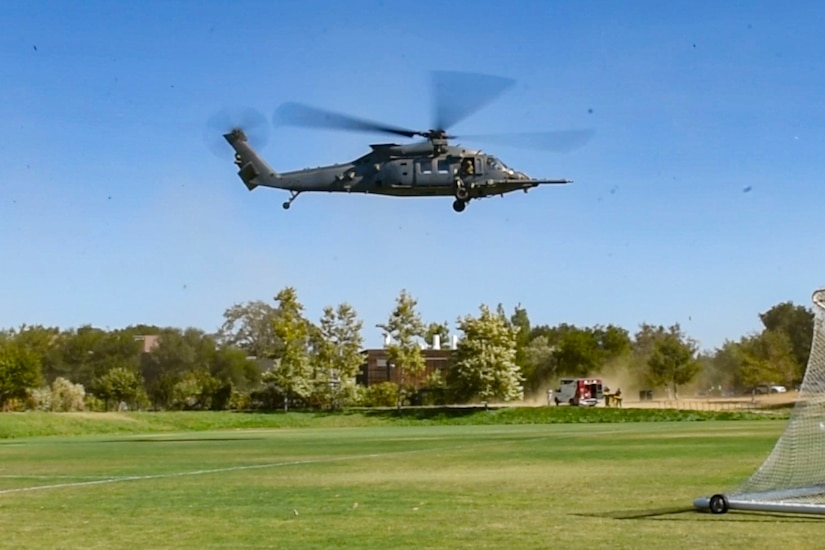
A helicopter hovers in a blue sky over a grassy field with trees in the background and a soccer goal in the foreground.

"This mission demonstrates disciplined planning, swift insertion and expert patient care at an extreme distance," said Air Force Maj. Coda Brown, 129th Operations Group. "Our Guardian Angel teams, rotary-wing crews and HC-130J aircrews integrate seamlessly with the U.S. Coast Guard to save lives when both minutes and miles matter."  

Brown noted that interagency cooperation is critical to maritime safety and security in the Pacific region. 

The patient was hoisted to a helicopter and transported to Stanford Hospital, where local paramedics were staged at the landing zone to complete the handoff for a higher level of care. Officials said the rapid transfer is expected to improve the patient's outcome. 

"I am incredibly grateful to be part of this mission, but most importantly, I am happy the patient received the care he needed, and all members returned home safely," said a pararescueman with the 131st Rescue Squadron. 

Unit officials said the operation is recorded as the wing's first life saved with the HH-60W and possibly the final life saved with the HH-60G, marking a conversion milestone for the 129th Rescue Wing. Unit leaders said this achievement underscores the wing's ongoing commitment to modernizing its fleet and maintaining high operational readiness, adding that the response reinforces the 129th Rescue Wing's enduring ties with key partner nations and allies, including the Philippines, and demonstrates the unit's commitment to saving lives. The mission's strategic effects build Pacific proficiency and validate the wing's vital role in the region. 
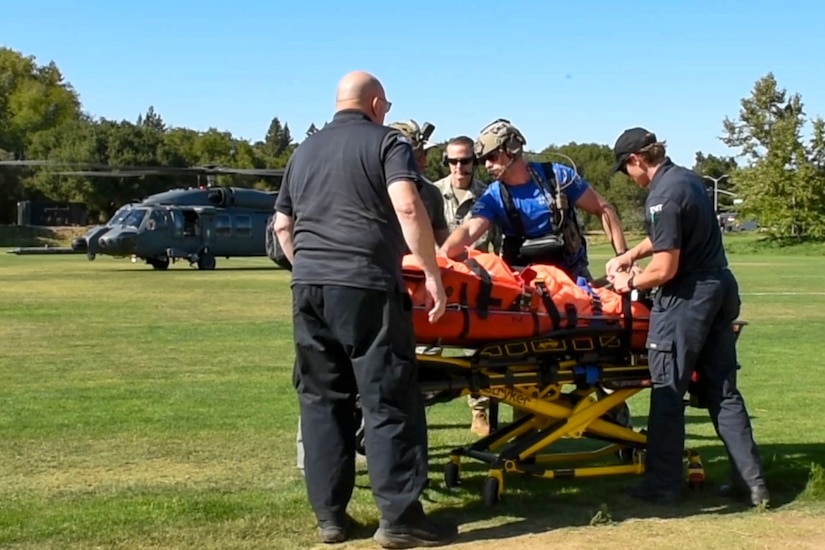
Five people secure a person to a medical transport stretcher in a grassy field with a helicopter behind them.

Behind the scenes, maintainers, weather and intelligence professionals, aircrew flight equipment specialists, logistics personnel, communications experts, command post staff and medical specialists enabled the response. 

The 129th Rescue Wing provides worldwide combat search and rescue, as well as civil search and rescue capabilities. The wing operates HH-60G/HH-60W helicopters, HC-130J aircraft and Guardian Angel teams in support of joint and interagency partners, including the Coast Guard. 

The mission marks the wing's 1,169th life saved.


Security Forces in Alaska Take Part in Specialized Training

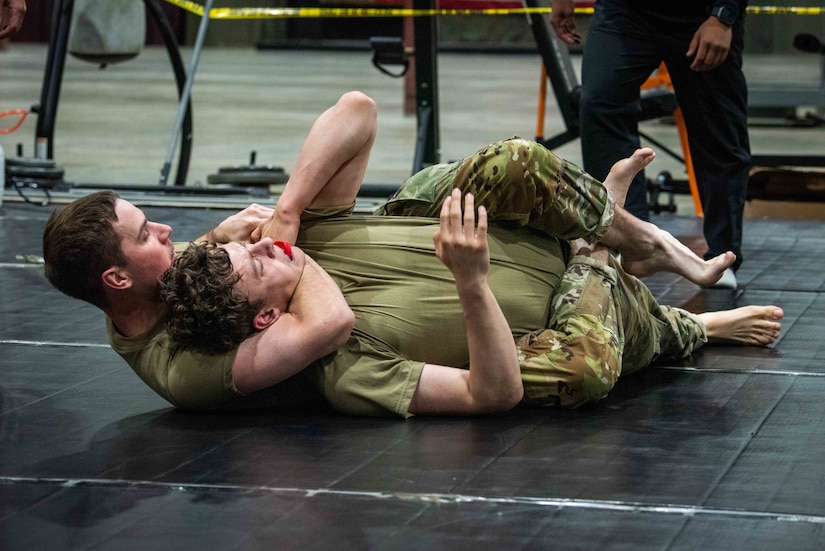
Eight airmen assigned to the 673rd Security Forces Squadron participated in a Fly Away Security Team training course at Joint Base Elmendorf-Richardson, Alaska, Sept. 15-19.

Two men dressed in camouflage military uniforms wrestle during combatives training. One man has a red bite guard in his mouth.

 
Fly Away Security Team training is a five-day, 40-hour course that challenges airmen physically and mentally to enhance their lethality while protecting aircraft, aircrew, cargo and distinguished visitors during operations on austere airfields. 
 
They aid in humanitarian missions and War Department operations; their missions typically involve providing a security perimeter around aircraft at unsecured, foreign airfields.

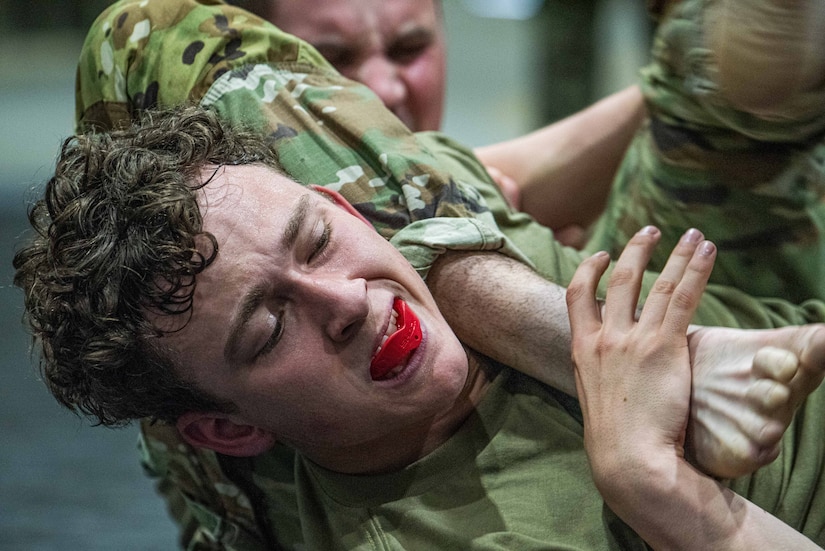
Two men wearing camouflage military uniforms wrestle during combatives training. One man has a red bite guard in his mouth.

 
"Fly Away Security is a certification that should carry a lot of weight — it is not for your average security forces member," said Air Force Staff Sgt. Taylor Davis, 673rd Security Forces Squadron noncommissioned officer in charge of small unmanned aircraft systems. "Here at [Joint Base Elmendorf-Richardson], we hold the FAST to a higher standard, and we train them at a higher standard; we train them to win." 
 
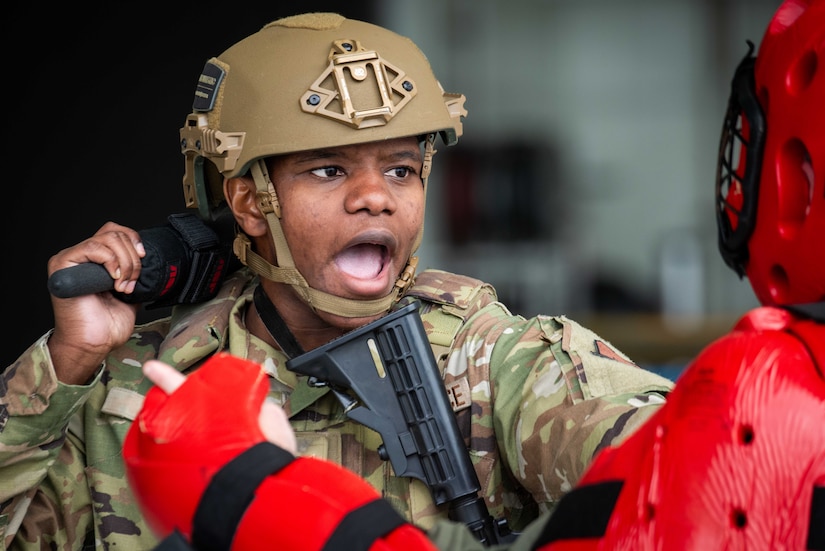
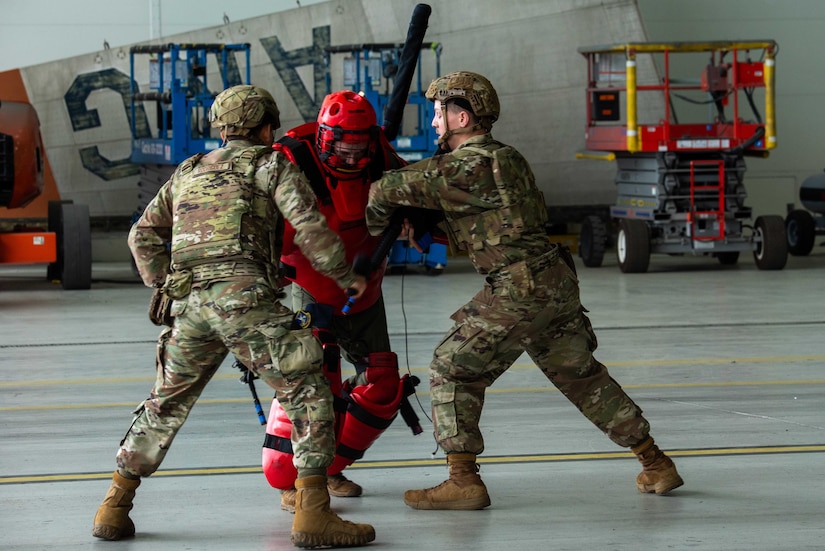
During the course, students undergo combat and hands-on training. They work through real-world simulations, demonstrating skills they have learned throughout the week. Some of the training included peer-on-peer wrestling, baton evaluation and flightline training with a C-17 Globemaster III assigned to the 517th Airlift Squadron.

A man wearing an advanced combat helmet and camouflage military uniform swings a baton at a person wearing a red padded suit during baton combatives training.
Two men wearing advanced combat helmets and camouflage military uniforms push a person dressed in a red padded suit and helmet during combatives training.
"We train our members to go out to these austere locations or airfields that do not have adequate security," said Air Force Tech. Sgt. Adam Stanley, 673rd Security Forces Squadron base defense noncommissioned officer in charge. "They have been trusted in protecting personnel and assets to provide a safer environment within their area of responsibility." 
 
The 673rd Security Forces Squadron conducts FAST training courses multiple times a year, not only for its own members but also for other Air Force units. They plan to expand the program to enhance security for airfields and aircraft.

Green to Gold: Alaska Guardsman Embarks on Path to Leadership

The leaves aren't the only thing changing in Alaska this fall. For Cadet Gabriel Gravel, an Alaska National Guardsman attending the University of Alaska Anchorage, transformation is also happening on his journey from enlisted soldier to officer candidate through the Army's Green to Gold program.

Gravel joined fellow ROTC cadets from his school, as well as the University of Alaska Fairbanks, for the annual joint fall field training exercise at Joint Base Elmendorf-Richardson, Alaska, Sept. 17-20. During the multiday event, cadets were challenged with land navigation, patrolling and obstacle courses, all while developing the leadership traits needed to earn a commission. 

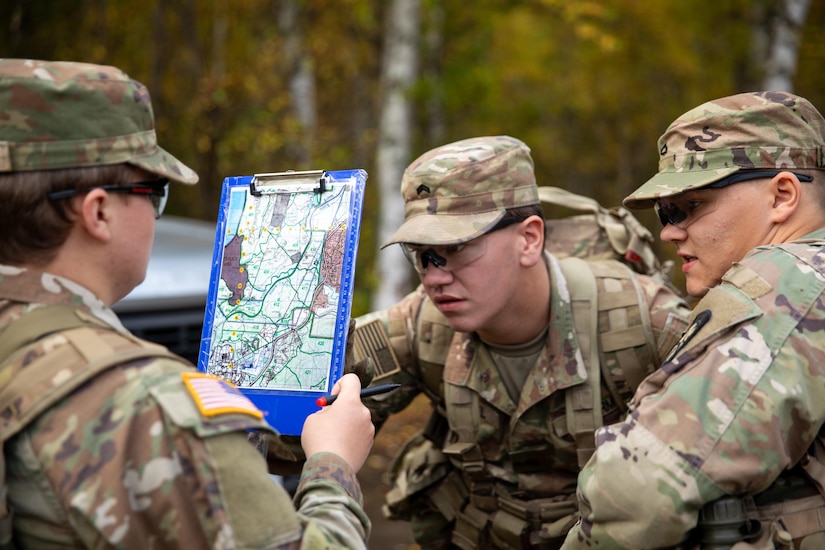
Two soldiers wearing camouflage military uniforms look at the back of a clipboard, while another soldier in similar attire holds it up while looking at a map attached to the clipboard.

The Green to Gold program provides enlisted soldiers with the opportunity to pursue a college degree while preparing to become Army officers. For Gravel, the transition builds on years of exposure to the Army, first in Junior ROTC, then as an enlisted soldier before stepping into the cadet role. 

"When I was in JROTC, I talked to senior and retired officers — lieutenant colonels and majors," he said. "I picked their brains, and it led me toward something I wanted to do." 

Additionally, Gravel said his enlisted experience provides an advantage in ROTC training and defines the type of officer he wants to become.

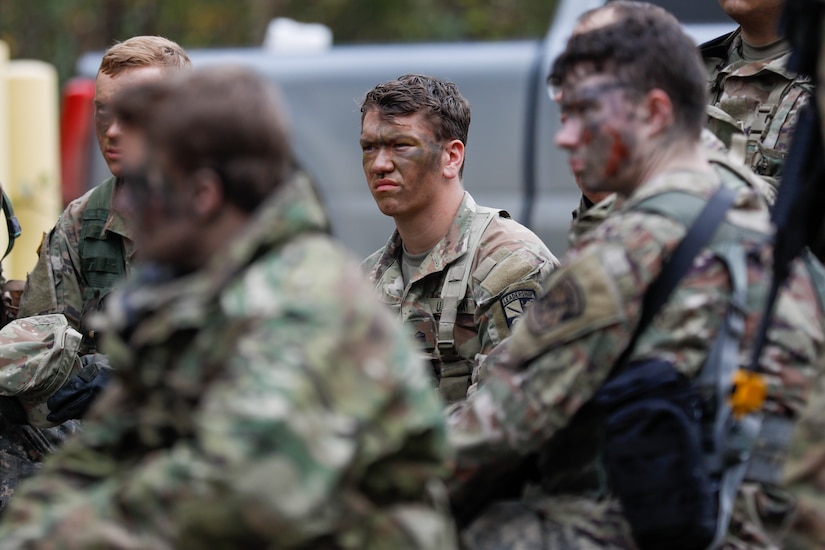
A group of soldiers wearing camouflage military uniforms and face paint, sits and listens to a person not pictured.

"I want to be a humble officer [who] can work together with [noncommissioned officers]," he said. "Overall, officers' knowledge complements NCOs' skills." 

That perspective guided him through the field training exercise as he leaned on lessons learned from the enlisted side of the Army. The exercise reminded Gravel that leadership is about teamwork, not individual achievement.

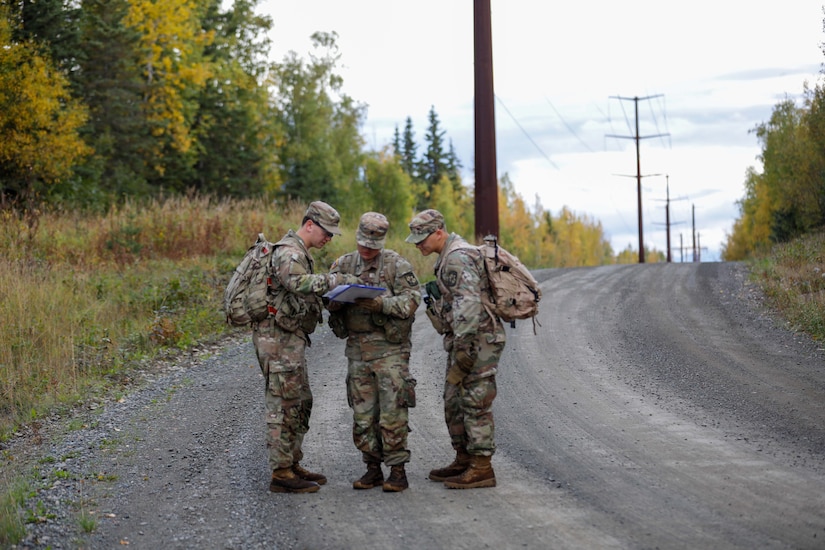
Three soldiers wearing camouflage military uniforms and backpacks stand on the side of a gravel road looking at a map attached to a clipboard.

"No matter how you think — it should end up with one common goal and you're all going to get it done together," he said. 

Gravel credits his peers for building his confidence, even when facing obstacles like the rope climb. 

"By the end of the [exercise], I was way more confident," he said. "Everybody trusted me more than I trusted myself." 

Looking back, Gravel said the experience reinforced both humility and resilience. He encourages other cadets to embrace the challenge. 

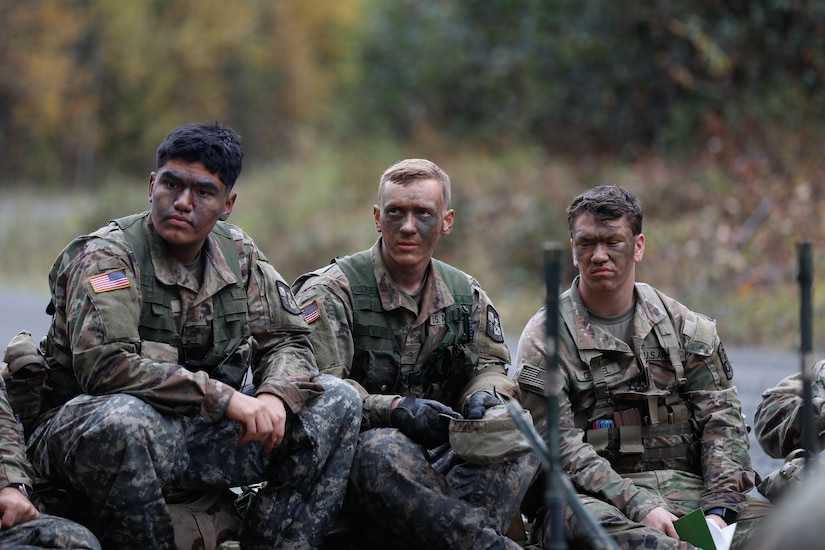
Three soldiers wearing camouflage military uniforms and face paint sit while looking to their left.

"Don't be afraid to embrace the suck," he said. "It might be raining, it might be 120 degrees, but the best thing is that you're doing it with other cadets next to you." 

Ultimately, for Gravel, the Green to Gold program is more than a path to a commission. It is a journey where lessons from enlisted service meet the challenges of officer training, shaping a leader who values trust, teamwork and courage. 

"They are going to rely on me, so I have to believe in myself to achieve the mission," he said. "No matter what, I'll always do what's necessary for both me and my battle buddies to accomplish our mission." 

U.S. Navy to Christen Future USS Louis H. Wilson Jr.


SEPT. 26, 2025 The U.S. Navy will christen the future USS Louis H. Wilson Jr. (DDG 126), during a ceremony at General Dynamics Bath Iron Works (BIW) on Saturday, September 27, at 10:30 a.m. (EST).

The principal address will be delivered by Commandant of the Marine Corps, Gen. Eric Smith; Additional speakers include Governor of Maine, Janet Mills; U.S. Senator of Maine Angus King; Assistant Secretary of the Navy for Research, Development, and Acquisition, Jason Potter; Deputy Chief of Naval Operations for Integration of Capabilities and Resources, Vice Adm. Brad Skillman; Medal of Honor Recipient, Col. Harvey C. Barnum, Jr.; and President of General Dynamics Bath Iron Works, Chuck Krugh.

In a time-honored tradition, ship sponsors Janet Wilson Taylor, daughter of the namesake and Susan J. Rabern, former Assistant Secretary of the Navy for Financial Management and Comptroller, will christen the ship by breaking a bottle of sparkling wine across the bow.

The ship is named after Gen. Louis Hugh Wilson Jr., a World War II and Vietnam War veteran who was awarded the Medal of Honor for his heroism during the Battle of Guam. Following his service in Vietnam, he served as the 26th Commandant of the Marine Corps from 1975 to 1979.

The christening of DDG 126 symbolizes the Navy's 250-year commitment to innovation and maritime dominance. From seabed to space, the Navy delivers power for peace – always ready to fight and win. This milestone marks the Navy's enduring legacy and commitment to shaping the future of maritime power.

Arleigh Burke-class Flight III destroyers feature the AN/SPY-6(V)1 Air and Missile Defense Radar and incorporate upgrades to the electrical power and cooling capacity plus additional associated changes to provide enhanced warfighting capability to the fleet. Future destroyers Harvey C. Barnum Jr. (DDG 124), Patrick Gallagher (DDG 127), William Charette (DDG 130), Quentin Walsh (DDG 132), John E. Kilmer (DDG 134), Richard G. Lugar (DDG 136), and J. William Middendorf (DDG 138) are also in production at BIW.

Media may direct queries to the Navy Office of Information at (703) 697-5342.