Monday, June 29, 2026

USS Theodore Roosevelt Hosts International Helicopter Exchange

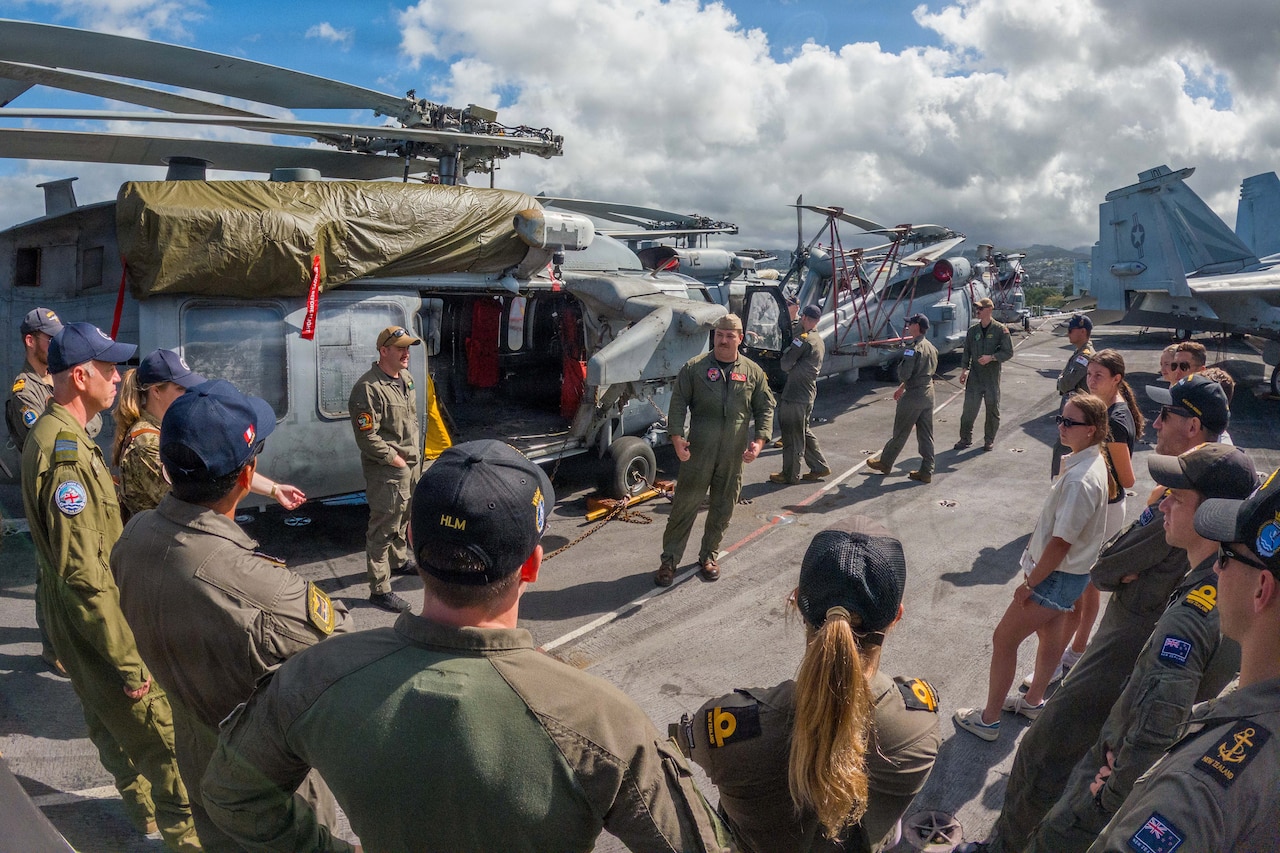
Two men in military flight suits stand in front of a military helicopter as a large group of people wearing flight suits and a couple of people in civilian attire look on.

The aircraft carrier USS Theodore Roosevelt hosted more than 45 international partners from eight countries during an international helicopter warfighter exchange at Joint Base Pearl Harbor-Hickam, Hawaii, June 27, 2029, as part of Exercise Rim of the Pacific.

During the visit, military pilots from the U.S., South Korea, Italy, Peru, Chile, New Zealand, Australia, Canada and Mexico compared procedures, discussed aviation challenges and strengthened relationships. The event was designed to build trust, improve communication and support cooperation among the different countries.

"We're privileged to host the international helicopter exchange aboard the Theodore Roosevelt," said U.S. Navy Cmdr. Andrew Poulin, USS Theodore Roosevelt strike operations officer. "It's a great opportunity to showcase naval aviation and work with our partners from different countries."
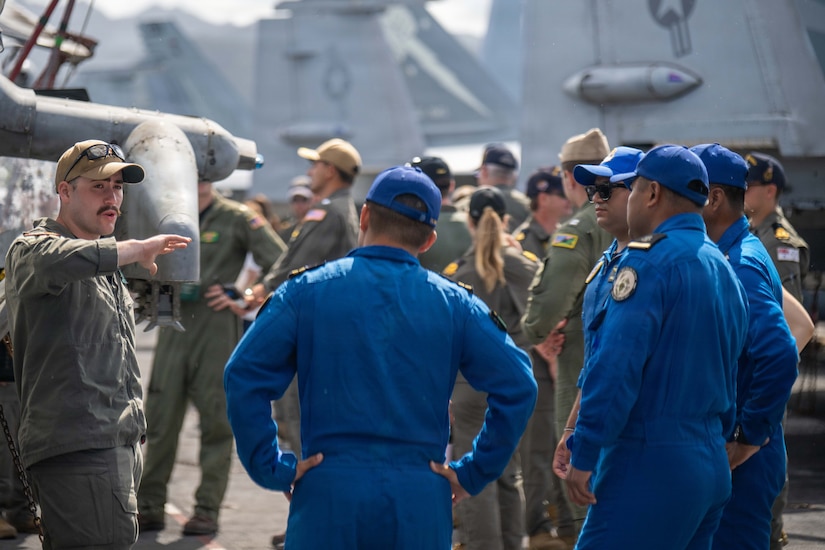
A man in a brown military uniform gestures near a group of four men dressed in blue flight suits while standing on the flight deck of a Navy aircraft carrier.
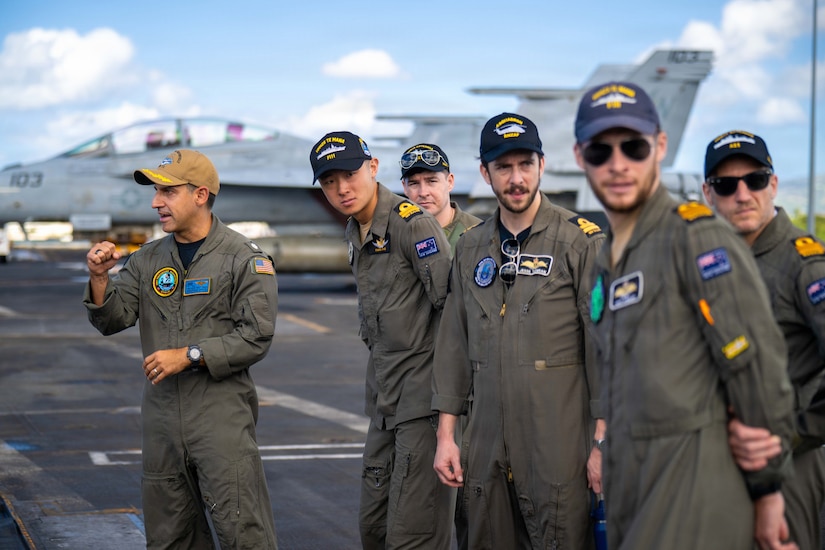
A group of men in military flight suits look to their left down the flight line of an aircraft carrier while another man in similar attire is looking to the right.
Sailors assigned to the Roosevelt highlighted flight deck procedures, launch and recovery operations and the coordination required to operate aircraft safely, while visiting sailors observed how U.S. embarked aviation units work in unison.

"It's been a great experience for helicopter pilots to exchange ideas, share flight experiences, learn about different cultures and get to know more people," said Peruvian Navy Cmdr. Antonio Gonzáles.

During the exchange, visiting sailors were taken to the hangar bay, flight deck and navigation spaces. The locations on the tour route all play a role in flight operations aboard the Theodore Roosevelt.

"We're grateful for the opportunity to participate in exercises like this, which allow us to improve our tactical skills and build relationships with other navies," said Mexican Navy Lt. j.g. Francisco Valencia.
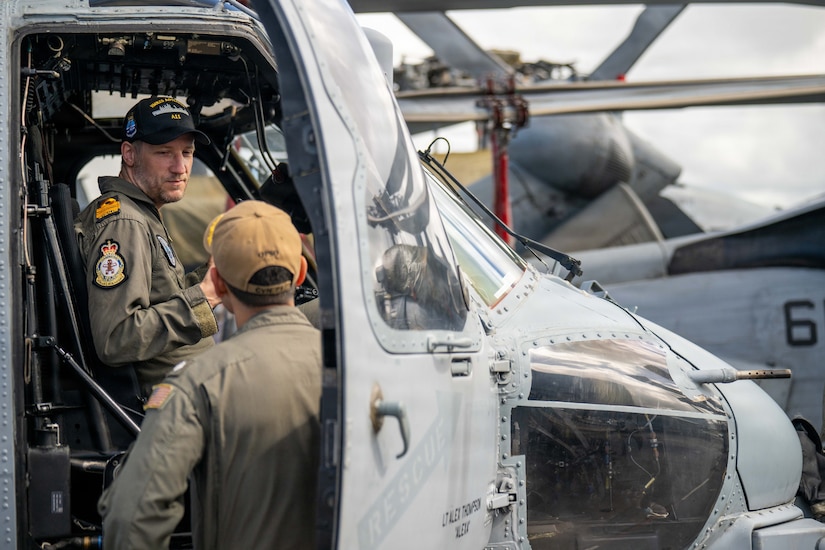
:  Two men in military flight suits talk to each other while one of them is sitting in the cockpit of a military helicopter.

The Roosevelt is participating in Rimpac to enhance readiness, strengthen partnerships and support regional security across the Indo-Pacific region. Thirty nations, over 30 surface ships, five submarines, 15 national land forces, more than 206 aircraft and 30,000 personnel are participating in the exercise taking place in and around the Hawaiian Islands from June 24-July 31.

The world's largest international maritime exercise, Rimpac provides a unique training opportunity while fostering and sustaining cooperative relationships among participants critical to ensuring safety of sea lanes and security on the world's oceans. This year's exercise is the 30th iteration in the series that began in 1971.

Medal of Honor Monday: Army Pvt. Elden Harvey Johnson

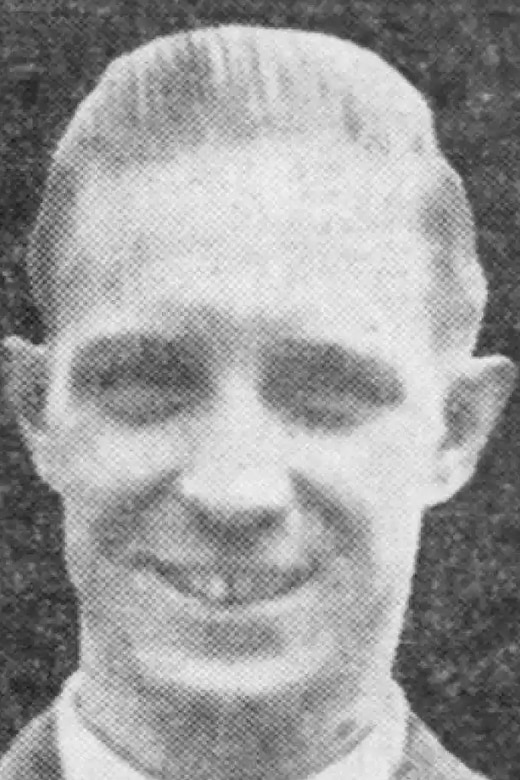
Army Pvt. Elden Harvey Johnson fought in the 1944 Italian Campaign of World War II as an infantryman and was posthumously awarded the Medal of Honor for his extraordinary heroism.

A man smiles and poses for a photo.

Johnson was born in Bivalve, New Jersey, Feb. 13, 1921, and grew up in East Weymouth, Massachusetts.

He enlisted in the Army in April 1943, at age 22, shortly after the United States entered World War II. Later that year, after completing basic training, he shipped out to Italy as a replacement soldier assigned to Company H, 15th Infantry Regiment, 3rd Infantry Division.

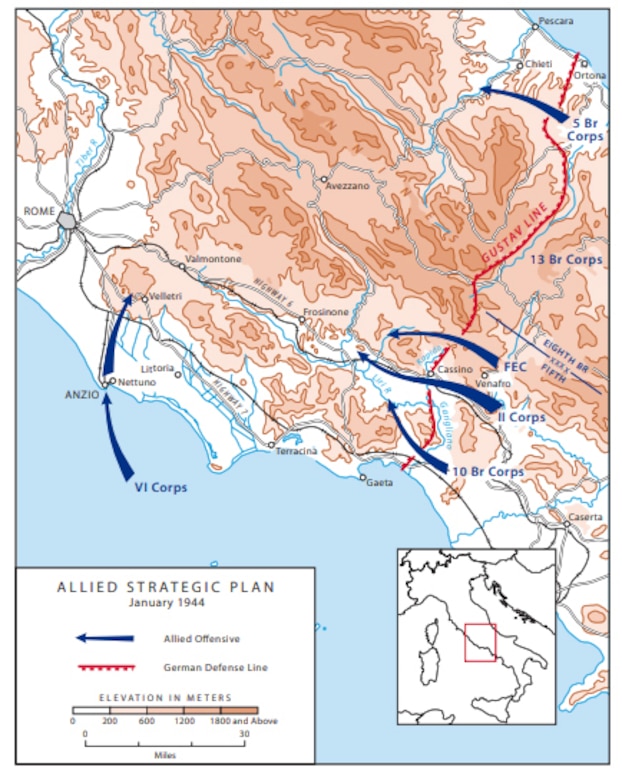
Johnson was part of the Rome-Arno Campaign, which began Jan. 22, 1944, and lasted until Sept. 9, 1944.

While on patrol June 3, 1944, his unit was attacked near Valmontone, Italy, about 30 miles southeast of Rome — three days before the D-Day invasion of Normandy, France.

It was night, but the area was brightly illuminated by enemy flares. Despite the enemy fire directed at him, Johnson advanced beyond the enemy in a slow, deliberate walk. He fired his rifle from his hip, distracting the enemy enough for 12 of his fellow soldiers to escape. Once he was within about 5 yards of the German machine gun position, Johnson killed the crew.

A map depicts terrain and military movements during World War II. The key in the corner reads, "Allied Strategic Plan, January 1944."

His Medal of Honor citation reads in part:

"Johnson elected to sacrifice his life in order that his comrades might extricate themselves from an ambush. Braving the massed fire of about 60 riflemen, three machine guns and three tanks from positions only 25 yards distant, he stood erect and signaled his patrol leader to withdraw."

Standing in full view of the enemy, Johnson reloaded, turned to the riflemen to the left and fired directly into their positions.

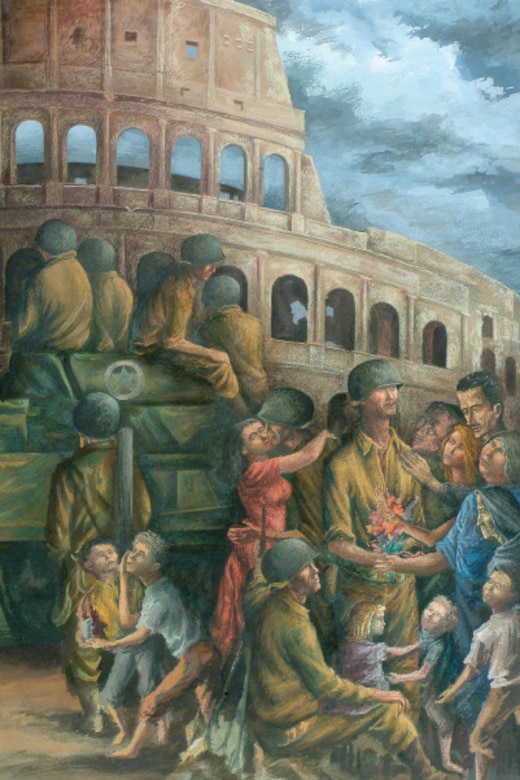
A painting depicts World War II-era soldiers near the Coliseum in Rome.
"He either killed or wounded four of them. A burst of machine-gun fire tore into Johnson, and he dropped to his knees. Fighting to the very last, he steadied himself on his knees and sent a final burst of fire crashing into another German. With that, he slumped forward dead," the citation states, noting that Johnson's acts of valor were an inspiration to the entire command.

Army Gen. Sherman Miles presented Johnson's Medal of Honor to his mother, Althea Bernice Johnson, May 30, 1945, in Boston.

Johnson was buried at Union Cemetery in Scituate, Massachusetts.

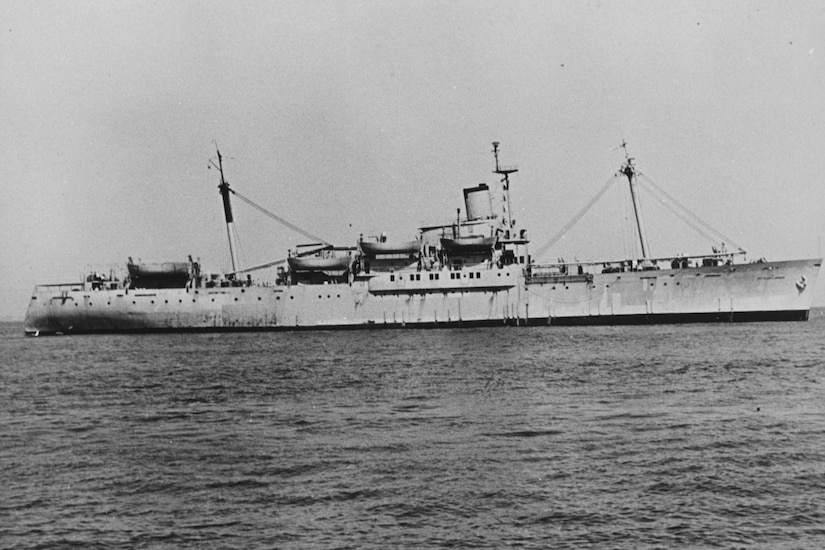
The former transport ship USS Pinkney was transferred to the U.S. Army Transportation Service in 1946 and recommissioned as the USAT Private Elden H. Johnson in 1947. The ship was reacquired by the Navy in 1950 and placed in service as the USNS Private Elden H. Johnson under the Military Sea Transportation Service. It went out of service in 1957.

For nearly 50 years, Johnson Barracks in Fürth, Germany, was named for him. The Army installation housed the 16th Engineer Battalion, quartermaster offices and other administrative and support functions. The installation was sold back to the Germans in the early 2000s and is now a business park. Additionally, Weymouth is the only town in the U.S. with five Medal of Honor recipients: Johnson, Thomas W. Hamilton, William Seach, Frederick C. Murphy and Ralph Talbo.

A large ship sails in the ocean.

On May 26, 2025, the city dedicated five bronze statues to honor them at the Ralph Talbot Amphitheater in Weymouth, which is adjacent to a veterans memorial wall that lists the names of city residents who have served during times of war.