Monday, November 02, 2026

Face of Defense: Marines Earn Top Honors at Drill Instructor School, Bring Elite Standards Home

Marines assigned to Blount Island Command earned two of three honor graduate spots in their drill instructor school class and brought leadership lessons back to Marine Corps Support Facility Blount Island, Fla.  

Marine Corps Staff Sgt. Alexa Vuturo and Sgt. Dylan Burge led Marines through endurance drills in humid morning air Oct. 2  at the installation in Jacksonville, Florida, then turned to the standards they uphold every day.  

Marine Corps Staff Sgt. Alexa Vuturo and Sgt. Dylan Burge
Two Marines in camouflage pants and green T-shirts walk outside at a military installation on a sunny day.
Job: Logistics
Stationed: Marine Corps Support Facility Blount Island, Fla.
Unit: Blount Island Command

"It doesn't matter where you are, a standard is a standard," Burge said, kneeling among Marines between an obstacle course and a row of palm trees dedicated to maritime prepositioning ships. "The standard you walk past is the standard you accept."  

Vuturo and Burge graduated Sept. 24 with drill instructor school class 4-26 at Marine Corps Recruit Depot Parris Island, South Carolina.  

Vuturo finished second academically and earned the leadership award. Burge finished third academically and received the Ironman award for physical excellence. Fourteen Marines from the command made the more-than-three-hour drive to attend the ceremony.  

Setting the Standards 

Both Marines volunteered for drill instructor duty. The 11-week school prepares Marines to train recruits, developing their leadership, instructional skills and physical conditioning. They are scheduled to leave Blount Island in the weeks ahead.  

A Marine leads a talk with other Marines outside while they sit on the grass at a military installation.

"I wanted to create the standard for the recruits," Vuturo said, "just as it was created for me, by my drill instructors. Plus, I wanted to push myself — get over a hump that I didn't think was possible." 

A Marine Corps martial arts program instructor-trainer and the command's physical training representative, Burge led a three-week course in May that certified four martial arts instructors. He said drill instructor school also tests physical fitness, mental readiness and character.  

Passing the Parris Island Grit Test 

Burge said even an assignment in Florida could not prepare him for the summer heat radiating from the Parris Island parade deck. He had heard plenty about "sand fleas," tiny biting midges found near marshes and nicknamed "flying teeth."  

"And the fire ants, nobody tells you about the fire ants," he said.  

Three Marine stand and a fourth sits on the grass, forming a circle. Trees and wooden beams are in the background.

Back at Blount Island, about two dozen Marines completed shamrock drills, a high-intensity endurance workout, before noncommissioned officers led three small-group discussions on leadership, standards and unit cohesion. The discussions focused on "sustaining the transformation" — reinforcing the values and discipline instilled during initial training throughout a Marine's career.  

Upholding Excellence in Global Logistics 

Vuturo and Burge apply those standards in their work at Blount Island Command, which maintains, modernizes and distributes equipment and supplies across the Marine Corps' global positioning network.  

In the command's aviation branch, Burge manages the individual material readiness list, assessing the support equipment needed to maintain aircraft readiness. Vuturo's supply responsibilities include accountability for forward-positioned materiel in Norway.  

For Vuturo, leadership starts with consistent effort.  

"You never have to be the best in the class; you just have to give your best every day," she said.  

"On Blount Island, there's a lot of moving parts and working with other organizations, units and people in other countries," Vuturo said. "Giving my best will make sure the Marines doing the exercises are getting the best possible experience they can."

Idaho Army National Guard Conducts Remote Rescue Mission

The Idaho Army National Guard assisted with a search and rescue mission near New Meadows, Idaho, Oct. 29, marking the second time in as many months the team has supported local fire and emergency medical services in a remote part of the state.

Two people in camouflage military uniforms, aviation helmets and gloves help a woman in casual attire out of a military helicopter and onto a tarmac.

In the afternoon, an HH-60 Black Hawk crew hoisted a 46-year-old woman, who had suffered a broken ankle on a hiking trail, and transported her to the airport. Fire and emergency medical services then transported her to a medical center for further treatment.

"That's a very remote area, and there's no way to get any kind of vehicle in there, even a dirt bike," said Doug Buys, Meadows Valley Fire and EMS chief. "With the extent of her injuries, we decided, if possible, we were going to try to airlift her out of there."

Buys said the last time someone was rescued near that same spot, it took seven to eight hours due to the complex terrain.

The Idaho Army National Guard previously assisted the agency in September with another remote rescue mission involving a hunter who punctured his calf after an arrow fell out of his quiver.

"We very much appreciate the Idaho Army National Guard helping us twice now," Buys said. "It's best for the patient. It definitely helps rural Idaho as it grows to help protect the recreationists who come out here. Without the help of the Idaho National Guard, I'm not sure what we would have done."

Idaho Army National Guard HH-60 Black Hawk helicopters provide search and rescue agencies throughout Idaho with a unique capability. These aircraft allow crews to operate at high elevations and are equipped with hoists capable of rescuing people from rugged and inaccessible terrain.

The Idaho Army National Guard operates the only helicopters in the state with this hoist capability. The team has completed 17 successful search and rescue missions this year, including four in October.

Medal of Honor Monday: Marine Corps Maj. Ross Lindsey Iams

A man in a military dress uniform poses for a photo.

Marine Corps Maj. Ross Lindsey Iams received the Medal of Honor for his courageous acts of valor as a sergeant while fighting a Haitian rebel force in 1915. 

Iams was born April 5, 1881, in Graysville, Pennsylvania, to William Lindsey Iams, a farmer, and Elizabeth Iams.

On Jan. 29, 1901, after graduating from high school, he enlisted in the Marine Corps. Later that year, he sailed to China to suppress the Boxer Rebellion and then to the Philippines, where he participated in the Philippine-American War. 

He provided naval security at the Mare Island Naval Shipyard in Vallejo, California, from 1904 until 1907. He was then assigned to the Marine Barracks in Norfolk, Virginia, until 1913, where he deployed aboard several Navy ships. 

Veracruz Marines ride on a flat car.

In 1914, he participated in the invasion and occupation of Veracruz, Mexico.

Iams married Elizabeth Sarah Craft, Jan. 2, 1915, and they had two children, both of whom served in the military during World War II.

Small boats sail from a large ship toward shore.

Later in 1915, Iams, assigned to the 5th Marine Company, 5th Marine Regiment, arrived in Haiti aboard the battleship USS Connecticut to help stop an uprising by nationalist rebels known as Cacos. 

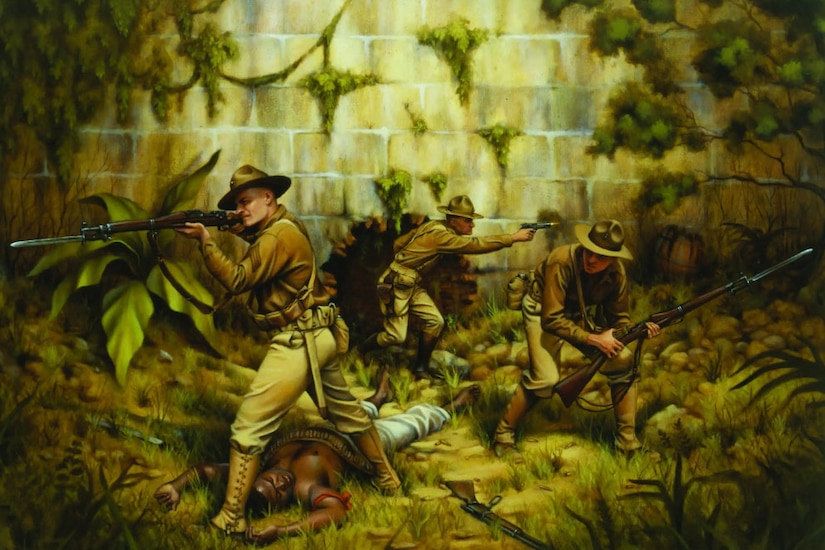
On Nov. 17, 1915, three Marine companies attacked Fort Riviere in northern Haiti. Iams, then a sergeant, was the first to charge into a small breach in the fort's wall, despite intense enemy fire.   

Once inside, a melee ensued for about 10 minutes, with the Marines engaging the rebels in hand-to-hand combat before ultimately seizing the fort.

A painting depicts three uniformed men with guns pointed at natives outside beside a wall.

Assistant Secretary of the Navy Franklin D. Roosevelt recommended Iams, Marine Corps Pvt. Samuel Gross, the second to charge inside the fort, and Marine Corps Maj. Smedley D. Butler, commander of the three companies, to receive the Medal of Honor for their actions. 

Iams and Gross received their medals June 22, 1917, in Port-au-Prince, Haiti, and Butler received his June 17, 1916. At the time of the award, Iams was a sergeant major. 

When the U.S. entered World War I, April 6, 1917, Iams was sent to Marine Corps Base Quantico, Virginia, to train infantry officers for combat.  

A year later, he was promoted to gunner, a Marine Corps warrant officer rank and sent to France as a member of the 13th Marine Regiment, 5th Marine Brigade. The brigade participated in rear-area security duty. 

Iams was promoted to captain and remained in France as part of the occupational forces before returning to the U.S. in 1919. 

He was stationed at Marine Barracks, San Diego from 1920 until 1922, now known as Marine Corps Recruit Depot San Diego, where he trained enlisted recruits. The installation is one of two Marine Corps enlisted training bases; the other is Marine Corps Recruit Depot Parris Island, South Carolina. 

He finished his initial military service with stops at Guantanamo Bay, Cuba; a return to Norfolk, Nicaragua, Shanghai and then back to Quantico to again oversee officer training before retiring in 1932 as a captain. 

Iams was recalled to active duty in 1942 during World War II to train Marines for combat in the Pacific theater. He retired shortly thereafter for the final time as a major. 

He died March 29, 1952, and was buried at Fort Rosecrans National Cemetery in San Diego. His wife, who died Jan. 2, 1982, was buried alongside Iams. 

USS George Washington Sailors Vote While Deployed

 Nov. 2, 2026 |U.S. Naval Forces Central Command

Sailors aboard the aircraft carrier USS George Washington voted during a voting rodeo event held in the ship's library last month.

A man in a dark blue military uniform looks down and votes.

Navy Chaplain (Lt.) Steven Matkins, the U.S. Naval Forces Central Command's voting assistance officer, organized the event for the sailors currently deployed to the U.S. 5th Fleet area of operations. 
 
"We have sailors from all backgrounds working as a team, and oftentimes, we're so far away from home, we think things don't affect us," Matkins said. "When you give people the opportunity to vote, you see how much we really care about things back home." 
 
Navy Capt. Nicholas DeLeo, the ship's commanding officer, said casting a ballot means participating in something far greater than self. 
 
"The opportunity to vote while deployed … is profound. It allows our sailors to directly exercise the very rights and freedoms they have sworn to defend," he said. "No matter how far from home, every sailor can still participate in our nation's elections — a powerful reminder that those who safeguard our republic are never excluded from it." 
 
Regardless of location or mission demands, DeLeo said the sailors recognize voting as a fundamental civic duty that directly shapes our nation's future, their forward-deployed operations and their own careers.

A man in a dark blue military uniform poses while holding a voting ballot.

Navy Seaman Gavin Naab, an information systems technician assigned to the George Washington, voted for the first time during the election rodeo. He said he was genuinely excited to participate in the democratic process. 
 
"Your ballot can directly affect the policies enacted both at home and abroad, which has the power to alter the trajectory of your career, international affairs and history as a whole," Naab said. 
 
The George Washington is deployed to the U.S. 5th Fleet area of operations, supporting maritime security and stability in the Middle East.