Monday, April 13, 2026

Medal of Honor Monday: Spanish-American War Heroes

Many heroic actions took place during the Spanish-American War in the late 19th century. One such action was the Battle of Tayabacoa, Cuba, a special operation effort to land supplies and reinforcements, which resulted in four Buffalo Soldiers receiving the Medal of Honor.

The battle took place June 30, 1898, when 30 Cuban freedom fighters and U.S. soldiers aboard the Army transport steamships Fanita and Florida and the gunboat USS Peoria made an amphibious landing at Tayabacoa.
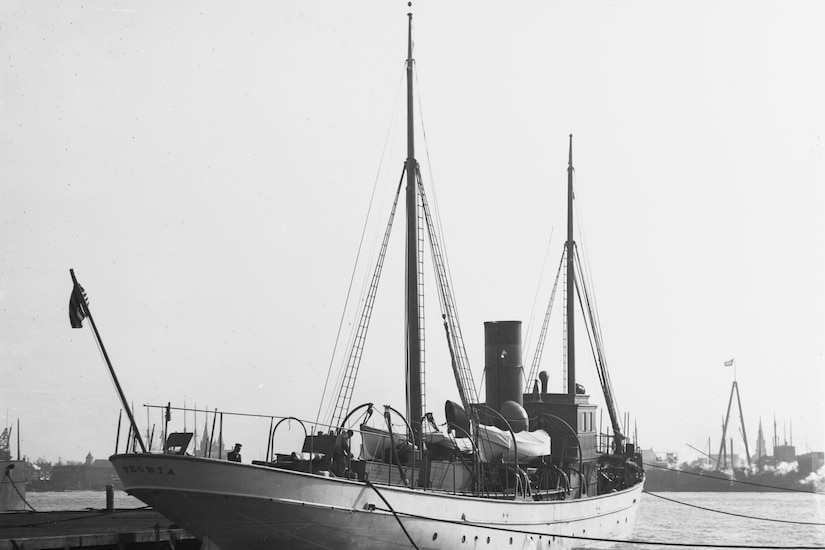
A black and white photo of a small military ship tied to a dock in a harbor.

Four miles west of the town, at the mouth of the Tallabacoa River, was a heavily defended Spanish fort. The Peoria lobbed cannonballs at the fort, but the damage was light.

The 30 fighters crept into the jungle on a reconnaissance mission but were discovered by Spanish scouts and soon came under heavy enemy fire, causing them to retreat.

The party took cover in a mangrove swamp. Maximilian Lund, a Danish surgeon, swam out to the Peoria to report that the survivors needed assistance, as some were wounded and their rowboats had been sunk by Spanish fire.

The first four rescue attempts failed due to heavy enemy fire. The fifth attempt was made under the cover of darkness.
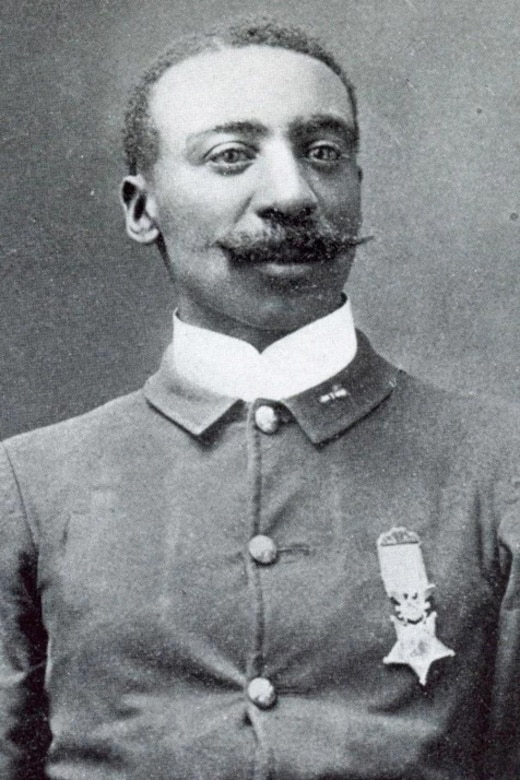
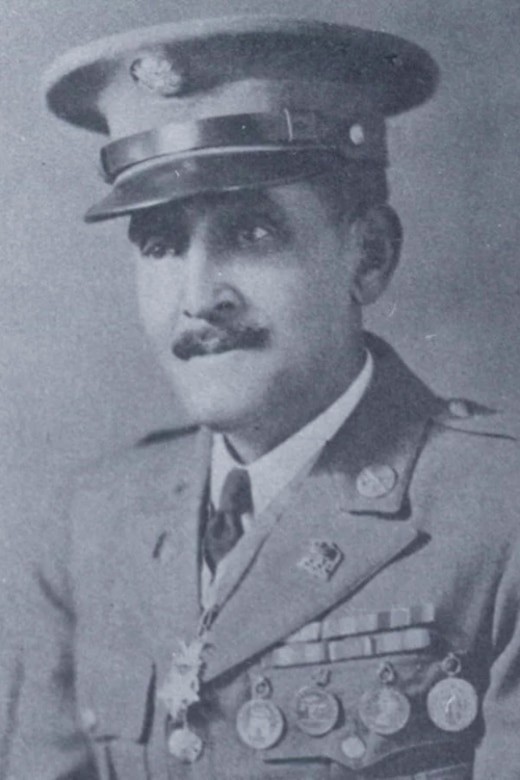
A black and white photo of a man posing for a portrait in his military dress uniform. The Medal of Honor is pinned on the man's uniform.
A black and white photo of a man posing for a portrait in his military dress uniform.
Army 2nd Lt. George P. Ahern, Army Sgt. William H. Thompkins, Army Cpl. George H. Wanton and Army Pvts. Dennis Bell and Fritz Lee volunteered for the rescue mission, battling sustained enemy fire from concealed positions.

This time, the rescue was a success, with all but one soldier returning safely to the ships.

But the fearless warfighters were not ready to quit. On July 2, 1898, the Peoria returned to the mouth of the Tallabacoa River, along with the gunboat USS Helena, and shelled the fort for 30 minutes, damaging it and the area around it.

The troops then set fire to Spanish housing in the nearby town of Tunas de Zaza. The gunboats then proceeded 40 miles east to Palo Alto, near the town of Trinidad, where the Cuban troops and supplies disembarked to carry on other operations.
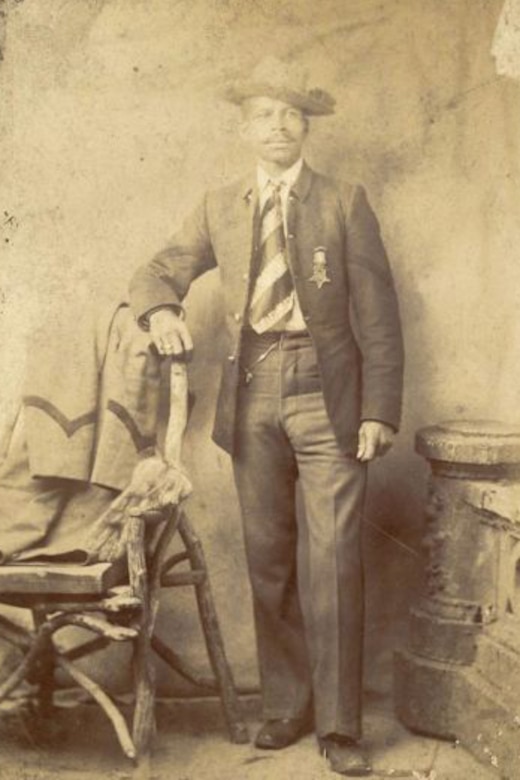
A black and white photo of a man in a suit posing for a photo while leaning on a chair. The Medal of Honor is pinned on the man's jacket.
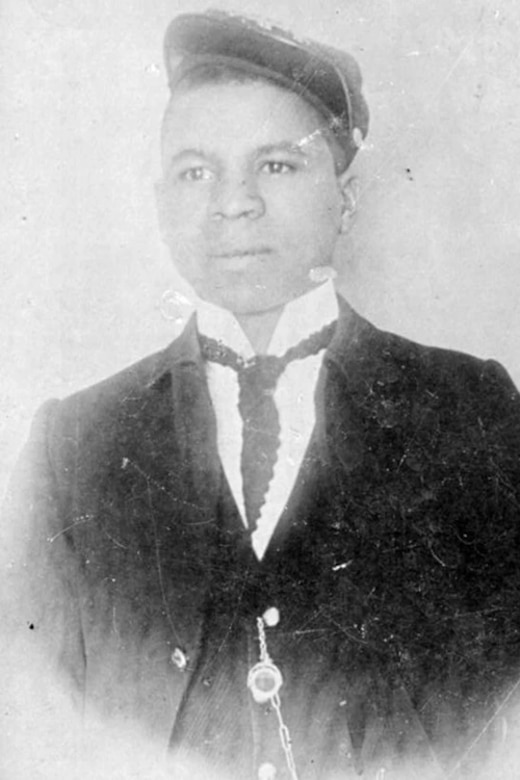
A black and white photo of a man in a suit and hat posing for a portrait.
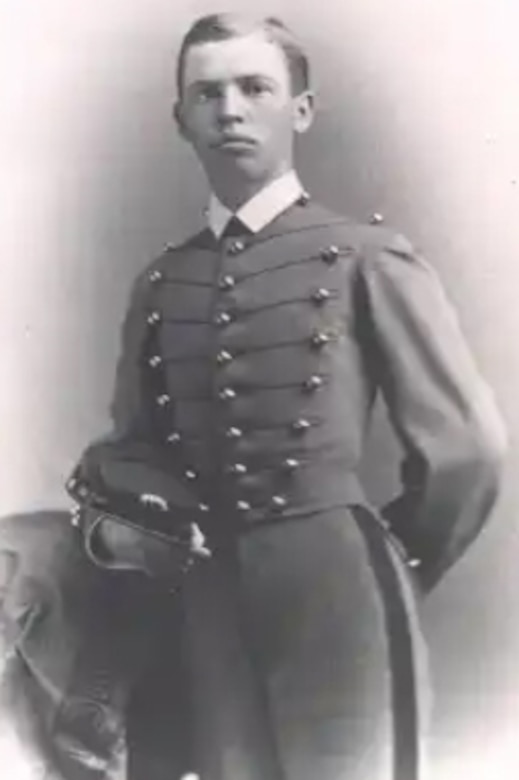
A black and white photo of a man in a dress military uniform posing for a photo.
Bell, Wanton, Lee and Thompkins received the Medal of Honor, and Ahern received a Silver Star Medal. All the soldiers served in the 10th Cavalry Regiment.

Bell, who was born in Washington, D.C., enlisted in the Army in 1892. He received his Medal of Honor while still serving in Cuba in June 1899. He attained the rank of corporal before retiring from the Army in December 1903. He died Sept. 28, 1953, in Washington, and he is buried at Arlington National Cemetery in Arlington, Virginia.
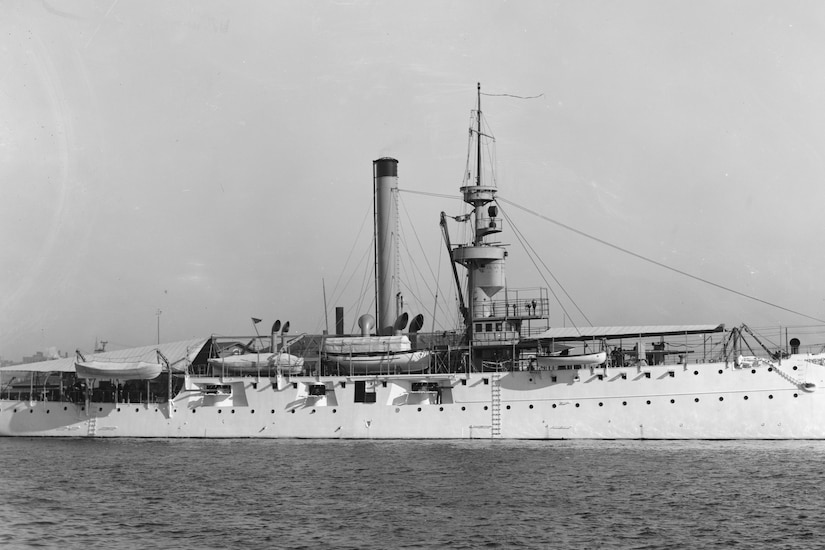
A black and white photo of a large gunboat docked in a harbor.

Wanton was born May 15, 1868, in Paterson, New Jersey. He served in the Navy from 1884 to 1888 and then joined the Army in August 1889. He received his Medal of Honor in June 1899. Wanton attained the rank of master sergeant before retiring in 1925. He died Nov. 27, 1940, in Washington, and is also buried at Arlington National Cemetery.

Lee was born in June 1866 in Dinwiddie County, Virginia, and joined the Army in 1889. Shortly after the war ended, his health deteriorated. He received his Medal of Honor while in the hospital June 23, 1899, and was medically discharged July 5, 1899. He moved to Leavenworth, Kansas, and died there Sept. 14, 1899. He is buried at Fort Leavenworth National Cemetery. In July 2025, Fort Lee, Virginia, located a few miles from where Lee grew up, was rededicated to him.
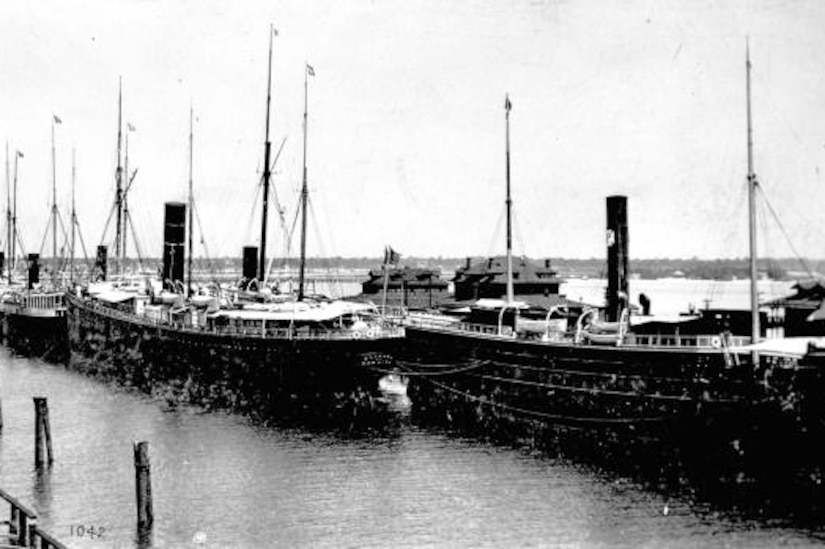
A black and white photo of several small steamships tied up in a port.

Thompkins was born Oct. 3, 1872, in Paterson, New Jersey, and joined the Army in August 1889. He received his Medal of Honor in June 1899, and not much is known about his life after his military service. He died in 1916 and is buried at San Francisco National Cemetery.

Ahern was born in New York City on Dec. 29, 1859. In 1906, he initially retired from the Army as a major but returned to active-duty service July 1, 1916, and served as secretary of the War College from 1918 to 1919. He worked at the Veterans Bureau from 1920 to 1924 and finally retired as a lieutenant colonel in 1930. He died in Washington on May 13, 1942, and is the final rescue volunteer buried at Arlington National Cemetery.

Hegseth, Indonesian Counterpart Announce Defense Partnership

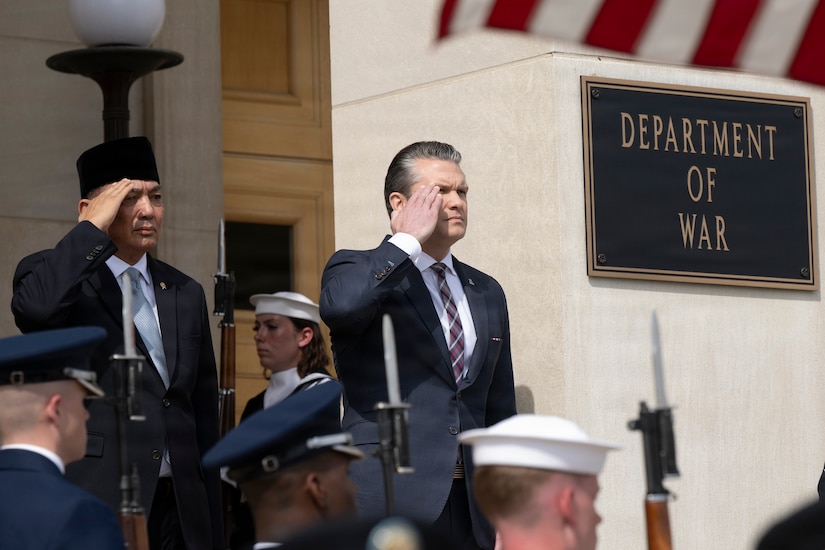
Secretary of War Pete Hegseth welcomed his Indonesian counterpart — Defense Minister Sjafrie Sjamsoeddin — to the Pentagon today, where the two men announced the establishment of the Major Defense Cooperation Partnership between the two countries.

Two people in business attire salute as they stand outside during daytime, with service members standing at attention nearby.

The partnership will serve as a framework to advance bilateral defense cooperation between the U.S. and Indonesia in order to maintain peace and stability throughout the Indo-Pacific region.

"Your visit demonstrates the importance that the War Department places on our growing security relationship — and it is active and growing — with Indonesia," Hegseth told Sjamsoeddin, just before noting that the two countries complete more than 170 military exercises together each year.

"This [partnership] signifies the strength and potential of our security relationship … bolsters regional deterrence, and advances our shared commitment to peace through strength," Hegseth added.

During his brief remarks, Sjamsoeddin affirmed Hegseth's sentiment regarding the strength of the U.S.-Indonesia relationship.

"Today, we are here as Indonesian delegates … with very great enthusiasm to continue to develop our defense relationship, [which] should be enduring for our next generation in Indonesia and the United States of America," Sjamsoeddin said. "We're working on behalf of mutual respect and mutual benefit to enhance [the] value of our national interests."

The new cooperation agreement features three "foundational pillars" that are based on each country's national sovereignty and mutual respect: military organization and capacity building; training and professional military education; and exercises and operational cooperation.


Under the framework of the agreement, both countries will work on exploring cutting-edge initiatives, "including codeveloping sophisticated asymmetric capabilities, pioneering next-generation defense technologies in the maritime, subsurface and autonomous systems domains, and cooperating on maintenance, repair and overhaul support to improve operational readiness," according to a joint statement on the new partnership.

The statement goes on to explain that both the U.S. and Indonesia have agreed to enhance joint special forces training, and that such engagements will make the bond between both countries' militaries stronger.

Additionally, Hegseth noted that Indonesia has been helpful to the U.S. with the recovery of fallen service members.

"I appreciate your continued support in helping the United States find, return and protect the remains of our soldiers who fought alongside Indonesians during World War II," Hegseth told Sjamsoeddin.

He added that the signing of the partnership memorandum will enable the War Department's Defense POW/MIA Accounting Agency to recover those aforementioned service members' remains in Indonesia.

Both Hegseth and Sjamsoeddin described the defense cooperation as a "line of departure" — a military term for setting off on a new mission — for their respective countries.

"So, here's to the next chapter and our new mission together for our great countries," Hegseth told Sjamsoeddin.

The U.S. and Indonesia have maintained formal diplomatic relations for more than 75 years, and established ties in 1949, just after Indonesia's war for independence from the Netherlands.