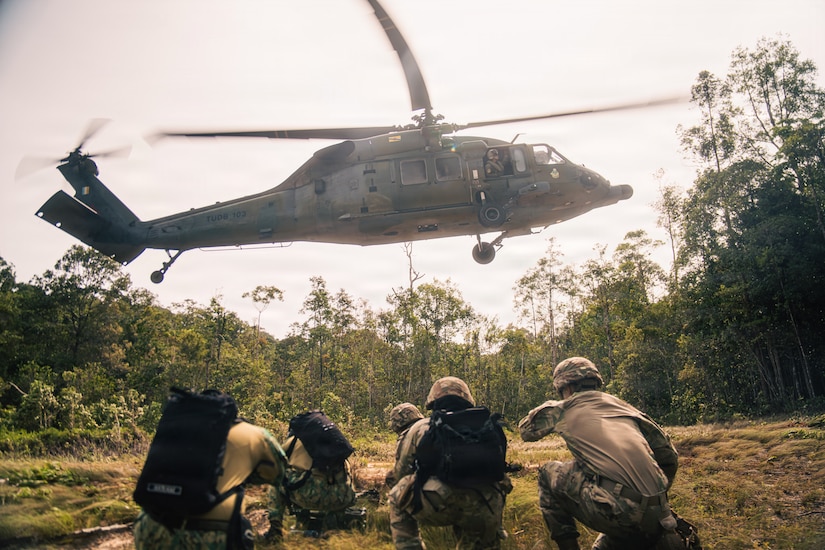
U.S. soldiers and Oklahoma National Guardsmen
partnered with Royal Brunei Land Forces soldiers to sharpen their skills
during Exercise Pahlawan Warrior 26 at Tutong Camp, Brunei, Aug. 11-21,
increasing readiness through shared tactics, jungle training and
relationship-building.
Pahlawan Warrior 26 brought approximately 130 U.S. personnel to
Brunei for the biennial exercise under Operation Pathways. Led by the
1st Squadron, 180th Cavalry Regiment, Oklahoma National Guard, U.S.
participants trained alongside Bruneian counterparts in tactical
operations and subject matter expert exchanges spanning cyber defense,
medical operations and public affairs.
Throughout the exercise, each force brought its own experience to the
training, creating opportunities to compare techniques, share expertise
and adapt lessons from one another to their own formations.
"For me, leadership requires adaptability," said Royal Brunei Land
Forces Lt. Col. Mohammad Sufrien bin Johan. "We are not here to
determine which method is better, which country does better, but to
identify what works, why it works and how it can be adapted to our
respective forces."
The exchange was evident throughout the exercise, with U.S. and
Bruneian personnel sharing their expertise, while tactical training
allowed each force to bring its own strengths to the table — from U.S.
experience in live-fire range operations to RBLF expertise in jungle
operations.
"Our soldiers have showed a lot of grit, but the Royal Brunei Land
Forces go through this like they do it every day, because they do," said
U.S. Army Maj. Kent Turner, commander of U.S. personnel during the
exercise. "Their ability to navigate on different analog systems and go
from one hilltop to the other at a rapid pace is just amazing."
That experience also gave RBLF leaders an opportunity to see how U.S. soldiers adapted to an unfamiliar environment.
"[They] are highly adaptable, resilient and ready to thrive anywhere,
side by side with the troops of the Royal Brunei Land Forces on the
exact opposite side of the globe," said RBLF Col. Erwan bin Haji
Ibrahim.
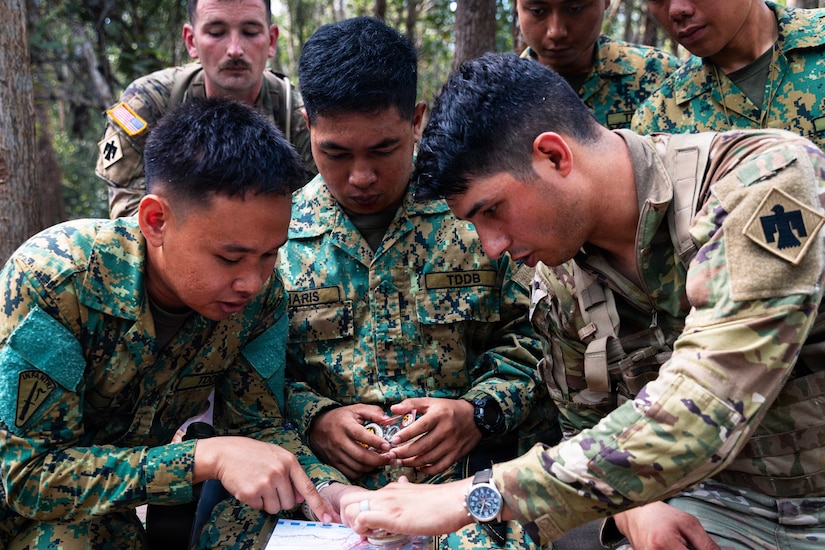
Working through those challenges together did more than build
tactical proficiency. Integrating U.S. and Bruneian soldiers at the
small-unit level gave them opportunities to understand how their
counterparts communicate and operate while developing relationships.
"They really are becoming friends," Turner said. "I'm sure that some
of the people, when they leave, they will remain in contact with them
throughout. And what that's done is, it's picked up both sides, Royal
Brunei [Land Forces] and also with our U.S. forces. Everybody is excited
to be here."
That trust also created an environment where junior leaders were
expected to adapt, make decisions and lead through the challenges of
unfamiliar terrain and limited communications.
"We want to test the junior leadership in terms of decision-making,"
Sufrien bin Johan said. "For the soldiers, it's about the communication,
coordination and understanding. ... The major focus here is so that
they understand each other's procedures and try to adapt it into a
realistic tactical situation."
For Oklahoma National Guard leaders, those lessons extended beyond
tactical decision-making to the challenges of moving, supporting and
leading a formation thousands of miles from home.
"It's much different than being a junior leader back in Oklahoma for a
drill weekend," said U.S. Army Brig. Gen. Colby Wyatt, Oklahoma
National Guard joint staff director. "Now you're having to travel all
the way around the world, communicate with people who speak a different
language, and you're not just leading — there's an operational piece,
there's a logistical piece. They learn at such a faster pace, and then
they're able to take that information back to their unit and train those
that maybe didn't get to make the trip."
The relationships developed throughout Pahlawan Warrior 26 extended
beyond formal training. U.S. soldiers learned Malay phrases, Bruneian
soldiers picked up Oklahoma slang, and participants exchanged patches,
shared meals and spent time getting to know each other.
"I sincerely hope our Oklahoman friends had at least a little time to
explore the beauty of Brunei Darussalam and taste our local food," Haji
Ibrahim said. "The true value of Pahlawan Warrior is in the human
connection. Lifelong friendships have been forged here. I hope this
experience inspires [U.S. service members] to return to this region in
the future."
Those relationships built at the individual level also contributed to the exercise's broader strategic purpose.
"It's really a tactical operation with strategic impact," Wyatt said.
"We can take soldiers at the tactical level, put them into an
environment like this, and they can gain the training that they need.
But the strategic impact is what it means for the United States and for
our soldiers to have a relationship with another country."
For Sufrien bin Johan, those personal connections contributed to an
outcome that lasts beyond the individual training events or even the
exercise itself.
"Our mission with Pahlawan Warrior is to contribute to a sustained
and mature defense relationship between Brunei Darussalam and the United
States of America," he said. "Beyond that, the real measurement of
success is not only during this one exercise, but the trust and
coordination between both nations and our commitment toward peace and
stability in the region."
The relationship between the Oklahoma National Guard and Brunei has
grown since Oklahoma National Guardsmen first participated in Pahlawan
Warrior in 2024. The connections developed during this iteration
continued that training at the tactical, operational and strategic
levels.




 Posts

