Tuesday, March 24, 2026

Navy's Newest Destroyer Arrives at Naval Station Norfolk Ahead of Commissioning

The Navy's newest destroyer, the future USS Harvey C. Barnum Jr., arrived at its home port, Naval Station Norfolk, Virginia, March 20, ahead of its commissioning ceremony, scheduled for April 11.
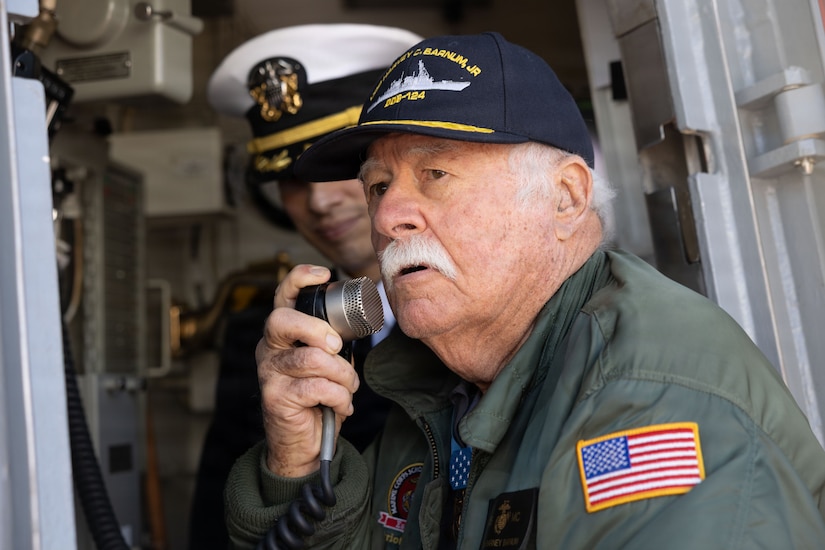
An elderly man speaks into a microphone while on a large military ship. The man is wearing a jacket with an American flag sewn on the shoulder and a command baseball hat with the ship's name on it; another man in a military dress uniform stands in the background.

The warship's namesake, retired Marine Corps Col. Harvey Curtiss Barnum Jr., a Medal of Honor recipient, was on the pier to welcome the ship and its crew.

"To be on the pier and welcome this incredible crew to their new home port is monumental," Barnum said. "This warship represents the enduring bond between the Marine Corps and the Navy, and I have the utmost confidence in the crew to carry on the legacy of service and courage that defines our naval forces. I look forward to seeing them 'bring her to life' and join the fleet."
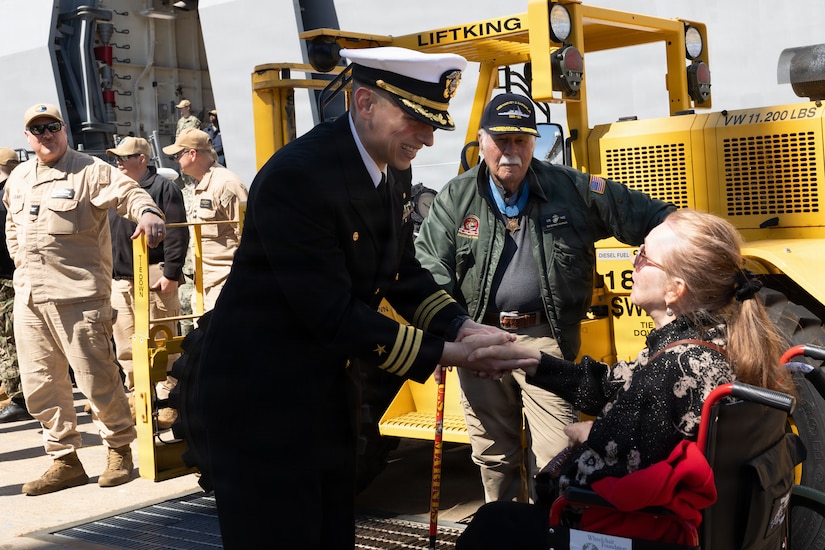
A man in a military dress uniform shakes hands with a woman in a wheelchair while standing on a pier; an elderly man in civilian attire and four men in military uniforms stand in the background.
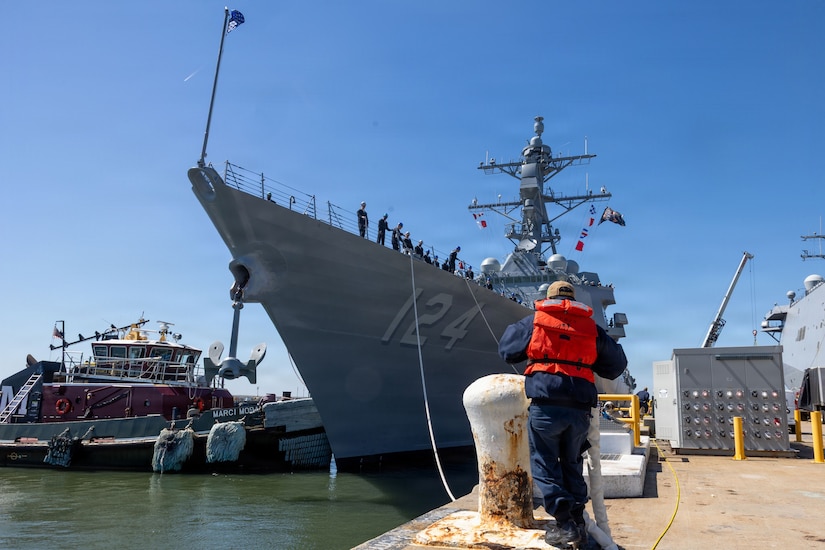
A person in a military uniform and life jacket ties the mooring line of a large military ship to a pier, as several people in military uniforms stand on the bow.
The destroyer is the first ship to bear Barnum's name. It honors his gallantry and intrepidity at the risk of his life beyond the call of duty during the Vietnam War.

On Dec. 18, 1965, then-1st Lt. Barnum assumed command of his company after the commander was mortally wounded. With two helicopters under his control, he moved fearlessly through deadly fire to lead air attacks against the enemy's well-entrenched positions while directing one platoon in a successful counterattack on the key positions.

Having cleared a small area, Barnum requested and directed the landing of two transport helicopters to evacuate the deceased and wounded. He then assisted in accomplishing the battalion's objective. He is among the few living namesakes to witness his warship's commissioning.

"It is an honor to bring this warship to Norfolk and to be welcomed by Col. Barnum himself. His heroism is the standard we strive to meet every day," said Navy Cmdr. Benjamin R. Cantu, the ship's commanding officer. "This crew has trained relentlessly to prepare for this moment. We are ready to join the fleet and carry the name of a true American hero as we defend our nation's interests around the globe."
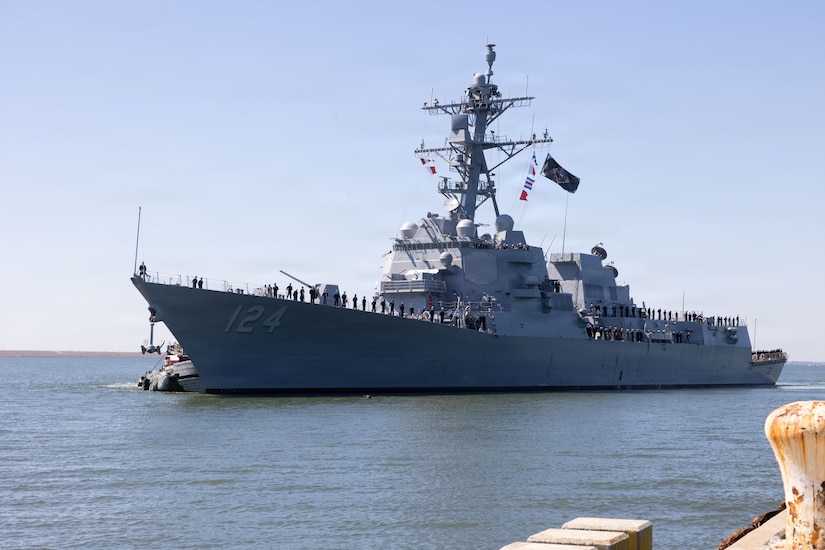
Dozens of people man the rails of a large military ship as it comes into port.

The warship's sponsor is Barnum's wife, Martha Hill, who has maintained a close relationship with the crew since the keel-laying ceremony in 2021. In keeping with naval tradition, she will give the order during the commissioning to "man our ship and bring her to life." At that command, the crew will hoist the commissioning pennant, and the USS Harvey C. Barnum Jr. will officially become a warship in the Navy's fleet.

The ship is designed to conduct a wide range of maritime operations, including antiair warfare, antisubmarine warfare and antisurface warfare in support of national security and global maritime stability. Once commissioned, the warship will be capable of operating independently or as part of a carrier strike group, surface action group or an expeditionary strike group.

Wyoming National Guard Grows HIMARS Force Through Transition Course

The Wyoming National Guard is expanding its field artillery capability by training soldiers as High Mobility Artillery Rocket System crew members, one of the Army's most in-demand roles. 

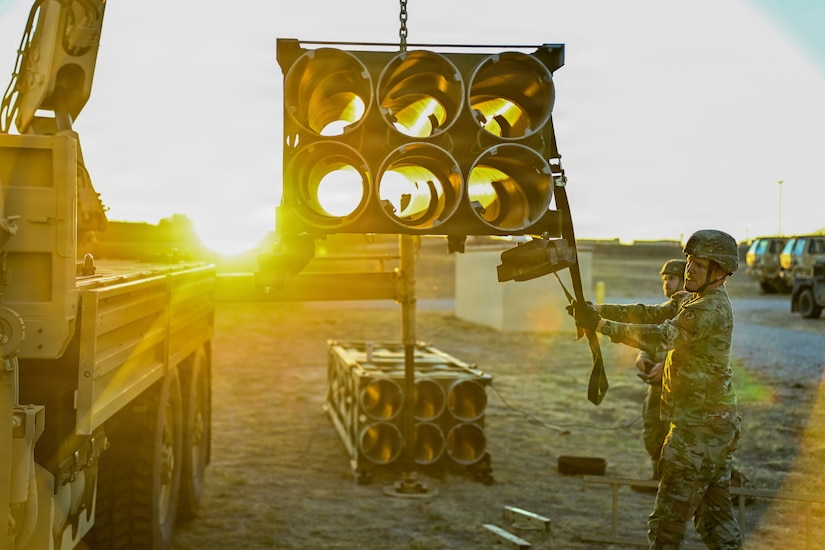
Two soldiers dressed in camouflage military uniforms lift a box of metal tubes using a military vehicle crane.

At the Regional Training Institute in Camp Guernsey, Wyoming, soldiers from across the force attended a 13M military occupational specialty transition course, March 20. Here, they learned how to operate and support one of the Army's most lethal and mobile weapon systems.

The course takes experienced soldiers from other career fields and prepares them to serve on HIMARS crews.

"This course enables soldiers who are already trained in another specialty to become qualified HIMARS crew members," said Army Capt. Matthew Buchanan, operations officer and officer in charge at the training institute. "There's a growing demand for this capability across the Army and Wyoming is part of that growth."

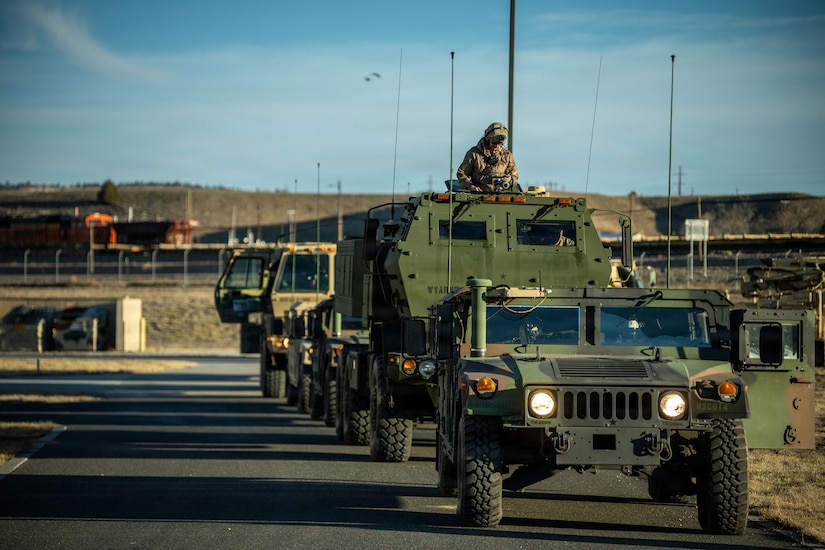
A soldier dressed in a camouflage military uniform stands in the opening of a military vehicle as it drives down a road in a formation with other military vehicles.

That demand is tied to how the Army is changing. HIMARS has proven its effectiveness in modern conflicts, increasing the need for long-range precision fires. As units expand, so does the need for trained crews, including within Wyoming's 2nd Battalion, 300th Field Artillery Regiment.

"Every HIMARS battalion is growing," Buchanan said. "We're adding batteries, and that means we need more trained soldiers. This course allows us to build that capability here at home."

Students arrive with a wide range of experience. Many have spent years in other military occupational specialties before transitioning into field artillery.

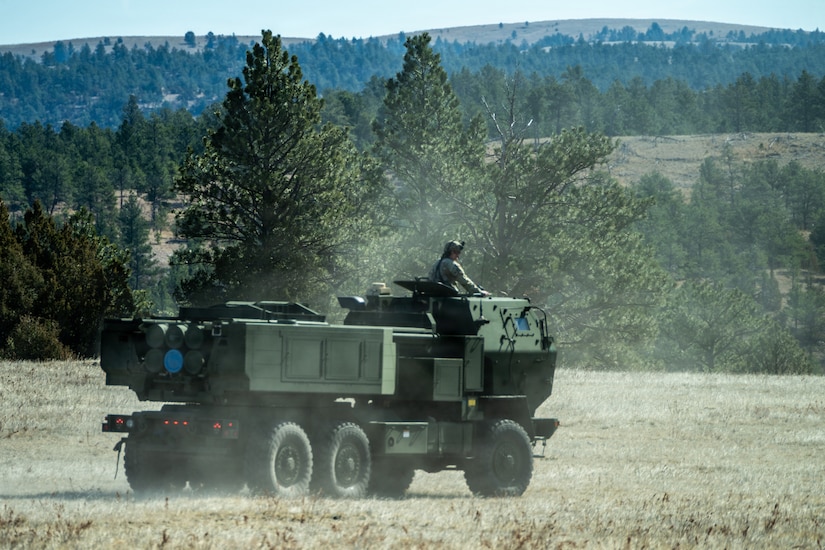
A soldier dressed in a camouflage military uniform stands in the opening of a military vehicle as it drives onto a grassy field.

"We encourage them to bring that experience with them," said Army Staff Sgt. Jeremy Larkey, a Wyoming National Guard lead instructor. "Every background adds something to the team, whether it's maintenance, communications or logistics."

The course blends classroom instruction with hands-on training to ensure soldiers understand system components, safety procedures and operational concepts before applying those skills in practical exercises.

"There's a lot of information," Larkey said. "But the goal isn't to memorize everything. It's to give them a foundation so they can continue learning when they get to their unit."

Training culminates in a field training exercise during which students apply their skills as full HIMARS crews under realistic conditions, demonstrating operational readiness and the ability to perform required crew tasks.

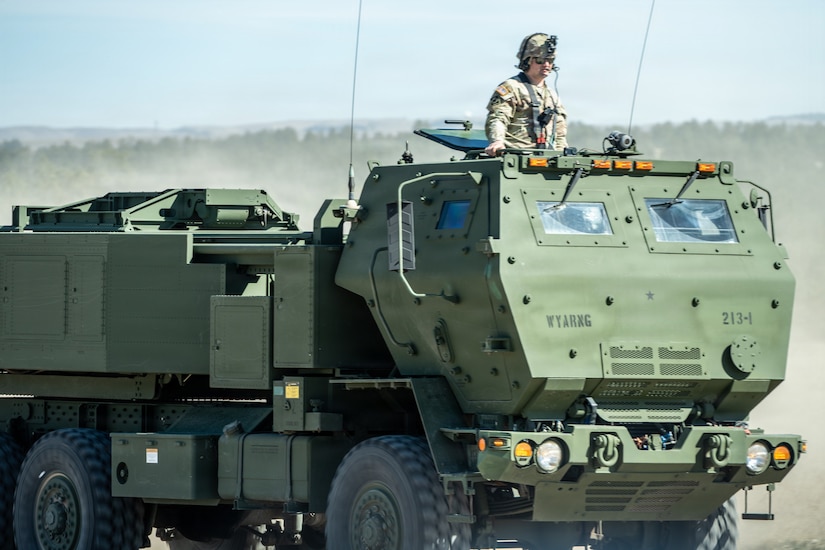
A soldier dressed in a camouflage military uniform stands in the opening of a military vehicle as it drives onto an open field.

"It's about building confidence," said Army Staff Sgt. Austin Paulsen, a Wyoming National Guard instructor. "We want them to go back to their units, contribute immediately and keep improving."

Beyond technical skills, leaders emphasize the mission's purpose.

"HIMARS gives the Army the ability to reach targets at long distances and shape the battlefield," Buchanan said. "When you're part of that, you're part of something bigger than yourself."

As the Wyoming National Guard continues to grow its field artillery capability, the HIMARS transition course is preparing soldiers for that mission.

Joint Interagency Task Force Awards Critical Counter-UAS Contract

Joint Interagency Task Force 401 has successfully executed additional contract awards as part of Domestic Shield to procure counter-unmanned aerial systems capability in support of U.S. Northern Command and U.S. Strategic Command.

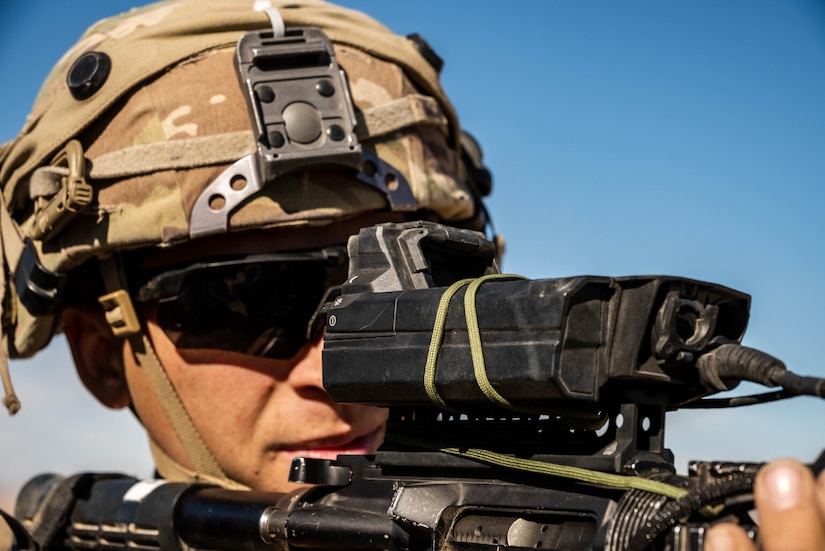
A man wearing a camouflage military helmet and sunglasses looks through a sight mounted on a military weapon outside under a blue sky.

The combined contract, valued at $6.1 million, includes the purchase of 210 SmartShooter Smash 2000LE systems and one AeroVironment Titan Cerberus XL system. This milestone expands the layered defenses that protect installations and critical defense infrastructure from the emerging UAS threats in the U.S.

"We need a layered defense that includes distributed sensing, the ability to track in real time, and capabilities to engage with both non-kinetic and kinetic countermeasures," said Army Brig. Gen. Matt Ross, task force director. "This purchase does not solve that problem, but it's a step in the right direction."

He added that both contracts were executed at a record pace, underscoring JIATF 401's commitment to cutting through red tape to deliver critical counter-UAS capability at the speed of relevance during combat operations in support of Operation Epic Fury.

The rapid award timeline reflects strong coordination across requirements, contracting and mission stakeholders to ensure timely responses to operator needs.

Additionally, two radar systems have been assigned to support the National Capital Region in coordination with the Department of Homeland Security, enhancing the region's ability to detect and counter emerging UAS threats. Ross said this strategic move strengthens local defense capabilities, ensuring that critical infrastructure remains protected.

In support of this reconfiguration, JIATF 401 is also advancing the integration of the Lattice system, a cutting-edge, tactical user interface for command-and-control of counter-UAS that links sensors and effectors across installations and agencies. This integration will boost response times and strengthen national defense, enabling more agile and effective counter-UAS operations.

The task force is pioneering acquisition reform practices to ensure the services and the entire joint force receive the critical technologies they need to maintain the operational advantage and keep America safe.

Joint Force Comes Together for Special Operations Sniper Competition

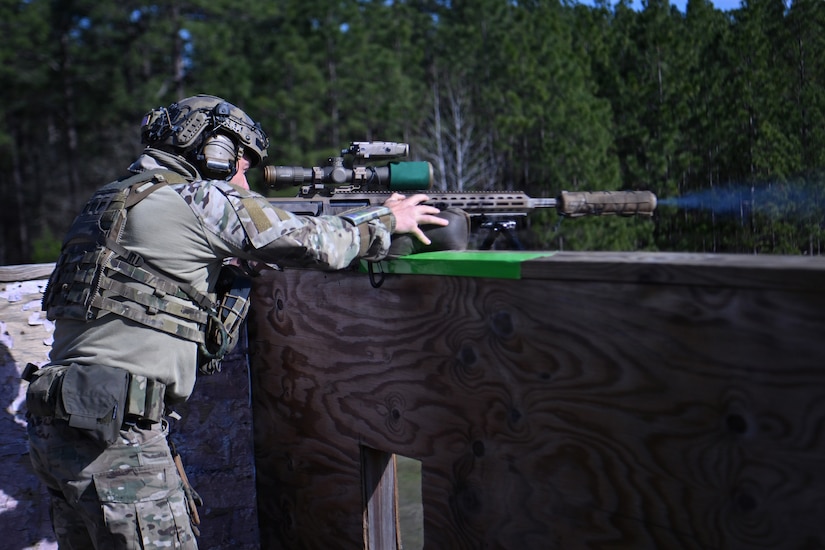
In a demanding test of precision, endurance and teamwork, 17 elite sniper teams participated in the U.S. Army Special Operations Command International Sniper Competition at Fort Bragg, North Carolina, March 15-19. 

A man wearing a military camouflage uniform and a tactical helmet with hearing protection aims and fires a rifle with the support of a plywood wall.

 
The U.S. Army John F. Kennedy Special Warfare Center and School hosted the competition, now in its 17th year. Special Forces sniper course instructors and leadership designed the various challenges and served as officials and scorekeepers. 
 
"This competition represents the pinnacle of the sniper craft," said Army Col. Simon Powelson, commander of the 2nd Special Warfare Training Group. "We have brought together highly trained teams from across the joint force and partner nations. These competitors are not just here by chance; they are the product of intense and specialized training within their respective units." 
 
The five-day event included special operations forces representing multiple allied nations with participants drawn from the ranks of Army Special Forces, Army Rangers, Naval Special Warfare Command, Marine Forces Special Operations Command and Coast Guard units. 

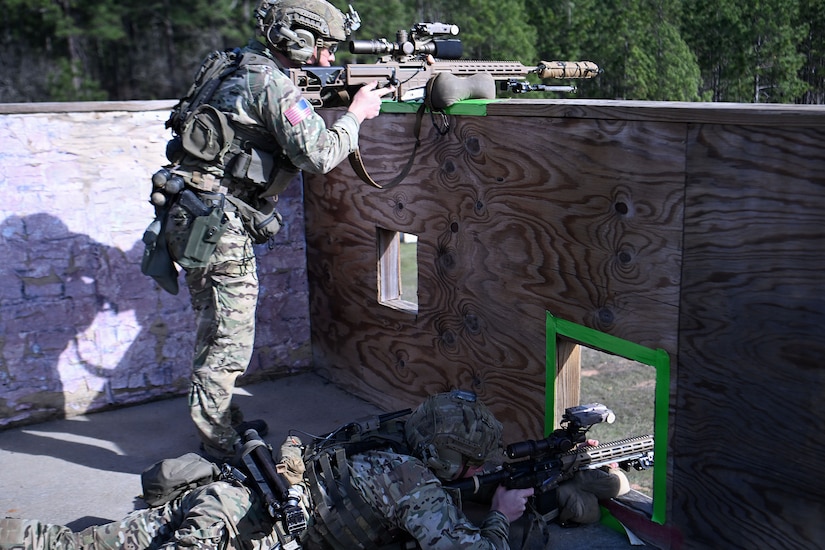
Two men wearing camouflage military uniforms and tactical helmets with hearing protection point rifles at targets. One man is standing, using a plywood wall as a support for his rifle, while the other is lying in a prone position, aiming his weapon through a hole in the wall.

 
Designed to strengthen interoperability and foster esprit de corps among partner forces, the competition featured a series of complex engagements conducted both during the day and under the cover of darkness that pushed competitors to their physical and mental limits. 
 
Throughout the week, sniper teams of two highly trained operators were evaluated across multiple ranges at Fort Bragg. Competitors demonstrated proficiency with sniper rifles, carbines and pistols, engaging at distances of up to 1,200 meters while adapting to constantly changing scenarios. 
 
The opening day set the tone for the grueling challenge ahead. Persistent thunderstorms brought intermittent rain and strong winds, forcing teams to contend with reduced visibility, slick terrain and unpredictable shooting conditions, adding a layer of realism for competitors. 
 
"The weather played a significant role," said Timothy Gozelski, the sniper course manager. "Our goal with the wind and rain was to make sure the visibility was the same for all the teams." 
 
In the following days, the weather cleared, but conditions remained poor. Temperatures dropped to 35 degrees, and variable winds swept across the ranges, complicating long-distance shots. 

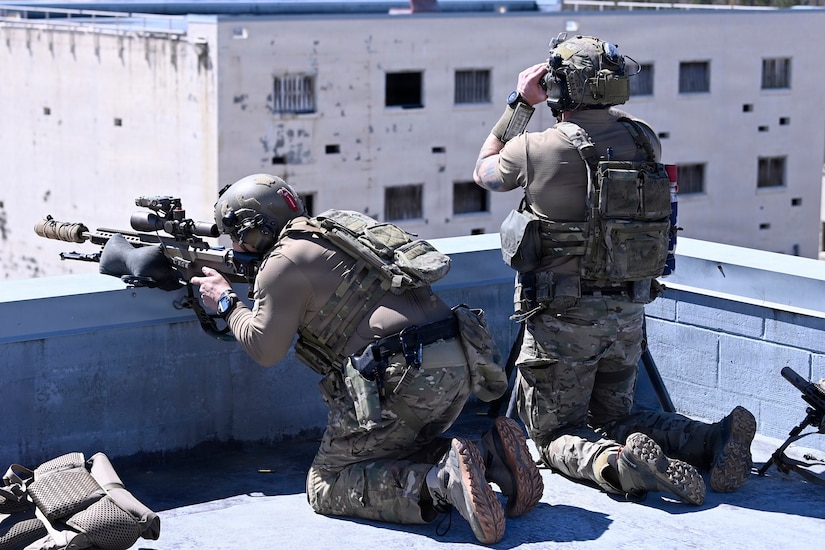
Two men wearing camouflage military uniforms and tactical helmets with hearing protection are on a rooftop; one aims a rifle at a target while the other looks through binoculars.

 
Competitors had to calculate wind speed and direction on the fly while maintaining communication and coordination with their teammates. 
 
"Good, clear, concise communication is a must," said Richard Cuza, a sniper course instructor. "It's beyond important; it's crucial." 
 
Each stage of the competition emphasized not only marksmanship but also teamwork. 
 
Sniper pairs had to locate, range and engage multiple targets in rapid succession, often while maneuvering between firing positions. Communication, trust and synchronization proved just as critical as shooting accuracy. 
 
"Being in sync with your teammate is equal in importance to communication," Gozelski said. "To be successful, the two have to talk and be on the same page in everything they do." 
 
Organizers emphasized the competition was more than a test of skill. It brought together international partners and joint force teams in a high-stress training environment. As a result, the event allowed competitors to build relationships, and it improved the joint forces' ability to operate seamlessly in real-world missions. 

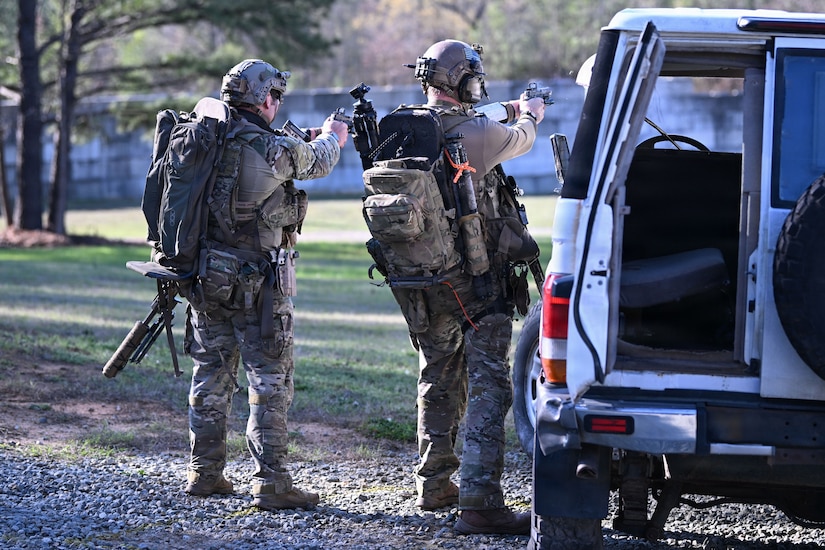
Two men wearing camouflage military uniforms, backpacks and tactical helmets with hearing protection stand next to a vehicle while aiming pistols at a target.

 
"It's awesome to have international teams competing," Gozelski said. "It helps with interoperability and being able to look at each other's equipment and techniques. It's not just about competing; it's about learning some things from our allies and how they operate. All the foreign teams are thrilled to be here. This competition helps us in expanding operational expertise." 
 
Cuza added that "it was great to have allies and teams from our sister services here. It will help us in working together and that's important." 
 
After five days of intense competition, the Army Special Operations Command team emerged as the overall winner, demonstrating consistent performance across all events and conditions. The Army's 3rd Special Forces Group team finished second. 
 
As the competition concluded, participants departed not only with sharpened skills but with stronger bonds between allied forces and sister services. 
 
"Most importantly, this competition is a powerful vehicle for building esprit de corps among an elite group of warriors who may one day serve alongside each other," Powelson said.

Medal of Honor Monday: Marine Corps Pfc. Ronald Leroy Coker

During conflict, the last thing many selfless warriors have done is shield their comrades from grenade explosions using their own bodies. Marine Corps Pfc. Ronald Leroy Coker was one of them, but amazingly, that didn't stop him from continuing to drag a wounded man to safety. His courage through horrific pain inspired his fellow Marines, and it led him to receive a posthumous Medal of Honor.

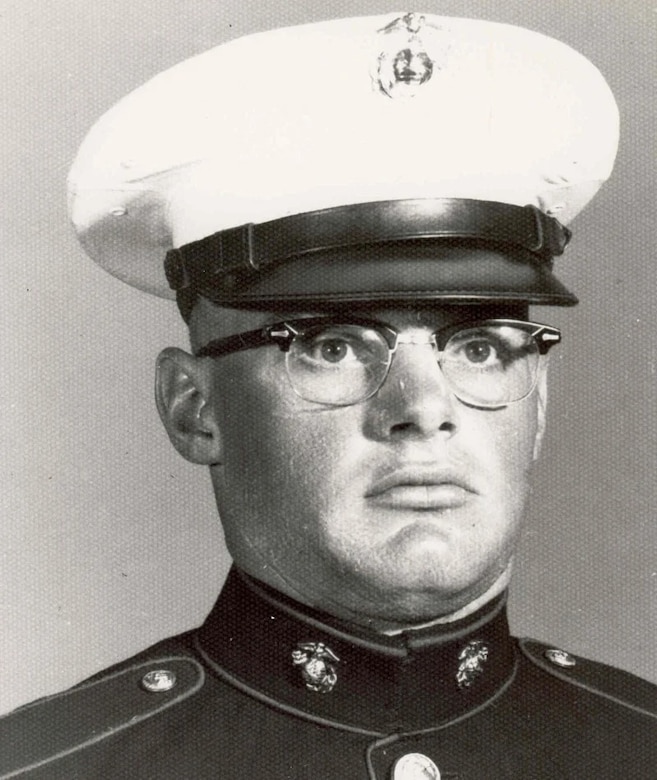
A man wearing a cap and military dress uniform poses stoically for a photo.

Coker was born Aug. 9, 1947, in Alliance, Nebraska, to Cecil and Nellie Coker, who raised their family on a 160-acre farm. Coker had two brothers, Charlie and Ray, and a sister named Janet.

After graduating from Alliance High School in 1965, Coker attended an automotive school in Denver, where he completed a mechanic training program in 1966. Sadly, that same year, his mother died.

As a young man, Coker was known for his quiet intelligence. Standing 6 feet, 3 inches tall, he was lean, liked to do things with his hands and always wore a black cowboy hat, according to a profile of him published in the 2013 Omaha, Nebraska, World-Herald newspaper.

In January 1968, Coker was working as a well driller in Alliance when he was drafted. He wanted a say in where he would end up, though, so three months later, he enlisted in the Marine Corps.

By September 1968, Coker had completed all of his training and was sent to join a staging company that would prepare him to deploy to Vietnam, where the war was raging.

When Coker arrived in-country that November, he was assigned as a rifleman to Company M of the 3rd Battalion, 3rd Marine Regiment, 3rd Marine Division, which was sent to the embattled Quang Tri Province along the north-central coast of South Vietnam. The company was tasked with patrolling the jungles south of the demilitarized zone to keep northern combatants from infiltrating the area.

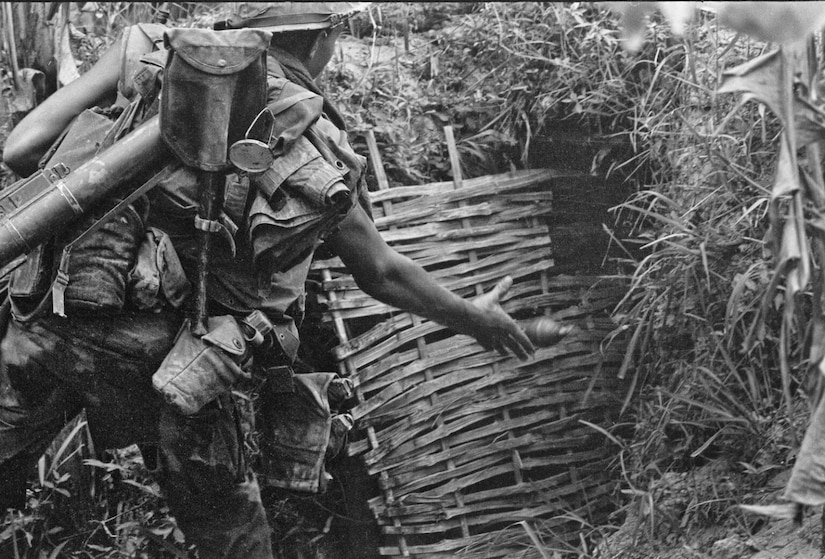
A man wearing several pieces of combat gear slung over his back throws a grenade into a thatched hole.

On March 24, 1969, Coker was leading his platoon's patrol when he came across five enemy soldiers on a narrow jungle trail. The whole squad quickly chased the combatants, who had hidden in a cave.

As the squad moved closer to the cave's entrance, they came under intense enemy fire, which seriously wounded Marine Corps Cpl. Ronald Playford, forcing everyone else to take cover. Playford was left suffering out in the open, so Coker ignored his own peril and ran back into the fire-strewn area to try to collect him.

Along the way, Coker was wounded in the chest and throat, but he continued to crawl toward his comrade, eventually lobbing a hand grenade toward the enemy's position to quiet their fire long enough to get to Playford.

As Coker began dragging the injured man to safety, a grenade landed squarely on top of Playford. Without hesitation, Coker grabbed it with both hands and turned to throw it. Unfortunately, before he could, it exploded. Witnesses said the explosion severed both of Coker's hands at the wrists.

Shockingly, Coker kept going. Refusing to abandon Playford, he used what was left of his arms to pull Playford along from his cartridge belt. As they moved toward friendly lines, two more enemy grenades exploded near Coker, inflicting even more devastating injuries to his chest, face and legs.

With every ounce of strength he had left, Coker continued to pull Playford toward safety until another Marine was close enough to grab them both and pull them to cover.

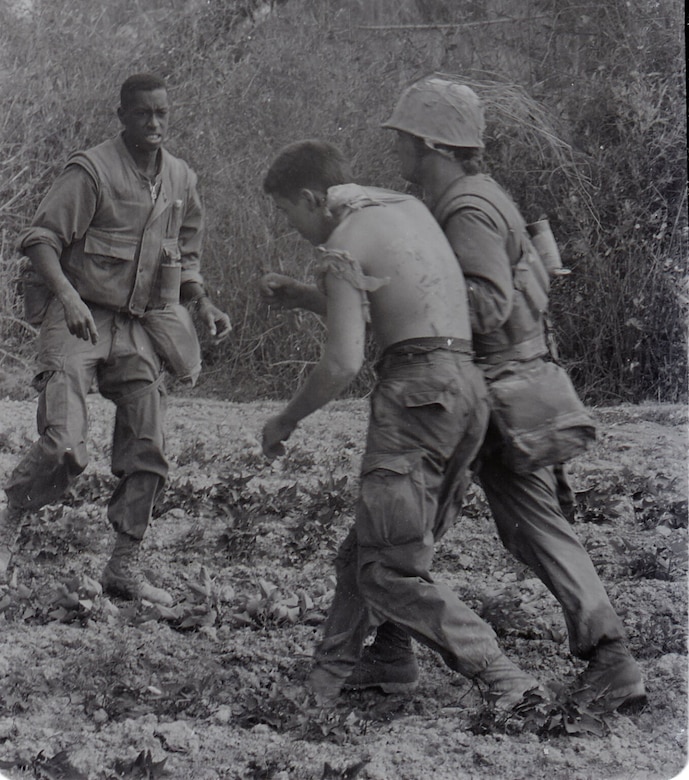
A man wearing a military uniform has his arm slung under a shirtless man to help him walk through a grassy area. Another man, dressed in a military uniform, walks in their direction.

Coker's valor inspired his fellow Marines so much that they eventually annihilated the enemy hiding in the cave.

Unfortunately, both Coker and Playford died almost as soon as they were pulled to safety.

"I saw a lot of brave acts in Vietnam, and I saw a lot of people die for their country," Marine Corps Pfc. Jimmy Murphy, who was with Coker during the incident, told the Omaha World-Herald. "This was the bravest act I witnessed."

Several of Coker's comrades who witnessed his selflessness nominated him for the Medal of Honor. On April 20, 1970, Coker's father and siblings received the nation's highest honor for valor on his behalf from Vice President Spiro Agnew during a White House ceremony.

Coker is buried in Alliance's Fairview Cemetery, next to his mother.

The fallen hero's father kept the medal, but sadly, Cecil Coker died in 1972 during a flash flood of his new home in Rapid City, South Dakota. The flood swept the house off its foundation, and the medal was lost, according to the Omaha World-Herald. The newspaper said one of Coker's brothers later received a replacement medal that the family now keeps in storage for safekeeping.