Tuesday, September 01, 2026

Meet Mmoab: A Military Working Dog Serving in England

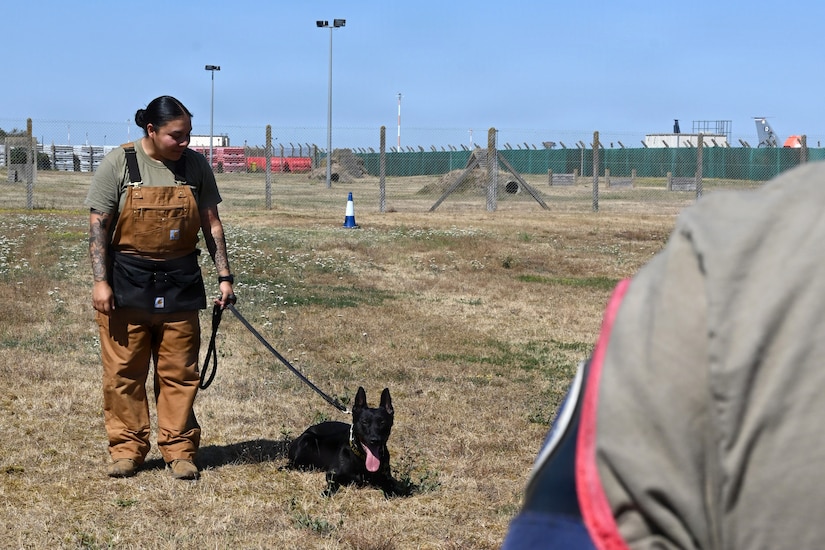
A woman wearing brown overalls holds a black dog on a leash.

The latest addition to the 100th Security Forces Squadron's military working dog pack is 3-year-old Mmoab, a black Belgian Malinois who joined the U.S. Air Force canine team at Royal Air Force Mildenhall, England.

The double letter at the beginning of Mmoab's name is intentional. It signifies that he came from the Military Working Dog Breeding and Foster Program at Joint Base San Antonio, Texas. He is currently the only 100th Security Forces Squadron dog born, bred and initially trained at the Military Working Dog Center in Texas — and just the fourth specially bred canine at RAF Mildenhall — his predecessors being military working dogs Vvonya, Ootto and Oorion.

Operated by the 341st Training Squadron, the puppy program, as it is commonly called, was established at Joint Base San Antonio in 1998 to allow the military to breed its own dogs, cut costs and produce highly trained military working dogs. The program provides hands-on training from the day the puppy is born, and the Air Force can track the dog's social progression. Their training includes several months of detection and patrol work.
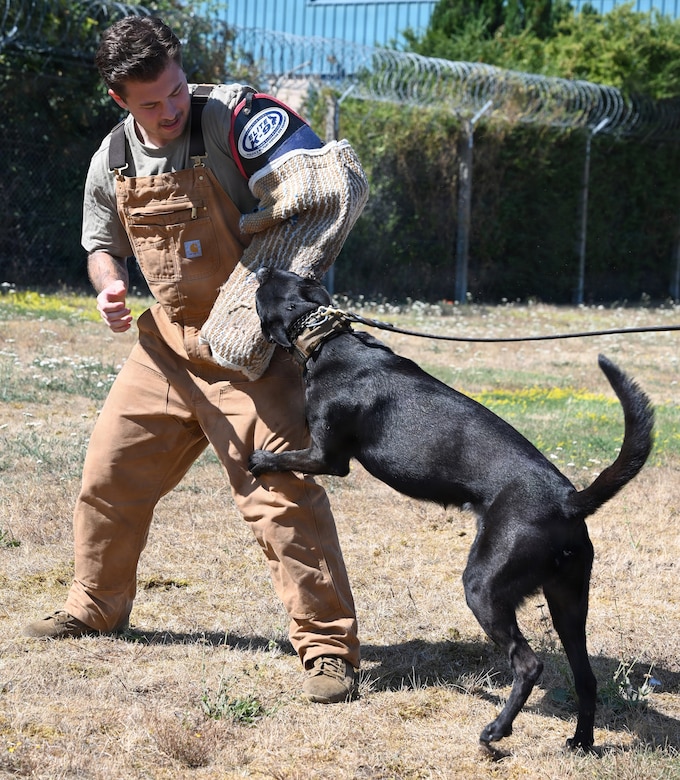
A black dog bites a safety pad on a man’s arm outside in a field.

Once a litter is whelped and weaned, the puppies are placed in foster homes in and around San Antonio. The volunteer families must meet specific requirements before being accepted into the program. They provide care until the puppies return to the training program. Foster families receive everything needed to care for the puppies, including dog food, veterinary care equipment, toys and training.

Once a dog is trained and ready to head to its new duty station, a handler travels to Joint Base San Antonio to personally escort the dog to its new home.

Mmoab's handlers said he showed from the start that he was perfect for the job.

"He's insanely fast, very driven and loves to give hugs to his handlers," said Air Force Staff Sgt. Cameron Gilbert, a trainer assigned to the 100th Security Forces Squadron, who was also the first handler paired with Mmoab. The pair recently returned from a five-month deployment to Royal Air Force Fairford in England, where they performed patrol and detection duties.

"I've done his field evaluation from the ground up," Gilbert said. "Everything he's done and where he is now is a result of how I've worked with him, so I'm proud of where he's at right now and when I handed him over to his new handler."
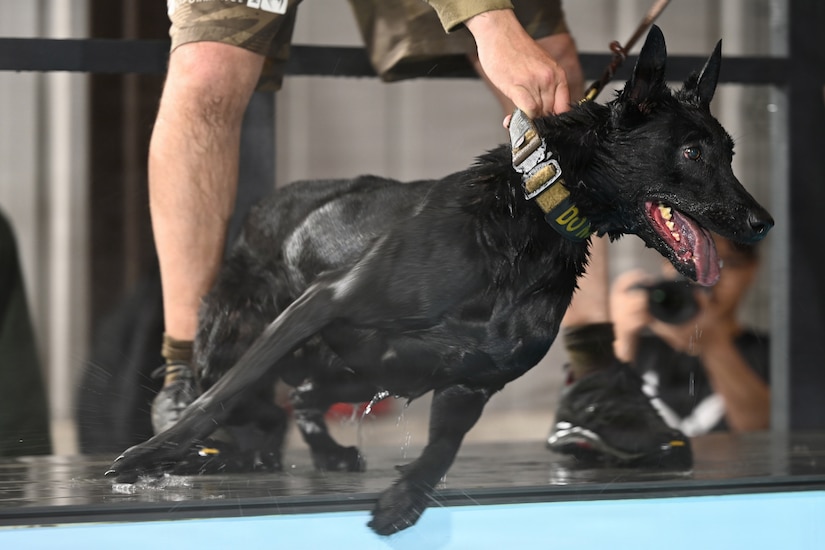
A person stands on the edge of a swimming pool and holds a black dog by the collar.

The young Belgian Malinois is now teamed with Air Force Senior Airman Karina Flores, a handler assigned to the 100th Security Forces Squadron. Mmoab is the third K-9 she's worked with during her Air Force career, and she said they are currently in the rapport phase of their partnership.

"He's my first puppy program dog and is focused 24/7; other dogs can often be like, 'Okay, I'm here, so I'll do it,' but he's completely dedicated," she said. "Mmoab is definitely the most energetic dog I've worked with, and I've been spending a lot of time bonding with him and getting him used to me.

Flores said she gives Mmoab simple tasks, and he receives his favorite toy as a reward so he knows he can trust her and sees her as his "mom."

"It's going good so far," Flores said. "Because he's so driven, I know he's going to make me a better handler because of how much he wants to work."
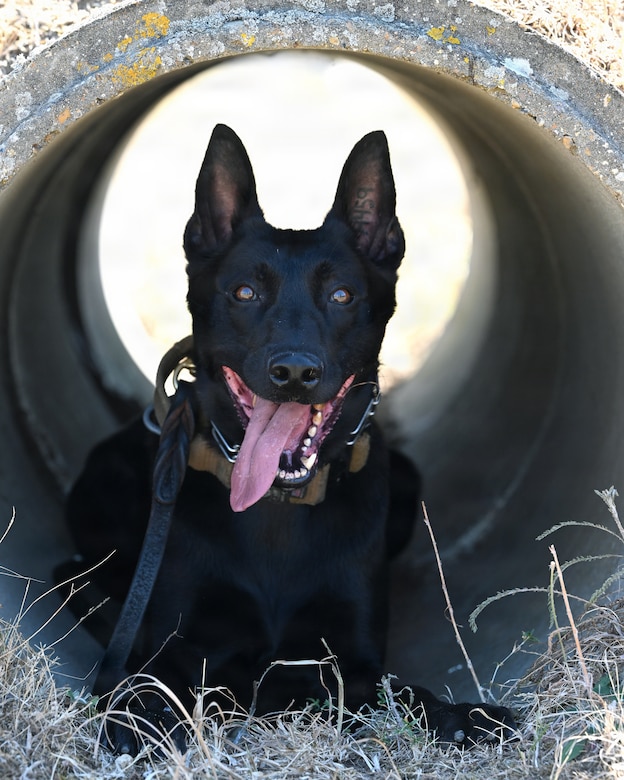
A black dog sits under a large concrete pipe.

After military working dogs arrive at the base, which will be their home for the duration of their career, the next stage for them is to pass their field evaluation qualification.

"We made sure Mmoab can meet what's asked of us operationally here," Gilbert said. "Once he arrived and settled in, we took him out to the different training areas to make sure he can do the tasks no matter what."

While military working dogs may draw attention when they are out, don't let their appearance fool you. With a top running speed of more than 30 mph, a bite force of more than 200 pounds and a nose 40 times more powerful than a human, they are highly trained psychological deterrents and a vital asset to the Air Force and the War Department.

Airlift Wing Builds Mobility Readiness During Exercises

The 86th Airlift Wing supported Exercise Saber Junction 26 with joint air mobility operations alongside Army and Marine Corps forces at Ramstein Air Base, Germany, Aug. 24-30. 

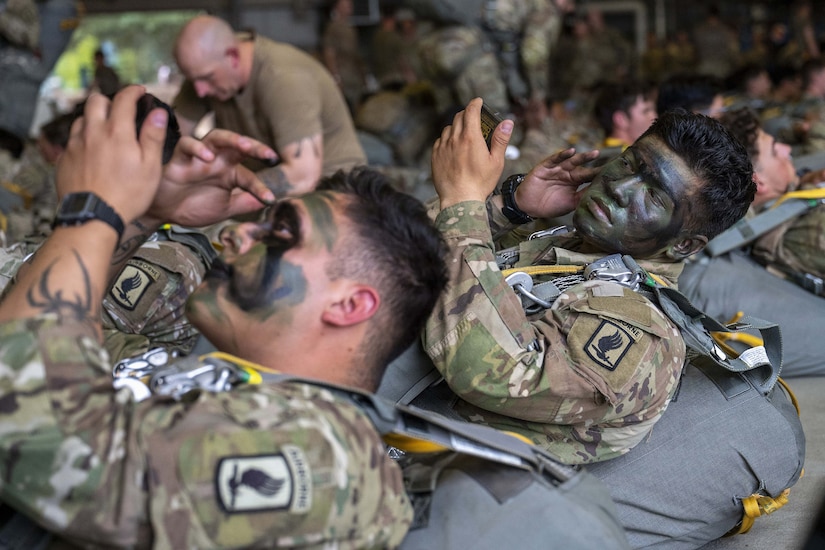
Two men wearing camouflage military uniforms put camouflage paint on their faces while lying in an aircraft hangar.

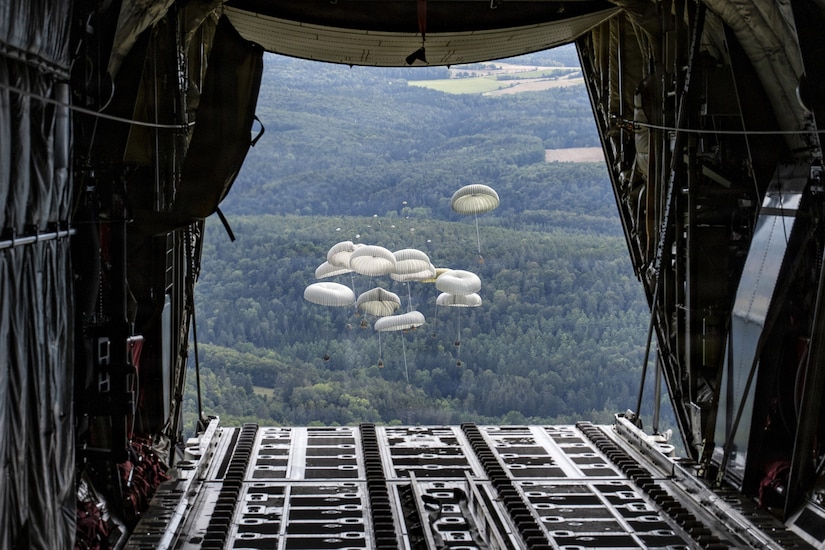
During the week, the wing executed distributed mission planning, patient movements, tactical airdrops and joint airborne operations, culminating in a joint forcible entry event that integrated Air Force C-130J and Marine Corps KC-130J Super Hercules crews with more than 600 paratroopers assigned to the 173rd Airborne Brigade. 

Saber Junction 26 is a U.S. Army Europe and Africa exercise that tests the airborne brigade's ability to rapidly deploy, conduct joint forcible entry and operate alongside allied and partner forces during large-scale combat operations. 

Leading into Saber Junction, the airlift wing conducted Exercise Agile Gateway, which began with a staging event at Chievres Air Base, Belgium, where, with 86th Communications Squadron support, an aircrew received its tasking and planned the mission from a distributed location. 

Packages parachute to the ground in a wooded area after being dropped from a military aircraft.

The following day, the 86th Aeromedical Evacuation Squadron responded to a simulated mass casualty event, transporting three simulated patients from Belgium to Germany. They were then transferred to a 76th Airlift Squadron C-21A Learjet during an engine-running offload/onload for a follow-on aeromedical evacuation. 

The transfer was one of three aeromedical evacuation training flights conducted throughout the week as the squadron exercised engine-running patient transfers, rapid alert response and simultaneous generation of its C-21A and C-37A Gulfstream fleets. 

"Agile Gateway and Saber Junction gave us an opportunity to test our agility and crisis-response capabilities in ways routine day-to-day missions can't," said Air Force Lt. Col. Kyle Gadoury, 76th Airlift Squadron assistant director of operations. "These exercises help ensure our squadron remains ready to support joint partners across Europe and Africa in high-tempo or contested environments." 

Following the patient transfer, the 86th Logistics Readiness Squadron conducted simultaneous hot-pit refueling and engine-running onload operations on the C-130J. 

These employment capabilities enabled the immediate transfer of patients and rapid onload and airdrop of sustainment cargo, setting the stage for the 173rd Airborne Brigade's upcoming operations at the Joint Multinational Readiness Center in Hohenfels, Germany. 

The training also demonstrated joint interoperability capabilities as 37th Airlift Squadron crews planned and operated alongside aircrews from Marine Aerial Refueler Transport Squadron 234, working through differences in terminology, procedures and aircraft capabilities before mission execution. 

"This week showed how our different capabilities can connect and build on one another," said Air Force Capt. Charles Khoshabjian, 37th Airlift Squadron weapons officer. "Working with the Marines reinforced the importance of identifying differences in terminology and procedures early so we can build shared understanding, integrate effectively and deliver combat power for the joint force." 

The wing's support for Saber Junction 26 peaked Aug. 26, when Air Force C-130Js and Marine Corps KC-130Js carried more than 600 paratroopers from Ramstein to the Joint Multinational Readiness Center. A C-37A also supported the mission as an airborne communications node, relaying the launch command between the airborne brigade and the airlift squadron. 

The mission brought together Air Force, Army and Marine Corps capabilities to strengthen interoperability and rehearse rapid force employment across the theater. 

"The joint forcible entry may be the culmination of our air mobility mission, but for the Army, it marks the start of the larger operation," Khoshabjian said. "What we deliver by air enables everything that follows on the ground." 

The integration across airframes, mission sets and military services reflects the broader role the airlift wing provides to the joint force. 

"No single capability defines what the 86th Airlift Wing brings to the fight," said Air Force Col. Matthew Wunderlich, 86th Operations Group commander. "By integrating our mobility capabilities with the joint force, we create the flexibility commanders need to respond across the theater. That integration is what turns individual capabilities into combat power."