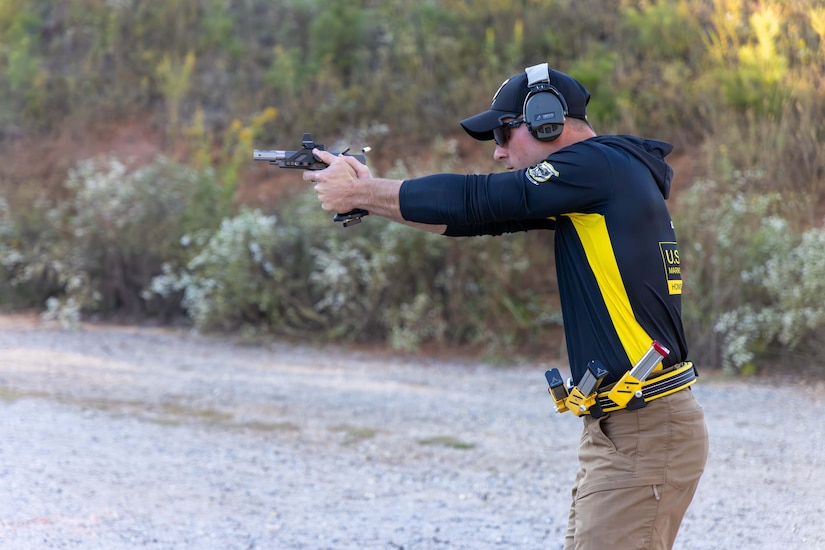
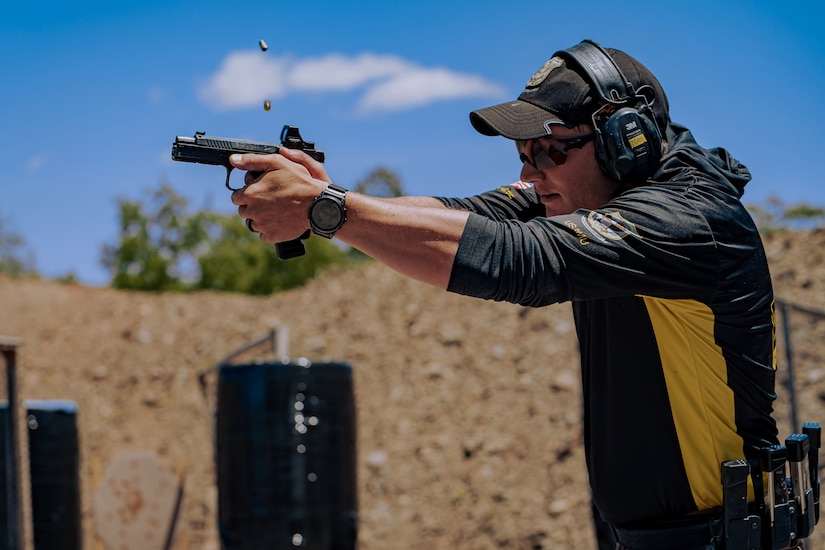
Army Sgt. Aaron Eddins and Staff Sgt. Jacob
Hetherington will compete at the 2025 International Practical Shooting
Confederation World Shoot Handgun Championships in South Africa Sept.
22-27.
Eddins and Hetherington are instructors and competitive shooters
assigned to the Army Marksmanship Unit at Fort Benning, Georgia, and
part of the U.S. Practical Shooting Association Team representing the
United States at the 30-stage, five-day handgun championships.
More than 1,700 marksmen from at least 50 countries qualified to
represent their countries at this elite competition, making it an honor
to attend, Eddins said.
Some of the countries represented include Poland, Czech Republic,
Italy, Brazil, Venezuela, Kenya, China, Serbia, Ukraine, Zimbabwe, New
Zealand, Ecuador, Papua New Guinea, Republic South Africa, Sri Lanka,
Germany, Paraguay, France, Canada and Philippines.
"The IPSC World Shoot is the Olympics of practical shooting. It takes
place every three years but has recently changed to every four to match
the Olympic schedule," Eddins said.
The first World Shoot was in Zurich in 1975 where American marksman
Ray Chapman won the gold medal. As firearms developed and the number of
competitors increased, changes were inevitable. In 1990, American Doug
Koenig became the first marksmen to win the World Shoot using a red dot
sight. In the following 1993 World Shoot, competitors were divided into
divisions based on equipment. For example, marksmen competing with
optical sights were in the open/modified division, while competitors
with iron sights were the standard division.
This year's World Shoot has six divisions that include classic, open, production, production optics, revolver and standard.
To qualify for the 2025 World Shoot, athletes had to compete in four
qualifying matches. From those four, the top three scores were combined,
Eddins said.
"The top four in each country [for each division] are selected to be on that country's national team," he said.
Eddins will represent Team USA in the open division alongside
civilian marksmen Christian Sailer, Bryan Jones and John Vlieger. These
four Americans will vie for the gold against 358 other individual
competitors. They will also compete as a divisional team against 35
other countries.
Hetherington will represent Team USA in the production optics
division alongside civilian marksmen JJ Racaza, Tom Castro and Jay Beal.
These four Americans will seek the gold against 447 other individual
marksmen and 40 other country teams.
Competing internationally is not new for the USAMU Action Shooting
Team. Years ago, the team competed at IPSC Championships regularly.
USAMU veterans such as Travis Tomasie, Max Michel, KC Eusebio and Shane
Coley have competed and medaled in several IPSC World Shoots over the
years. In fact, in 2008, USAMU Action Shooting Team soldiers swept the
podium when Eusebio, Brad Balsley and Coley won the gold, silver and
bronze in the junior category.
Although the Action Shooting Team stepped away from international
competitions for several years because of a variety of administrative
challenges, there is now a refocused effort. The 'Home of Champions' is
well known for international shooting sports like the 10m air rifle, 50m
smallbore, trap and skeet since they have had a strong presence at the
Olympics in those sports.
Across the nation, the Action Shooting Team is well known in
practical shooting, precision rifle series and multi-gun competitions,
and since the IPSC World Shoot is similar in nature to the unit's
Olympic presence in other shooting disciplines, it's in-line with the
unit's mission to win on a global stage, said Army Sgt. 1st Class
Christopher Workman, USAMU Action Shooting Team chief.
"It is important for these world-shooters to be able to represent the
U.S. Army and the Army Marksmanship Unit on an international stage, not
only matches within [the United States]," Workman said.
To prepare for this competition, Eddins said he competed in seven
international competitions over the last three years. Hetherington, who
earned the highest qualifying points in the production optics division,
earned his spot on the World Shoot by competing at French Nationals,
Extreme Euro in the Czech Republic and the Viking Extreme in Denmark.
However, this is not his first World Shoot. He competed in the
championships before joining the Army.
"The last World Shoot I shot was in 2014. I was on the U.S. Junior
Production Team and earned a silver medal. The U.S. Team won the gold
medal for team production," Hetherington said.
Like the Olympics, the IPSC Championships will be intense, not only
with competition but in course of fire as well. U.S. Practical Shooting
Association competitions typically have between nine and 12 stages over
two to three days. The international competition is more like a marathon
with 30 stages over five days. Those stages are broken up into three
courses, short (12 rounds or less), medium (13-24) and long (25-32),
making each competitor prove their skills are fast and accurate with
nearly 600 rounds.
Team USA will begin competing Sept. 22, with the 30 stages broken
down into five areas, meaning they will complete six stages per day.




 Posts
Posts

