Showing posts with label army reserve. Show all posts

Thursday, October 08, 2026

Army Reserve Unit Supports Local Junior ROTC Raider Challenge

Mud, sweat and chants of esprit de corps filled the air at Northwest High School in Wichita, Kansas, Oct. 1, 2026, as the next generation of military leaders were put to the test.  

Junior ROTC cadets from eight high schools across the area converged for the annual City League Raider Challenge, a grueling competition of physical strength and mental fortitude. Providing support and encouragement throughout the event, and often right in the thick of the action, were soldiers assigned to the Army Reserve's 451st Expeditionary Sustainment Command.

Four teenagers lift a large tire while taking part in an obstacle course.

The Raider Challenge pushed 11 teams of cadets to their limits with a demanding series of events, including a rope bridge, a mile team run and an obstacle course. Cadets traversed walls, navigated rope obstacles and powered through a muddy low crawl, demonstrating exceptional teamwork and grit. 

"There was a lot of motivation out there," said Army Maj. Chris Cooper, command inspector general, who served as a grader on the obstacle course. "They really liked getting in the mud. I thought they'd all be hesitant, but they dove right in and showed a lot of encouragement towards one another."

A man in a camouflage military uniform holds up a stopwatch as three people in similar attire prepare to run outside.

Soldiers assigned to the 451st ESC, a Wichita-based Army Reserve unit, volunteered their time to help score and mentor the cadets throughout the competition. Their presence provided more than logistical support; it offered the students a direct link to service members living in their own community. 

"It's important for them to see a representation of what being a service member looks like and to know that we are out here supporting our community," said Army Master Sgt. Brian Michael Poe Jr., command assistant inspector general. "If they are curious about the military after high school, they can pick our brains a bit." 

Their presence is a cornerstone of the Army Reserve's identity as "twice the citizen" —soldiers who serve the nation while living and working as civilians in their local communities. For the command, participating in events like the Raider Challenge is a direct investment in the future of Wichita.

"This is the youth, this is the future," explained Army Sgt. 1st Class Lewis Nicholson, an operations noncommissioned officer with the unit and a former high school Junior ROTC cadet. "By getting ourselves involved with the high school and the JROTC program, it's another way to give back." 

The sentiment was echoed by retired Army Lt. Col. Bob Bystrek, senior Army instructor for the Northwest High School Junior ROTC program and a former member of the 451st ESC. 

"Today is where months of training and dedication come to fruition for these cadets and seeing that hard work pay off is incredibly gratifying," Bystrek said. "A huge thank you to the team at the 451st ESC for coming out and helping us." 

As the final teams crossed the finish line, it was clear the event was more than just a competition. It was a powerful demonstration of community, mentorship and the enduring bond between the city of Wichita and the citizen-soldiers of the sustainment command.

Thursday, October 01, 2026

Face of Defense: Soldier Fights Back From Cancer Diagnosis to Become a Drill Sergeant and CrossFit Athlete

Sgt. 1st Class Samantha Lamirand was mid-career and moving fast when a routine test came back with two words: cervical cancer.

A person wearing exercise clothing rides a stationary bicycle while three other people in similar attire stand behind her.
Job: Drill Sergeant / Combat Engineer
Stationed: Round Rock Armed Forces Reserve Center, Texas
Unit: Company D, 1st Battalion, 355th Regiment
"I had these plans to do something big and grand with my life," she said. "It felt like everything just came to a screeching halt."

Today, Lamirand is a combat engineer, a drill sergeant and a competitive CrossFit athlete on the Army's Warrior Fitness Team. Five years ago, she was a Soldier navigating a health crisis at a difficult moment in her career.

Lamirand was in the middle of submitting a packet for a civil affairs assignment, one that required a full medical screening, when the results turned up something she never expected: human papillomavirus, or HPV, that had already progressed to cervical cancer.

"They told me one of my results came back different, positive or undecided, they weren't totally sure," she said. "So they had me get tested again, and when I got the call, they said, 'Hey, it turns out you have HPV.'"

Lamirand had no reservations about the lessons she learned from the experience and the impact it could have on others. "I'm not afraid to talk about it. People should know this stuff, because I didn't know it myself," she reflected. "The HPV vaccine wasn't even around yet when I was young, and it turned into cancer just like that."

A person wearing athletic clothing pulls on a thick rope outdoors on a bright day.

Her doctors recommended a loop electrosurgical excision procedure, a minimally invasive procedure used to remove abnormal, precancerous cells from the cervix. The procedure worked and the cancer never returned, but it left her with lasting effects that required ongoing pelvic floor therapy, something she still lives with today.

After her surgery, Lamirand requested a medical stabilization to stay at her current unit for a year so she could finish treatment with the doctors who already knew her case. Her orders, however, had her scheduled to move across the country to serve in Georgia. Lamirand's request for stabilization was not approved and she left active duty, disillusioned and demoralized.

"To be honest, I was just really angry," she said. "I think I was doing a lot of things in spite of a lot of people, which is not healthy." That anger became fuel for a while, but it had a shelf life. "Anger can only drag you so far. It worked at the time, but it doesn't work for very long."

What actually got her through was therapy. "I started going to behavioral health, I started seeing a therapist," she said. "I really believe in therapy. I think it's a great resource, and it really helps keep you grounded."

That's also where she started learning to invest in her own career. "I think if it wasn't for that diagnosis and some doors closing, I wouldn't have learned how to advocate for myself. Now I really am kicking down doors. No one's going to care more about you and your career than you."

Lamirand had accepted that she was getting out of the Army entirely. Then, during her transition briefings, a U.S. Army Reserve recruiter made her an offer she didn't expect. They wanted her, wanted her immediately in her chosen military occupational specialty, or MOS, and were prepared to give her a bonus to make it happen. Lamirand accepted the offer and joined Company D, 1st Battalion, 355th Regiment, beginning a new chapter in the Army Reserve.

"I got into a really healthy dynamic with the Reserve, where I had more flexibility," she said. During her first drill weekend, her unit gave her a coin for maxing her physical training test. It was a small gesture that meant a lot. "I drove home tearing up," she said. "This might be it. This might be the change I need."

That flexibility gave her room to chase something else: a spot on the Army's Warrior Fitness Team. Lamirand got her start as a teenager training to be a competitive surfer, when her parents' CrossFit habit rubbed off on her. It wasn't until she joined the Army Reserve, with the flexibility to actually train, that she made the team.

Four people wearing fitness clothing pose for a photo with their arms around each other in front of a large sign that says "FTX."

When an injury sidelined the team's commander, Capt. Catherine Cunningham, before a competition, Lamirand got the call to fill in alongside teammates she'd never even trained with before, Capt. Marie Docken and Staff Sgt. Kooper Fordyce of the Accessions Mission Support Battalion's Outreach Company, and Sgt. Michael Hagerman of the Chicago South Side Recruiting Battalion. Together, they took third place.

"Everything I had gone through, all the things I thought were setbacks, it finally brought me to this moment where I was very proud," she said.

That finish wasn't a one-time thing. Lamirand and her team most recently competed in the Pro Team Division at the Fittest Experience in Taylor, Texas, taking home another third-place podium finish and two individual event wins, along with an invitation to compete at the Fittest Experience Invitational later this year.

This September, Lamirand will step onto a new kind of course as one of six Soldier subject matter experts selected for "Field Tested," an Amazon-produced competition broadcast nationally on Twitch. Civilian competitors will take on Army-inspired physical and mental challenges, and Lamirand will coach them through it, sharing her own story on camera. 

"I hope it makes people want to take on the challenge themselves, whether that's finding a gym, talking to a recruiter, or just stepping outside their comfort zone," she said. "I love challenging myself, and I hope this encourages other people to do the same."

Lamirand is currently finishing her Bachelor of Science in Exercise Science at Middle Tennessee State University. Her advice to any Soldier facing a health setback is simple. "You're going to get back what you put in," she said. Her answer to anyone facing a hard diagnosis of their own doesn't waver.

"No one cares more about you than you," she said. "Any decision is better than no decision. Make a decision, commit to it, and don't let anyone's opinion deter you from what you think you should be doing." She thinks about it the way she thinks about everything now: long view, no regrets. "If I were 80-plus years old, sitting on a porch in a rocking chair, could I say with confidence that I lived to the fullest of my abilities, how I wanted to, and not how other people wanted me to?"

For Samantha Lamirand, the answer, finally, is yes.

Tuesday, August 25, 2026

Partners in Life, Partners in Service: Newlyweds Enlist Together

When many newlyweds are focused on building a home and starting careers, one young married couple in their 20s decided to do something different. Lance and Riley Qualls enlisted in the Army together. 

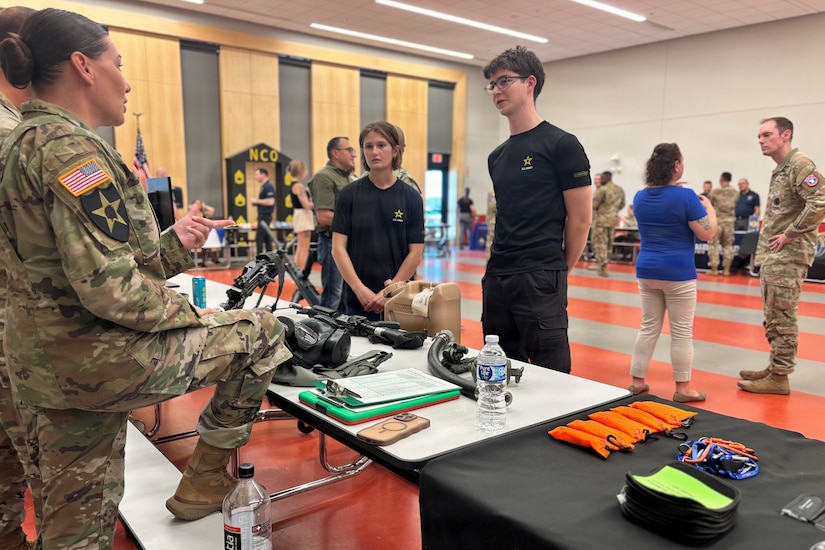
A man and woman in casual attire talk to a woman in a camouflage military uniform.

Lance is heading to active duty as an infantry recruit, with hopes of earning a spot in the elite 75th Ranger Regiment. Riley has chosen to join the Army Reserve, where she will serve as a paralegal specialist. 

"It was actually my idea first," Lance said. "Riley wanted to join the Army and then I kind of started searching for my path." 

Riley explored a career in emergency medical services but felt it wasn't the right fit. When her husband committed to enlisting, she saw an opportunity. 

"I wanted something along the same lines," she said. "The Army was close enough, and he was already doing it. There's no better time than now." 

The couple's decision highlights both the challenges and opportunities facing dual-military marriages. While Lance will serve on active duty and Riley in the reserve, both will fall under the Married Army Couples Program, which works to keep spouses together when possible. 

For Riley, the reserve component offers the balance she was seeking.

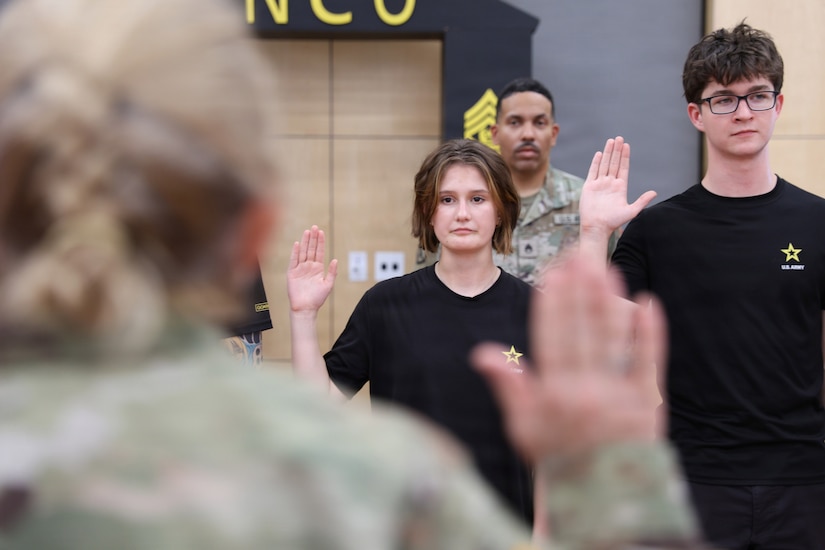
Two people in casual attire hold up their right hands. A person in the foreground in a camouflage military uniform also holds up their right hand.
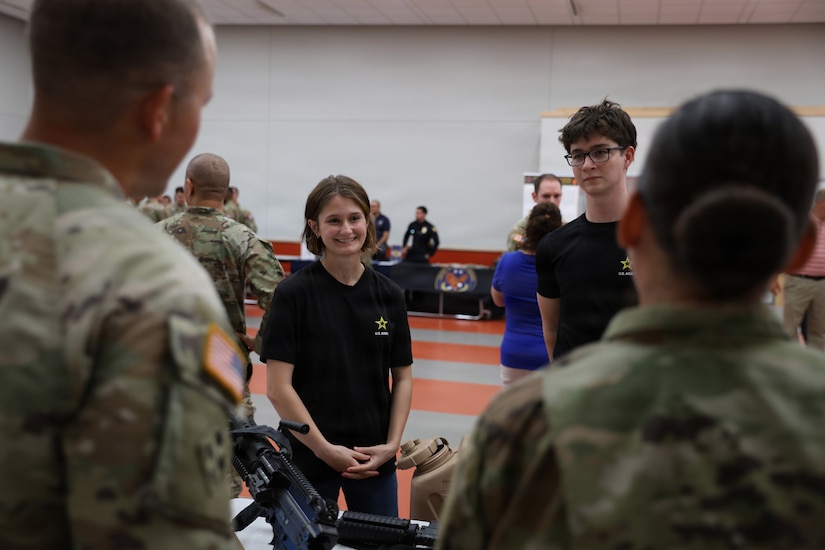
A woman and a man in casual attire speak to two people in camouflage military uniforms.
"It gives me a part-time job," she said. "That peace of mind of knowing that I have something to do when he's gone." 

Riley also sees long-term civilian value in her military occupational specialty. As a paralegal specialist, she will support the Judge Advocate General's Corps by preparing legal documents, assisting with military justice matters and providing legal help to soldiers and families — skills that translate directly to civilian paralegal and administrative careers. 

Lance, who originally considered other options before settling on infantry, is embracing the physical and mental demands ahead.  

Both said the decision has brought them closer. Instead of one spouse pursuing military service while the other stays behind, they are building their marriage around a shared sense of purpose and sacrifice. 

The couple's story is the kind recruiters love to share. In an era when many young adults report feeling directionless, these two have chosen structure, service, financial stability and mutual growth. More importantly, they said they believe the shared experience will strengthen their marriage over the long term. They will speak the same military language, understand the demands of service and be able to support each other through deployments, training and the unique stresses that come with wearing the uniform. 

For this young couple, enlisting together wasn't a leap of faith. It was a deliberate step toward a future they chose as partners — one that combines service to country with a shared vision for their life together.

Thursday, August 13, 2026

Army Reserve Engineers Train Across Multiple Missions During Exercise Northern Strike

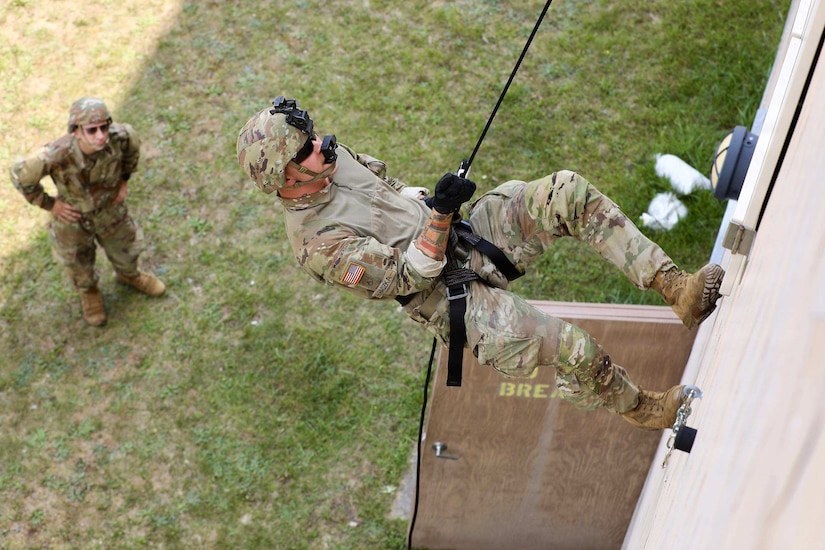
Army Reserve soldiers assigned to two engineering companies spent the first week of Exercise Northern Strike 26-2, Aug. 1-7, moving between water operations, chemical, biological, radiological and nuclear defense training, live demolitions and preparations for urban operations at Camp Grayling, Michigan.

A man wearing a camouflage military uniform rappels down the front of a building as another man in similar attire observes on the ground.
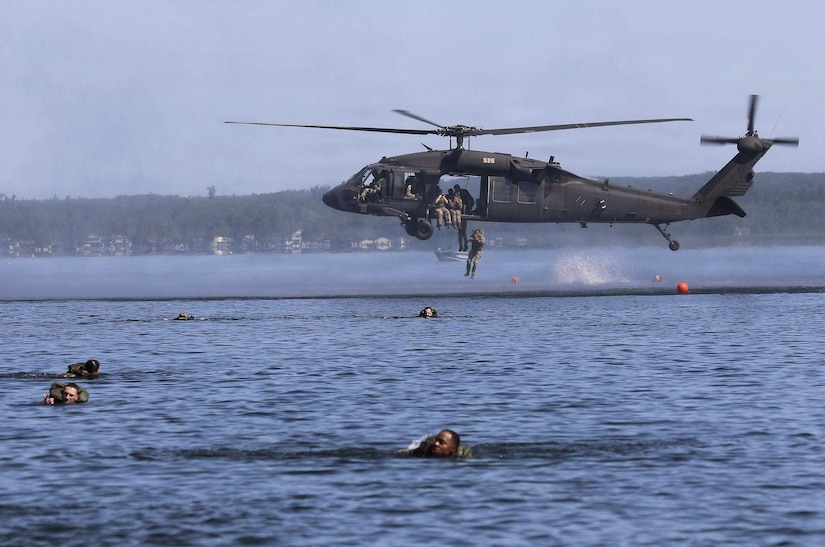
People wearing camouflage military uniforms swim in a lake after jumping into the water from a hovering military helicopter.
The range of training gave soldiers experience beyond their usual engineering tasks while showing how those skills fit alongside maneuver forces. 

For Army Capt. Brandon Lalonde, 428th Combat Engineer Company-Infantry commander, that connection is an important part of Northern Strike. 

"The maneuver part, though, is something that generally we avoid when we plan training; and I think there's some shame in that because you don't really get to see how security is established, how people move forward on the battlefield [and] where the engineers fit in the mission," Lalonde said. "We need to see the bigger picture." 

On Aug. 3, soldiers conducted helocast operations, exiting a hovering aircraft into the water before making their way to shore. They later moved into CBRN training that included protective mask procedures, decontamination and mission-oriented protective posture operations.  

The next day, they trained with M18A1 claymore mines and selectable lightweight attack munitions and worked through emplacement procedures before conducting live detonations.

"This training is critical to building our unit's readiness and combat effectiveness," said Army 1st Lt. Parker Mock, 365th Engineer Company officer in charge during the event. "Northern Strike provides soldiers with realistic, large-scale training in an [immersive] environment, allowing them to integrate with joint and partner forces while employing emerging technologies and capabilities."

Service members assigned to the 428th Combat Engineer Company-Infantry also worked with industry partners to learn about emerging engineer technologies. Later in the week, soldiers began planning and preparing for urban operations at the Combined Arms Collective Training Facility at Camp Grayling. 

Moving from one event to another required soldiers to apply different skills and work through changing mission requirements. 

"Northern Strike prepares soldiers for real-world missions by replicating the complexity and pace of today's operational environment," Mock said. "This experience develops adaptable, disciplined and mission-ready soldiers who are better prepared to operate and win in large-scale combat operations." 

By the end of the week, the soldiers had trained in the air and water, worked with protective equipment, conducted live demolitions and prepared for operations in an urban setting. The different events allowed the engineers to practice their technical skills while seeing how their work supports other elements on the battlefield.

Sunday, July 05, 2026

Vietnam Veteran Receives Purple Heart 57 Years Later

Fifty-seven years after Spec. 4 Raymond Williams was wounded in Vietnam, one Army Reserve noncommissioned officer made sure he finally had his moment.

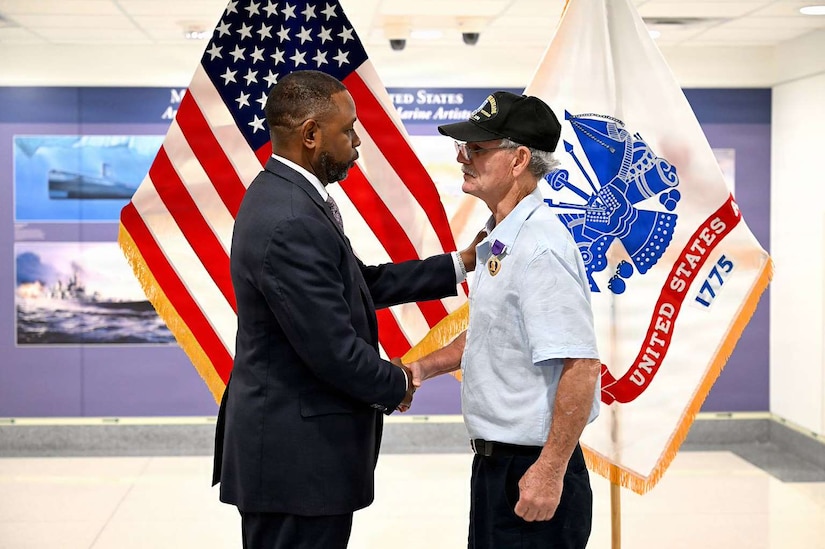
A man in business attire shakes the hand of a man in casual attire in front of an American flag and an Army flag.

For then-19-year-old Williams, 1969 was shaping up to be a year to forget before it even began. On Dec. 31, 1968, the young infantryman was being loaded onto a helicopter and evacuated out of the jungle with wounds that would take more than half a century to heal. 

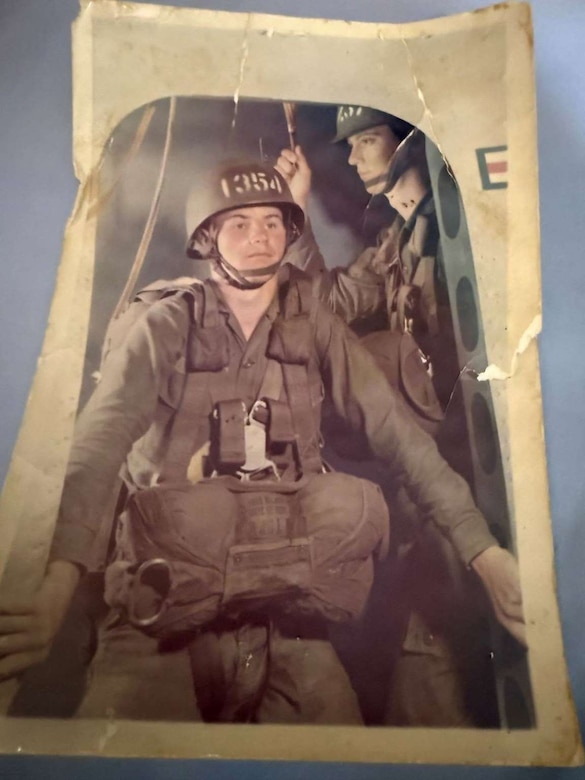
A year earlier, almost to the day, Williams walked into a recruiting station and raised his right hand. He completed basic training, earned his paratrooper wings and soon became the M60 gunner for his unit, Bravo Company, 4th Battalion, 503rd Infantry, 173rd Airborne Brigade. It was the weapon he carried into the Central Highlands of Vietnam, where Williams found himself in what he called "a small firefight." 

"I just remember getting shot in the arm first, then the shoulder. I was trying to carry on, but my right arm was just hanging," Williams said. "I did the best I could." 

Military records confirm what happened; at approximately 10 a.m., local time, near the town of An Khe, Vietnam, an enemy AK-47 round tore through his right arm. The round fractured the bone in two places and lacerated the nerve leading to his forearm and thumb. 

Eight months later and permanently disabled from his combat wounds, Williams medically retired from the Army. 

"I remember getting on the chopper, and I didn't want to leave," he said. "I did not want to leave." 

A man, wearing a Vietnam-era Army uniform, a helmet and a packed parachute, prepares to jump from an aircraft.

Back home, Williams built a life. He worked as a pressman at the Easter Seals printing press, married and raised three children. Life was good — but the war never fully lost its grip. 

"The [Department of Veterans Affairs] was never prepared for us," he said. "We stood outside in a line in the ice-cold to get into the hospital because they just weren't ready. But it was just what it was." 

Williams rarely spoke of the war. Like many veterans of that era, he battled with depression and did his best to cope with post-traumatic stress disorder, long before it had a name. 

"It was a tough, unpopular war — coming home was tough," he said. "Nobody wanted to talk. You kind of bury it." 

Years passed; his family learned not to bring it up. Then, in 2025, Williams decided it was time. 

At 77, while in the hospital, Williams told his daughter Kelly he wanted to visit the Vietnam Veterans Memorial — and finally receive the Purple Heart he had earned but never been awarded. 

Kelly Williams filed the paperwork with the National Personnel Records Center. Weeks later, she received confirmation. When the medal arrived in May, she contacted the Army to ask whether her father could receive it during their trip to Washington. She hoped it could be a surprise. 

It was a long shot. The family was deep into their travel plans from New Hampshire, and time was short. 

Army Master Sgt. Virginia Crutchfield was working at the Pentagon when the request came through — and immediately knew she had to make it happen. 

Crutchfield was on a yearlong tour coordinating Medal of Honor ceremonies; Purple Heart presentations were not in her lane. She had just nine days to pull it together, and the team shifted workloads so she could take on the mission. She handled every detail — from securing Pentagon space to arranging homemade brownies and cake. She said she was driven by an understanding of what soldiers of Williams' generation faced when they came home — the silence, the stigma, the lack of welcome — it drove her to make the moment right. 

"When I go out, people see me in uniform and say, 'thank you for your service,' with a smile; sometimes with a hug. In their time, they didn't," Crutchfield said, her voice breaking. "It touched me. They go out and fight for us to remain free. It's the least we could do." 

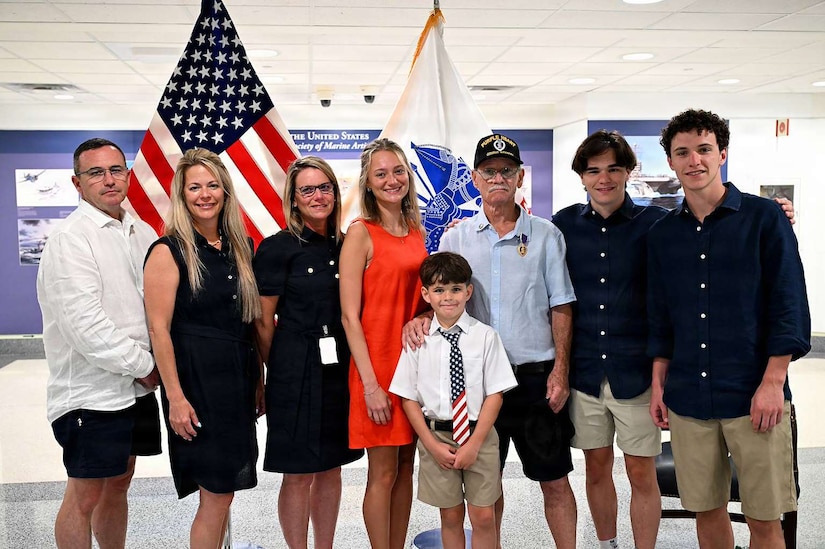
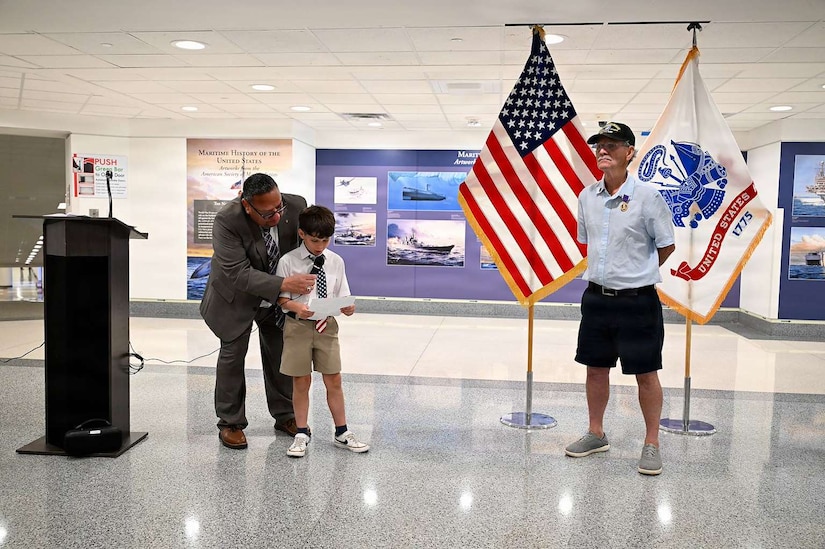
On the morning of the ceremony, Williams arrived expecting a tour. He and his family — daughter Kelly, sons Eric and Mark, and grandson Fynn — were escorted through the Pentagon to a corridor junction where a crowd had gathered: unfamiliar faces, soldiers in uniform and Crutchfield.

Eight people pose for a photo in front of an American flag and an Army flag.

That's when he realized what was happening. Overwhelmed, he took Crutchfield's hand. 

"All he could say was, 'You, you … you got me,'" she recalled, replying, "Sir, you did this. We are honored to do this for you." 

Retired Army Maj. Gen. Phillip Churn Sr., Army Reserve ambassador, presented the award.  

"The Purple Heart is not an award soldiers seek," Churn said. "It is … earned through blood, sacrifice and an unyielding commitment to the defense of this nation. Today, we correct the record. Today, we pin this medal where it has always belonged — on the chest of a paratrooper who gave his blood for our freedom." 

Fynn Williams, 8, had practiced his speech for weeks while keeping the secret from his grandfather. 

"There are some things in life that should never be lost," Fynn said. "Especially honor, sacrifice and courage. Years ago, you earned this through your service and sacrifice for our country. Even though the medal was gone, what it represents never was. We wanted to make sure it found its way back home, to where it belongs."

"We are proud of you. We are grateful for you. We love you, Papa."

A man in business attire crouches to hold a microphone for a boy who is speaking into a microphone while another man stands to the side at parade rest. An American flag and an Army flag are in the background.

For Kelly Williams, the ceremony was about more than just a medal. 

"It is about ensuring that his story, his service and his legacy are remembered," she said. "We have hope that today provides our father with a measure of peace." 

Williams had one word to describe the ceremony: "closure." 

"It never goes away," he said of the memories that still haunt him. "But it's a step in the right direction. This is probably good closure now. I feel like it's all out in the open." 

"I feel good now; I feel good today. This is good," he added.

Monday, April 23, 2012

DOD Announces Recruiting and Retention Numbers for Fiscal 2012, Through March


The Department of Defense announced today recruiting and retention statistics for the active and reserve components for fiscal 2012, through March.

Active Component.

Recruiting.  All four active services met or exceeded their numerical accession goals for fiscal 2012, through March.

Army - 27,701 accessions, with a goal of 27,550; 101 percent
Navy - 15,151 accessions, with a goal of 15,151; 100 percent
Marine Corps - 10,625 accessions, with a goal of 10,591; 100 percent
Air Force - 14,353 accessions, with a goal of 14,353; 100 percent 

Retention.  The Army, Navy, Marine Corps, and Air Force all exhibited strong retention through the sixth month of fiscal 2012.

Reserve Component.

Recruiting.  Five of the six reserve components met or exceeded their numerical accession goals for fiscal 2012, through March.

Army National Guard - 24,706 accessions, with a goal of 25,991; 95 percent
Army Reserve - 14,095 accessions, with a goal of 12,852; 110 percent
Navy Reserve - 3,756 accessions, with a goal of 3,756; 100 percent
Marine Corps Reserve - 4,485 accessions, with a goal of 4,216; 106 percent
Air National Guard - 4206 accessions, with a goal of 4,192; 100 percent
Air Force Reserve - 4,255 accessions, with a goal of 4,255; 100 percent 

Attrition - All reserve components are on target to achieve their fiscal year attrition goals.

Detailed information on specific recruiting data can be obtained by contacting the individual military recruiting commands at 502-626-0164 for Army, 210-565-4678 for Air Force, 703-784-9454 for Marine Corps, and 901-874-9048 for Navy.  The reserve components can be reached at the following numbers:  National Guard Bureau 703-607-2586; Army Reserve 910-570-8330; Air Force Reserve 703-697-1761; Navy Reserve 757-322-5652; and Marine Corps Reserve 504-678-6535.

Thursday, March 08, 2012

Active-duty Downsizing Should Benefit Reserve Forces, Board Says


By Lisa Daniel
American Forces Press Service

WASHINGTON, March 8, 2012 – A policy board plans to ask Defense Secretary Leon E. Panetta to highlight service in the reserve forces as a good option for outgoing active-duty members during downsizing.

In its first official action with broader membership and a direct line to the secretary, the Reserve Forces Policy Board yesterday agreed to send eight recommendations to Panetta to encourage National Guard and reserve service for people leaving active duty. The fiscal 2013 defense budget request calls for the military to reduce its end strength by 5.5 percent in the next five years.

Retired Marine Corps Maj. Gen. Arnold L. Punaro, who chairs the board, said a force reduction letter the secretary sent to the services last month included 12 objectives in the drawdown, but did not mention the National Guard and reserves.

Air Force Maj. Gen. Anita Gallentine, a reserve mobilization augmentee who heads the board’s continuum of service subcommittee, said the Defense Department should learn from past drawdown mistakes that discouraged active duty members from joining the reserve components. In the post-Cold War drawdown, she said, programs helped service members become civilian teachers and police officers and offered bonuses for troops to leave active duty, but they had to pay the bonuses back if they entered the Guard and reserves.

Gallentine noted that the reserve forces now are more of an operational force than their traditional status as a strategic reserve, and other members of the 20-member board spoke of the need to preserve those operational capabilities and training investments.

Gallentine said the military pay and personnel system does not allow for an easy transition into the reserve forces, and noted that many benefits are not portable. Past efforts in the Defense Department to improve continuum of service, she added, have “buckled under their own weight.”

“We believe that there is a lot of work that needs to be done in those over-arching areas,” she said, adding that reserve centers should offer more widespread support for reservists, modeled after active-duty deployment centers.

The board also agreed to send these recommendations to the secretary regarding homeland defense:

-- Policy changes to accelerate the use of Guard and reserve forces to respond to disasters;

-- Guidance that training exercises can be used to support disaster relief and other missions, such as when the National Guard pre-positioned forces leading up to Hurricane Irene in 2010;

-- Guidance that will allow state leaders better predictability for calling up forces under Title 32, which has been used 13 times in the past nine years;

-- Increase from 75 to 90 percent the amount the Federal Emergency Management Agency would reimburse states for National Guard disaster relief operations;

-- Give consistency to protections and benefits states give National Guard members.

Also, the board requested that Congress change the law on the Defense Department’s disaster reimbursement fund for states to stipulate it is for domestic use only. “If we don’t limit it to domestic use, it becomes a State Department get-well fund,” he said.

Tuesday, February 21, 2012

Face of Defense: Soldier, 51, Completes Basic Combat Training

By Melissa K. Buckley
Fort Leonard Wood

FORT LEONARD WOOD, Mo., Feb. 21, 2012 – Army Sgt. Sandra Coast graduated from Basic Combat Training here Feb. 17, officially beginning her Army career at 51 years old.

The average age for an Army Reserve recruit is about 23, making Coast one of the oldest people to go through basic combat training, U.S. Army Recruiting Command officials said.

"Everybody in the world thinks I am a total nutcase," Coast said. "I just want to support our troops. I love all of them."

From 1982 to 1993, Coast devoted her life to the Navy. She gave up her lifestyle as a sailor to raise her son, Jeff, who ironically led her back to the military she left behind years ago.

"When Jeff graduated high school, he joined the Marine Corps. When I was at the recruiter's office with my son, I walked into the Army recruiting office and said 'I want to join,'" Coast said. Her previous years of military service allowed her to join the Army Reserve well past the age someone without prior service could join, she explained.

For as long as she can remember, Coast said, she has had a special place in her heart for troops and a hunger to serve.

"I have a friend in the Navy that was emailing me from Afghanistan,” she said. “It's his third combat tour in seven years. I don't know, I can't explain it. I just had this overwhelming desire to give back to the military somehow. I was doing the same job day after day after day. I can't live my life that way. There is more to life than this, so I ended up in basic training."

She was stunned to learn that as a paralegal specialist she would have to go back to basic training -- this time, Army style.

"I wasn't quite expecting to be running around with an M16 and all of this gear," Coast said as her training neared its end. "This is nothing even remotely similar to being a sailor. I was blown away by the total difference of it. We carried M16s during Navy boot camp, but we never shot them. Here we are shooting several times a week. Shooting this weapon with all of the gear on takes a toll on me."

Coast started preparing for basic combat training months prior to stepping foot on Fort Leonard Wood.

"Before the recruiters would even talk to me, I had to lose 30 pounds,” she said. “I went from sitting at home every night eating ice cream to exercising and watching what I ate. I also started getting up at 4 o'clock in the morning to exercise and tried to go to bed early at night. I knew I needed every advantage I could have to get through this."

Coast’s 10-week journey from civilian to soldier was spent in Company B, 2nd Battalion, 10th Infantry Regiment, 3rd Chemical Brigade. Army 1st Sgt. John Byars, her first sergeant, said his first reaction when he heard he had a 51-year-old headed his way was "Wow, that's strange." Now, Byars has a new perception.

"I was impressed, because she can do everything the younger soldiers do," he said. "She never expected us to feel sorry for her. She even got one of the highest Army physical fitness test scores in the company. She is a prime example that age is just a number. She ran faster than soldiers young enough to be her kids."

Coast even amazed herself when she came in second place during the test.

"I am still kind of blown away by that,” she said. “I even ran faster than all but one female."

The fitness test may have been a breeze for Coast, but she said one of the hardest things for her to adjust to was the divide in life stages between her and her roommates.

"Everything about basic training is pretty tough, but living with more than 30 teenage females is one of the hardest things," she said. But despite the age gap, she added, she was treated like every other soldier in training.

"We don't treat her any different, and we don't see the privates treat her any different," Byars said.

Coast agreed.

"They treat me as an equal,” she said. “The males, especially, have the utmost respect. They will do little things that they probably aren't supposed to do, like give me their seat on the bus and hold the doors for me. It's the little things that mean so much."

Coast recalled an incident during hand-to-hand combat training that was particularly tough for one of her battle buddies.

"We had to slap each other in the face. The poor guy that was up against me said, 'I cannot do this. I cannot slap her,'” she said. “I told him I would pay for his counseling when we were done. I was slapping him -- he finally slapped me."

As her graduation approached, she said the thing she was looking forward to the most was wrapping her arms around her son.

"I am thrilled to wear the title of sergeant in the U.S. Army, but the title that is also very near and dear to my heart is Marine mom. You can't beat that. I feel totally blessed," Coast said.

Marine Corps Pfc. Jeff Coast didn't think his mother was serious when she expressed interest in joining the Army, but recently he started seeing a side of her that was new to him.

"She is doing what most people her age would consider crazy," he said. "I think she is hardcore. I hope when I get older I am still active and do all kinds of cool stuff."

The Marine’s mother said she made it through basic training because of the support she received from family, friends and even outsiders.

"It blows my mind that I am able to accomplish this," she said. "I couldn't have done it without the support of my Marine mom friends. I get more mail from them than anybody. That support keeps me going. They are constantly cheering me on. Even random people around here will tell me they are cheering for me.

"At the dining facility the workers walk up and tell me they are cheering for me," she continued. "I cry pretty much every day. Not a lot, because it's not an Army thing to do I know, but it's mind-boggling to me how supportive strangers can be."

Coast said she is delighted to have reached the end of her basic training adventure, and that she’s thankful for all of the new experiences it provided.

"This has been very challenging,” she said before her graduation. “It makes me realize that I can do all of this. I got to do some really fun things. After the rappelling tower, I decided to start rock climbing when I get out of basic training."

Coast added that she also is looking forward to her life in the Army Reserve. She said she enlisted hoping to work directly with active-duty troops, but instead was attached to a reserve unit. But on the plus side, she said, she will be able to work near her son's reserve unit.

"I wanted to go active duty, but they are not taking people as old as me for active duty,” Coast said. “So I got attached to a virtual unit. Everything I do will be by the Internet and phone.”

Basic combat training left her with a new respect for combat soldiers and a new respect for herself, Coast said.

"Their gear is heavy, and they are doing this constantly,” she noted. “We have some really awesome troops out there. I am 51 years old, and I can do this."