Monday, July 06, 2026

Medal of Honor Monday: Army Sgt. Thomas Alexander Baker Jr.

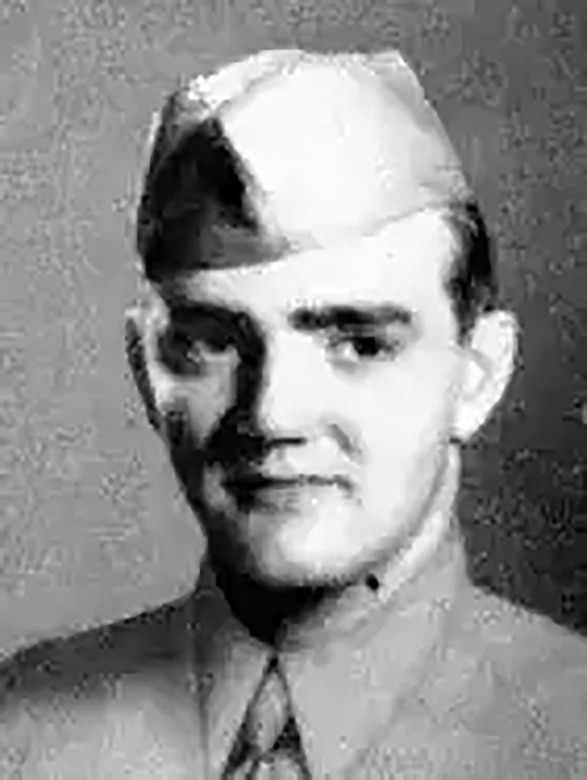
A man in a formal military uniform smiles for a photo.

Army Pvt. Thomas Alexander Baker Jr. was an infantryman who served in the Pacific Theater during World War II. He was posthumously promoted to sergeant and awarded the Medal of Honor for his heroic actions during the Battle of Saipan. 

Baker was born in Troy, New York, on July 25, 1916, to Thomas Alexander Baker Sr. and the former Emma Balser. He had an older sister, Marion, and a younger brother, Joseph. 

After graduating high school, Baker enlisted in the Army Oct. 8, 1935, and was assigned to Company A, 105th Infantry Regiment, a New York Army National Guard unit. He separated from the Army Oct. 7, 1938, and rejoined the same unit Oct. 15, 1940. 

The 105th Infantry Regiment was federalized and inducted into active service Oct. 15, 1940, and assigned to the 27th Infantry Division through the Army's wartime mobilization process.

Following the Japanese attack on Pearl Harbor and other bases on Oahu, Hawaii, Dec. 7, 1941, Baker and the 105th Infantry Regiment deployed to Hawaii in March 1942, marking the regiment's move into combat training in the Pacific Theater. 

The 27th Infantry Division left Hawaii, May 31, 1944, and landed on Saipan, June 17, 1944 — two days before the start of the Battle of Saipan — the regiment's first combat action in the Pacific Theater.  
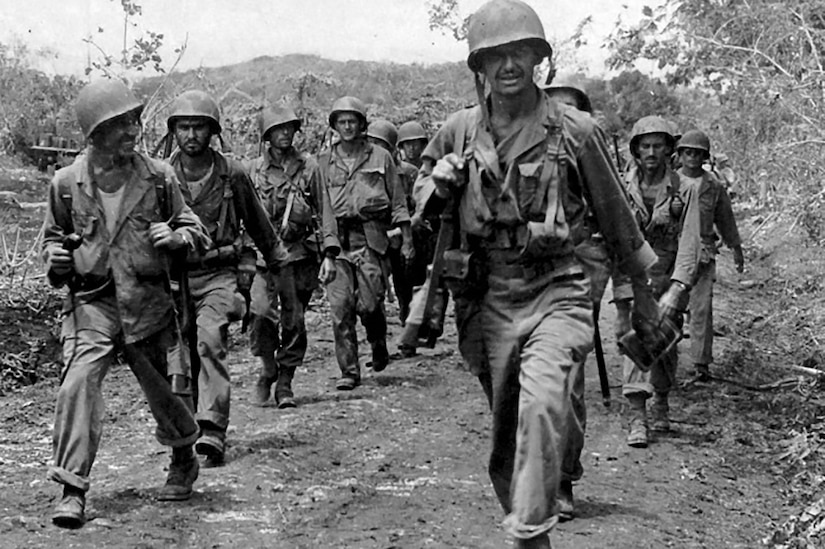
Soldiers walk on a dirt path in a black-and-white photo.

After heavy fighting in the hilly, well-fortified southern part of the island, the 27th Infantry joined forces with the 2nd and 4th Marine divisions. Near the end of the battle, the 105th Infantry was attacked by the war's largest banzai charge, a large-scale, mass infantry assault tactic used by the Japanese soldiers. Baker's Medal of Honor citation states that his company was held up from advancing by automatic-weapon and small-arms fire from strongly fortified enemy positions that commanded the view of the company. He voluntarily took a bazooka and dashed alone to within 100 yards of the enemy. Despite heavy small-arms fire, Baker eliminated the enemy positions, enabling his company to assault the ridge.  

Some days later, while his company advanced across an open field, flanked by obstructions and places of concealment for the enemy, Baker again voluntarily took up a position in the rear to protect the company against surprise attacks and came upon two heavily fortified enemy pockets manned by two officers and 10 enlisted men that had been bypassed.  

Despite being outnumbered, Baker attacked and killed them all without hesitation. About 500 yards farther, he discovered six more Japanese troops, who had concealed themselves behind friendly lines, and he killed all of them.  

On July 7, 1944, Baker's perimeter was attacked from three sides by an estimated 3,000 to 5,000 Japanese soldiers. During the early stages of this attack, he was seriously wounded but insisted on remaining and fired at the enemy at ranges sometimes as close as 5 yards, until the ammunition in his M-1 Garand rifle ran out.  

Without ammunition and with his own weapon battered to uselessness from hand-to-hand combat, Baker was carried about 50 yards to the rear by a comrade, who was then himself wounded. At this point, Baker refused to be moved any farther, saying that he preferred to be left to die rather than risk the lives of any more of his friends.  

A short time later, at his request, Baker was placed in a seated position against a small tree. Another comrade offered assistance, but he refused, insisting that he be left alone. 

He was given an M-1911 pistol with eight rounds of ammunition. When last seen alive, Baker was propped against a tree, smoking a cigarette, pistol in hand, calmly facing the enemy. 

When Baker's body was recovered later, it was found in the same position — pistol empty — with eight Japanese soldiers lying dead before him. 
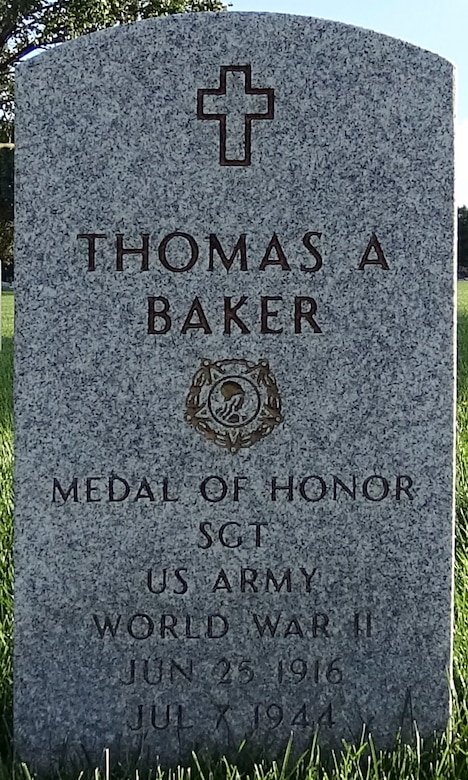
A headstone reads, "Thomas A. Baker, Medal of Honor, SGT, U.S. Army, World War II, June 25, 1916, July 7, 1944.”

Baker was posthumously promoted to sergeant and awarded the Medal of Honor on May 9, 1945. His mother received his medal during a ceremony held May 27, 1945, at the Rensselaer Polytechnic Institute in Troy. During the ceremony, Baker's commander, Army Lt. Col. William Joseph O'Brien, also received the medal posthumously. In 2002, Army Capt. Ben L. Salomon, a dentist for the 105th's 2nd Battalion, also received the medal for his actions that day. 

Baker was buried at the National Memorial Cemetery of the Pacific in Honolulu and later moved to the Gerald B.H. Solomon Saratoga National Cemetery in Saratoga, New York. 

Baker's home state has not forgotten him. 

During Armed Forces Week in May 1951, Frear's Department Store in Troy prominently displayed photos of Baker and O'Brien in a window display. 

In November 2009, the city unveiled a memorial in a Rensselaer County government building honoring Baker and O'Brien and Army Maj. Gen. Ogden J. Ross, another Troy native who commanded the 105th Infantry. 

In September 2014, officials from Fort Drum, New York, and the New York Army National Guard honored Baker by renaming the building housing the engagement skills weapons simulator as the Baker Weapons Training Facility. 

Retired Submariner Commemorates Both Bicentennial, Semiquincentennial in Guam

Fifty years after raising the national colors in Guam for America's bicentennial, retired Navy Cmdr. Allan Riggs returned to the island July 4 to commemorate the nation's 250th birthday alongside a new generation of submariners.

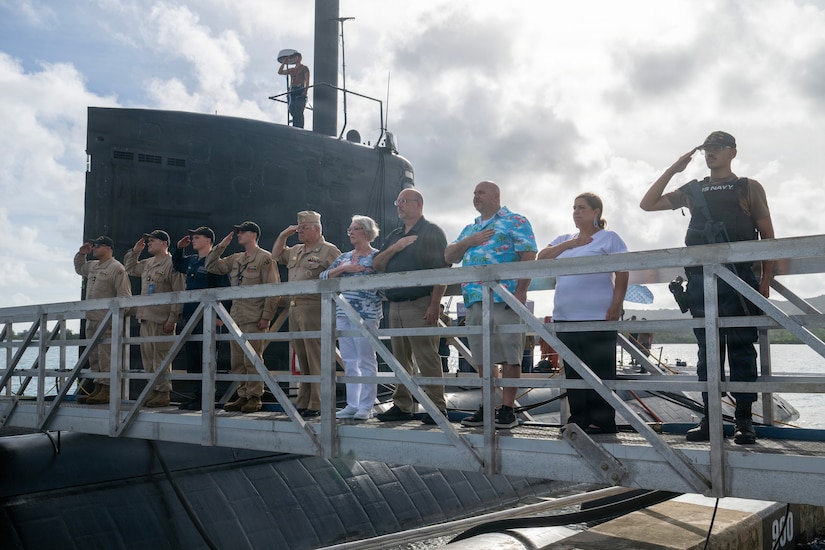
Nearly a dozen people wearing military and civilian attire salute while standing on the gangway of a submarine.

Riggs has now participated in morning colors from Guam during both America's 200th and 250th birthday celebrations, a distinction spanning half a century of submarine history.

Now 77, Riggs stood alongside the duty officer aboard the fast-attack submarine USS Annapolis as the national ensign was raised over the submarine.

"I served proudly for 27 years," Riggs said. "I'm proud of the country; I'm proud of where it's going, and I'm honored to be able to do this."

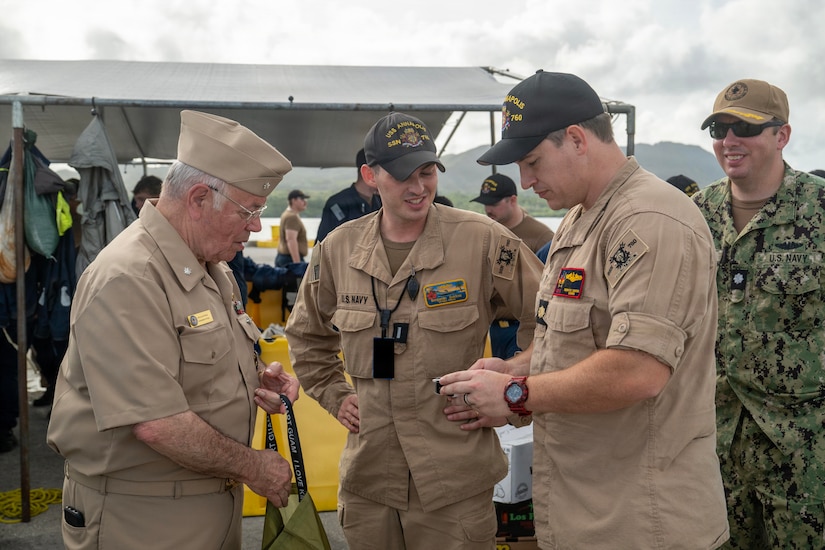
A man in a formal military uniform presents another man in similar attire with a gift while two others smile and watch.

On July 4, 1976, then-Navy Lt. j.g. Riggs was serving as the duty officer aboard the ballistic-missile submarine USS Theodore Roosevelt in Guam. That morning, he had the distinct honor of raising the national colors in recognition of America's bicentennial.

Serving in what he described as a symbolic location, the Roosevelt was the first submarine to raise the colors that historic morning in Guam, where America's day begins.

"It will remain one of the most profound privileges of my career to have executed morning colors on that historic morning in such a symbolically significant location," Riggs said.

Exactly 50 years later, Riggs returned to the same island to honor that moment and mark another milestone in the nation's history.

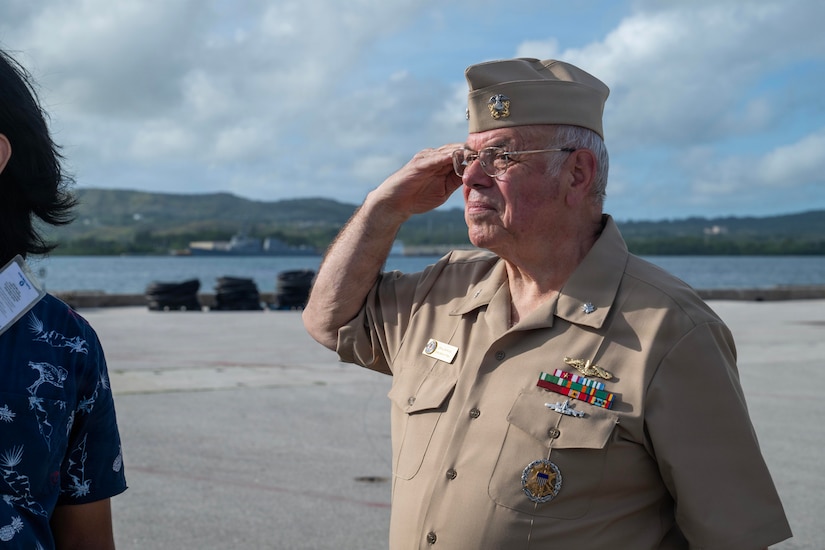
A man in a formal military uniform salutes an off-camera flag; mountains and water are in the distance.

When he approached Commander, Submarine Squadron 15, with the idea of returning to Guam for the historic anniversary, Navy Capt. Neil Steinhagen immediately recognized the significance of the occasion.

"Having Cmdr. Riggs as a guest aboard [the] Annapolis was an easy decision to support," Steinhagen said. "We often look back on our history and ask what has carried our nation and our Navy forward. Moments like this provide the answer. Morning colors is a tradition observed every day, but on the Fourth of July, the flag represents the freedom generations before us fought to secure and the promise today's sailors have volunteered to defend. By standing together aboard [the] Annapolis on America's 250th birthday, we united the legacy of those who came before us with the future leaders who will carry that fighting spirit forward."

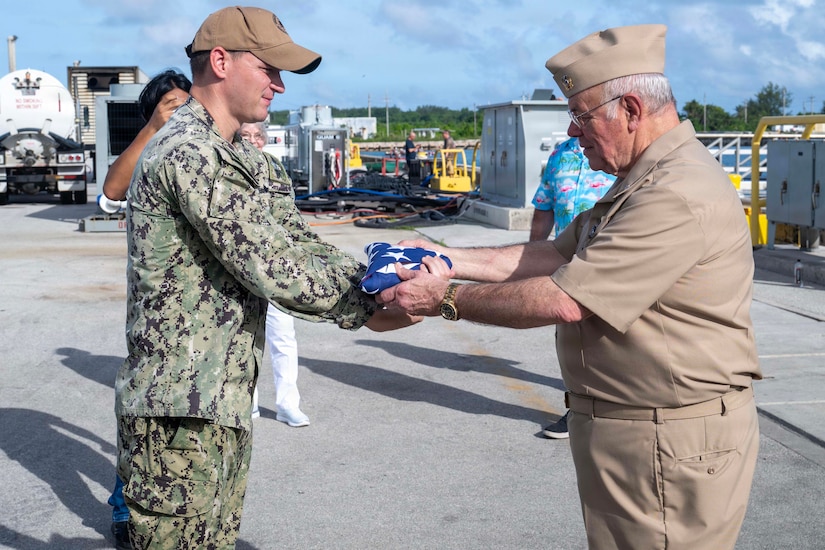
A man in a camouflage military uniform presents a folded American flag to a man in a formal military uniform; heavy equipment and transport containers are in the background.

For Riggs, returning to the place where he marked the nation's bicentennial offered an opportunity to connect two generations of submariners and reflect on a lifetime of service.

"This is a deeply meaningful opportunity to honor the enduring traditions of the submarine force, reflect on my service and pay tribute to the ongoing legacy of naval excellence in the Pacific," the Ohio native said.

Following morning colors, the color detail presented Riggs with the flag flown. Navy Lt. Cmdr. Derrick Simmons, the submarine's executive officer, also presented him with a commemorative flag certificate honoring the lasting example of his service.

The certificate stated that Riggs' presence served as a lasting reminder that while generations of submariners may change their devotion to duty, honor and country remain eternal.

The moment represented more than a celebration of the nation's birthday. It served as a reminder that the traditions of the submarine force are carried forward by the sailors who serve, the families who stand beside them and the generations who follow in their footsteps.

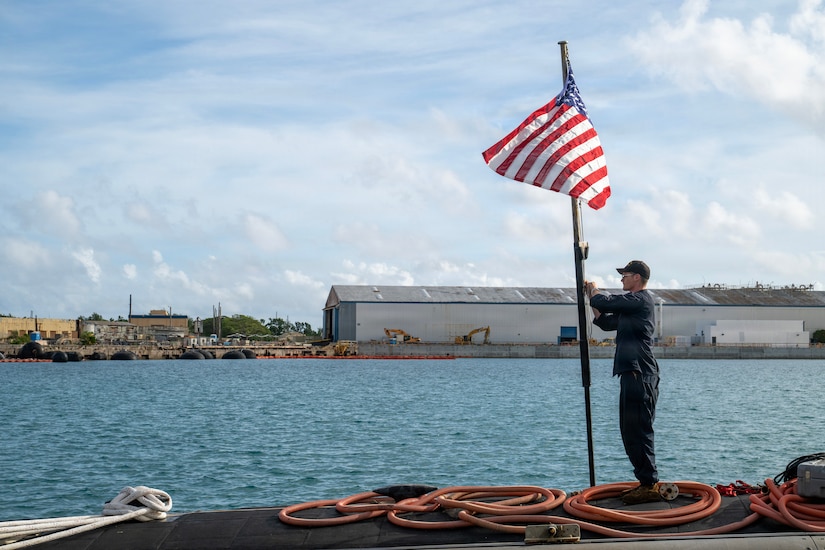
A man wearing a dark blue military uniform raises an American flag while standing on the deck of a submarine; water and buildings are in the distance.

For Riggs, the day also provided an opportunity to recognize those who made his return possible — and those who supported him throughout his 27 years of naval service.

"I want to thank the people who helped make this possible," he said. "My wife supported me throughout all my years of service, as did my sons and all the people here at Submarine Squadron 15. This is the finest military in the world. We're doing what needs to be done, and we're going where we need to go. Being here alongside [the] USS Annapolis, a superb U.S. Navy fast-attack submarine, is an honor."

Fifty years after raising the colors for America's bicentennial, Riggs once again stood beneath the flag he proudly served — this time alongside a new generation of submariners continuing the watch.