Showing posts with label war of 1812. Show all posts

Thursday, August 27, 2026

The Capital's Defenders: Two Centuries After Historic Battle, Citizen-Soldiers are Recognized

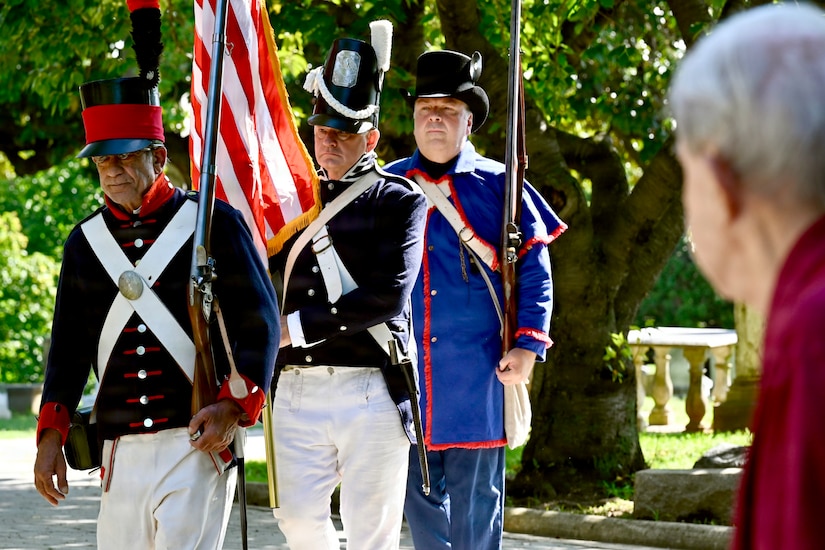
Three men dress in historical military uniforms stand in a line; the man in the middle is holding the American flag while the other two men are holding muskets.

As America celebrates 250 years of independence, the District of Columbia National Guard, citizens and other government staff gathered at the Congressional Cemetery in Washington, Aug. 23, to look back 212 years — to a moment when ordinary citizens answered an extraordinary call and stood in defense of the young nation's capital during the Battle of Bladensburg.

The wreath-laying ceremony connected America's Freedom 250 commemoration with the citizen-soldier tradition that helped defend the nation in its earliest years and continues today with the National Guard. Held among the gravesites of those who lived that history, the ceremony honored their courage while examining the lessons their service left for future generations.

"Whether you're describing acts of bravery or military chaos, the story [of that battle] cannot be told without recognizing the role of the citizen-soldier," said Mark Hudson, executive director of the cemetery. "The local militia joined the desperate fight to defend our young nation."

Historian Glenn Williams placed their service within the broader Chesapeake campaign during the War of 1812. With much of the nation's military strength committed elsewhere, he said the Washington area was defenseless except for the citizen-soldiers of the militia as British forces advanced toward the capital.

Williams described how American riflemen initially engaged and counterattacked the British advance before reinforcements shifted the balance. Outnumbered three to one and eventually outflanked, the American defense collapsed, clearing the way for British forces to enter Washington and burn several prominent public buildings.

Army Brig. Gen. Leland D. Blanchard II, interim commanding general of the D.C. National Guard, said approximately 1,000 D.C. militia members assembled to defend the capital in 1814.

"They were ordinary Americans who answered an extraordinary call," he said. "They stood in defense of a young capital, a young government and an independence won only a generation earlier."

For Blanchard, remembering the battle also means confronting the lessons that came from defeat. The militia members who assembled in 1814 possessed courage and commitment, but courage alone could not overcome their shortcomings in preparation, organization and coordination.

"Bladensburg reminds us that courage is essential, but courage must be matched by readiness," Blanchard said. "Training matters. Leadership matters. Command and control matter. And the relationships we build before a crisis matter when that crisis arrives."

Reflections on the D.C. Militia Legacy

Those lessons, he said, remain relevant more than two centuries later as the National Guard confronts an increasingly complex mission set spanning domestic response, homeland defense and support to global operations.

"Readiness is not something we begin building when the emergency starts," Blanchard said. "It is built every day — through training, preparation and trust between the people and organizations who may one day be called to respond together."

While the Battle of Bladensburg ended in defeat, Blanchard emphasized that its enduring value lies in what America carried forward from the experience.

"Winning independence and preserving independence are not the same thing," he said. "One required a generation to establish a nation. The other requires every generation to remain prepared to defend it."

That responsibility, he said, has always depended on more than one organization or institution.

A.J. Orlikoff, cemetery director of programming, brought the commemoration from military history to personal remembrance. Through research, Orlikoff has positively identified 26 D.C. militia veterans of the Chesapeake campaign buried at the Congressional Cemetery, while noting many more may remain unidentified.

"These defenders of the capital came from all walks of life — clerks, craftsmen, public officials, businessmen — all stepped up to defend the city," he said, before reading aloud the names of all 26 identified militiamen, restoring individual identities to men whose graves, in some cases, are unmarked.

"By reading their names and visiting their graves, we are doing much more than simply remembering a battle," Orlikoff said. "We're restoring their identity as people; we're restoring the memory of their service."

Following the remarks, Hudson and Blanchard laid a wreath at the grave of one of the fallen militiamen. A color guard then rendered a ceremonial volley in honor of those who defended the capital.

For Blanchard, the connection between 1814 and 2026 remains clear. The uniforms, technology, missions and threats have changed, but the responsibility to remain ready— and the citizen-soldier and airmen tradition behind it — endures.

"The citizen-soldier is not simply part of our history," Blanchard said. "It is a living tradition. Today, ordinary men and women continue to step away from their families, their careers and their communities when the nation calls."

That continuity carries particular meaning in Washington, where today's D.C. National Guard traces its heritage to the militia tradition that helped defend the capital more than two centuries ago.

Tuesday, August 28, 2012

Cleveland Navy Week, War of 1812 Commemoration begins with Mayoral Proclamation


By Hospitalman Cathan Bricker, Navy Operational Support Center Akron

CLEVELAND (NNS) -- Cleveland Navy Week and War of 1812 Commemoration kicked off early Aug. 27 with a rock concert and ended with an official proclamation from the mayor.

In the morning, variety band Liberty Call performed a free 30-minute show in the Rock and Roll Hall of Fame atrium. The group is one of 17 ensembles assigned to U.S. Navy Band Great Lakes.

"We've all wanted to be rock stars since we were kids, so what better place to perform?" said Musician 3rd Class James Choate of Oklahoma. Choate has played the trombone for 13 years.

The nine-piece group played a set of Top 40, R&B and classic rock. Banners with the faces of music icons David Bowie, Elvis and Janis Joplin hung in the rafters above the band as they belted out hits of Hall of Fame inductees.

"They were fantastic. I can honestly say it was one of the best performances we've ever had here at the Rock Hall," said sales assistant Megan Mihalich.

As the day progressed, Sailors spread out across the city for several community engagement events. Sailors played basketball with kids at the Boys and Girls Club of Cleveland, while others offered manpower at the Habitat for Humanity warehouse. Navy divers also took a swim in the tanks at the Greater Cleveland Aquarium for visitors' enjoyment.

Three of the ships to be featured at Cleveland Navy Week; USS De Wert (FFG 45), USS Hurricane (PC 3) and U.S. Coast Guard Cutter Katmai Bay (WTGB 101) arrived at the Port of Cleveland. They will be joined by the U.S. Brig Niagara and two Canadian vessels, HMCS Moncton (MM 708) and HMCS Summerside (MM 711).

Meantime, the opening ceremonies commenced at the Cleveland City Hall rotunda. Amanda Hall, wife of Aviation Structural Mechanic 1st Class Thomas Hall of Navy Operational Support Center (NOSC) Akron, sang the national anthem. NOSC Akron Commanding Officer Cdr. Eric Johnson delivered opening remarks, followed by speeches from U.S. Navy Capt. William Seaman, chief of staff, Carrier Strike Group 2, U.S. Coast Guard Rear Adm. Michael Parks, commander, 9th Coast Guard District and Cleveland Mayor Frank Jackson.

"I happen to believe service is an honorable calling," said Jackson. He went on to congratulate all service members on their sacrifices and dedication.

The Navy presented the city of Cleveland with a commemoration plaque to thank the city for its hospitality.

The Navy's Commemoration of the Bicentennial of the War of 1812 in Cleveland is one of 15 signature events planned across America in 2012. The weeklong event commemorates the Bicentennial of the War of 1812, hosting service members of the U.S. Navy, U.S. Marine Corps, U.S. Coast Guard and Royal Canadian Navy.

Tuesday, August 21, 2012

Reserve Master-at-Arms Provide Security, Public Outreach in Chicago


By Mass Communication Specialist 1st Class Katherine Brooks Hofman, Commander, Navy Reserve Forces Command Public Affairs

CHICAGO (NNS) -- A team of 56 Reserve Sailors from Commemoration of the War of 1812 Navy Security Forces (COMWAR 1812 NR NSF) provided security for U.S. Navy ships during Chicago's Air and Water Show and the city's commemoration of the War of 1812, Aug. 15-19.

After a three-week break from other War of 1812 events the COMWAR 1812 NR NSF team regrouped to support the second phase of the Commemoration of the War of 1812 throughout the Great Lakes region.

A core group of 22 members provide continuity to COMWAR 1812 NR NSF, protecting ships and visitors during the historic weeklong commemoration events.

The events in the Great Lakes region act to showcase the Navy and its forces to the local community.

Although the COMWAR 1812 NR NSF mission is to protect the fleet, several of the members are seasoned civilian law enforcement officers who understand the benefit of working with the public to provide information as well as providing force protection.

Master-at-Arms 1st Class Robert Evans recognized the value of public relations as a part of the security forces mission.

"People are sometimes intimidated by us. We are looked at as big guys with guns," said Evans. "Once you begin talking to them and they realize you are a regular guy it opens up the lines of communication. They are here to see the ships and they have questions. We are here to engage with them."

Evans said he takes pride in being both a Navy and civilian police officer, and he enjoys acting as a positive role model to children through public interaction.

"I tell them to be good, eat their vegetables and stay in school, then they can grow up and do what I do," he said.

Sometimes the experiences the Sailors have with the public have an unexpected and profound impact. Master-at-Arms 1st Class David Utz was touched by his experiences in Chicago during public tours.

"People ask about why we are here and where we are from. Overall the reception is positive. I can't tell how many thank you's I have gotten for my service," said Utz. "It is definitely motivating and makes me feel good to be a part of the Commemoration of the War of 1812."

Utz, the father of a six-year-old son, fondly recalled interacting with a child and his parent at the event. "The little boy had a piece of paper in his hand. He had drawn a picture with a blue crayon of a fighter jet. He held it up to me and said, 'I made this for you,'" said Utz.

Wednesday, July 18, 2012

This Day in Naval History - July 18


From the Navy News Service

1775 - Continental Congress resolves that each colony provide armed vessels.
1779 - Commodore Abraham Whipple's squadron captures 11 prizes in largest prize value of Revolutionary War.
1792 - John Paul Jones dies in Paris, France.
1813 - U.S. Frigate President captures British Daphne, Eliza Swan, Alert and Lion.
1920 - Naval aircraft sink ex-German cruiser Frankfurt in target practice.
1943 - German submarine shoots down K-47, the first and only U.S. airship lost during WW II.
1947 - President Harry S. Truman delegates responsibility for the civil administration of former Japanese mandated island to the Secretary of the Navy.
1966 - Launch of Gemini 10 with Lt. Cmdr. John W. Young, as Command Pilot. Mission involved 43 orbits at an altitude of 412.2 nautical miles and lasted 2 days, 22 hours, and 46 minutes. Capsule was recovered by HS-3 helicopter from USS Guadalcanal (LPH 7).

War of 1812 Expert Delivers History Lecture at Pentagon


By John Valceanu
American Forces Press Service

WASHINGTON, July 18, 2012 – A Pentagon audience yesterday learned about the impact and legacy of the War of 1812 on the United States from a historian specializing in the conflict.

Christopher T. George, author of “Terror on the Chesapeake: The War of 1812 on the Bay” and editor of the Journal of the War of 1812, spoke about the war’s early stages to a packed room in the Pentagon Conference Center. The event was part of a speaker series coordinated by the Historical Office within the Office of the Secretary of Defense.

More than 100 people, including military service members from U.S. and allied nations, along with Defense Department civilians and guests, listened as George delivered a lecture titled “The War of 1812: First Campaigns on Land and Sea.”

Speaking with a British accent resulting from a childhood spent in England before emigrating to the U.S. as a boy, George described the defeats suffered on land by American troops against their British and Native American foes, as well as the stunning successes of U.S. naval forces against the British navy, which was then the dominant naval force in the world.

Though time limitations prevented him from going into great detail, George sketched some of the more important events and leaders of that conflict, including U.S. Brig. Gen. William Hull surrendering Fort Detroit to British Maj. Gen. Sir Isaac Brock and Brock’s later death during the Battle of Queenston Heights in what is now the province of Ontario, Canada.

British Navy Adm. Sir George Cockburn, whose troops burned Washington, D.C., and attacked Havre de Grace, Md., was another figure about which the historian talked, as well as U.S. 2nd Lt. John O’Neill, a hero of Havre de Grace who single-handedly manned what came to be known as the “Potato Battery” against the ransacking British.

But George didn’t just discuss U.S. and British military figures. He also talked about Tecumseh, a Native American leader of the Shawnee, who fought alongside the British against the Americans in the hope of creating an American Indian confederacy and stopping the westward expansion of European Americans, and about President James Madison and the impact his lack of military knowledge had on the war. In concluding his presentation, the historian noted that the war was an important milestone in the development of the United States.

“It was desperately hard work, but it was part of the growing up process for the new American nation,” he said. “It allowed American forces to stand toe to toe with a major nation, to gain a new respect in the world, for Americans to think of themselves at last as a nation, rather than a collection of states.”

Speaking with American Forces Press Service after the lecture, George expounded on that theme. “Previously, the nation saw itself as being just separate states in a federalized system, but here they managed to have a national identity,” he said. “The U.S. Army and the U.S. Navy had stood up to perhaps the preeminent military might in the world, and they managed to hold their own against the British without French help, which of course they had in the Revolution. So it was a whole new ball game, in a way.”

During the interview, George said he disagreed with those who use the term “the second war of American independence” to describe the conflict, as he said the British were clearly not interested in recapturing their colonies.  “The major British intent was to protect Canada,” he said. “By the end of the war, the U.S. Army and Navy had proved themselves and although it wasn’t an American victory overall, they had done themselves good credit.”

Though the war was essentially a stalemate, George says he sees it as “a big part of America’s expansion across the continent” and credits it with producing some important national symbols, such as the USS Constitution’s nickname, “Old Ironsides,” the Star Spangled Banner and the motto “Don’t give up the fight!”

“It’s sometimes said that the Americans think they’ve won the War of 1812, the Canadians know they won the War of 1812 and the British have forgotten all about it,” he said. “There’s something for each side to like about the war, some success that each of those three sides had.”

The biggest losers of the conflict, George pointed out, were the Native Americans. The possibility of realizing the dream of a nation of their own died along with Tecumseh and the dissolution of his confederacy.

Friday, July 06, 2012

Vice Chief Thanks Boston and Sailors for Navy Week Support


By Lt. Cmdr. Chris Servello, Vice Chief of Naval Operations Public Affairs

BOSTON (NNS) -- The vice chief of naval operations (VCNO) met with Boston city officials and U.S. Sailors July 5 to thank them for their hardwork work during Boston Navy Week.

Adm. Mark Ferguson met with Mayor Thomas Menino at Boston City Hall to thank him for the warm hospitality that the city showed Sailors while USS Wasp (LHD 1) and USS Gravely (DDG 107) were in port for Navy Week.

"Boston is a Navy town with a rich maritime heritage dating back to the earliest days of the American colonies," said Ferguson. "Throughout this week, the citizens of Boston, state and city governments and area businesses have treated our Sailors with warm hospitality."

A celebration of the nation's sea services, Boston Navy Week provides an opportunity for the citizens of Boston and New England to meet Sailors, Marines and Coastguardsmen, as well as see the latest capabilities of today's maritime services firsthand.

"Our Sailors have greatly enjoyed their visit," said Ferguson. "This week has been a success in sharing America's Navy with Boston and celebrating the bicentennial of the War of 1812."

Ferguson also visited Wasp and Gravely to say thank you to their crews for the work they did to showcase America's Navy to the thousands of local visitors who toured the ships and interacted with Sailors.

Wasp and Gravely participation in Boston Navy Week from June 28 to July 6, gave their Sailors the opportunity to tour the city and interact with locals, as well as participate in community relations events.

"I could not be more proud of the Sailors who represented our Navy during Boston Navy Week," said Ferguson. "They were the embodiment of our values of professionalism, service, honor, and integrity, and were outstanding ambassadors for the naval service."

Boston Navy Week is one of many signature events around the country commemorating the Bicentennial of the War of 1812 and "The Star-Spangled Banner." The commemoration of the 200th anniversary of the War of 1812 is a salute to all Sailors and Marines who fought gallantly in that conflict, who served in all the nation's conflicts since then, and who continue defending freedom around the world today.

Since winning independence in 1776, the United States has been a maritime nation, relying on unobstructed access and free use of the world's oceans, which are essential to our national security and prosperity. The performance of America's Sailors and Marines in the War of 1812 set the standards upon which the nation's naval forces continue to build today.

For more information, visit the official Boston Navy Week Web site at www.bostonnavyweek.com or search "Boston Navy Week" on Facebook.