Wednesday, November 19, 2025

Calm Under Pressure: Airman's Quick Thinking Saves Infant's Life

What began as a quiet autumn Sunday for Air Force Senior Airman Hannah Lillund quickly turned into a moment that would test her composure, skills and instinct.
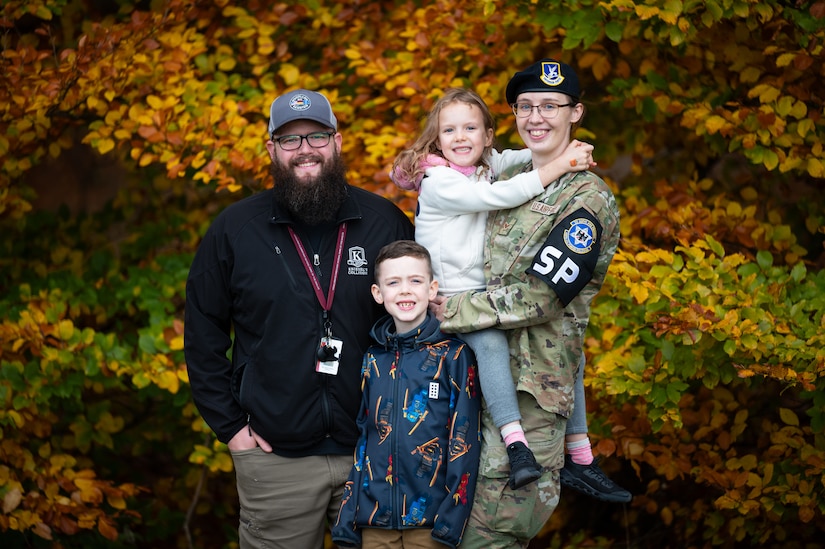
An airman wearing a camouflage military uniform smiles while holding a child. The airman is standing next another child and a person dressed in business casual attire. There are trees with yellow, brown and green leaves in the background.

 
"I was just sitting on the couch relaxing," said Lillund, a 569th U.S. Forces Police Squadron vehicle registration clerk stationed at Kapaun Air Station, Germany. "I heard someone yelling, 'Help us! She's not breathing!' So I ran down the stairwell barefoot, in pajamas, to help." 
 
Air Force Senior Airman Elena Lucas, an 86th Communications Squadron client systems technician, and her husband, Mason Edlin, were frantically trying to save their 9-month-old daughter, Eumi, who suddenly began choking. 
 
"We were just in our living room playing with her," Lucas said. "One second she was fine, and the next, she started coughing and then went completely silent. Her eyes were wide and she wasn't breathing. I yelled for my husband to call [emergency services] and we ran outside the apartment screaming for help." 
 
Thankfully, Lillund heard the call for help and her instincts as a first responder kicked in. On her way down the stairs, she ran into her kids, who were on their way to alert her.

She and her husband, Tanner, immediately sprinted out of their apartment to help. She went to their neighbor's apartment while Tanner went to find emergency services. 
 
As she arrived, Lillund found Lucas still striking her baby's back, desperately trying to clear Eumi's airway. 
 
"She came down so calm," Lucas said. "She just said, 'Can I see her?' and took her from me. I swear, it was just three taps on the back and suddenly all this saliva came out of her mouth; she coughed and the color came back to her face. It was like watching a miracle happen right in front of us." 
 
Within two minutes of calling, emergency services arrived on the scene, Edlin said. Paramedics assessed Eumi and found her breathing steadily. 
 
"The fire department got there so fast," he said. "But by then, Hannah had already saved her. The whole thing happened in about five minutes, but it felt like forever." 
 
Lillund said her training kicked in like muscle memory. 
 
"In security forces [technical] school, they teach you how to keep calm under pressure," she said. "They make you perform while your heart's racing. You learn to breathe, focus and just do what needs to be done." 
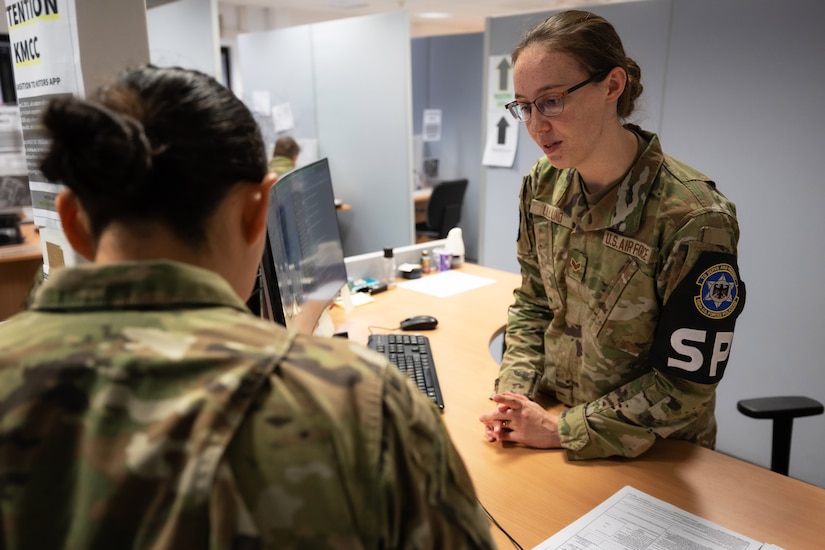
An airman wearing a camouflage military uniform stands behind a desk while observing another airman in similar attire fill out paperwork.

 
For Lucas and Edlin, the experience remains both terrifying and humbling. 
 
"I've never felt more helpless," Edlin said. "I was doing everything I knew to do but it wasn't working. And then Hannah shows up cool, calm and collected, like she's done it a hundred times. She really saved Eumi's life."
 
The first baby girl delivered at Landstuhl Regional Medical Center this year, Eumi is now back to her usual self. 
 
"I still think about it sometimes," Lillund said. "How everything lined up perfectly. My kids seeing it, me being home when it happened and being trained for moments like this. It reminds me why we do what we do. You never know when you'll need to be ready." 
 
For one family, that readiness made all the difference.

Legendary Marines From Throughout Corps' 250 Years

The stories of legendary Marines are familiar to all leathernecks, many of whom are inspired by them. 

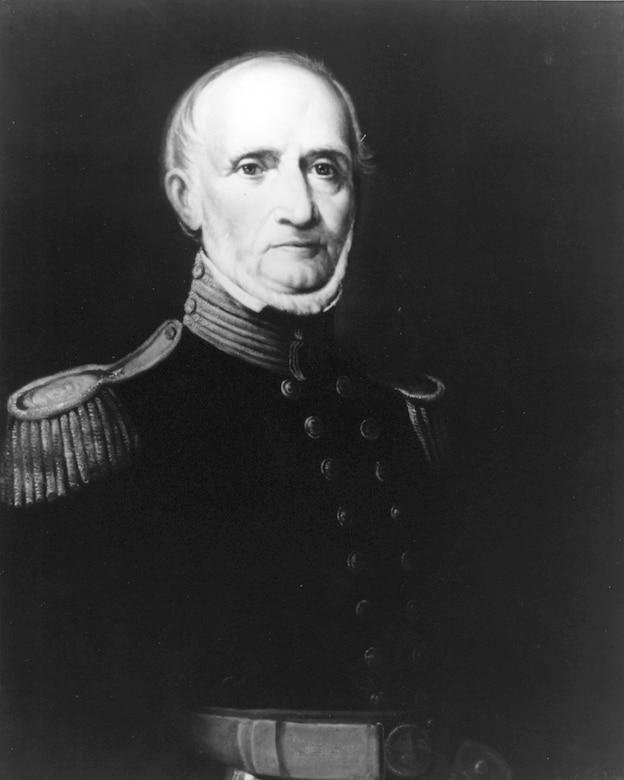
A portrait painting of a man in a military dress uniform is shown.

Marines call Col. Archibald Henderson the "grand old man of the Marine Corps." He served in the Marine Corps from 1806 to 1859 and was commandant from 1820 to 1859, making him the longest-serving commandant.

During the War of 1812, Henderson served aboard the heavy frigate USS Constitution, the world's oldest commissioned naval warship still afloat today. The Constitution fought in a number of victorious engagements. 

Henderson led Marines in combat during the Indian campaigns in 1836 and 1837 in Florida and Georgia, as well as in the Mexican War, from 1846 to 1848. He was decorated for his bravery. 

The sword presented to him at the end of the Mexican War was inscribed, "From the Halls of Montezuma to the Shores of Tripoli," which became the first stanza of the Marines' Hymn. 

When President Andrew Jackson tried to merge the Marine Corps with the Army in 1829, Henderson stopped the effort and ensured Marines would remain under the Navy Department.

Henderson, who was born in Colchester, Virginia, Jan. 21, 1783, died Jan. 6, 1859, while still on active duty. The transport USS Henderson and Henderson Hall Barracks in Virginia were named in his honor.

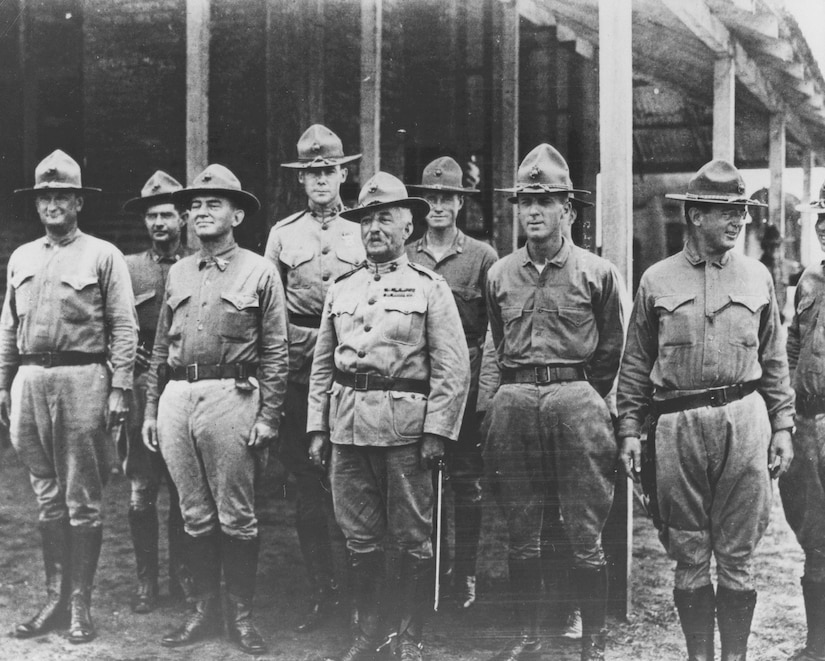
Marine Maj. Gen. Smedley Butler served in the Marine Corps from 1898 to 1931 and is one of only two Marines to receive two Medals of Honor, the first for action at Vera Cruz, Mexico, in 1914; the second for valor in Haiti in 1915.

Marines standing in uniform pose for a photo outside.

Butler also served in the Spanish-American War in 1898, the Philippine-American War from 1899 to 1902, the Boxer Rebellion in China, which lasted from 1899 to 1901, the occupation of Nicaragua, which lasted from 1912 to 1933, World War I in France, which lasted from 1917 to 1918 and the expedition to Tianjin, China, from 1927 to 1929.

Later, Butler went public with criticism of intervention in nations to benefit U.S. businesses and also wrote a book on the topic titled "War is a Racket."

In 1924, while still on active duty, Butler was invited by Philadelphia's mayor to run the city's police and fire department and rid the city of crime and corruption. He was effective in doing so and worked in that capacity until 1925. 

Butler, who was born in West Chester, Pennsylvania, July 30, 1881, died in Philadelphia on June 21, 1940. Marine Corps Base Camp Smedley Butler on Okinawa, Japan, is named for him.

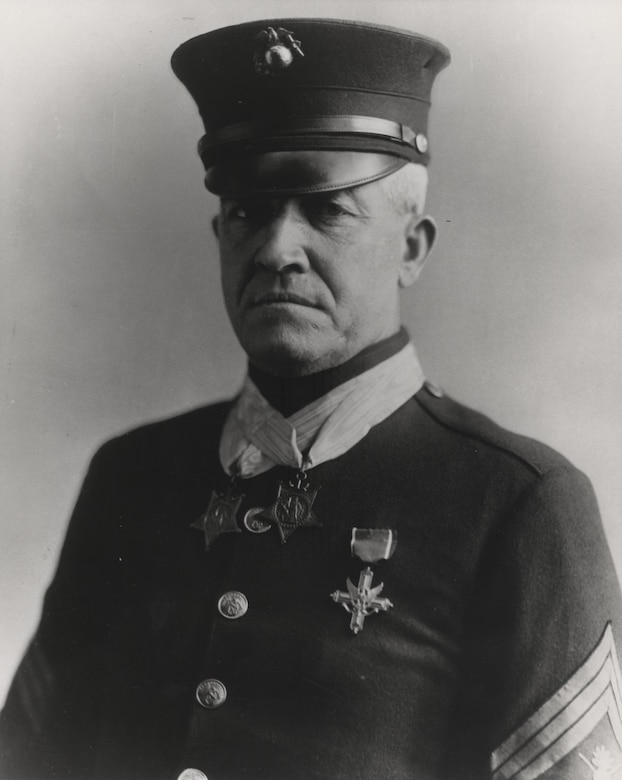
Marine Corps Sgt. Maj. Dan Daly also earned two Medals of Honor, the first during the Boxer Rebellion and the second in Haiti, the same year Butler received his. 

A Marine in uniform wearing medals poses for a black and white photo.

During World War I, he earned the Navy Cross Medal and the Distinguished Service Cross. 

Daly was court-martialed once for drunkenness on post and spent three weeks in the military jail at the Boston Navy Yard, thereby further enhancing his legend. He was also widely known as a skilled boxer.

On Feb. 6, 1929, Daly retired from the Marine Corps and found work as a bank guard on Wall Street in New York City. 

Daly, who was born in Glen Cove, New York, Nov. 11, 1873, died in New York City on April 27, 1937. The destroyer USS Daly was named for him.

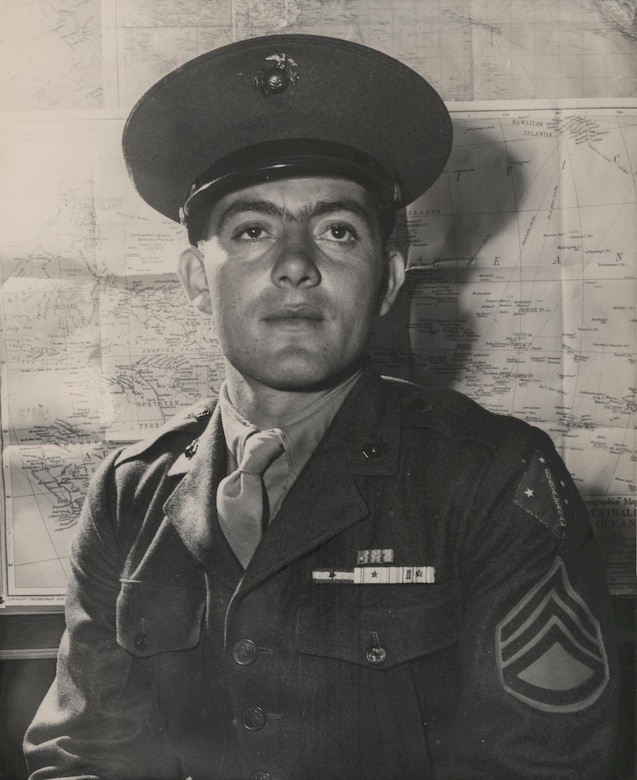
Marine Corps Gunnery Sgt. John Basilone served in the Army from 1934 to 1937 before enlisting in the Marine Corps, July 11, 1940. While in the Army and stationed in Manila, he gained fame as a champion boxer, which earned him the nickname Manila John.

A Marine in uniform and wearing medals poses for a photo.

In September 1942, he fought in the Battle of Guadalcanal. The following month, he received the Medal of Honor.

Basilone, who was born in Buffalo, New York, Nov. 4, 1916, was killed on the first day of fighting during the Battle of Iwo Jima, Feb. 19, 1945. He was posthumously awarded the Navy Cross for heroism on Iwo Jima. Two destroyers were named for him.

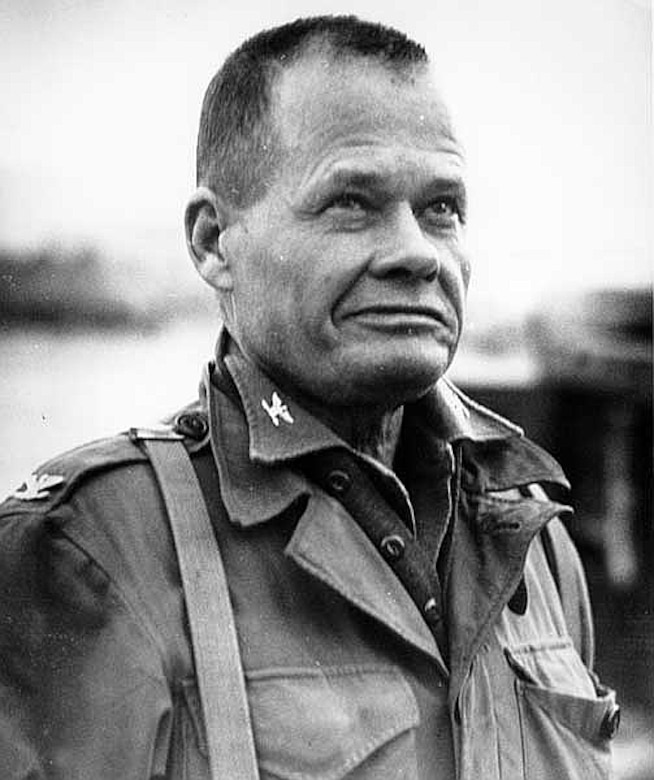
Marine Corps Lt. Gen. Lewis Burwell Puller is better known as Chesty Puller. Although Puller never received the Medal of Honor, he's considered the most decorated Marine, having earned five Navy Crosses for valor in the 1928 Nicaragua campaign, the 1932 Nicaragua campaign, 1942 on Guadalcanal, 1943 on New Britain and in North Korea in 1950.

A Marine in uniform poses for a photo.

Puller also earned the Distinguished Service Cross from the Army for action in North Korea in 1950. 

He is beloved by enlisted troops and is credited with the tradition of officers receiving rations last when in the field. To this day, as soon as Marine recruits hit the rack, they chant "Good night, Chesty, wherever you are."

Also, when Marines are doing pullups or other exercises, they are often told to "Do one for Chesty" at the end when they're fatigued.

The official Marine Corps mascot, an English bulldog, is perpetually named "Chesty." Puller had a barrow chest and bulldog face, so the resemblance is apt. 

Puller, who was born in West Point, Virginia, June 26, 1898, died in Hampton, Virginia, on Oct. 11, 1971. The frigate USS Lewis B. Puller was named for him.

Incidentally, Puller's distant cousin was Army Gen. George S. Patton. 

Other notable Marines include, but are not limited to: 

  • Col. John Glenn, the first American to orbit the Earth, and who later became a senator from Ohio. 
  • Cpl. JD Vance, who became a senator from Ohio and is currently serving as vice president of the United States. 
  • Sgt. Chuck Mawhinney, a sniper credited with 103 confirmed kills during the Vietnam War. 

Marine Veteran Dies While Rescuing Trapped Coal Miners

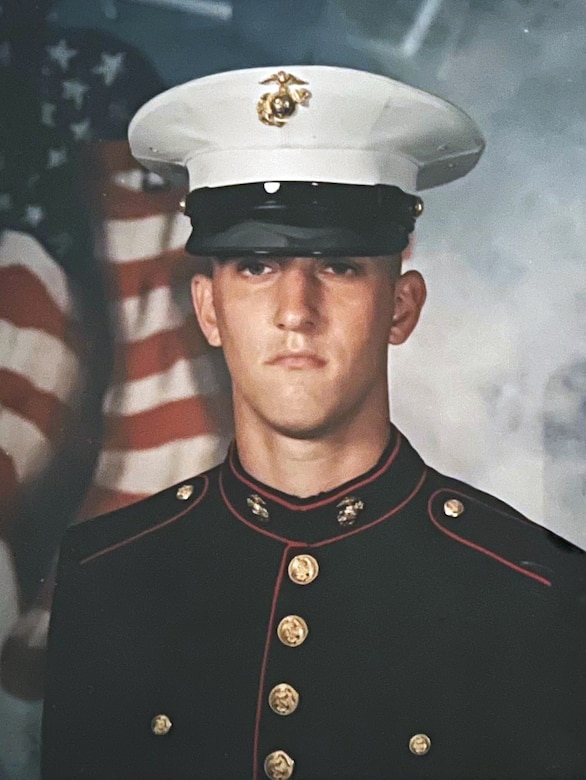
Marine Corps combat veteran Steven M. Lipscomb lost his life, Nov. 8, while looking after the safety of his crew at the Rolling Thunder Mine in Nicholas County, West Virginia.

A Marine in a dress blue uniform poses for a photo with the American flag in the background.

"All of West Virginia mourns the loss of this courageous man," said West Virginia Gov. Patrick Morrisey in a Nov. 14 proclamation, which also ordered state flags flown at half-staff. "He spent his final moments ensuring his men could escape to safety." 

During routine operations at the coal mine, a crew encountered a sudden and substantial inflow of water, said a report from the mine's owner. Lipscomb was last seen attempting to ensure the safety of his crew but was unable to reach safety himself. All other miners in the area evacuated safely. 

"Lipscomb, the foreman, stood his ground until every member of his crew was evacuated. The water filled the shaft, making escape impossible. For five days, crews worked around the clock to rescue Lipscomb, but sadly, he did not survive," Morrisey said. 

"Our coal miners represent some of the most courageous among us, and Steve was a testament to that," the governor added. 

Lipscomb participated in the First Battle of Fallujah in Iraq, which began April 4, 2004, according to his obituary. He was wounded in Iraq seven days later, when his Humvee hit a roadside bomb, said Heather Lipscomb, his wife of 20 years. 

The corporal was medically discharged May 1, 2005, as a result of his extensive injuries, she said, adding that they wed as soon as he returned to their hometown of Elkview, West Virginia. 

"Retired Marine Steve Lipscomb represents the best of our American military and embodies the hero spirit. This Purple Heart recipient and Operation Iraqi Freedom veteran protected his nation and community until the very last day," said Secretary of War Pete Hegseth.

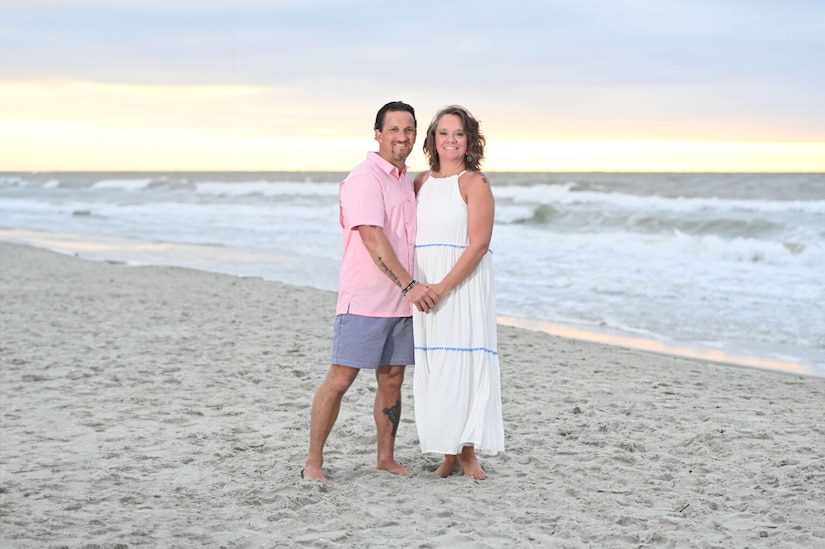
A man and a woman, in a slight embrace, pose for a photo on a beach, hands clasped.

"Steve's life will forever be an example of service and sacrifice for myself and for all who serve. My prayers remain with the Lipscomb family; your father, husband and son will never be forgotten," Hegseth said. 

"A great American. Semper Fi, Steve," wrote Vice President JD Vance on his social media account. Vance is also a Marine veteran. Semper Fi is short for Semper Fidelis, Latin for Always Faithful, the Marine Corps motto. 

Lipscomb enlisted in the infantry as a rifleman on Feb. 25, 2002, shortly after the terrorist attacks of 9/11. 

"I think Steven was a very selfless person. He had 17 men on his crew in the coal mines. He was more worried about everybody else getting out and getting to safety, more than he was concerned about himself," Heather Lipscomb said. 

She said she credits his Marine training with preparing him for the arduous rescue task, even if it meant sacrificing his own life. 

Steven Lipscomb began his mining career in 2006, working alongside his brother, Joseph, according to his obituary. "Steve built a distinguished career and earned the deep respect of his fellow miners, working his way up to become a foreman in 2015," it reads. 

Lipscomb's awards include the Global War on Terrorism Service Medal, National Defense Service Medal and the Sea Service Deployment Ribbon. 

He is survived by his wife, two daughters, ages 13 and 17, as well as a sister, a brother and a sister-in-law.