While movies like "Top Gun" and "Top Gun: Maverick"
show people a glamorized version of military fighter pilot life, most
people really have no idea what it takes to become an elite aviator,
until now.
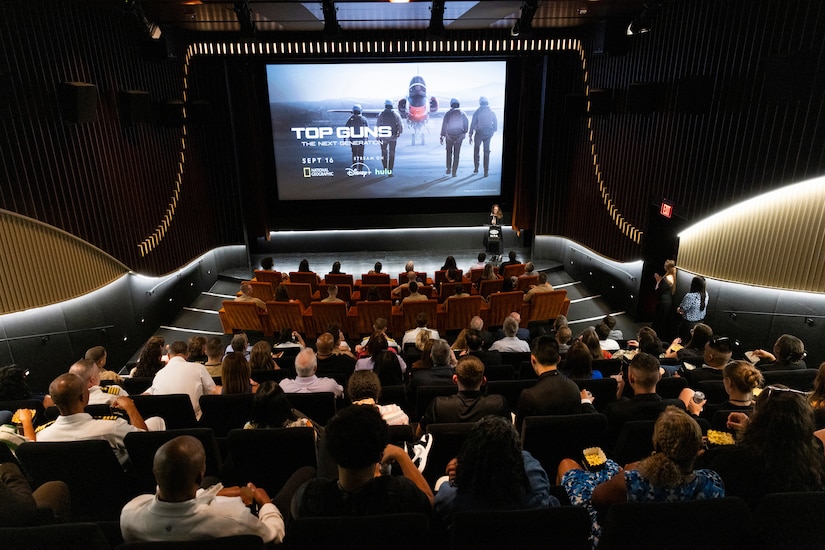
A new National Geographic docuseries called "Top Guns: The Next
Generation," follows a handful of Navy and Marine Corps officers as they
go through advanced strike fighter training — the last, hardest and
most unforgiving phase of fighter pilot qualification training.
The show's producers chose to film that phase because of its
intensity, but it's also what audiences are most familiar with. The show
skips past the classroom training and highlights when students go
beyond being "just a pilot" to what it takes to become a fighter pilot.
"It's the most crucial point of their training. It's really the point
in which they can fail, and their dreams of becoming a fighter pilot
are over," said Karen Edwards, the series' showrunner. "They spent years
getting to this point, and now it's all on the line."
When choosing candidates for the show, Edwards said they met with
about 30 trainees assigned to Training Wing One, based at Naval Air
Station Meridian, Mississippi, where most of the series was shot for
more than a year. They selected a variety of students with different
backgrounds, experience levels and skills.
"One of the participants used to be a yoga teacher and is now a
Marine," Edwards said. "Another guy talked about how he was adopted at
birth and how that has impacted him and his religion. For others, it's
in the family blood."
Marine Corps Capt. Micah Nissly was the adoptee Edwards mentioned. He
said his dad, a pastor, impressed upon him the importance of public
service and giving back, so he enlisted in the Marines. After eight
years of service, he went to officer candidate school before starting
aviation training.
"I think it's important for individuals to know that, regardless of
their upbringing and how they came into this, they have this
opportunity," Nissly said. "Naval flight training is truly the great
equalizer: you give it all. You make it or you don't. And I think your
background matters so little … what matters is your performance."
Initial Reluctance
When the documentary opportunity arose, Nissly said he initially
denied the offer to preserve the legacy of the "quiet professional," as
he knew most in the jet community to be. But then his wife convinced him
that it's something his 6-year-old daughter could one day look back on
with pride.
"I really hope the viewers … see that behind every flight is a naval
aviator committed to teamwork, integrity and self-improvement. They'll
see our ups and downs, but humility and accountability define us way
more than the egos," Nissly said.
Marine Corps Capt. Stephanie Harris was also reluctant to be part of
the production because she didn't want it to take away from her focus on
training. But she eventually agreed.
"I've looked up to so many people who walked this path before me,"
she said. "Providing an example of the kind of people that do this — and
not just your stereotypical version — felt important to me."
Stunning Cinematography With a Focus on Accuracy
Some of the series' filming also took place at Naval Air Facility El
Centro in the California desert. El Centro specializes in teaching
trainees strike training — how to accurately drop bombs and other
ordnance. A small portion of filming also took place at Naval Air
Station Key West, so the students could access the aircraft carrier USS
Dwight D. Eisenhower. These locations helped crews capture stunning
aerial visuals that included precision bombing drills, dogfighting,
evasive maneuvers and carrier landings.
"[Students learn this] in a really short period of time, and it's a
lot to ask, which makes it all the more amazing when they achieve it,"
Edwards said.
To get the shots, the production team put cameras inside T-45 Goshawk
training aircraft using in-cockpit mounts designed, fabricated and
installed by Naval Air Systems Command and the Naval Air Warfare
Development Center. When the students are flying, the audience can hear
minute by minute what they're saying.
"Everything that happens inside the jet is caught in real time,"
Edwards said. "You hear them being taught — what they get right, what
they get wrong, how they can improve."
To ensure safety wasn't compromised, the production team had
instructors and professionals fly the aircraft for the external
cockpit-to-cockpit scenes, recreating the flights the students had
taken.
"We filmed them externally using the same film crew as they used for
'Top Gun: Maverick' … because that is so dangerous," Edwards said.
Nissly said he thinks the series did a great job of focusing on authenticity.
"They did an amazing job filming the honest struggles. There's no
do-overs for this," he said. "This is real life, and the stakes were as
high for us then. What you see is what you get."
"It's inspiring to hear and see up close the authentic stories of
those serving in our Navy today," said Navy Rear Adm. Ryan M. Perry, the
service's chief of information. "It's about young men and women chasing
a dream to fly, and the intense training and challenges they go through
to achieve their goals."
Emotions Run High
For many of the participants, the high-stakes, life-or-death training takes an emotional toll, which is also captured on camera.
"All of them come back and share and have moments where it's like,
'Am I good enough? Am I going to pass tomorrow? Will I make the grade?'"
Edwards said. "That is crucial to their training. They can never become
complacent or confident. They're always being pushed to the next
level."
At one point in the series, Nissly gets sick while practicing
dogfighting with a senior officer in the jet with him. The fact that it
was an incident beyond his control was something he struggled with.
"Getting through that mental block of, 'Will this happen again? Is
this going to be a common occurrence? How am I going to fight through
that?' It was definitely something I had to get over," Nissly said,
before joking, "Humility also comes in and will always keep me on the
straight and narrow."
Nissly said he's driven by the desire to support enlisted troops —
which he was, once — fighting on future battlefields. Similarly, Harris
said the hardest part of her training was the thought of those troops on
the ground someday and knowing that she needed to hit her targets for
them.
"[Strike training] is one of the most difficult missions that we do. So that phase, for me, felt the most intense," she said.
When asked what drives her, Harris said some of it is the fear of
letting other people down. "Not being prepared enough when the moment
comes," she said. "Fear that I won't be ready, and that drives me in
tremendous ways."
The Takeaway
For the Navy and Marine Corps, the goal of capturing the intense
demands of this program on film was to highlight what it truly takes to
be a naval aviator — even if it shows failure that inevitably happens.
"These are real human beings, real people who are really giving it
their all," said Navy Lt. Cmdr. Joseph "Bones" Pfaff, entertainment
liaison at Navy Office of Information West, which led the project. Based
in Los Angeles, the office works with entertainment industry
professionals to ensure an authentic, accurate portrayal of the Navy's
assets, policies and people in television and film.
"We have a very strenuous and challenging pipeline to go from being
an unwinged aviation student to actually earning their wings. Not
everybody succeeds, and that’s OK," Pfaff continued.
"It doesn't end when they finish fighter pilot school," said Marine
Corps Maj. Hector Alejandro, director of the Marine Corps Entertainment
Office in Los Angeles. He explained that the trainees who earn their
wings continue training at their squadrons in the fleet. "Someday, a
19-year-old Marine is going to be pinned down on a hillside, and he'll
be looking to the sky for help. The person in that cockpit has to be the
one who won't fail him. Our selection and training pipeline is ruthless
because we're building pilots worthy of that trust."
Series producers said they expect the audience to connect with the
dedicated men and women highlighted in the show — and learn that it’s
not like what they see in the movies.
"It's not just about going up and having some fun in the jets on a
daily basis. This is a job. They are careful. They're trained by very,
very experienced people," Edwards said. "You take the audience into a
privileged world that they would never, ever be able to see."
"Top Guns: The Next Generation" airs on Tuesdays on National Geographic and streams the following day on Disney+ and Hulu.




 Posts
Posts

